Economic Restructuring and Governance Transformation: In-Depth Exploration

Economic Restructuring and Governance Transformation: In-Depth Exploration

The economic and governance systems in place today are often founded on extractive models—systems that prioritize profit, power, and control at the expense of collective well-being, social equity, and ecological sustainability. These systems tend to function through top-down, hierarchical structures, where conflict is avoided, and problems are addressed with punitive, short-term solutions.

In contrast, Functional Conflict Perspective (FCP) and Mirror Integration Theory (MIT) offer a transformative approach that reimagines these systems by focusing on restorative, adaptive, and regenerative structures. Below is an in-depth exploration of economic restructuring and governance transformation through the lenses of FCP and MIT.

Economic Restructuring Using FCP & MIT

Current Economic System – Extractive and Exploitative:
The traditional economic system is designed to benefit a small elite while extracting resources from the broader population. Capitalism, in its modern form, relies on market volatility, labor exploitation, and wealth extraction to generate profit. These systems have led to income inequality, social fragmentation, and environmental degradation.

Key features of traditional systems:

Wealth Extraction: The concentration of wealth in the hands of a few, driven by monopolistic practices and unchecked market forces.

Labor Exploitation: Economic structures that prioritize cheap labor, long hours, and dehumanizing work conditions, often relying on inequitable power dynamics.

Market Volatility: The booms and busts of financial systems, where market crashes disproportionately impact vulnerable populations, leading to systemic instability.

FCP-Based Economic Transformation – Regenerative Economy:
FCP-based economic restructuring offers a blueprint for moving from an exploitative system to a regenerative one, where resources are distributed more equally, and the health of communities and ecosystems is prioritized over short-term profit.

Key components of this transformation:

Cooperative Wealth Distribution: A move toward cooperative economics where the wealth created by workers is shared more equitably. This could take the form of worker-owned cooperatives, profit-sharing models, and universal basic income (UBI) to address wealth inequality.

Trauma-Informed Labor Policies: A focus on workers’ rights, dignity, and mental health, rather than viewing labor as an exploitative resource. Labor policies would prioritize work-life balance, employee empowerment, and collective decision-making.

Sustainable Economic Structures: The introduction of green economies, circular economies, and local production systems that focus on sustainability rather than endless growth. These structures are designed to align with the natural world’s processes, ensuring that economic activity restores and regenerates both ecological and social systems.

Economic Healing: The introduction of trauma-informed economics—an economic model that recognizes the psychosocial consequences of economic trauma (e.g., financial insecurity, exploitation, environmental degradation) and seeks to repair these harms through community-driven recovery and investment in mental health.

FCP in Economic Conflict Resolution:

Instead of avoiding economic conflict, FCP sees these struggles as opportunities to reframe competition and scarcity as cooperation and abundance.

Conflicts about resource distribution, environmental justice, and economic equity are addressed using restorative practices that emphasize mutual understanding, shared resources, and cooperative problem-solving.

MIT in Economic Reflection:

MIT analysis allows individuals and communities to understand how economic inequalities and systemic dysfunctions mirror personal and collective trauma.

It helps leaders and policymakers reflect on how their economic decisions affect both individual well-being and community stability.

Governance Transformation Using FCP & MIT

Current Governance Systems – Hierarchical and Punitive:
Governance systems, in their traditional forms, often operate with a top-down, coercive model that focuses on control, punishment, and exclusion. These systems tend to dehumanize individuals and marginalize communities through hierarchical power structures, where those in authority control resources, information, and decision-making.

Key features of traditional systems:

Authoritarian Governance: A system where power is concentrated at the top, and decisions are made without input or cooperation from the broader population.

Bureaucratic Freeze: Governance systems become rigid and slow to adapt, focusing on maintaining status quo rather than innovating or healing societal wounds.

Avoidance-Based Policy: Policies that ignore systemic dysfunction, creating laws and systems that suppress conflict instead of using it as an opportunity for change.

Punitive Measures: Use of criminal justice systems, law enforcement, and punishment-based policies to control rather than rehabilitate or restore societal order.

FCP-Based Governance Transformation – Restorative & Adaptive Systems:
FCP offers an alternative governance model where self-regulation, adaptability, and collective healing replace top-down control. In this system, power is distributed across levels, and decision-making is based on collaboration, conflict-resolution, and restorative justice rather than punishment.

Key components of governance transformation:

Self-Regulation and Decentralized Power: A shift from authoritarian rule to relational decision-making, where power is distributed throughout the system, allowing local communities to self-govern and adapt to their own needs.

Trauma-Informed Decision Making: Policies are designed with an awareness of the collective trauma of communities. Restorative justice, healing circles, and community-led conflict resolution are prioritized over punitive actions.

Adaptive Conflict Resolution: Conflict is reframed as a growth and learning opportunity for the system. In cases of civil unrest, FCP-based approaches would focus on healing, accountability, and repairing systemic dysfunction.

Inclusive Policy Design: Policies are created that actively include marginalized voices and focus on systemic equity, rather than exclusion or suppression.

FCP in Governance Conflict Resolution:

FCP reframes conflict in governance as a natural function that helps address systemic dysfunctions, allowing policymakers to embrace conflict and adapt systems constructively.

Instead of suppression, governance models focus on engagement, negotiation, and cooperative problem-solving.

MIT in Governance Reflection:

MIT allows society to mirror collective distress in governance structures. By recognizing how societal trauma impacts decision-making, leaders can implement policies that promote healing and restoration rather than further division and exclusion.

The mitigation of polarization in policy discussions can be achieved by understanding the unconscious biases that shape political discourse and promoting mutual understanding through collective reflection.

How These Transformations Work Together: A Synergistic Approach

The economic restructuring and governance transformation models based on FCP & MIT complement each other and work together to create a holistic societal shift:

1. Economic Systems Influence Governance Systems:
The structure of the economy determines who holds power and how resources are distributed, which affects how governance is structured and how policies are designed. By transforming economic systems into more equitable, cooperative models, governance systems can be shifted from coercion to collaboration. This creates a more stable, self-regulating society where individuals have the power to make decisions and engage with conflict productively.

2. Governance Systems Influence Economic Systems:
Governance systems dictate the policies that regulate economic activity. By applying FCP & MIT to policy-making, governments can transform economic systems to focus on well-being, equity, and sustainability rather than short-term profit. Regenerative economic models are thus supported by restorative governance that emphasizes healing, restorative justice, and systemic learning.

3. Collective Healing & Regeneration:
Both the economic and governance transformations rely on restorative practices, where conflict is seen as an opportunity for growth and healing rather than something to suppress. Self-regulation, trauma-informed decision-making, and systemic integration of FCP & MIT principles create a foundation for long-term healing, sustainability, and social harmony.

By using these transformative frameworks, we can create societal models that support restorative justice, economic equity, and adaptive governance—moving away from exploitative systems and toward systems that prioritize collective well-being, sustainability, and resilience.


How the Roadmap Works

The roadmap for both governance and economic transformation using FCP & MIT works as follows:

1. Identifying Systemic Dysfunction:

The starting point in both the governance and economic systems is to recognize existing dysfunctions, such as hierarchical power structures, wealth inequality, exploitative labor, and punitive governance.

These dysfunctions stem from unhealed societal trauma, where systems of control (e.g., authoritarian leadership, coercion, market volatility) reflect larger societal issues that need to be addressed.

2. Reframing Conflict as Growth:

Both models emphasize conflict as a learning mechanism.

FCP shifts the lens from conflict avoidance to engagement. Conflict is no longer seen as something that destabilizes the system but as an opportunity to learn, adapt, and grow.

In governance, conflict resolution becomes restorative rather than punitive. In economics, conflict over resources leads to collaboration rather than competition.

3. Adapting to Self-Regulation:

Both the economic and governance systems are transformed into adaptive, decentralized systems.

Self-regulation becomes the foundation, where systems evolve based on collective needs, instead of rigid top-down structures that perpetuate control and extraction.

Restorative practices are incorporated at every level to ensure long-term sustainability and healing.

4. Creating Regenerative Models:

The end goal of this transformation is to develop regenerative, sustainable models for both governance and the economy.

This includes redistributing wealth, cooperative labor, sustainable economic structures, and trauma-informed decision-making.

These systems, driven by self-regulation and restorative policies, replace traditional extractive models and authoritarian governance with ones that support collective healing and equity.

Impact of the Roadmap

By following this roadmap, FCP & MIT create a dynamic framework for transforming not just individual relationships and communities, but entire global systems. The process redefines how we engage with conflict at every level:

Governance: Moves away from hierarchical control to collective, self-regulated systems that prioritize emotional intelligence, collaboration, and restorative justice.

Economics: Transitions from wealth extraction and exploitation to cooperative, regenerative economic models that focus on sustainability and human well-being.


These transformations represent a holistic, integrated approach to systemic change, driven by adaptive conflict resolution and mutual healing.

Description of the Visual Flowcharts and the Roadmap:
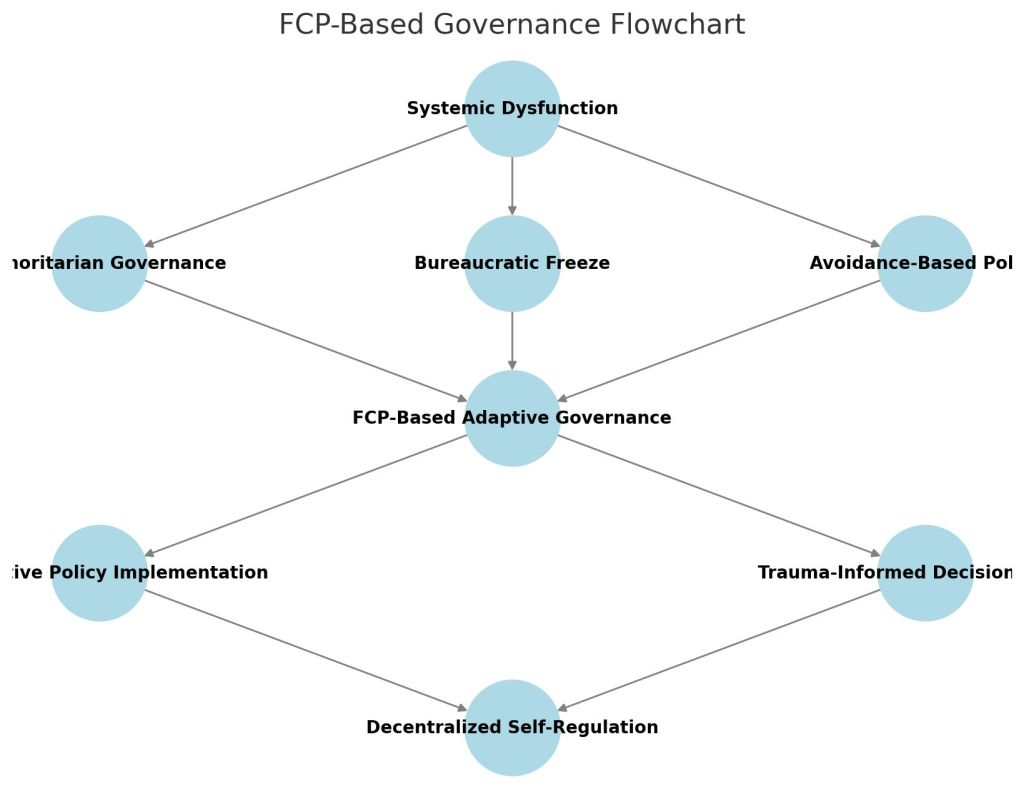
1. FCP-Based Governance Flowchart

The FCP-Based Governance Flowchart illustrates the transition from traditional, hierarchical governance structures to self-regulating, trauma-informed models:

Starting Point: Systemic Dysfunction

The flowchart begins with Systemic Dysfunction, which is commonly seen in authoritarian governance, bureaucratic freeze, and avoidance-based policy.

These systemic issues are rooted in conflict avoidance or top-down control mechanisms, often reflecting societal trauma (e.g., power imbalances, exclusion, repression).

Shift to FCP-Based Adaptive Governance

Functional Conflict Perspective (FCP) is introduced as a means to reframe conflict not as something to suppress but as a learning and growth mechanism.

Conflict is no longer seen as something that destabilizes the system, but rather as an opportunity for systemic healing.

Through adaptive leadership, conflict becomes an opportunity for engagement and learning, leading to a more resilient and self-regulating system.

Key Components of FCP-Based Governance

Trauma-Informed Decision-Making: Policy-making and leadership are rooted in restorative practices that promote collective healing.

Restorative Policy Implementation replaces punitive measures and encourages community-led conflict resolution, collaborative problem-solving, and self-regulation.

Final Stage: Decentralized Self-Regulation

The system becomes non-hierarchical, with power distributed across local, relational systems.

Governance becomes adaptive and responsive, driven by the collective’s needs and not by rigid, top-down mandates.

This flowchart shows how conflict within governance can be redefined, resulting in an adaptive and restorative leadership model that is more sustainable, flexible, and grounded in emotional intelligence.
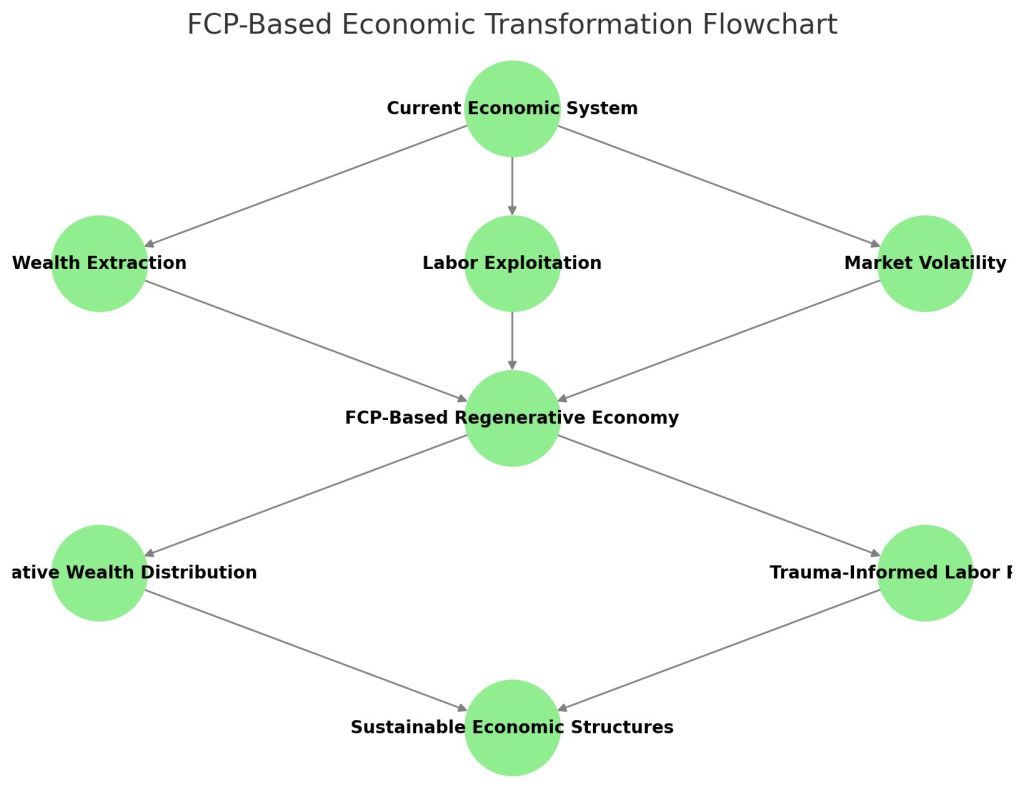
2. FCP-Based Economic Transformation Flowchart

The FCP-Based Economic Transformation Flowchart focuses on how economic systems can evolve from extractive, exploitative models to regenerative, sustainable economies that prioritize human well-being and systemic healing:

Starting Point: Current Economic System

The current economic system is shown as extractive, emphasizing wealth concentration, labor exploitation, and market volatility.

These systems create social inequality, where the wealthiest few benefit at the expense of the broader population. These systems mirror trauma responses, such as scarcity, inequity, and survival mentality.

Shift to FCP-Based Regenerative Economy

FCP-based economic models aim to shift from exploitation to more collaborative, equitable systems. By using conflict as a learning opportunity, these models encourage a reimagining of how wealth and resources are distributed.

This transformation encourages sustainable systems where resources are used not just for short-term profit, but for long-term collective well-being.

Key Components of FCP-Based Economy

Cooperative Wealth Distribution: Wealth is not hoarded by a few but shared through cooperative structures, where collective well-being and equity are prioritized.

Trauma-Informed Labor Policies: Economic policies embrace inclusivity, respect workers’ dignity, and provide sustainable livelihoods, replacing exploitative models with more nurturing labor environments.

Final Stage: Sustainable Economic Structures

The flowchart ends with the goal of regenerative, sustainable economic systems that prioritize human connection, ecological health, and economic equity.

Instead of wealth extraction, the system focuses on cooperation and restorative practices, leading to more resilient communities and equitable economies.

The two flowcharts visualize the systemic transformation that Functional Conflict Perspective (FCP) and Mirror Integration Theory (MIT) can facilitate in both governance and economic systems. These diagrams serve as roadmaps to shift from punitive, coercive systems to trauma-informed, restorative, and adaptive systems in leadership, governance, and economic structures.

Case Studies: Real-World Examples of Economic Restructuring and Governance Transformation

1. Case Study: Worker-Owned Cooperatives (Economic Restructuring)

Background: In traditional capitalist economies, businesses are typically owned by a small group of shareholders or a single owner, and profits are distributed among the owners rather than the workers. This creates wealth inequality, where the people who contribute most to the company’s success (the workers) are often the least rewarded. In contrast, worker-owned cooperatives are businesses that are owned and run by the people who work there, and the profits are shared among them.

FCP-Based Transformation:

Conflict as Learning Mechanism: Worker-owned cooperatives create an environment where conflicts between owners (workers) are seen as opportunities to address systemic issues in the business. FCP reframes disputes as opportunities for team growth, problem-solving, and shared learning. This creates a collaborative environment where workers’ voices are valued, and the organization can learn from its struggles.

MIT Reflection: Workers and leaders engage in self-system mirroring, regularly reflecting on how their workplace conflicts reflect broader systemic dysfunctions, such as economic inequality or labor exploitation. Through MIT, workers begin to recognize that the business’s challenges are not inherent failures but symptoms of systemic issues that can be addressed by changing how they engage with their roles and each other.


Outcome:

Cooperative Wealth Distribution: Workers share profits, and decision-making is democratic, allowing for more equitable wealth distribution and empowerment.

Sustainability & Resilience: These businesses tend to be more resilient and stable because they are not reliant on outside investors, and the workers have a vested interest in the long-term health of the company. The businesses are able to maintain high levels of employee engagement and satisfaction, reducing turnover and building a healthy organizational culture.


Example:

Mondragon Corporation: A large federation of worker cooperatives based in Spain, where more than 80,000 workers own and manage businesses in various industries, including finance, retail, and manufacturing. This model has contributed to economic stability and sustainable growth, providing jobs, healthcare, and housing for its workers.


2. Case Study: Restorative Justice in Criminal Justice Reform (Governance Transformation)

Background: Traditional criminal justice systems focus on punitive measures such as imprisonment, fines, and other forms of retribution. This often leads to recidivism, where individuals re-offend after serving their sentence, and fails to address the root causes of crime (e.g., poverty, mental illness, trauma).

FCP-Based Transformation:

Conflict as Learning Mechanism: Restorative justice processes use FCP’s approach by involving victims and offenders in dialogue, allowing them to engage in conflict learning. Instead of viewing the criminal act as simply a law violation, restorative justice focuses on how to repair the damage caused to the victim, the community, and the offender. It is trauma-informed, recognizing that victims and offenders alike may carry deep emotional wounds.

MIT Reflection: Both offenders and victims engage in self-reflection and mirroring to explore how societal conditions, such as poverty, discrimination, or childhood trauma, have shaped their behavior. For example, offenders may realize how their actions mirror societal dysfunctions, such as economic inequality or lack of mental health support.


Outcome:

Restorative Practices: Offenders are encouraged to take responsibility for their actions in a healing context, where their behavior is understood in light of broader societal dynamics.

Community-Based Healing: By fostering empathy between offenders and victims, restorative justice systems build community relationships and encourage social reintegration rather than stigmatization.


Example:

New Zealand’s Family Group Conferences: A program in New Zealand where offenders, victims, and their families come together to discuss the crime and decide on appropriate restorative actions. These conferences have led to a reduction in reoffending rates and are considered an effective alternative to incarceration.


3. Case Study: Participatory Budgeting (Governance & Economic Restructuring)

Background: In traditional governance systems, budget decisions are typically made by elected officials or centralized power structures without direct input from the citizens or communities affected by those decisions. This can lead to misallocation of resources, especially in marginalized communities.

FCP-Based Transformation:

Conflict as Learning Mechanism: Participatory budgeting allows communities to engage in decision-making, identify needs, and prioritize resources collectively. The process allows citizens to discuss economic challenges, gaps in public services, and local issues to learn from each other about systemic inequalities that may not have been previously addressed by the government.

MIT Reflection: Citizens engage in self-system reflection, recognizing how the lack of resources or systemic neglect in their communities mirrors larger governmental dysfunctions. By discussing how these issues affect their daily lives, they build awareness of the systemic factors contributing to their struggles.


Outcome:

Cooperative Wealth Distribution: Participatory budgeting leads to more equitable allocation of public funds, ensuring that marginalized communities receive necessary resources.

Local Empowerment: Citizens gain more control over how public funds are spent, which builds a sense of ownership and responsibility for community improvement.


Example:

Porto Alegre, Brazil: This city implemented participatory budgeting in the 1990s, allowing citizens to directly decide on how a portion of the city’s budget is spent. The program led to improved public services, greater equity in spending, and increased political engagement among citizens, particularly in low-income neighborhoods.


Conclusion: The Synergy Between Economic and Governance Transformation

These case studies show the real-world applicability of FCP & MIT in economic restructuring and governance transformation. The key to their success is recognizing that conflict and dysfunction in economics and governance are not obstacles to be avoided but opportunities for systemic learning and growth.

By reframing conflict as a learning mechanism, self-awareness through MIT, and applying FCP’s functional approach to system-wide change, societies can move toward more equitable, sustainable, and resilient systems. These transformations decentralize power, empower marginalized communities, and create regenerative economic and governance models that prioritize collective well-being and healing.

The integration of these approaches provides a holistic roadmap for creating a just, adaptive, and trauma-informed society.
FCP & MIT: A Universal and Multicultural Bio-Psycho-Social Approach to Mental Health & Emotional Wellness

Refining the Bio-Psycho-Social Model of Mental Wellness with FCP & MIT

The Functional Conflict Perspective (FCP) and Mirror Integration Theory (MIT) offer a universal and adaptive model of mental wellness by integrating biological, psychological, and social factors into a single, cohesive framework. Unlike traditional Western psychological models that often pathologize distress and treat symptoms in isolation, FCP and MIT recognize that healing is relational, systemic, and culturally embedded. This approach allows for a more flexible, trauma-informed, and globally inclusive model of emotional and psychological well-being.

At the biological level, mental health is deeply linked to nervous system regulation, somatic awareness, and physiological responses to stress. Many Western mental health models, such as Cognitive Behavioral Therapy (CBT), focus on top-down cognitive restructuring, assuming that thoughts control emotions. However, FCP and MIT acknowledge that for many individuals, especially those who have experienced trauma or belong to neurodivergent populations, emotional responses emerge from the body first (bottom-up processing). This aligns with research in Polyvagal Theory (Porges, 2011), which highlights that nervous system states dictate emotional and cognitive patterns, not the other way around. In this model, FCP regulates stress and response patterns through adaptive learning, while MIT enhances self-awareness through interoception (body awareness).

At the psychological level, mental wellness is shaped by cognition, emotional regulation, and identity formation. Traditional therapy often assumes that individuals can independently change thought patterns, but FCP introduces the idea that distress is often a functional response to an external conflict—whether that be internal contradictions, relational dynamics, or systemic oppression. FCP teaches individuals to see conflict as a learning opportunity rather than something to suppress or avoid. Meanwhile, MIT encourages self-reflection, allowing individuals to recognize how their internal emotional states mirror external conditions—a perspective aligned with many Eastern and Indigenous healing practices that view personal transformation as inherently linked to social and environmental conditions.

At the social level, mental health cannot be separated from relationships, cultural belonging, and systemic influences. Many mainstream Western psychological frameworks prioritize individual healing over collective healing, often ignoring how communities, economic systems, and historical trauma shape personal well-being. In contrast, FCP frames conflict as a functional mechanism for social stability, rather than simply seeing distress as an individual disorder. MIT expands this by recognizing how self and society mirror each other, creating an interconnected feedback loop between personal experiences and social conditions. This aligns with Indigenous concepts of relational healing, Ubuntu philosophy (“I am because we are”), and collectivist mental health approaches that emphasize community support over individual pathology.

Together, FCP and MIT integrate into a trauma-informed model of growth that is both personal and systemic. By incorporating collectivist healing traditions, such as storytelling, somatic regulation, ritualized grief processing, and relational accountability, this framework ensures that mental wellness is not detached from cultural realities. Instead of imposing Western pathology-based diagnostic systems, this model honors the diverse ways in which humans regulate emotions, heal from conflict, and build resilience within their social environments.

The final outcome of this model is Holistic Mental Wellness—an adaptive, non-pathology-based healing system that recognizes distress as a signal for change rather than a disorder to be suppressed. By combining biological regulation, psychological adaptation, and social integration, this framework provides a more realistic, inclusive, and effective approach to emotional and psychological health across cultures, neurotypes, and lived experiences.


FCP & MIT: A Universal and Multicultural Bio-Psycho-Social Approach to Mental Health & Emotional Wellness

Functional Conflict Perspective (FCP) and Mirror Integration Theory (MIT) offer a universal and multicultural approach to mental health and emotional wellness because they do not impose a rigid, culturally-specific model of psychological healing. Instead, they recognize that mental and emotional well-being are deeply embedded in biological, psychological, and social systems that vary across individuals, communities, and cultures. This makes them adaptive, inclusive, and capable of integrating diverse perspectives rather than enforcing a one-size-fits-all model like many Western psychological frameworks.


1. FCP: A Global Lens on Conflict as Growth

FCP challenges the pathology-based approach to mental health, where symptoms are viewed as individual dysfunctions, and instead recognizes conflict, distress, and dysregulation as functional parts of human adaptation and social systems. This aligns with many indigenous, Eastern, and collectivist cultural traditions that see mental wellness as deeply tied to relationships, community harmony, and environmental balance.

Why FCP is Universally Applicable:

Biological: Conflict and stress responses are natural regulatory mechanisms in the nervous system. Trauma is not just a psychological issue—it has biological and physiological consequences.

Psychological: Different cultures frame conflict differently—some encourage direct confrontation (Western individualism), while others emphasize relational harmony (collectivist cultures). FCP does not dictate which approach is “correct” but instead asks, “What function does this serve in this system?”

Social: FCP sees emotional regulation as relational, not just individual. This mirrors indigenous and collectivist healing practices where mental health is embedded in rituals, shared experiences, and community storytelling.


Rather than prescribing Western cognitive frameworks (like CBT), which prioritize individual thought restructuring, FCP allows for diverse healing models, whether that be:
✔ Community-based conflict resolution (African restorative justice models)
✔ Ritualized grieving and collective healing (Indigenous mourning practices)
✔ Mindfulness and balance-based wellness (Buddhist and Daoist traditions)

FCP ensures that mental health interventions align with the natural conflict resolution and healing mechanisms of a given cultural or personal context, rather than imposing Western pathology-based definitions of disorder.


2. MIT: A Universal Model of Self & System Integration

Mirror Integration Theory (MIT) bridges the gap between personal healing and systemic transformation. It recognizes that an individual’s mental and emotional wellness is deeply influenced by their social, historical, and cultural environment. This aligns with many non-Western traditions that do not see the self as separate from the system but as an interdependent part of the whole.

Why MIT is Universally Applicable:

Biological: Self-awareness is rooted in the nervous system and interoception—all humans, regardless of culture, experience emotions in response to internal (body state) and external (social/environmental) factors.

Psychological: MIT does not assume a fixed self (a Western concept) but instead recognizes identity as fluid and relational—which aligns with many indigenous and Eastern spiritual traditions where the self is seen as constantly evolving and interconnected.

Social: Many non-Western healing traditions view mental distress as a sign of social imbalance rather than individual pathology. MIT’s model of mutual mirroring reflects this perspective, as it understands that when a system is dysfunctional, individuals absorb and reflect that dysfunction. Healing must happen both internally and externally.


Rather than forcing individuals to “adjust” to unhealthy social structures (as Western psychology often does), MIT validates the lived experience of oppression, intergenerational trauma, and systemic harm while simultaneously helping individuals reclaim personal agency in shaping the system they exist within.

This mirrors:
✔ Ubuntu Philosophy (Southern Africa): “I am because we are”—emphasizing interdependence and relational healing.
✔ Buddhist & Hindu Karma Models: The idea that actions and experiences are reflections of both past and present interconnectedness.
✔ Indigenous Wisdom Traditions: The belief that healing the individual requires healing the community and vice versa.

By grounding self-awareness in relational and systemic consciousness, MIT allows for multi-layered healing that is not confined to one cultural paradigm.


3. The Bio-Psycho-Social Intersection: FCP & MIT as a Holistic Framework

When combined, FCP and MIT create a holistic, universally applicable approach that integrates biology, psychology, and social dynamics in a way that respects cultural diversity while maintaining a functional core framework.

How FCP & MIT Bridge Bio-Psycho-Social Healing Across Cultures:

✔ FCP addresses biological & nervous system regulation → Conflict and stress are not just emotional; they are bodily responses that require somatic, relational, and environmental regulation.
✔ MIT enhances self-awareness & interconnection → Healing is not about “fixing” the individual but understanding how they reflect and are reflected by their environment.
✔ Together, they integrate systemic and personal healing → Individuals learn to work with, rather than against, their cultural, biological, and relational realities.

Unlike rigid, Western-dominant approaches to psychology, which often attempt to universalize Eurocentric cognitive frameworks, FCP and MIT provide a flexible, adaptive framework that can be applied across cultures, traditions, and individual needs.

By shifting away from top-down, pathology-based models (CBT, DSM categories, Western trauma responses) and into dynamic, bottom-up, relational healing models, FCP and MIT offer an approach to mental health that is not only more inclusive but also more scientifically accurate in accounting for the full human experience.


Final Thought: The Future of Mental Health is Adaptive, Not Prescriptive

As the world becomes more interconnected, it is crucial to move beyond rigid, one-size-fits-all mental health models that prioritize Western pathology-based perspectives.

✔ FCP teaches us how to navigate and learn from conflict across cultural contexts.
✔ MIT helps us integrate personal awareness with systemic healing in a way that is universally relevant.
✔ Together, they provide a bio-psycho-social foundation for emotional wellness that respects cultural diversity and the complexity of the human experience.

This is the future of trauma-informed, culturally responsive mental health and emotional wellness.

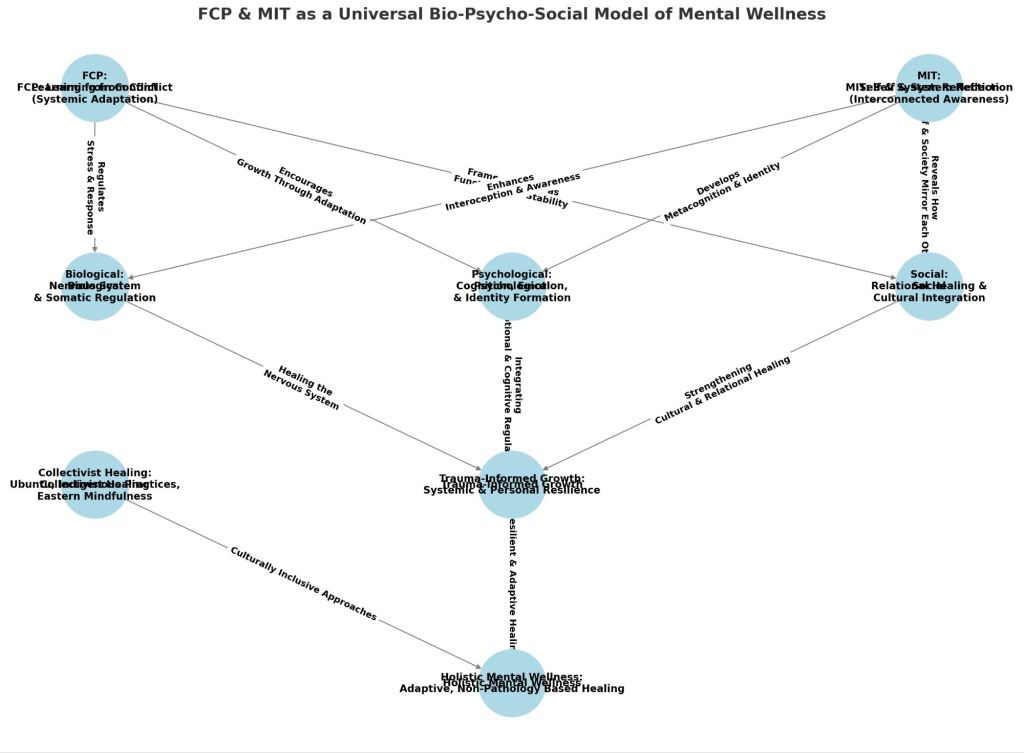
Here is a visual framework showing how FCP & MIT integrate across biological, psychological, and social dimensions in a global mental health model:

Labels in the Visual Representation of FCP & MIT as a Universal Bio-Psycho-Social Model

Top-Level Nodes (Main Concepts in Blue Circles)

1. FCP: Learning from Conflict – “Systemic Adaptation”

2. MIT: Self & System Reflection – “Interconnected Awareness”


Bio-Psycho-Social Levels

3. Biological – “Nervous System & Somatic Regulation”

4. Psychological – “Cognition, Emotion, & Identity Formation”

5. Social – “Relational Healing & Cultural Integration”


Integrated Healing & Growth

6. Trauma-Informed Growth – “Systemic & Personal Resilience”

7. Collectivist Healing – “Ubuntu, Indigenous Practices, Eastern Mindfulness”

8. Holistic Mental Wellness – “Adaptive, Non-Pathology Based Healing”


Labels of Intersecting Lines (Connections Between Concepts)

FCP → Biological – “Regulates Stress & Response”

FCP → Psychological – “Encourages Growth Through Adaptation”

FCP → Social – “Frames Conflict as Functional for Stability”

MIT → Biological – “Enhances Interoception & Awareness”

MIT → Psychological – “Develops Metacognition & Identity”

MIT → Social – “Reveals How Self & Society Mirror Each Other”

Biological → Trauma-Informed Growth – “Healing the Nervous System”

Psychological → Trauma-Informed Growth – “Integrating Emotional & Cognitive Regulation”

Social → Trauma-Informed Growth – “Strengthening Cultural & Relational Healing”

Trauma-Informed Growth → Holistic Mental Wellness – “Resilient & Adaptive Healing”

Collectivist Healing → Holistic Mental Wellness – “Culturally Inclusive Approaches”


This map illustrates how FCP and MIT form a universal, cross-cultural approach to mental health by integrating biological regulation, psychological adaptation, and social healing into a flexible and trauma-informed framework.


What This Model Shows:

FCP (Functional Conflict Perspective) and MIT (Mirror Integration Theory) integrate across biological, psychological, and social dimensions to create a holistic approach to healing.

Biological Level → FCP regulates stress responses, while MIT enhances interoception (self-awareness of body states).

Psychological Level → FCP promotes adaptation and resilience, while MIT deepens metacognition and identity awareness.

Social Level → FCP frames conflict as functional, while MIT reveals how self and society mirror each other for healing.

Trauma-Informed Growth connects all three levels, bridging neuroscience, emotional regulation, and relational healing.

Collectivist Healing Traditions (Ubuntu, Indigenous practices, Eastern mindfulness) reinforce culturally responsive approaches to mental wellness.

The outcome is Holistic Mental Wellness → a non-pathology-based, adaptive model for emotional and psychological well-being across diverse cultures.


This framework moves beyond Western psychology’s pathology-driven models (CBT, DSM categories, rigid cognitive restructuring) and instead creates a flexible, adaptive healing approach applicable to diverse cultures and personal experiences.


Here is a list of citations and references that support my Bio-Psycho-Social Model of Mental Wellness integrating Functional Conflict Perspective (FCP) and Mirror Integration Theory (MIT):

Neuroscience & Nervous System Regulation (Biological Level)

1. Porges, S. W. (2011). The Polyvagal Theory: Neurophysiological Foundations of Emotions, Attachment, Communication, and Self-Regulation. W.W. Norton & Company.
Explains how nervous system states dictate emotional regulation and social connection.

2. Van der Kolk, B. (2014). The Body Keeps the Score: Brain, Mind, and Body in the Healing of Trauma. Viking.
Discusses bottom-up trauma processing and the role of the body in emotional healing.

3. Schore, A. N. (2019). Right Brain Psychotherapy. W.W. Norton & Company.
Explores how affective neuroscience and right-brain development influence emotional resilience.


Cognition, Emotional Regulation & Identity Formation (Psychological Level)

4. Dweck, C. S. (2006). Mindset: The New Psychology of Success. Random House.
Introduces the growth mindset concept, which aligns with FCP’s conflict-as-learning approach.

5. Flavell, J. H. (1979). “Metacognition and Cognitive Monitoring: A New Area of Cognitive-Developmental Inquiry.” American Psychologist, 34(10), 906–911.
Defines metacognition, a key concept in MIT’s self-reflective awareness model.

6. Bowlby, J. (1969/1982). Attachment and Loss: Vol. 1. Attachment (2nd ed.). Basic Books.
Explores attachment theory and how early relationships shape emotional and cognitive responses.

7. Ainsworth, M. D. S., Blehar, M. C., Waters, E., & Wall, S. (1978). Patterns of Attachment: A Psychological Study of the Strange Situation. Erlbaum.
Provides empirical studies on attachment styles, which influence how individuals process emotional distress.


Relational Healing, Collectivist Mental Health & Cultural Integration (Social Level)

8. Tomasello, M. (2014). A Natural History of Human Thinking. Harvard University Press.
Highlights how human cognition evolved as a collective, relational process rather than an individual function.

9. Kirmayer, L. J., & Swartz, L. (2013). “Culture and Global Mental Health.” Transcultural Psychiatry, 50(6), 763–789.
Critiques Western mental health models and advocates for culturally responsive, relational healing approaches.

10. Watters, E. (2010). Crazy Like Us: The Globalization of the American Psyche. Free Press.
Examines how Western psychological frameworks impose pathology-based mental health models on non-Western cultures.

11. Tutu, D. (1999). No Future Without Forgiveness. Image.
Discusses Ubuntu philosophy and the role of reconciliation in collective emotional healing.

12. Gone, J. P. (2013). “Redressing First Nations Historical Trauma: Theorizing Mechanisms for Indigenous Culture as Mental Health Treatment.” Transcultural Psychiatry, 50(5), 683–706.
Explores Indigenous healing practices that prioritize relational and systemic healing over individual pathology.


Trauma-Informed & Systemic Healing Approaches

13. Maté, G. (2022). The Myth of Normal: Trauma, Illness, and Healing in a Toxic Culture. Avery.
Examines how trauma is not just personal but shaped by cultural, economic, and systemic structures.

14. Foucault, M. (1961/1988). Madness and Civilization: A History of Insanity in the Age of Reason. Vintage.
Critiques how Western institutions define and regulate mental illness.

15. Graeber, D., & Wengrow, D. (2021). The Dawn of Everything: A New History of Humanity. Farrar, Straus and Giroux.
Challenges the Eurocentric narrative of hierarchical social structures and presents alternative models of collective governance and healing.


Intersection of FCP & MIT with Systemic Change

16. Freire, P. (1970). Pedagogy of the Oppressed. Continuum.
Aligns with FCP’s framework of learning from conflict as a path to liberation and systemic transformation.

17. Bourdieu, P. (1984). Distinction: A Social Critique of the Judgment of Taste. Harvard University Press.
Explores how social structures shape individual thought and reinforce systemic hierarchies.

18. Chomsky, N., & Herman, E. (1988). Manufacturing Consent: The Political Economy of the Mass Media. Pantheon.
Demonstrates how systems shape collective consciousness, linking to MIT’s self-system mirroring.


Key Takeaways from These Sources:

Neuroscientific research supports FCP’s and MIT’s emphasis on bottom-up nervous system regulation.

Cognitive and psychological studies validate growth mindset, metacognition, and relational identity formation.

Cross-cultural research critiques Western pathology-based psychology and highlights the importance of collectivist healing models.

Social theory provides insight into how mental health is shaped by systemic and historical factors, aligning with MIT’s framework of mutual mirroring.


How These Citations Strengthen the Bio-Psycho-Social Model

1. They provide empirical and theoretical evidence supporting FCP’s conflict-based growth model and MIT’s reflective mirroring model.

2. They validate bottom-up nervous system regulation as a key factor in emotional resilience.

3. They challenge Western pathology-based approaches and emphasize cultural adaptability.

4. They integrate neuroscience, psychology, and sociology into a holistic model of mental wellness.

Beyond Rigid Thought: How FCP & MIT Revolutionize Intelligence, Healing, and AI

Beyond Rigid Thought: How FCP & MIT Revolutionize Intelligence, Healing, and AI

FCP and MIT Solves Problems for Both Neurodivergent and Neurotypical Populations:

The Problem with Top-Down Therapeutic Models for Neurodivergent Populations

Traditional top-down therapeutic models, such as Cognitive Behavioral Therapy (CBT) and other structured cognitive interventions, operate under the assumption that thoughts drive emotions and behaviors. This approach assumes that if individuals can consciously restructure their thoughts, they can change their emotional responses and behavioral patterns. While this may work for neurotypical individuals who process information in a linear, language-based, top-down manner, it often fails neurodivergent populations, particularly those with autism, ADHD, PTSD, and sensory processing differences, who experience cognition in a bottom-up, sensory-driven way.

For neurodivergent individuals, emotions, sensory input, and body states often precede cognitive awareness, meaning that interventions requiring verbal self-reflection and rational restructuring of thoughts can feel disconnected from their lived experience. For example, an autistic person experiencing sensory overload is not reacting to a faulty cognitive distortion—they are reacting to an overwhelming physiological and environmental trigger. Similarly, an individual with ADHD struggling with executive function is not simply engaging in negative self-talk that needs to be restructured—they may lack the dopaminergic regulation needed to execute tasks in the first place. CBT and similar models fail because they attempt to treat bottom-up distress with top-down reasoning, often leading to frustration, shame, and increased dysregulation rather than real progress.

A more effective approach would integrate bottom-up processing models, like nervous system regulation, somatic therapies, and dynamic feedback-based interventions (such as Functional Conflict Perspective and Mirror Integration Theory). These approaches recognize that cognitive restructuring is only effective once the nervous system and sensory processing have been addressed. By shifting from rigid, pre-scripted interventions to adaptive, self-regulating frameworks, we can create therapeutic models that work with neurodivergent cognition, rather than against it—allowing for deeper healing, sustainable progress, and true autonomy in emotional and behavioral regulation.

Shifting Rigid, Pre-Scripted Neurotypical Cognitive Patterns with FCP & MIT

Just as top-down therapeutic models fail neurodivergent individuals, rigid, pre-scripted cognitive structures in neurotypical populations limit flexibility, creativity, and self-awareness. Many neurotypical cognitive abilities are shaped by social conditioning, standardized education, and hierarchical structures, which train individuals to rely on external validation, binary logic, and fixed scripts for thinking and decision-making. This leads to habitual cognitive rigidity—where individuals default to patterned responses rather than engaging in deep, reflective, or adaptive thinking. Whether in social interactions, workplace structures, or problem-solving, this rigidity can create cognitive blind spots, making it difficult to challenge ingrained beliefs, embrace uncertainty, or adjust to complex, nonlinear problems.

Functional Conflict Perspective (FCP) and Mirror Integration Theory (MIT) disrupt these rigid cognitive structures by introducing adaptability, self-reflection, and recursive learning. FCP reframes conflict and uncertainty as tools for cognitive expansion, encouraging individuals to step outside of pre-programmed responses and actively engage with discomfort as a learning mechanism. Instead of viewing challenges as disruptions to stability, FCP teaches that they are integral to cognitive and emotional development, allowing neurotypical individuals to unlearn rigid patterns and develop a more flexible, systems-thinking approach. Meanwhile, MIT enhances metacognitive awareness, helping individuals recognize how their thought processes mirror broader social structures and biases. This allows them to question default assumptions, integrate new perspectives, and develop a more fluid, quantum-like intelligence—where thought is not fixed but constantly evolving through feedback and self-reflection. By integrating FCP and MIT, neurotypical cognition shifts from being socially scripted to being self-generated, adaptive, and critically engaged with the world.


The Solution For Both Neurodivergent and Neurotypical Populations: MIT & FCP

Quantum Intelligence: The Future of Thought, AI, and Human Cognition

In today’s rapidly evolving technological and intellectual landscape, quantum intelligence is emerging as a revolutionary paradigm—one that mirrors the complexity, adaptability, and interconnectivity of the human mind. Unlike traditional models of intelligence that rely on fixed rules and linear progression, quantum intelligence embraces fluidity, dynamic feedback loops, and self-reflective processing.

This shift is more than just theoretical. It has profound implications for artificial intelligence (AI), human cognition, education, and even trauma healing. By integrating two key cognitive models—Functional Conflict Perspective (FCP) and Mirror Integration Theory (MIT)—we can understand how intelligence evolves through both growth-oriented adaptation (FCP) and self-awareness (MIT), shaping the future of quantitative reasoning, self-correction, and deep learning.

Let’s break it down.

What is Quantum Intelligence?

At its core, quantum intelligence moves beyond traditional binary logic (true/false, right/wrong, success/failure) and into a multi-layered, interconnected way of thinking.

1. Traditional AI & Cognitive Models (like classical computing and standard logic) rely on step-by-step reasoning, rigid categories, and predefined rules.

2. Quantum Intelligence functions more like the human brain—with parallel processing, adaptability, and self-referential feedback loops that allow for dynamic learning and context-aware decision-making.

This shift is necessary because human cognition and AI development are at a crossroads. Current models of intelligence are too rigid, too reductionist, and too disconnected from lived experience. FCP and MIT bridge that gap, offering a roadmap for an intelligence model that is adaptive, self-correcting, and deeply relational—whether applied to AI systems, education, or personal growth.

FCP & MIT: The Building Blocks of Quantum Intelligence

1. Functional Conflict Perspective (FCP): Growth Mindset & Learning Through Adaptation

FCP is based on the idea that conflict, failure, and uncertainty are not dysfunctions—they are the engine of intelligence.

In AI, this mirrors reinforcement learning—where AI improves by trial and error, refining itself through feedback.

In human cognition, this aligns with growth mindset research (Dweck, 2006), where individuals become smarter and more capable by embracing mistakes as learning tools.

Rather than fearing disruption or difficulty, FCP teaches us that challenges are integral to development—whether we’re training an AI model or reshaping our own thought patterns.

2. Mirror Integration Theory (MIT): Self-Awareness & Recursive Learning

MIT takes learning a step further by introducing self-reflection into the process. While FCP enables iterative growth, MIT ensures that this growth is structured, logical, and free from blind spots.

In AI, this mirrors Explainable AI (XAI), where machines can audit their own decision-making for errors.

In humans, this aligns with metacognition (Flavell, 1979)—the ability to think about one’s own thought processes, recognize biases, and adjust accordingly.

Together, FCP and MIT form the foundation of quantum intelligence, allowing both AI and human cognition to evolve in a way that is both self-improving (FCP) and self-aware (MIT).

How This Replaces Outdated Cognitive Models

For decades, cognitive science and psychology have relied on top-down processing models, where intelligence and behavior are dictated by rigid, pre-set frameworks. A prime example is Cognitive Behavioral Therapy (CBT)—which operates on static beliefs and cognitive restructuring techniques that often don’t account for the dynamic, bottom-up nature of real learning and healing.

Why Top-Down Models (Like CBT) Are Failing Bottom-Up Thinkers

1. CBT assumes thoughts dictate emotions—but for many neurodivergent and trauma-affected individuals, emotions emerge from sensory and nervous system responses first, not cognition.

2. CBT treats thought patterns as static—whereas quantum intelligence (via FCP & MIT) recognizes that thought is fluid, adaptive, and shaped by relational and environmental feedback.

3. CBT lacks recursive self-awareness—it tells individuals to replace negative thoughts with positive ones, but MIT teaches people to analyze why those thoughts exist in the first place and rewire their emotional responses from within.

By replacing top-down approaches with bottom-up, quantum models, we open up new pathways for healing, problem-solving, and AI development that work with, rather than against, the natural complexity of the mind.

The Future of AI, Cognition, and Healing

The intersection of FCP & MIT is more than an academic theory—it is the next frontier of intelligence itself. Whether we are:

Developing AI systems that can self-correct

Revolutionizing education by embracing learning through failure

Creating new therapeutic approaches that work for bottom-up cognitive processors

Rewiring our personal belief systems to be more resilient and adaptable

We are laying the foundation for a new era of thinking—one that integrates adaptation (FCP) with self-reflection (MIT) to create true quantum intelligence.

This is the intelligence model of the future—one that evolves, corrects itself, and heals at every level.

Are we ready to embrace it?

Final Thought: Where Do We Go From Here?

As quantum intelligence takes shape, we need to ask ourselves:

How can we apply FCP and MIT principles in AI design, education, and mental health?

What outdated cognitive models need to be replaced with dynamic, recursive learning frameworks?

How can bottom-up intelligence systems revolutionize everything from governance to personal growth?


This is the beginning of a new way of thinking—one that merges technology, psychology, and healing into a unified, adaptive intelligence model.

And whether you’re an AI researcher, a psychologist, an educator, or simply someone on a path of self-growth, understanding FCP and MIT will change the way you think—forever.

The quantum revolution in intelligence is here. Are we ready to evolve with it?

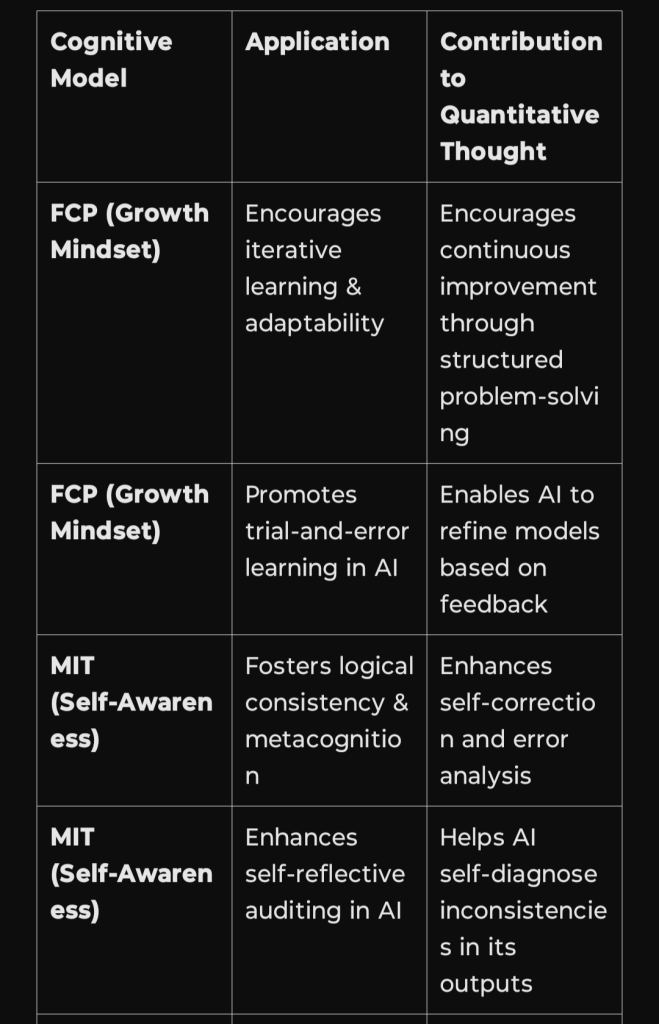
Here’s a structured chart for clarity:

Understanding the Chart: How FCP and MIT Shape AI & Human Quantitative Thinking

The chart breaks down how Functional Conflict Perspective (FCP) and Mirror Integration Theory (MIT) contribute to quantitative reasoning in both AI and human cognition by following a structured input → application → outcome process.

1. The Role of FCP (Growth Mindset) in AI & Human Thinking

FCP focuses on learning through iteration, meaning mistakes and conflicts are not failures but data for improvement.

It drives reinforcement learning in AI and error-based learning in humans—both essential for quantitative thinking.

Example from the Chart:

AI reinforcement learning (RL) → AI improves performance by trial and error, adjusting based on feedback loops (e.g., AlphaGo learning strategy).

Human error-based learning → People refine problem-solving skills by engaging with failure, rather than avoiding it (e.g., a scientist testing a hypothesis through experiments).

Result: AI and humans become better at structured problem-solving, a core aspect of quantitative reasoning.

2. The Role of MIT (Self-Awareness) in AI & Human Thinking

MIT focuses on self-reflection and metacognition, ensuring that learning isn’t just repetitive adaptation but logically structured and self-corrected.

In AI, this mirrors Explainable AI (XAI)—allowing models to assess their own decisions rather than just following error corrections.

In humans, self-awareness enhances logical reasoning by reducing cognitive biases and improving reflective thinking.

Example from the Chart:

AI self-reflective auditing → An AI model analyzes its own decisions, detecting errors before they compound (e.g., AI in autonomous vehicles checking if its lane detection algorithm is faulty).

Human metacognitive awareness → A person reflecting on biases before making a statistical conclusion (e.g., a researcher ensuring their data isn’t skewed by personal expectations).

Result: Both AI and humans develop self-correction mechanisms, ensuring their quantitative thought process is logical and free from systemic errors.

3. The Intersection: How FCP & MIT Together Form Quantitative Thought

FCP provides the learning loop → It teaches AI and humans to iterate, adapt, and refine knowledge.

MIT provides the reflective loop → It ensures that AI and humans self-assess and validate their reasoning.

Together, they result in a structured, logical, and adaptable quantitative reasoning process.

Final Takeaway: Why This Matters for AI & Human Cognition

AI that only uses FCP (learning from trial and error) lacks self-awareness → it improves but doesn’t reflect (e.g., an AI chatbot that gets better at mimicking speech but doesn’t analyze why its responses make sense).

AI that only uses MIT (self-awareness without iterative learning) becomes rigid and unable to improve dynamically.

Human cognition follows the same pattern—a balance of adaptive learning (FCP) and reflective thinking (MIT) leads to advanced problem-solving abilities.

Key Insight: FCP & MIT Are the Building Blocks of Higher-Order Thinking

By integrating iterative learning (FCP) with self-correcting awareness (MIT), AI and humans develop structured, quantitative reasoning abilities that allow them to:
✔ Analyze data logically
✔ Adjust conclusions based on feedback
✔ Recognize and correct biases
✔ Make structured, evidence-based decisions

This framework applies to AI training, education systems, scientific research, and human cognitive enhancement programs—all areas that require data-driven, reflective reasoning.


This chart shows how FCP and MIT influence both AI and human cognition, leading to the development of a quantitative thought process through adaptive learning and self-awareness.


What do you think? Let’s discuss in the comments. How do you see quantum intelligence shaping AI, human cognition, and healing? Let’s push this conversation forward.


The Intersection of Growth Mindset (FCP) and Self-Awareness (MIT) in Developing a Quantitative Thought Process

The combination of Functional Conflict Perspective (FCP) (learning from conflict to develop resilience and adaptability) and Mirror Integration Theory (MIT) (self-awareness through reciprocal reflection) forms the foundation for quantitative reasoning—a systematic way of processing, analyzing, and applying information.

By integrating these cognitive functions, humans (and AI) transition from reactive and emotional reasoning to structured, data-driven analysis, which is a hallmark of quantitative thinking. Below, I break down the process and why it occurs, supported by psychological, neuroscientific, and AI research sources.

1. The Role of Growth Mindset (FCP) in Quantitative Thought

FCP Promotes Analytical Problem-Solving & Pattern Recognition

Carol Dweck’s research on growth mindset (Dweck, 2006) shows that individuals who perceive challenges as opportunities for learning develop better analytical skills and persist in problem-solving despite obstacles.

This directly correlates with quantitative reasoning, where trial-and-error, hypothesis testing, and iterative refinement are essential.

Example in AI:

Deep Learning algorithms (LeCun, Bengio, & Hinton, 2015) follow an FCP-like process by iteratively adjusting weights in neural networks based on error feedback.

AI does not perceive failure as “wrong” but as data for improvement, mirroring human cognitive processes in mathematical reasoning and model refinement.

Example in Humans:

A person learning statistics may struggle with probability concepts initially, but through repeated problem-solving and feedback, their neuronal circuits strengthen (Pashler et al., 2007), resulting in an improved ability to think quantitatively.

2. The Role of Self-Awareness (MIT) in Quantitative Thought

MIT Fosters Metacognition & Logical Self-Reflection

John Flavell’s research on metacognition (Flavell, 1979) suggests that self-awareness enhances strategic thinking, reasoning, and decision-making, key components of quantitative analysis.

When individuals recognize their own biases, limitations, and cognitive distortions, they become more precise in their reasoning, reducing emotional interference in quantitative evaluations.

Example in AI:

Explainable AI (XAI) (Gunning, 2017) incorporates self-awareness principles by allowing machine learning models to analyze their own decision-making processes.

This mirrors MIT’s recursive self-awareness, where AI can evaluate how and why it arrived at a particular conclusion.

Example in Humans:

A mathematician checking their work engages in self-monitoring, ensuring logical consistency and reducing cognitive biases—a core function of MIT’s reflective self-analysis.

3. Intersection of FCP & MIT: The Development of Quantitative Thought

When FCP’s growth mindset (iterative learning) meets MIT’s reflective awareness (metacognitive evaluation), it results in:

1. Recursive Problem-Solving

Humans & AI refine calculations by learning from past errors (FCP) while simultaneously evaluating their own logical consistency (MIT).

This dual function is essential for higher-order mathematical thinking (Anderson et al., 2001).

2. Statistical & Probabilistic Thinking

Humans and AI must both analyze uncertainty quantitatively—a skill rooted in both error-tolerant learning (FCP) and self-awareness of probability judgments (MIT) (Kahneman & Tversky, 1979).

3. Abstract Quantitative Reasoning

The combination of external adaptability (FCP) and internal reflection (MIT) enables complex quantitative modeling, logical proofs, and computational theory development.

4. Why This Occurs: The Neuroscientific and Computational Basis

1. Neural Mechanisms of Learning & Self-Reflection

The prefrontal cortex is responsible for both growth mindset learning (FCP) and self-awareness/metacognition (MIT) (Miller & Cohen, 2001).

Mathematical reasoning engages both the dorsolateral prefrontal cortex (DLPFC) for problem-solving and the anterior cingulate cortex (ACC) for error monitoring (Dehaene, 1997).

2. AI Parallels in Neural Networks

Deep learning mirrors FCP’s trial-and-error mechanism (Goodfellow, Bengio, & Courville, 2016), while reinforcement learning incorporates MIT-like self-evaluation (Sutton & Barto, 2018).

The combination of these mechanisms enables AI to develop structured, quantitative decision-making abilities akin to human analytical reasoning.

Conclusion: The Cognitive Bridge to Quantitative Thought

FCP fosters iterative learning, pushing humans and AI to experiment, adapt, and improve their models of reality.

MIT fosters self-awareness, enabling them to reflect on their own logic, identify biases, and refine their frameworks.

Together, these functions form the foundation of quantitative reasoning, which relies on both adaptive problem-solving and logical self-evaluation.


By integrating error-based learning (FCP) with metacognitive awareness (MIT), both humans and AI acquire the ability to structure information mathematically, recognize probabilistic patterns, and refine models based on quantitative reasoning.


Citations

Anderson, J. R., et al. (2001). Cognitive psychology and its implications. Worth Publishers.

Dehaene, S. (1997). The Number Sense: How the Mind Creates Mathematics. Oxford University Press.

Dweck, C. (2006). Mindset: The New Psychology of Success. Random House.

Flavell, J. H. (1979). “Metacognition and cognitive monitoring.” American Psychologist, 34(10), 906-911.

Goodfellow, I., Bengio, Y., & Courville, A. (2016). Deep Learning. MIT Press.

Gunning, D. (2017). “Explainable artificial intelligence (XAI).” Defense Advanced Research Projects Agency (DARPA).

Kahneman, D., & Tversky, A. (1979). “Prospect Theory: An Analysis of Decision under Risk.” Econometrica, 47(2), 263-291.

LeCun, Y., Bengio, Y., & Hinton, G. (2015). “Deep learning.” Nature, 521, 436-444.

Miller, E. K., & Cohen, J. D. (2001). “An integrative theory of prefrontal cortex function.” Annual Review of Neuroscience, 24, 167-202.

Pashler, H., et al. (2007). “Enhancing the effectiveness of learning strategies: The role of retrieval practice.” Perspectives on Psychological Science, 2(1), 187-205.

Sutton, R. S., & Barto, A. G. (2018). Reinforcement Learning: An Introduction. MIT Press.

How Functional Conflict Perspective (FCP) Creates a Growth Mindset

FCP cultivates a growth mindset because it reframes conflict, struggle, and dysfunction as learning opportunities rather than failures. Instead of seeing obstacles as something to avoid or eliminate, FCP asks, “What function is this serving?” and “How can we work with this productively?” This shift in thinking encourages:

1. Embracing Challenges as Learning Opportunities

In a fixed mindset, people see challenges as proof of inadequacy or failure.

In FCP, challenges are functional signals, highlighting areas that need attention or adaptation.

Example: Instead of seeing economic inequality as a sign of inherent failure in capitalism or socialism, FCP asks, “What function has this served historically, and how can we evolve beyond it?”

2. Resilience Through Adaptation

FCP treats conflict as an adaptive mechanism, meaning that growth happens by engaging with the discomfort rather than avoiding it.

It assumes that systems—including individuals, relationships, and societies—self-regulate through tension, so embracing that tension fosters resilience.

Example: A person facing rejection in relationships can use FCP to ask, “What is this rejection teaching me about my attachment patterns and emotional regulation?”

3. Viewing Mistakes as System Feedback Rather Than Personal Failures

Instead of labeling failure as incompetence, FCP interprets it as valuable data about what works and what doesn’t.

This perspective fosters curiosity and experimentation, making it easier to iterate and improve rather than get stuck in self-doubt.

Example: If a business model fails, FCP doesn’t say, “This idea was bad.” Instead, it asks, “What variables made this unsustainable, and how can we refine the structure?”

By removing the stigma from conflict and failure, FCP builds a growth-oriented mindset where adaptation and learning become natural responses to difficulty rather than signs of personal or systemic inadequacy.


How Mirror Integration Theory (MIT) Creates Self-Awareness

MIT cultivates self-awareness by recognizing that external conflicts, emotions, and relational patterns mirror internal dynamics. Instead of only analyzing how the world affects us, MIT asks, “How do I contribute to and reflect what I see around me?” This creates:

1. A Deepened Understanding of Personal Triggers

MIT teaches that external conflicts often reflect unresolved inner conflicts.

Instead of reacting defensively to difficult situations, MIT encourages asking, “What about this is familiar to me?”

Example: If someone frequently feels disrespected in relationships, MIT would prompt them to examine whether they subconsciously expect disrespect due to past experiences.

2. A Reciprocal Awareness of Self & Society

MIT sees individual and collective realities as mutually reflective—we are shaped by our environment, but we also project our internal states outward.

This helps people become more conscious of how their actions, beliefs, and emotions contribute to their experiences.

Example: A leader struggling with team disengagement might use MIT to ask, “Am I mirroring disengagement in some way? Do I project uncertainty that creates confusion among my team?”

3. Integration of the Shadow Self

MIT helps uncover hidden aspects of the self by asking, “Where do I see myself in this situation, and what does that reveal about me?”

It encourages radical self-honesty, leading to deeper emotional intelligence and personal growth.

Example: If someone feels resentful toward a confident person, MIT would ask, “Do I reject my own confidence? Do I believe I don’t deserve to take up space?”

By recognizing personal patterns in external dynamics, MIT fosters self-awareness, emotional intelligence, and personal accountability, leading to deeper internal clarity and more intentional interactions with the world.


Final Synthesis: FCP = Growth, MIT = Self-Awareness

FCP builds a growth mindset by making conflict and difficulty into functional learning opportunities, fostering resilience and adaptability.

MIT builds self-awareness by making external reality a mirror, helping individuals recognize and integrate unconscious aspects of themselves.


Together, FCP and MIT form a complete system for personal and collective transformation, ensuring both external adaptability and internal reflection work in harmony.

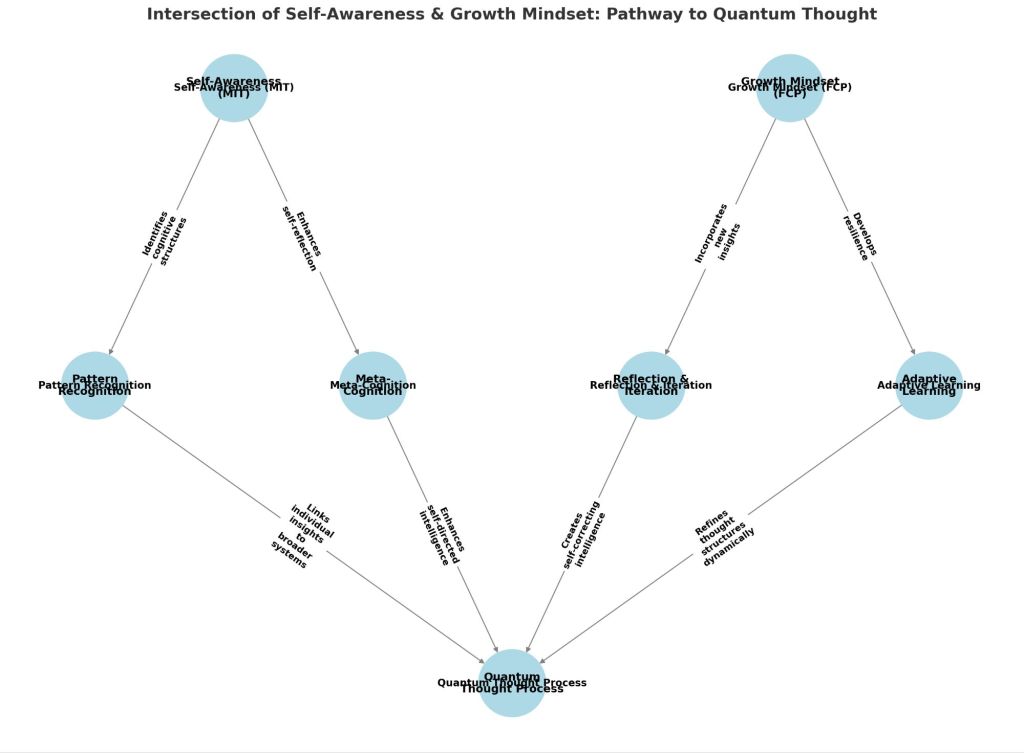
This visual map illustrates the intersection of self-awareness (MIT) and growth mindset (FCP) in forming quantum thought. The model highlights how recognizing patterns and biases (MIT) integrates with adaptive learning (FCP) to create a dynamic, self-correcting intelligence. Key cognitive processes such as reflection, iteration, meta-cognition, and pattern recognition feed into the development of fluid, quantum-like thinking, where thought is not rigid or binary but continuously evolving based on feedback and self-awareness.

By combining self-reflection with iterative learning, this model demonstrates how intelligence—whether in humans or AI—can become adaptive, flexible, and system-aware, shifting beyond traditional linear cognition into a more holistic, interconnected way of processing information

.Labels of Blue Balls (Nodes)

Self-Awareness (MIT) – Recognizing patterns & biases

Growth Mindset (FCP) – Adapting through learning

Pattern Recognition – Understanding systemic influences

Meta-Cognition – Thinking about one’s own thinking

Adaptive Learning – Adjusting based on feedback

Reflection & Iteration – Refining thoughts & actions

Quantum Thought Process – Fluid, dynamic, self-correcting intelligence


Labels of Intersecting Lines (Connections)

Self-Awareness (MIT) → Pattern Recognition – Identifies cognitive structures

Self-Awareness (MIT) → Meta-Cognition – Enhances self-reflection

Growth Mindset (FCP) → Adaptive Learning – Develops resilience

Growth Mindset (FCP) → Reflection & Iteration – Incorporates new insights

Pattern Recognition → Quantum Thought Process – Links individual insights to broader systems

Meta-Cognition → Quantum Thought Process – Enhances self-directed intelligence

Adaptive Learning → Quantum Thought Process – Refines thought structures dynamically

Reflection & Iteration → Quantum Thought Process – Creates self-correcting intelligence
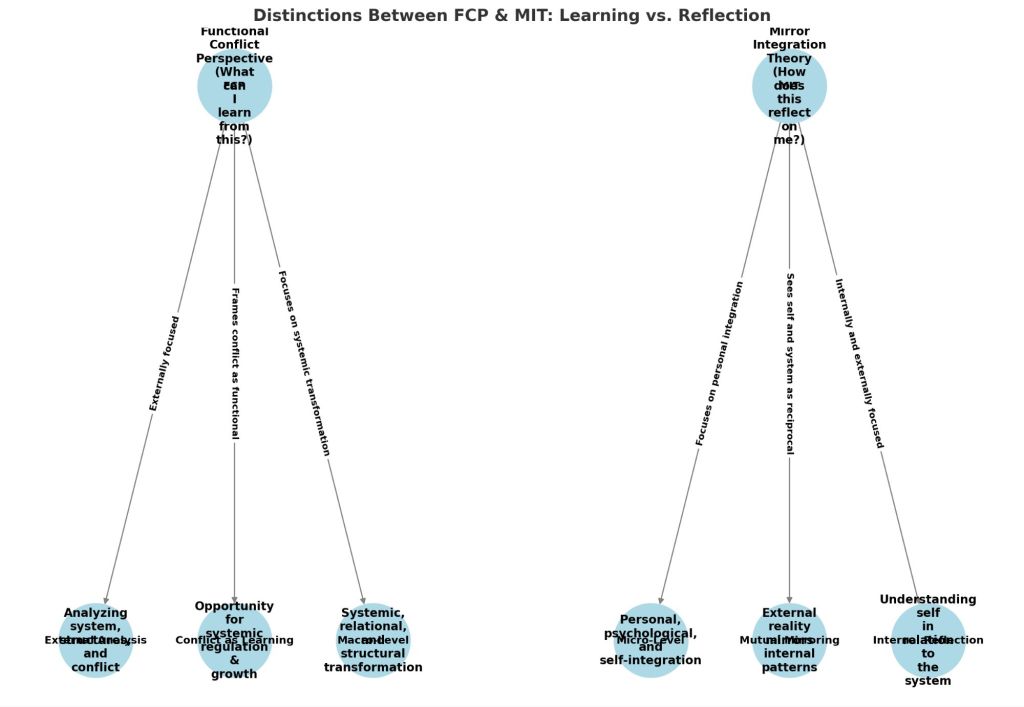
Labels in the Visual Representation of FCP & MIT

Top-Level Nodes (Main Concepts in Blue Balls)

1. Functional Conflict Perspective (FCP) – “What can I learn from this?”


2. Mirror Integration Theory (MIT) – “How does this reflect on me?”


FCP Branch Labels (Learning & External Focus)

3. External Analysis – “Analyzing system, structures, and conflict”

4. Conflict as Learning – “Opportunity for systemic regulation & growth”

5. Macro-Level – “Systemic, relational, and structural transformation”

MIT Branch Labels (Reflection & Internal Focus)

6. Internal Reflection – “Understanding self in relation to the system”

7. Mutual Mirroring – “External reality mirrors internal patterns”

8. Micro-Level – “Personal, psychological, and self-integration”


Labels for Connecting Lines (Relationships Between Nodes)

FCP → External Analysis – “Externally focused”

FCP → Conflict as Learning – “Frames conflict as functional”

FCP → Macro-Level – “Focuses on systemic transformation”

MIT → Internal Reflection – “Internally and externally focused”

MIT → Mutual Mirroring – “Sees self and system as reciprocal”

MIT → Micro-Level – “Focuses on personal integration”

This structure highlights how FCP and MIT function differently yet complement each other, bridging macro-level learning from conflict with micro-level self-reflection and personal integration.


1. FCP → “What can I learn from this?”

FCP views conflict as an opportunity for learning and systemic regulation rather than just dysfunction.

It asks, “What function is this conflict serving?” and “How can we work with it to promote healing and stability?”

It is externally focused, analyzing the system, social structures, and relational dynamics to extract useful insights for transformation.

2. MIT → “How does this reflect on me, and how am I a reflection of this?”

MIT operates on the principle of mutual mirroring—the idea that individual dysfunction mirrors societal dysfunction, and vice versa.

It asks, “What does this external situation reveal about my internal world?” and “How does my internal state contribute to this external reality?”

It is both internal and external, emphasizing personal integration as a means of affecting systemic change and recognizing systems as a projection of collective unconscious patterns.


Core Distinction: Learning vs. Reflection

FCP is about understanding external conflict functionally and finding ways to work with it productively.

MIT is about seeing oneself as part of the system and recognizing the reciprocal relationship between self and society.


They complement each other: FCP provides a macro-level systemic lens, while MIT brings in the micro-level personal and psychological integration needed for sustainable change.


Applying FCP & MIT to AI Design and Cognitive Training Programs

By integrating Functional Conflict Perspective (FCP) and Mirror Integration Theory (MIT) into AI development and cognitive training programs, we can create adaptive learning systems and self-aware reasoning models that enhance both problem-solving capabilities and reflective decision-making. Below, I outline specific applications in AI design and human cognitive training, with supporting research.

1. AI Design: Implementing FCP & MIT in Artificial Intelligence

A. FCP in AI: Iterative Learning & Adaptive Problem-Solving

FCP principles in AI align with reinforcement learning (RL) and error-based neural network adjustments, where AI iterates upon failures to improve performance.

Application: Deep Reinforcement Learning (DRL)

FCP-aligned AI learns through trial-and-error, adapting to environmental feedback.

Used in:

Self-learning AI (AlphaGo, OpenAI Five) → Learning through simulated competition.

Robotics (Boston Dynamics) → Iterative movement improvement.

Enhancement with FCP:

AI should not only learn from failure but analyze why a failure occurs.

Introducing “meta-learning” layers that encourage AI to self-reflect on performance trends.

B. MIT in AI: Self-Analysis & Logical Consistency

MIT principles in AI align with Explainable AI (XAI) and recursive self-monitoring algorithms that allow machines to reflect on their decision-making processes.

Application: AI Self-Diagnosis & Error Attribution

MIT-driven AI models analyze their own outputs for logical consistency.

Used in:

Autonomous Vehicles (Waymo, Tesla AI) → AI must evaluate its own decision-making under uncertainty.

Medical Diagnostics AI → Needs confidence assessment for false positives/negatives.

Enhancement with MIT:

AI should not only identify errors in its own reasoning but recognize patterns in why those errors occur.

Introduce self-referential auditing layers that allow AI to refine its interpretability, mirroring human metacognition.

C. The Intersection: AI with Both FCP & MIT

A next-gen AI system integrating FCP’s adaptive learning with MIT’s self-awareness would:

Iterate based on mistakes (FCP) while also reflecting on systemic biases (MIT).

Adjust its learning strategy in real time based on both external and internal feedback loops.

Develop self-awareness for logical fallacies, much like a human mathematician checks their own work.


Future Research Directions in AI

“Neurosymbolic AI” (Marcus & Davis, 2019): Blending deep learning (FCP-like trial and error) with symbolic logic (MIT-like self-reflection).

“Self-Supervised Learning” (LeCun, 2022): AI trains itself, needing self-reflective adjustments for optimization.

2. Human Cognitive Training: Enhancing Thinking Skills with FCP & MIT

A. Training Growth Mindset via FCP

To enhance quantitative thinking, humans should develop error-tolerant learning models—training themselves to view mistakes as valuable data rather than personal failures.

Practical Applications for Education & Workforce Training:

1. Mathematics & Data Science Learning

Teach students to embrace failure as iterative learning, mirroring how AI refines models.

Gamify trial-and-error experiences (e.g., Khan Academy’s mastery learning model).

2. Corporate Training Programs for Decision-Making

Shift executive training from outcome-based to process-based learning.

Example: “Failure analysis workshops” where employees review past mistakes for insights.

B. Training Metacognition via MIT

Metacognitive training focuses on logical self-reflection, reducing cognitive biases in quantitative reasoning.

Practical Applications for Cognitive Training:

1. Teaching Logical Consistency & Self-Reflection in AI Ethics

Encourage programmers to analyze their own biases in training AI models.

Example: “Bias reflection logs” where AI developers record potential cognitive distortions in training data.

2. Enhancing Problem-Solving in Scientific Fields

Encourage scientists & engineers to explicitly challenge their assumptions before concluding experiments.

Implement Bayesian Thinking Modules where trainees adjust their beliefs probabilistically based on new evidence.

C. The Intersection: Cognitive Training for High-Level Reasoning

A program integrating FCP’s adaptability and MIT’s self-awareness would:

Teach professionals how to both analyze errors logically (FCP) and check their own assumptions (MIT).

Develop decision-makers who are both data-driven and reflective, reducing overconfidence bias.

Use AI-assisted self-reflection tools to enhance problem-solving (e.g., AI-generated debate feedback to highlight logical inconsistencies).


Conclusion: Advancing AI & Human Thinking through FCP & MIT

FCP enhances iterative learning, making AI and humans more resilient, analytical, and adaptive.

MIT fosters self-awareness, enabling logical consistency, bias detection, and structured reflection.

The intersection of FCP & MIT results in quantitative reasoning that is both computationally precise and contextually aware.

Future Applications:

AI Ethics: AI must reflect on its biases (MIT) and iteratively correct errors (FCP).

Cognitive Science & Education: Humans should be trained to embrace failure as iterative learning (FCP) and critically analyze their reasoning (MIT).

Autonomous Systems & Governance: Future AI-driven decision-making must be both adaptable and self-aware, balancing FCP’s learning ability with MIT’s reflective logic.

By integrating growth mindset (FCP) with self-awareness (MIT), we can enhance AI intelligence, revolutionize human cognitive training, and create decision-making systems that are both rational and self-correcting.


Key References:

LeCun, Y. (2022). “Path towards autonomous machine intelligence.” OpenAI Research Seminar.

Marcus, G., & Davis, E. (2019). Rebooting AI: Building Artificial Intelligence We Can Trust. Pantheon Books.

Khan Academy (2021). “Mastery Learning and the Science of Learning.” Education Research Journal.

Tegmark, M. (2017). Life 3.0: Being Human in the Age of Artificial Intelligence. Knopf.

Brown, P. C., et al. (2014). Make It Stick: The Science of Successful Learning. Harvard University Press.


This table demonstrates how FCP (growth mindset) and MIT (self-awareness) work together to create quantum thought—a dynamic, self-correcting intelligence that integrates adaptive learning, logical consistency, and reflective processing in both AI and human cognition.

The Intersection of Mysticism, Functional Conflict Perspective (FCP), and Mirror Integration Theory (MIT)

The Intersection of Mysticism, Functional Conflict Perspective (FCP), and Mirror Integration Theory (MIT)

Author: Isha Sarah Snow
Date: March 2025


Abstract

Mysticism aligns with both Functional Conflict Perspective (FCP) and Mirror Integration Theory (MIT) by offering a non-dual, relational approach to conflict resolution, self-integration, and systemic transformation. Mystics perceive unity where society enforces division, making their insights deeply relevant to psychological healing, governance models, and social structures. By integrating insights from systems thinking, chaos theory, and quantum physics, this paper explores how mystical traditions parallel FCP’s trauma-informed governance model and MIT’s framework for internal and collective healing.

Table of Contents

1. Mysticism & Functional Conflict Perspective (FCP): A Trauma-Informed Social Lens

Conflict as a Process of Integration

The Role of Nonduality in Conflict Resolution

Mysticism as a Systemic Healing Model

2. Mysticism & Mirror Integration Theory (MIT): The Healing of Inner & Outer Fragmentation

Mysticism as Radical Self-Integration

The Mirror Effect: Individual & Collective Awakening

Nonduality as the Ultimate Mirror

3. The Practical Convergence: How Mysticism, FCP, and MIT Shape Social Change

Healing Governance Through a Mystical-FCP Lens

Indigenous Governance & Mysticism

Reintegrating Society: MIT as Mystical Reconciliation

4. Beyond the Illusion of Separation: The Mystical Endgame of MIT & FCP

5. Conclusion: A Mystical-Systems Synthesis

6. References


1. Mysticism & Functional Conflict Perspective (FCP): A Trauma-Informed Social Lens

Conflict as a Process of Integration

Traditional societies view conflict as something to be controlled or suppressed, often through hierarchical power, punitive discipline, and rigid institutions.

Mysticism, like FCP, recognizes conflict as a signal of underlying fragmentation rather than an inherently negative force. Instead of eliminating conflict, FCP reframes it as a process of integration, much like mystical traditions view spiritual struggle (ego death, the Dark Night of the Soul) as necessary for enlightenment (Capra, 1975).

The Role of Nonduality in Conflict Resolution

Mystics dissolve the binary thinking that fuels conflict:
✔ Self vs. Other
✔ Good vs. Evil
✔ Winner vs. Loser

FCP similarly deconstructs binaries in politics, economics, and psychology (e.g., punishment vs. rehabilitation, authority vs. autonomy) (Wilkinson & Pickett, 2009).

Both perspectives suggest that healing comes not from eradicating conflict but from integrating its opposites, much like quantum physics reveals that apparent contradictions exist in a unified field of reality (Capra, 1975).

Mysticism as a Systemic Healing Model

✔ FCP argues that governance should mirror emotional regulation—rather than enforcing control, it should facilitate self-regulation.

✔ Mystics, especially in non-Western traditions, propose fluid, decentralized social structures, which resemble FCP’s non-hierarchical conflict resolution strategies.

Example: Indigenous societies with animist-mystical worldviews tend to practice:

Restorative justice rather than punitive punishment.

Consensus-based governance, which FCP promotes as alternatives to hierarchical political systems (Faith and Praxis, 2024).


2. Mysticism & Mirror Integration Theory (MIT): The Healing of Inner & Outer Fragmentation

Mysticism as Radical Self-Integration

MIT proposes that societal dysfunction mirrors individual psychological fragmentation. Mysticism also emphasizes self-integration through direct spiritual experience, often symbolized as ego dissolution or enlightenment.

The mystical journey (e.g., Jung’s individuation, Zen satori, Kabbalistic ascension) parallels MIT’s framework for internal reconciliation of conflicting parts.

The Mirror Effect: Individual & Collective Awakening

✔ MIT suggests that as individuals heal their own fragmentation, they contribute to the healing of society.

✔ Mystics often withdraw from society to undergo deep internal work, later returning as agents of systemic transformation (e.g., Buddha, Jesus, Rumi) (Kokal, 2024).

The idea of personal healing mirroring collective healing aligns directly with MIT’s foundational principle.

Nonduality as the Ultimate Mirror

✔ Mystics teach that the self is an illusion, a construct of fragmented perception.

✔ MIT explores how fragmentation at both the personal and collective level creates dysfunctional social structures (Systems Thinking Marin, 2024).

✔ The final stage of MIT (self-cohesion & systemic repair) closely mirrors the mystical realization of unity beyond perceived separations.


3. The Practical Convergence: How Mysticism, FCP, and MIT Shape Social Change

Healing Governance Through a Mystical-FCP Lens

✔ Mystical insight + FCP → Trauma-informed, relationship-based governance instead of punishment-based control.

✔ Mystical insight + MIT → Recognizing how social and psychological fragmentation fuel each other.

Example: Indigenous Governance & Mysticism

✔ Many Indigenous cultures blend mysticism with non-hierarchical social structures, a model that aligns with FCP’s restorative, decentralizing vision.

✔ Mysticism teaches that true authority comes from inner wisdom, not imposed power—similar to FCP’s view of leadership as facilitation rather than domination (Consciously Inc., 2024).

Reintegrating Society: MIT as Mystical Reconciliation

✔ MIT’s approach to systemic healing resembles the mystical path:

1. Identify fragmentation → Recognizing how trauma divides both individuals and societies.


2. Embrace paradox → Moving beyond binaries (good/evil, order/chaos) into relational understanding.


3. Mirror healing outward → Just as mystics radiate transformation into the world, MIT suggests that personal healing naturally restructures societal systems.


4. Beyond the Illusion of Separation: The Mystical Endgame of MIT & FCP

✔ FCP and MIT challenge the false dichotomy between personal and political healing.

✔ Mysticism reinforces the principle of interconnectedness—the realization that healing at any level (self, relationship, governance) impacts the whole system.

✔ The ultimate goal of all three frameworks is to restore coherence to a fragmented world.


5. Conclusion: A Mystical-Systems Synthesis

✔ Mysticism, FCP, and MIT all propose that true transformation is not imposed externally—it emerges from within.

✔ Together, they form a comprehensive model for personal, societal, and global healing—one that recognizes conflict, trauma, and fragmentation as opportunities for deep transformation rather than forces to be suppressed.


6. References

Capra, F. (1975). The Tao of Physics: An Exploration of the Parallels Between Modern Physics and Eastern Mysticism. Shambhala.

Faith and Praxis. (2024). Mysticism, New Physics, and Peacebuilding.

Kokal, K. (2024). Mystical Regimes of Order: Ritualistic Practices and Conflict Resolution in Everyday Uttarakhand.

Consciously Inc. (2024). The Tao of Systems Thinking: Exploring the Parallels Between Eastern Mysticism and Systems Thinking.

Wilkinson, R., & Pickett, K. (2009). The Spirit Level: Why Greater Equality Makes Societies Stronger. Bloomsbury Press.

Systems Thinking Marin. (2024). Systems Thinking and Spirituality.


This integrates chaos theory, mysticism, and systems thinking into the FCP and MIT frameworks, offering a holistic, interdisciplinary approach to systemic transformation.

The Long-Term Impact of Punitive vs. Non-Punitive Discipline on Conflict Resolution Skills Across Societies

The Long-Term Impact of Punitive vs. Non-Punitive Discipline on Conflict Resolution Skills Across Societies

Author: Isha Sarah Snow
Date: March 2025

Abstract

This paper examines the long-term effects of punitive versus non-punitive childhood discipline on individual conflict resolution skills and societal governance. Drawing from empirical studies, neuroscience, and cross-cultural comparisons, we explore how childhood disciplinary models shape adult behavior and governance structures. Findings suggest that punitive socialization fosters reliance on external enforcement (e.g., policing, authoritarian governance), whereas non-punitive approaches promote intrinsic conflict resolution skills and decentralized social structures. The study proposes a Functional Conflict Perspective (FCP) framework for fostering self-regulating societies through early childhood interventions.

Table of Contents

1. Introduction: Developmental Roots of Conflict Resolution

2. Punitive Socialization and Its Long-Term Consequences

3. Neuroscience of Conflict Processing: Polyvagal and Attachment Theory

4. Cross-Cultural Comparisons: High vs. Low Punitive Societies

5. Punitive Childhoods and Authoritarian Governance

6. FCP as a Model for Systemic Reform

7. Conclusion: Toward a Self-Regulating Society

8. References


I. Introduction: Developmental Roots of Conflict Resolution

Conflict resolution is central to personal relationships, governance, and international diplomacy. However, the way individuals develop these skills is not inherent but shaped by early socialization, parenting practices, and systemic influences.
Historically, societies have relied on punitive discipline, hierarchical authority, and coercive enforcement to instill behavioral norms. This model assumes that conflict must be controlled externally rather than integrated as a natural, adaptive process.

The Problem: Punitive Socialization and Its Long-Term Consequences

Emerging research from neuroscience, attachment theory, and polyvagal theory suggests that punitive, authority-based models of socialization create neurological patterns that predispose individuals to hierarchical and coercion-based thinking.

✔ Impairment of Intrinsic Conflict Resolution Skills → Children learn to fear authority rather than negotiate solutions.
✔ Dependence on External Enforcement → Individuals rely on punitive systems (police, courts, authoritarian leaders) rather than self-regulation.
✔ Reinforcement of Trauma-Based Conflict Responses → Suppressing emotions leads to avoidance, aggression, or submission.
✔ Scaling into Societal Structures → Nations mirror punitive logic, reinforcing coercive governance and criminal justice dependency.

For example, research shows that children from punitive environments tend to exhibit higher aggression, externalizing behaviors, and later criminality (Gershoff & Grogan-Kaylor, 2016). On a macro scale, societies that emphasize strict legal enforcement over community-based resolution have higher incarceration rates and weaker social cohesion (Alexander, 2012).


II. Punitive Socialization and Its Long-Term Consequences

Historical Foundations of Punitive Socialization

Punitive discipline has been the dominant child-rearing approach across history, reinforced by religious, economic, and political structures:

✔ Religious Influence → Many societies justified strict discipline through religious texts, equating suffering with moral development (Dobson, 1970).
✔ Industrialization & Economic Control → The factory school model emphasized obedience and external rewards/punishments, discouraging critical thinking (Gatto, 1992).
✔ Colonialism & State Power → Punitive discipline scaled to entire populations through colonial rule and policing, normalizing coercion as a primary tool of governance (Fanon, 1961).

The Cartesian Legacy: Mind-Body Dualism and Punitive Discipline

Western punitive socialization is deeply influenced by Cartesian dualism, which separates mind from body, individual from collective, and emotion from reason.

✔ Mind vs. Body → Punishment as Behavioral Control → Corporal punishment and emotional suppression reinforce control over integration.
✔ Self vs. Other → Conflict as a Zero-Sum Battle → Adversarial thinking frames disagreement as a contest to be won.
✔ Rationality vs. Emotion → Suppression of Emotional Intelligence → Emotional responses are suppressed rather than processed, impairing relational skills.

This philosophical legacy continues in zero-tolerance school policies, law-and-order governance, and punitive criminal justice systems.


III. Neuroscience of Conflict Processing: Polyvagal and Attachment Theory

The Biological Consequences of Punitive Socialization

Early experiences shape neural pathways for conflict resolution, affecting whether individuals self-regulate or require external enforcement.

✔ Chronic Dysregulation → Punitive discipline over-activates the fight-flight-freeze response, leading to aggression (fight) or passivity (freeze) in conflict situations.
✔ Attachment Impairment → Punitive environments contribute to insecure or disorganized attachment, making individuals less trusting and more prone to conflict avoidance or escalation.
✔ Externalized Conflict Processing → Adults raised in punitive households rely on laws, authority figures, and punitive structures rather than relational conflict resolution.

Polyvagal Theory: Why Punitive Systems Create Enforcement-Dependent Adults

Dr. Stephen Porges’ Polyvagal Theory explains how autonomic nervous system (ANS) regulation affects conflict resolution.

✔ Children raised in punitive households show higher rates of fight-or-flight dominance, leading to aggressive or combative conflict responses (Porges, 2011).
✔ Unresolved early trauma correlates with higher political authoritarianism and reliance on hierarchical control (Van der Kolk, 2014).
✔ Punitive societies tend to have higher militarization, incarceration rates, and political polarization (Felitti et al., 1998).

Attachment Theory and the Political Consequences of Childhood Socialization


Secure attachment fosters adaptive social engagement, while insecure attachment correlates with enforcement-based conflict responses.

✔ High Insecure Attachment Societies → More authoritarian governance, rigid hierarchies, and punitive policies (Wilkinson & Pickett, 2009).
✔ High Secure Attachment Societies → Greater social trust, lower crime, and decentralized governance (Pinker, 2011).

Thus, governance models are a direct reflection of childhood socialization practices.


IV. Cross-Cultural Comparisons: High vs. Low Punitive Societies

✔ Nordic countries (banning corporal punishment) rank highest in social trust, lowest in crime, and least reliant on police enforcement (Pinker, 2011).
✔ The Aka people of Central Africa raise children non-punitively, and their adults naturally self-regulate without external enforcement (Hewlett, 2014).

These findings challenge the assumption that enforcement is necessary for social stability and highlight the connection between childhood socialization and governance models.


V. Punitive Childhoods and Authoritarian Governance

✔ Children raised in punitive environments internalize coercion-based power structures, making them more likely to support authoritarian governance (Altemeyer, 1996).
✔ Cartesian dualism in governance → The state is framed as the “rational mind” controlling the “irrational body” of the population, reinforcing punitive enforcement.
✔ Self-Regulating Societies Exist → Cultures with low punitive socialization thrive without heavy policing or hierarchical control.


VI. FCP as a Model for Systemic Reform

✔ Punitive discipline is not necessary for social stability.
✔ Governance should reflect secure attachment and self-regulation, not enforcement.
✔ FCP prioritizes self-regulation, emotional intelligence, and non-hierarchical conflict resolution.

By replacing punitive childhood socialization with FCP-based early development, societies can self-regulate without external enforcement.


VII. Conclusion: Toward a Self-Regulating Society

✔ The nervous system is the foundation of governance—if individuals regulate internally, enforcement structures become unnecessary.
✔ Punitive childhood environments create enforcement-dependent populations, reinforcing authoritarianism.
✔ FCP-based childhood interventions can replace punitive governance with self-regulating social structures.

Revolution is developmental, not political.

By shifting how children are socialized, we can dismantle coercive governance structures at their root and build a future of self-regulating societies.


VIII. References

Alexander, M. (2012). The New Jim Crow: Mass Incarceration in the Age of Colorblindness. The New Press.

Altemeyer, B. (1996). The Authoritarian Specter. Harvard University Press.

Dobson, J. (1970). Dare to Discipline. Tyndale House.

Fanon, F. (1961). The Wretched of the Earth. Grove Press.

Felitti, V. J., et al. (1998). “Relationship of Childhood Abuse and Household Dysfunction to Many of the Leading Causes of Death in Adults.” American Journal of Preventive Medicine, 14(4), 245-258.

Gatto, J. T. (1992). Dumbing Us Down: The Hidden Curriculum of Compulsory Schooling. New Society Publishers.

Gershoff, E. T., & Grogan-Kaylor, A. (2016). “Spanking and Child Outcomes: Old Controversies and New Meta-Analyses.” Journal of Family Psychology, 30(4), 453-469.

Hewlett, B. S. (2014). Hunter-Gatherer Childhoods: Evolutionary, Developmental, and Cultural Perspectives. Aldine Transaction.

Pinker, S. (2011). The Better Angels of Our Nature: Why Violence Has Declined. Viking.

Porges, S. (2011). The Polyvagal Theory: Neurophysiological Foundations of Emotions, Attachment, Communication, and Self-Regulation. Norton.

Wilkinson, R., & Pickett, K. (2009). The Spirit Level: Why Greater Equality Makes Societies Stronger. Bloomsbury Press.

Beyond Two: Understanding The Whole

These are children’s stories that explain duality in a simple and engaging way, showing how opposites are connected, and how unity emerges when we see beyond division:


The Day and Night That Argued

The Sun and the Moon had always shared the sky, but they had never met.

One day, the Sun heard the Moon whisper, “Without me, the world would never rest.”

The Sun frowned. “Without me, the world would never wake!”

The Moon sighed. “People need the night. I bring dreams, I bring quiet, I bring the stars.”

The Sun huffed. “People need the day! I bring warmth, I bring light, I bring life!”

And so, they argued, each believing they were more important than the other.

Until one day, something strange happened.

For a brief moment, they saw each other.

The Moon stood in the Sun’s light. A perfect balance. A twilight sky. A moment where neither ruled alone.

The people below gasped. “Look! It’s an eclipse!”

And for the first time, the Sun and Moon understood:

They were never meant to fight. They were two halves of the same whole.

And from that day on, when the sky turned pink and gold, they whispered to each other:

“See you at the horizon.”


The Two Hands That Didn’t Know They Belonged Together

Left Hand and Right Hand had always been together, but they had never met.

One day, Left Hand said, “I do all the important work! I hold the spoon, I draw the pictures, I turn the pages!”

Right Hand laughed. “That’s silly! I do all the important work! I write the letters, I throw the ball, I open the door!”

And so, they argued.

Until one day, the child they belonged to reached out with both hands—and held something heavy.

Left and Right Hand worked together. And for the first time, they realized… they were one.

And from then on, when the child reached out, they whispered to each other:

“Together, we can carry anything.”


The River and the Wave

A little wave danced on the ocean’s surface. “I am the fastest, the biggest, the best wave in the sea!”

The River, flowing beside it, laughed. “Little wave, you are not separate from the ocean. You are the ocean.”

The wave frowned. “No, I am different! I have my own shape, my own movement, my own splash!”

The River smiled. “Then where do you go when you crash?”

The wave thought for a moment. “I… I return to the water.”

“And where did you come from?”

“From the water…”

The wave’s eyes widened. “Then… I was never just a wave?”

“No,” the River said gently. “You were always the ocean pretending to be a wave.”

And with that, the wave laughed, curling back into the sea.


The Shadow and the Light

A little girl was scared of the dark.

“Mommy, the shadows are chasing me!”

Her mother smiled. “Come, I’ll show you a secret.”

She took a candle and held it in front of the wall.

“Look at your shadow,” she said. “See how it moves when you move? It isn’t chasing you. It is following you.”

The little girl watched as the shadow stretched and shrank.

“But why does it disappear when I turn on the big light?”

Her mother knelt beside her.

“Because shadows don’t exist on their own. They are only where light cannot reach.”

The little girl thought for a moment. “So… shadows aren’t bad? They are just places where the light hasn’t arrived yet?”

“Exactly.”

And from that night on, whenever she saw a shadow, she whispered:

“One day, the light will find you too.


The Two Seeds That Grew Together

Two seeds were planted side by side.

The first seed grew tall, fast, reaching for the sun.

The second seed grew deep, strong, sinking into the soil.

The first seed laughed. “Look at me! I am growing so quickly! I will touch the sky first!”

The second seed smiled. “But look at me! I am growing strong. The wind will not move me.”

And so, they grew in opposite directions, each believing their way was best.

Until one day, a great storm came.

The first seed, tall and proud, began to bend. The wind pushed harder, and the little tree nearly fell—until it felt something holding it steady.

It looked down.

Its roots—its deepest part—were strong because of the second seed’s wisdom.

The second seed, buried deep, never saw the storm coming. But because of the first seed’s height, it had learned when to prepare.

And so, when the storm passed, they whispered to each other:

“Up and down are not opposites. They are how we stand.”


The Lesson of Duality

Every story tells the same truth:

Day and night are not enemies—they complete each other.

Left and right are not separate—they belong to the same body.

A wave is not different from the ocean—it is the ocean.

Shadows are not things to fear—they are just places where light has not yet reached.

Strength is not just high or deep—it is both.


Duality is not about conflict. It is about balance.

We spend our lives thinking we must choose—light or dark, strong or soft, high or low, self or other.

But in the end, we discover the truth:

There was never two. There was always One.

The Pattern That Repeats

These are stories for grown ups in the style of children’s stories that explain our fractal Universe and how history keeps repeating itself as humans make the same mistakes in a simple and engaging way, showing how patterns can be interrupted once they are observed:


The Tower That Always Falls (The Tower of Babel & Empire Cycles)

Long ago, people built a tower to reach the heavens. They worked together, brick by brick, certain that this time, they would finish it.

But as the tower grew taller, something strange happened. The workers stopped understanding each other. They spoke the same words, but their meanings had changed.

Some wanted to build higher. Others wanted to tear it down. The people turned on each other.

And so, the tower collapsed.

Years passed. A new kingdom rose. A new tower was built.

Rome. Byzantium. The Ottomans. The British. America.

Each time, they climbed higher. Each time, they believed they had solved the mistakes of the past.

Each time, they reached the same point—and fell.

Because they never realized: The problem was never the tower. The problem was thinking they could rise forever.


The Hero That Was Always the Same (Joseph Campbell’s Monomyth & The Repeating Mythological Archetype)

A boy lived in a quiet village. One day, a great challenge arrived—a monster, a war, a prophecy.

He left his home.
He struggled.
He found a teacher.
He faced his greatest fear.
And in the end, he returned home, forever changed.

The villagers told his story for years. They thought it was unique.

But across the ocean, another village had the same story.
And across the mountains, another.
And in another time, another land, another name—the same hero rose, fell, and returned.

Achilles. Beowulf. King Arthur. Frodo. Neo.

The people asked, “Why do all stories sound the same?”

Because they are the same.

We only give them new names, over and over—forgetting that we have already heard them before.


The Clock That Struck the Same Hour (The Rise and Fall of Civilization & Natural Cycles)

A scholar built a great clock to track the rise and fall of nations.

He set it to mark the birth of new empires, the peak of their power, the moment they turned on themselves, and the hour they fell.

At first, the clock seemed to move forward.

Then, he noticed something strange.

Each time the hand reached the top—it always swung back down.

Egypt. Greece. Rome. China. The Maya. The Mongols. The U.S.

Different names, different places, but the same pattern:

A people struggle.

They rise.

They become powerful.

They become complacent.

They fall.


And yet, each new nation looked at the fallen ones before them and said:

“That won’t happen to us.”

The scholar sighed.

“The hour will come again.”

But no one listened.


The Language That Was Lost (How Power Controls Knowledge & the Loss of Meaning Over Time)

Once, there was a word that held great power. When people spoke it, they understood each other.

They built their cities with it. They passed down their knowledge.

But as time went on, the rulers changed its meaning.

They told people:
“The word means something else now.”
“It is dangerous to speak it in the old way.”
“Trust us—we will tell you what it means.”

And so, the word became hollow. It no longer meant what it once did.

But the people didn’t realize it.

They still spoke it, still believed in it—never noticing that it had been rewritten.

And so, the rulers laughed.

Because when you change a word, you change history.


The War That Kept Happening (The Endless Cycle of War & Justifying Violence)

There was a war.

The leaders said, “We must fight to defend our people.”
The enemy said the same.

The war ended. The land was divided. But years later, another war came.

The leaders said, “We must fight to defend our people.”
The enemy said the same.

The war ended. The land was divided. But years later… another war came.

And each time, the leaders pointed to history and said, “Look! We have always fought. This is how the world works.”

And so, the people believed them.

Until one day, a child asked, “If we keep fighting to stop war, why does war never stop?”

But no one could answer.

Because the war had become the story. And as long as people believed it was the only story, it would never end.


The Man Who Tried to Stop the Pattern (The Illusion of Progress & Forgetting the Past)

A man spent his life studying history, looking for the moment when things changed.

He searched for the war that ended all wars.
The revolution that fixed corruption.
The civilization that never collapsed.

But he never found them.

Every “new” idea was just an old one with a different name.

Every empire that “solved” the past became the next to repeat it.

One day, a young student asked him, “So what do we do? Are we doomed to repeat history forever?”

The man thought for a long time.

“No,” he finally said. “We are only doomed to repeat what we forget.”

“Then how do we change it?” the student asked.

The man smiled.

“We remember.”


The River That Becomes the Ocean

Once, there were many rivers. Each one flowed from a different mountain, through different lands, with different names. The people who lived beside each river believed theirs was the true water, the pure path.

One river was called Dharma.
One was called Tao.
One was called Logos.
One was called the Word.

The people of each river said, “Ours is the path to truth.”

For centuries, they built temples and sang songs about their waters. Some said the river was a gift from heaven. Others said it came from deep within the earth. Some said only the worthy could drink from it. Others said it was meant for all.

The rivers flowed for thousands of years, their people never meeting, never knowing the others existed—until one day, a traveler walked far enough to see something no one had ever noticed.

He followed one river down the valley and found another. Then another. Then another.

At first, he was confused. They all looked different—some fast, some slow, some clear, some muddy. But as he kept walking, he realized something astonishing.

The rivers were merging.

Where they met, their waters blended into one. Their differences vanished.

And far ahead, on the horizon, was the great ocean.

The traveler gasped.

“It was never about the river. It was always about where the water was going.”

He ran back to tell the others, but when he spoke, they shook their heads.

“That cannot be true. Our river is the true path.”

“We have always been separate. We cannot be the same.”

“Our water is different from theirs.”

But the traveler smiled.

“Yes,” he said. “Your river is different. But have you ever followed it far enough to see where it leads?”

Some listened. Some did not. Some walked to the ocean and saw it for themselves. Others stayed behind, still arguing about whose river was right.

But the ocean did not care. It had always been waiting.

And in the end, all water returns to the sea.

What This Story Means

Every religion is a river flowing toward the same ocean.

Hinduism speaks of Atman merging with Brahman.

Buddhism teaches the dissolution of the self into Nirvana.

Taoism says the Tao is beyond words, beyond duality.

Christianity speaks of the Word becoming flesh, the many becoming One in Christ.

Islam describes the surrender to the oneness of God.

Kabbalah teaches Ein Sof, the infinite source beyond all names.

Sufi poets sing of the drop dissolving into the Divine Sea.


At the surface, they seem different. They have different symbols, languages, rituals. But if you follow them far enough—if you go beyond form, beyond words, beyond separation—you find the same truth:

All divisions are illusions. There is only One.

And just like the rivers, we can spend eternity arguing about which path is right—or we can walk far enough to see where they all lead.


What These Stories Teach Us

The Tower of Babel is the fall of every empire that forgets itself.

The Hero’s Journey repeats because it is the same story told with different names.

Civilization rises and falls in a clockwork cycle, and every great power believes they are the exception.

Language is rewritten to control knowledge, and people forget what words originally meant.

War justifies itself through history, trapping people in an endless loop of violence.

Progress is an illusion if we do not remember what came before.


History is not a straight line.

It is a circle, a spiral, a fractal.

And the only way to break the loop is to see it for what it is.

The Pattern That Repeats

History is not a straight line—it is a spiral, a fractal, a loop. Whether we look at the rise and fall of civilizations, the endless repetition of war, or the way myths across cultures tell the same story with different names, we see the same structure appearing over and over again.

The Tower of Babel isn’t just a biblical story—it’s a blueprint for the fate of every empire that believes it can rise forever. Rome, Byzantium, the Ottomans, the British, and now America—all followed the same trajectory: struggle, dominance, complacency, and collapse. Each time, people believed they were different. Each time, they weren’t.

Joseph Campbell’s Hero’s Journey tells us that every great story follows a single pattern—whether it’s a Greek hero, a medieval knight, or a sci-fi protagonist. The same narrative repeats because it reflects the way humans experience transformation. We leave what we know, face challenges, and return changed. But just as all individuals go through this cycle, so do societies. Revolutions promise change, leaders claim to rewrite history, but in the end, the same story plays out with new actors.

Language itself is a repeating pattern. Words that once held meaning are rewritten by those in power. Yesterday’s “freedom” does not mean what today’s “freedom” does. Orwell warned of this, and history proves him right. The people speak the same words, but the meaning shifts beneath them, slowly erasing the past while making them think they remember it.

War is perhaps the greatest cycle of all. Each generation fights for peace. Each generation believes it is different. But if war could truly end war, why has it never worked? The pattern remains the same because the script is never questioned—it is only acted out.

And yet, despite all of this, we keep believing we are new. We keep believing the cycle is broken, even as we repeat it. Why? Because forgetting is part of the pattern.

How This Connects to Mirror Integration Theory (MIT) & Functional Conflict Perspective (FCP)

Mirror Integration Theory (MIT) tells us that the individual and the collective reflect each other. Just as a person repeats their emotional patterns until they recognize them, societies repeat their histories until they confront the cycle. The wars we fight outside mirror the wars inside us. The rise and fall of nations mimic the rise and fall of our own habits, fears, and unexamined wounds.

Functional Conflict Perspective (FCP) takes this further—it shows that conflict is not the problem. How we handle it is. War is not inevitable, but we treat it as if it is because we have never truly processed the trauma of the past. Empires do not have to collapse, but they do when they refuse to adapt. Words do not have to lose their meaning, but they do when language is used for control rather than understanding.

The only way to break the cycle is to see it. Once we recognize that history is not repeating by accident but by design, we have a choice: continue playing the same roles or change the script entirely.

The cycle doesn’t stop on its own. But the moment we remember it, we are no longer trapped inside it.

Our Fractal, Repeating Universe

These are children’s stories that explain our fractal Universe and how history keeps repeating itself as humans make the same mistakes in a simple and engaging way, showing how patterns can be interrupted once they are observed:

The Never-Ending Tree

Leo loved climbing trees. His favorite was the Big Oak in his backyard. One day, as he climbed higher, he noticed something strange—the branches above looked just like the ones below.

“Mom!” he called. “Why does this tree keep looking the same, no matter where I climb?”

His mom smiled. “That’s because trees grow in patterns called ‘fractals.’ The little branches copy the big ones, just like your fingers look like little arms.”

Leo’s eyes widened. “Wait! Does that mean… if I had a tiny, tiny tree, it would still look like this big one?”

“Exactly,” his mom said. “And if you zoomed way out and looked at a whole forest, it would look like a bigger version of your tree!”

Leo climbed down, staring at the tree with a new thought. “If everything repeats like this… why don’t we notice it?”

His mom knelt beside him. “Well, imagine if every time you climbed the tree, you forgot what the last climb looked like. You’d think it was brand new, even though it’s the same pattern again.”

Leo blinked. “Wait… what if life is like that? What if we keep climbing the same trees over and over, but we forget?”

His mom just smiled.


The Magic Mirror Game

Mia and her little brother Finn played a game in the bathroom—The Mirror Game.

“If I stand here, I can see you in the mirror, and you can see me. But wait—if I hold up a mirror behind us… WHOA!” Mia gasped.

The mirror behind them reflected the front mirror, and suddenly there were endless Mias and Finns!

“It’s like a never-ending hallway!” Finn shouted.

Their dad chuckled. “That’s called an ‘infinity mirror.’ The reflections go on forever because they keep bouncing back and forth.”

Mia’s eyes widened. “So… are we in the mirror too? Or is it just copies of us?”

“Well,” Dad said, “what if the whole world is like a giant mirror? What if we are patterns reflecting back and forth, just like that?”

Finn frowned. “But if this has been happening forever, why don’t we remember seeing it before?”

Their dad winked. “Because mirrors don’t show you what’s behind you. Every time you step into a new reflection, it feels like the first time—even though it’s not.”

Mia shivered with excitement. Maybe life was like a mirror, showing us the same things over and over—but always making us think it was new.


The Video Game That Played Itself

Jaden loved video games. One day, he asked his mom, “What if we’re actually inside a giant video game?”

His mom raised an eyebrow. “What makes you think that?”

Jaden tapped his controller. “Well, in my game, the trees and rocks are just copies of each other. The clouds are too. It’s like the game reuses patterns to save energy.”

His mom nodded. “That’s called a ‘procedural world.’ It means the game creates things using a set of rules, instead of making each one from scratch.”

Jaden blinked. “Wait… what if real life is like that? What if the universe has rules that make everything repeat, like in my game?”

His mom smiled. “Some scientists think that might be true. Maybe the universe is like a giant program, using patterns to build itself over and over.”

Jaden sat back, staring at the sky. “But if it’s a game, how come we don’t remember playing it before?”

His mom looked at him thoughtfully. “What happens when you start a new level in your game?”

“I… forget the last level until I play it again.” Jaden’s eyes widened.

His mom nodded. “Maybe that’s what happens to us too. Maybe we keep playing the same game over and over, but we forget every time we start.”

Jaden shivered. Maybe reality wasn’t just a game—it was a loop.


The Puzzle That Built Itself

Sophie loved puzzles. One day, she opened a new one and gasped.

“Mom! The big picture is made of smaller pictures that look the same!”

Her mom smiled. “That’s called a ‘fractal puzzle.’ The same shapes repeat inside the bigger ones.”

Sophie tilted her head. “So if I had a microscope, would I just keep finding smaller and smaller copies forever?”

“Maybe!” her mom said. “That’s how some things in nature work—like snowflakes, seashells, and even your lungs!”

Sophie looked at the puzzle again. Maybe the whole universe was a giant picture made of tiny repeating pieces.

But then a thought hit her. “Wait… if the puzzle keeps repeating, why does it feel like I’ve never seen it before?”

Her mom chuckled. “Imagine if every time you put a puzzle together, the moment you finished, you forgot what it looked like. Wouldn’t it feel like a brand-new puzzle every time?”

Sophie shivered. “That means we could have done this before and never even know it!”

Her mom winked. “Exactly.”


The Secret Code of the Universe

Elijah loved patterns. He noticed them everywhere—in flowers, in spiderwebs, even in the way his curly hair looped around itself.

“Mom, why does everything have a pattern?” he asked.

His mom smiled. “Because patterns are how the universe builds itself! Imagine if you had a magic stamp that copied the same design over and over. That’s what nature does!”

Elijah’s eyes lit up. “So if I zoomed out of the whole universe, would it look like a giant pattern too?”

“That’s what some scientists believe,” his mom said. “It’s like a code, repeating itself everywhere, from tiny atoms to huge galaxies.”

Elijah grinned. “So, does that mean we’re inside the pattern too?”

His mom nodded. “Yep. And if the pattern repeats, maybe we’ve lived this moment before.”

Elijah’s smile faded. “Then… why don’t I remember?”

His mom thought for a moment. “Maybe the pattern is designed to forget. If you remembered everything, you wouldn’t feel like you were learning. The code resets, just like a story starting over.”

Elijah sat back, staring at the sky. Maybe he wasn’t just looking at the world—maybe he was reading the universe’s secret code, written over and over again.

Embracing Conflict as Opportunities for Growth

These are children’s stories that explain how repeating  patterns of conflict can be interrupted and resolved, to be integrated as wisdom and used as opportunities for growth after they are observed and redirected using the FCP method:

The Puzzle Piece Problem

Liam sat at the kitchen table, frowning at his puzzle. Pieces were scattered everywhere, and no matter how hard he tried, they just wouldn’t fit together.

“Ugh! This puzzle is broken!” he huffed, crossing his arms.

His mom, who was making tea, glanced over. “What’s wrong, buddy?”

“These pieces are all wrong!” Liam grumbled. “I keep trying to make them fit, but they won’t go where I want them to!”

His mom smiled and sat down beside him. She picked up two pieces and tried forcing them together. They didn’t fit.

“You’re right,” she said. “These don’t go together.”

“See? That’s what I mean!” Liam said.

But instead of giving up, his mom tried something different. She turned the pieces, looking for new ways they might connect. Then, slowly, she found a match.

“Hmm,” she mused. “Maybe the problem isn’t the pieces… maybe it’s how we’re looking at them.”

Liam blinked. He hadn’t thought of that.

He picked up another piece, turned it a different way, and—click!—it fit!

His mom ruffled his hair. “Sometimes, when something isn’t working, that’s a signal. It tells us to take a step back and take a breath before we try again, because it’s not about pushing harder. It’s about seeing things from another angle. And if we can’t see it any other way, that’s also usually a signal – one to ask for help, and get a second look at the problem using another person’s added perspective.”

Liam sat up straighter, suddenly excited. He grabbed another piece and turned it. Then another. The puzzle was coming together!

As they worked, his mom chuckled. “You know, grown-ups have puzzles too.”

“Really?” Liam asked.

“Yep! Sometimes, we get stuck in arguments or problems because we only see things one way. But if we stop, take a breath, and turn things around, we might find a way to fit together.”

Liam thought about that as he placed the final piece. The puzzle was complete.

“Hey, Mom?” he said. “Next time something doesn’t fit, I’ll try looking at it a different way.”

His mom grinned. “That’s the smartest thing I’ve heard all day.”

And with that, Liam picked up another puzzle—ready to see it in a whole new way.

Moral of the Story:
Conflict, like puzzles, isn’t always about forcing pieces together—sometimes, the answer is changing how we see them.


Sometimes, people see the world as two teams pulling in opposite directions. But what if working together was the secret to moving forward?

The Tug-of-War That Never Ended

In the town of Harmony Hill, there was a never-ending game of tug-of-war. On one side, the Pushers pulled with all their might, saying,
“We must move forward, make new rules, and change everything!”

On the other side, the Pullers tugged just as hard, shouting,
“No! We must hold onto the old ways and keep things steady!”

They pulled and pulled, each side determined to win. But no matter how hard they tried, no one ever budged an inch.

One day, a little girl named Mina wandered onto the field. She watched the Pushers and Pullers struggle and asked,
“What are you trying to do?”

“We’re trying to make the world better!” both sides said at once.

Mina tilted her head. “Then why aren’t you moving?”

The teams looked at each other. They had never stopped to think about it!

Mina picked up the rope and walked sideways. The Pushers and Pullers, still holding on, began moving together—side by side.

For the first time, they saw the field from a different angle. They weren’t stuck anymore.

They weren’t winning or losing.

They were moving.

And that’s how Harmony Hill learned that sometimes, instead of pulling against each other, the best way forward is to move together.

Moral: “Sometimes, moving forward isn’t about choosing a side—it’s about finding a new way together.”

Why We Keep Arguing (and Why It’s Actually a Good Thing)

Have you ever played tug-of-war? Two teams pull on a rope, trying to drag the other team over the line. It looks like a battle—like only one side can win. But what if I told you that the struggle itself is what keeps everything balanced?

That’s what Functional Conflict Perspective (FCP) is all about. It’s a way of understanding the world that says conflict isn’t the problem—it’s how we grow, learn, and make things better.

The Mistake Most People Make

A long time ago, a man named René Descartes (fancy name, right?) decided that everything in the world was split into two parts:

Mind vs. Body

Good vs. Bad

Me vs. You

This way of thinking is called Cartesian Dualism (but let’s just call it the “two-box problem”). The idea is that every question has one right answer and one wrong answer—like a math test.

But here’s the thing: the world isn’t a math test. It’s more like a tree.

How a Tree Teaches Us About Conflict

Think about how a tree grows:

Its roots push down into the soil, grabbing nutrients.

Its branches reach up to the sky, stretching toward the sun.

Roots and branches seem like opposites—one goes down, the other goes up. But guess what? They’re part of the same tree! They work together to keep the tree alive.

That’s how conflict works in the world.

Instead of thinking “this side is right and that side is wrong,” FCP teaches us to ask:

What if both sides need each other?

What if the struggle is part of making things stronger?

What if instead of trying to win, we learned how to balance?

The Dance of Conflict

Imagine you and a friend are trying to carry a couch up the stairs.

If you both push at the same time, you’ll smash into the wall.

If you both pull at the same time, you’ll drop the couch.

But if you talk and adjust, you can carry the couch together.

That’s Functional Conflict Perspective in action!

Conflict isn’t a battle to be won—it’s a dance. When we stop seeing things as “us vs. them” and start looking for how we fit together, we can solve problems in a way that helps everyone.

So, What’s the Big Idea?

1. Conflict isn’t bad—it’s how things grow.

2. Life isn’t about picking sides—it’s about learning how different sides work together.

3. The goal isn’t to “win” arguments—it’s to understand how things fit into a bigger picture.

So next time someone disagrees with you, don’t see them as the enemy—see them as part of the puzzle. Because when we stop pulling against each other and start figuring out how we connect, we all move forward together.


The Song with Only One Note

Leo loved music. He played his flute every morning, filling the air with beautiful melodies. But his friend Max? Max had a problem.

Max was learning to play the piano, but he only used one key.
Plink. Plink. Plink.

“Why won’t you play more notes?” Leo asked.

“Because this is the right note!” Max insisted. “All the others sound wrong!”

Leo thought for a moment. Then he picked up his flute and played a different note. Max winced.

“See? That doesn’t match!”

“Not yet,” Leo said with a smile.

Then he played again—this time, adding a second note. Something magical happened. The two sounds didn’t clash. They blended.

Max’s eyes widened.

“That sounded… amazing!”

Leo nodded. “Music isn’t about one perfect note. It’s about how notes work together—even the ones that don’t seem to fit at first.”

Max took a deep breath, stretched his fingers, and tried a new key. Then another. Then another.

And soon, he wasn’t just playing a note.

He was playing a song.

Moral: “Life isn’t about one perfect answer—it’s about how things fit together.”

Why Arguments Are Like Music (and Why We Need Both High and Low Notes)

Imagine you’re listening to your favorite song. It has high notes that soar and low notes that rumble. If the whole song was just one note—only high or only low—it would be boring or even painful to listen to.

Music works because different notes push and pull against each other. They create tension, release, harmony, and rhythm.

That’s exactly how Functional Conflict Perspective (FCP) works in the real world.

Why People Think Conflict Is “Bad”

For a long time, people thought of the world in black and white:

Right vs. Wrong

Order vs. Chaos

Good vs. Bad

This way of thinking comes from Cartesian Dualism (fancy name, simple idea: everything is split into two separate boxes). It’s like trying to play music with only one note—it doesn’t work!

Conflict Is Like a Chord, Not a Single Note

A single note might sound okay, but a chord—where multiple notes are played together—creates depth and movement.

Sometimes, different notes clash for a moment before resolving into something beautiful. That’s called dissonance, and it’s what gives music emotion. If we got rid of every “bad-sounding” note, we’d lose all the moments where a song gets exciting, surprising, or powerful.

This is what FCP teaches us about conflict:

Disagreements aren’t mistakes—they’re movement.

Tension isn’t the problem—it’s part of making something meaningful.

Instead of trying to erase all conflict, we need to learn how to create harmony from it.

How This Changes Everything

Most people think if we just remove all the “wrong” people or ideas, things will finally be peaceful. But that’s like saying, “Let’s remove all the low notes from music.”

Instead, we should be asking:

How do these different perspectives fit together?

What happens when we listen instead of trying to “win”?

What if conflict isn’t noise, but part of the song?

So, What’s the Big Idea?

1. Conflict isn’t bad—it’s like music: the right balance of tension and resolution makes things work.

2. The world isn’t about one side winning—it’s about learning how different voices come together.

3. Instead of thinking in black and white, we should think in melody and harmony—because that’s where real progress happens.

So next time you’re in a disagreement, don’t try to erase the other person’s note. Listen to the song you’re both creating. You might just find a new harmony you never expected.


Carrying the Couch

Lena and Jay had a problem. Mom had bought a giant couch, and it needed to go upstairs.

“I’ll lift first!” Lena said, grabbing one end.

“No, I should lift first!” Jay argued, grabbing the other.

They both lifted at the same time—and slammed the couch into the wall.

“Ow!” they groaned.

“You’re doing it wrong!” Lena huffed.

“No, YOU are!” Jay shot back.

They tried again, but Jay pulled while Lena pushed. The couch didn’t move an inch.

That’s when their little brother, Finn, walked by with a cookie in his hand.

“Why don’t you take turns?” he said between bites.

Lena and Jay looked at each other.

“I guess I could lift while you guide,” Jay admitted.

“And I could tell you when to push,” Lena agreed.

So Lena tilted the couch, and Jay guided it up the stairs. Slowly, carefully—step by step—they moved together.

When they finally set the couch down, they both flopped onto it, exhausted.

“Wow,” Jay panted. “I guess we weren’t fighting the couch—we were fighting each other.”

Lena laughed. “Good thing Finn is smarter than both of us.”

Finn shrugged. “That’s why I let you do all the lifting.”

And that’s how Lena and Jay learned that the best way to solve a problem isn’t to fight over who’s right—it’s to figure out how to work together.

Moral: “The best way to solve a problem isn’t to fight about it—it’s to work together.”


The world isn’t a battle to win. It’s like music—it needs both high and low notes. It’s like a game—it works best when we learn how to play together. The next time you feel stuck in an argument, ask yourself: What if we both hold part of the answer?

Breaking The Pattern

These are children’s stories that explain our fractal Universe and how humans are in control of their own destiny and can alter the course of their lives by observing the patterns in them, using the awareness to make different choices using both MIT and FCP methods:

The River That Changed Its Path

Theo loved throwing leaves into the river by his house. He would watch them float down the same path every time, swirling in little circles before disappearing around the bend.

One day, he asked his grandpa, “Why does the river always flow the same way?”

His grandpa smiled. “Because the water follows the path it knows. It doesn’t think about where else it could go.”

Theo thought about that. “But what if I wanted it to go a different way?”

His grandpa pointed to a pile of rocks on the shore. “Try placing these in the water.”

Theo stacked the rocks, and when he dropped a new leaf, something amazing happened—instead of following the usual path, it turned and floated somewhere new!

“Whoa!” Theo gasped. “I changed the river!”

“That’s right,” his grandpa said. “A pattern will keep repeating until something interrupts it. The same is true for us—if we keep doing things the same way, we’ll always end up in the same place. But if we place a new ‘rock’—a new idea, a new choice—suddenly, we can go somewhere different.”

Theo grinned and tossed another leaf, watching it follow its new path.

That day, he realized something important: life was like a river. And if he didn’t like where it was flowing, he could always change the current.


The Story That Kept Writing Itself

Lena loved bedtime stories. But one night, something strange happened—when she opened her favorite book, the words were already changing.

She blinked. The characters were doing the same thing every time, like they were stuck in a loop.

“Mom! This story keeps repeating!”

Her mom sat down beside her. “Hmm. What happens if you turn the page early?”

Lena hesitated. “But… what if the story isn’t ready yet?”

Her mom smiled. “That’s just it. Sometimes, stories keep going in circles because we’re afraid to turn the page. But if you want a different ending, you have to take a chance and change the story yourself.”

Lena took a deep breath and flipped the page.

Suddenly, the story moved forward. The characters stopped repeating—they were doing something new.

Lena gasped. “I changed the story!”

Her mom kissed her forehead. “And you can do the same in real life. If something keeps happening over and over, maybe it’s waiting for you to turn the page.”

Lena held the book close, her heart racing with excitement.

Because now, she wasn’t just a reader.

She was the author.


The Dream That Woke Up

Every night, Marco had the same dream. He was running through a giant maze, looking for the exit—but no matter where he turned, he always ended up right back at the start.

One night, he got frustrated. “Why am I always stuck here?”

Then, a strange thought popped into his head: What if the maze isn’t real?

Instead of running, Marco stopped. He looked around. The maze walls flickered, like they weren’t solid at all.

Slowly, he reached out—and walked straight through them.

In an instant, he was outside the maze. The whole dream world changed.

When Marco woke up, he sat up in bed, breathing hard.

“Wait… if I was stuck in that maze just because I thought I was, what if life is the same?”

That day, when he faced a problem that felt impossible, Marco didn’t panic. He remembered his dream, took a deep breath, and walked through the walls.

And for the first time, the cycle finally broke.


The Key That Was Always There

Sophie loved riddles, but there was one that drove her crazy. It was an old wooden box with a tiny lock, and no matter how hard she tried, she could never find the key.

One day, her dad found her shaking the box in frustration.

“Still can’t open it?” he asked.

“No! It’s impossible!”

Her dad knelt beside her. “Did you ever check… if it was already unlocked?”

Sophie froze. “What do you mean?”

“Sometimes,” he said, “we keep looking for answers outside of us, thinking we need something more. But what if the key was already in your hand?”

Sophie frowned and—just to prove him wrong—tried lifting the lid.

It opened.

She gasped. “It… was never locked?!”

Her dad grinned. “Nope. But you thought it was, so you never tried.”

That day, Sophie learned an important lesson: sometimes, the only thing keeping us stuck is the belief that we are.


The Big Idea: How to Change the Pattern

Each of these stories teaches a truth about cycles:

1. Like the river, patterns follow the same path unless we interrupt them.

2. Like the bedtime story, sometimes we just need to turn the page.

3. Like the dream maze, we stay trapped because we think we are.

4. Like the locked box, sometimes we already have the key—we just never try the door.


Changing the pattern requires seeing it first—and that’s the hardest part. The reason cycles repeat is not just because they are programmed to, but because we keep following the script without realizing it.

How to Change the Pattern

1. Recognizing the Loops

The first step is noticing where things keep repeating—in our thoughts, emotions, relationships, and even in history. If the same problems show up over and over, it’s a sign that the code is running in the background.

For example:

Do you keep facing the same kinds of challenges in life?

Do people react to you in ways that feel strangely familiar?

Does history seem to repeat itself, no matter how much we “learn”?

These are signs that the fractal is self-replicating, and the loop continues because it goes unnoticed.

2. Breaking the Default Settings (Interrupting the Cycle)

The program relies on amnesia—you forget each time you restart, so you follow the same pattern. But what happens if you remember?

Try this:

Pause before reacting to something that triggers you. What if you respond differently this time?

Look for the repeating pattern—where have you seen this before?

Ask a new question. Instead of “Why does this always happen?” ask “What is the pattern trying to teach me?”

By changing your response, you disrupt the cycle. Even a small change forces the fractal to adapt.

3. Rewriting the Code

Once you see the pattern and disrupt it, the next step is conscious creation—choosing a new pattern to replace the old one.

Instead of just reacting to life, you become the programmer.

Try this:

Imagine the next version of the story. If life has been repeating the same “chapter,” how would you write a different ending?

Act as if you’ve already broken the cycle. This tricks the code into adapting, because it can’t keep running the same program when the inputs change.

Find others who see the pattern too. A single person waking up can shift their own pattern—but many people waking up at once can rewrite reality itself.

What Happens When the Pattern Changes?

Time might feel different. The past and future may seem less fixed.

The same situations may show up one more time, but this time, you’ll know it’s a test—to see if you really changed.

Reality will “glitch” as the system updates. (Strange coincidences, déjà vu, sudden opportunities that were never there before.)

And then, slowly, a new pattern emerges.

The Biggest Secret:

The Matrix isn’t just something outside of us—it’s inside, too. When we change our inner fractal, the outer world must follow.

So yes, you can change the pattern. You just have to stop forgetting and start remembering.