The Long-Term Impact of Punitive vs. Non-Punitive Discipline on Conflict Resolution Skills Across Societies
Author: Isha Sarah Snow
Date: March 2025
Abstract
This paper examines the long-term effects of punitive versus non-punitive childhood discipline on individual conflict resolution skills and societal governance. Drawing from empirical studies, neuroscience, and cross-cultural comparisons, we explore how childhood disciplinary models shape adult behavior and governance structures. Findings suggest that punitive socialization fosters reliance on external enforcement (e.g., policing, authoritarian governance), whereas non-punitive approaches promote intrinsic conflict resolution skills and decentralized social structures. The study proposes a Functional Conflict Perspective (FCP) framework for fostering self-regulating societies through early childhood interventions.
Table of Contents
1. Introduction: Developmental Roots of Conflict Resolution
2. Punitive Socialization and Its Long-Term Consequences
3. Neuroscience of Conflict Processing: Polyvagal and Attachment Theory
4. Cross-Cultural Comparisons: High vs. Low Punitive Societies
5. Punitive Childhoods and Authoritarian Governance
6. FCP as a Model for Systemic Reform
7. Conclusion: Toward a Self-Regulating Society
8. References
I. Introduction: Developmental Roots of Conflict Resolution
Conflict resolution is central to personal relationships, governance, and international diplomacy. However, the way individuals develop these skills is not inherent but shaped by early socialization, parenting practices, and systemic influences.
Historically, societies have relied on punitive discipline, hierarchical authority, and coercive enforcement to instill behavioral norms. This model assumes that conflict must be controlled externally rather than integrated as a natural, adaptive process.
The Problem: Punitive Socialization and Its Long-Term Consequences
Emerging research from neuroscience, attachment theory, and polyvagal theory suggests that punitive, authority-based models of socialization create neurological patterns that predispose individuals to hierarchical and coercion-based thinking.
✔ Impairment of Intrinsic Conflict Resolution Skills → Children learn to fear authority rather than negotiate solutions.
✔ Dependence on External Enforcement → Individuals rely on punitive systems (police, courts, authoritarian leaders) rather than self-regulation.
✔ Reinforcement of Trauma-Based Conflict Responses → Suppressing emotions leads to avoidance, aggression, or submission.
✔ Scaling into Societal Structures → Nations mirror punitive logic, reinforcing coercive governance and criminal justice dependency.
For example, research shows that children from punitive environments tend to exhibit higher aggression, externalizing behaviors, and later criminality (Gershoff & Grogan-Kaylor, 2016). On a macro scale, societies that emphasize strict legal enforcement over community-based resolution have higher incarceration rates and weaker social cohesion (Alexander, 2012).
II. Punitive Socialization and Its Long-Term Consequences
Historical Foundations of Punitive Socialization
Punitive discipline has been the dominant child-rearing approach across history, reinforced by religious, economic, and political structures:
✔ Religious Influence → Many societies justified strict discipline through religious texts, equating suffering with moral development (Dobson, 1970).
✔ Industrialization & Economic Control → The factory school model emphasized obedience and external rewards/punishments, discouraging critical thinking (Gatto, 1992).
✔ Colonialism & State Power → Punitive discipline scaled to entire populations through colonial rule and policing, normalizing coercion as a primary tool of governance (Fanon, 1961).
The Cartesian Legacy: Mind-Body Dualism and Punitive Discipline
Western punitive socialization is deeply influenced by Cartesian dualism, which separates mind from body, individual from collective, and emotion from reason.
✔ Mind vs. Body → Punishment as Behavioral Control → Corporal punishment and emotional suppression reinforce control over integration.
✔ Self vs. Other → Conflict as a Zero-Sum Battle → Adversarial thinking frames disagreement as a contest to be won.
✔ Rationality vs. Emotion → Suppression of Emotional Intelligence → Emotional responses are suppressed rather than processed, impairing relational skills.
This philosophical legacy continues in zero-tolerance school policies, law-and-order governance, and punitive criminal justice systems.
III. Neuroscience of Conflict Processing: Polyvagal and Attachment Theory
The Biological Consequences of Punitive Socialization
Early experiences shape neural pathways for conflict resolution, affecting whether individuals self-regulate or require external enforcement.
✔ Chronic Dysregulation → Punitive discipline over-activates the fight-flight-freeze response, leading to aggression (fight) or passivity (freeze) in conflict situations.
✔ Attachment Impairment → Punitive environments contribute to insecure or disorganized attachment, making individuals less trusting and more prone to conflict avoidance or escalation.
✔ Externalized Conflict Processing → Adults raised in punitive households rely on laws, authority figures, and punitive structures rather than relational conflict resolution.
Polyvagal Theory: Why Punitive Systems Create Enforcement-Dependent Adults
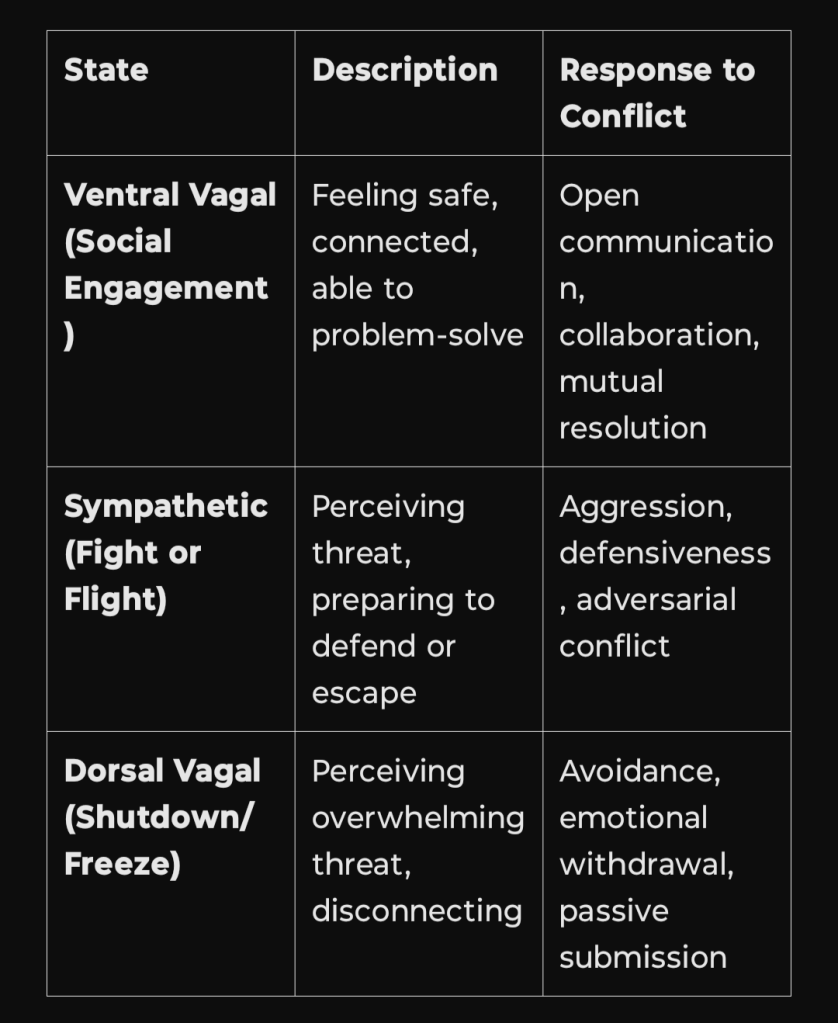
Dr. Stephen Porges’ Polyvagal Theory explains how autonomic nervous system (ANS) regulation affects conflict resolution.
✔ Children raised in punitive households show higher rates of fight-or-flight dominance, leading to aggressive or combative conflict responses (Porges, 2011).
✔ Unresolved early trauma correlates with higher political authoritarianism and reliance on hierarchical control (Van der Kolk, 2014).
✔ Punitive societies tend to have higher militarization, incarceration rates, and political polarization (Felitti et al., 1998).
Attachment Theory and the Political Consequences of Childhood Socialization
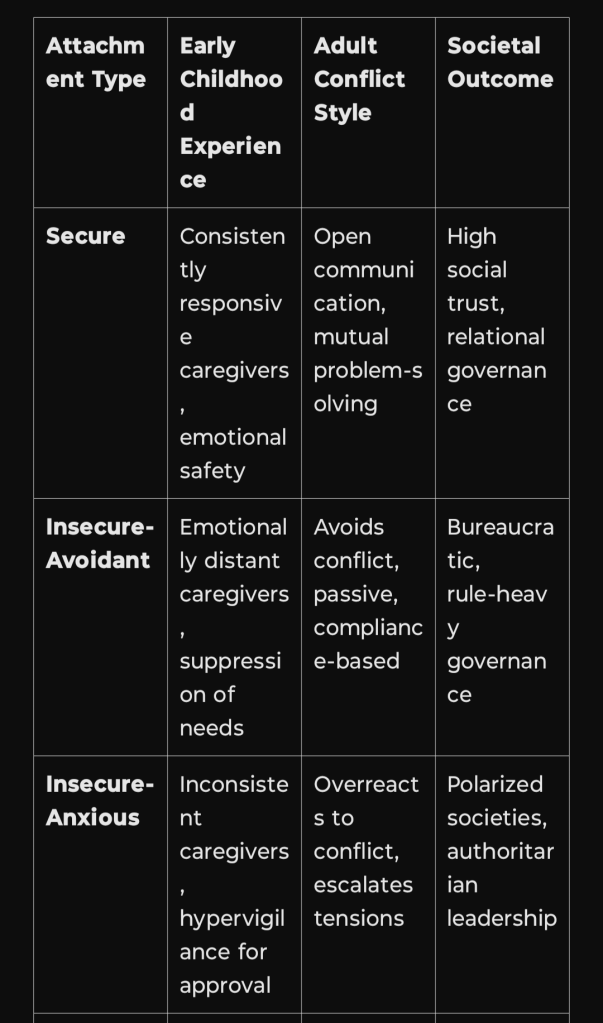
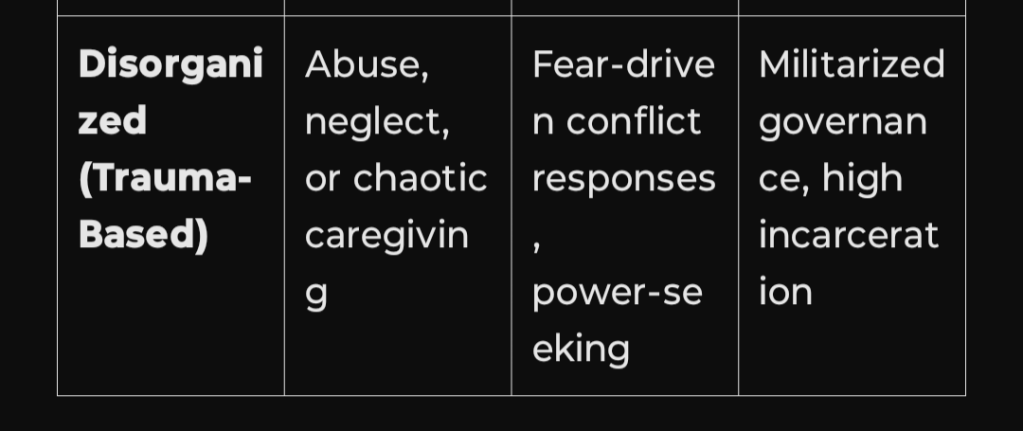
Secure attachment fosters adaptive social engagement, while insecure attachment correlates with enforcement-based conflict responses.
✔ High Insecure Attachment Societies → More authoritarian governance, rigid hierarchies, and punitive policies (Wilkinson & Pickett, 2009).
✔ High Secure Attachment Societies → Greater social trust, lower crime, and decentralized governance (Pinker, 2011).
Thus, governance models are a direct reflection of childhood socialization practices.
IV. Cross-Cultural Comparisons: High vs. Low Punitive Societies
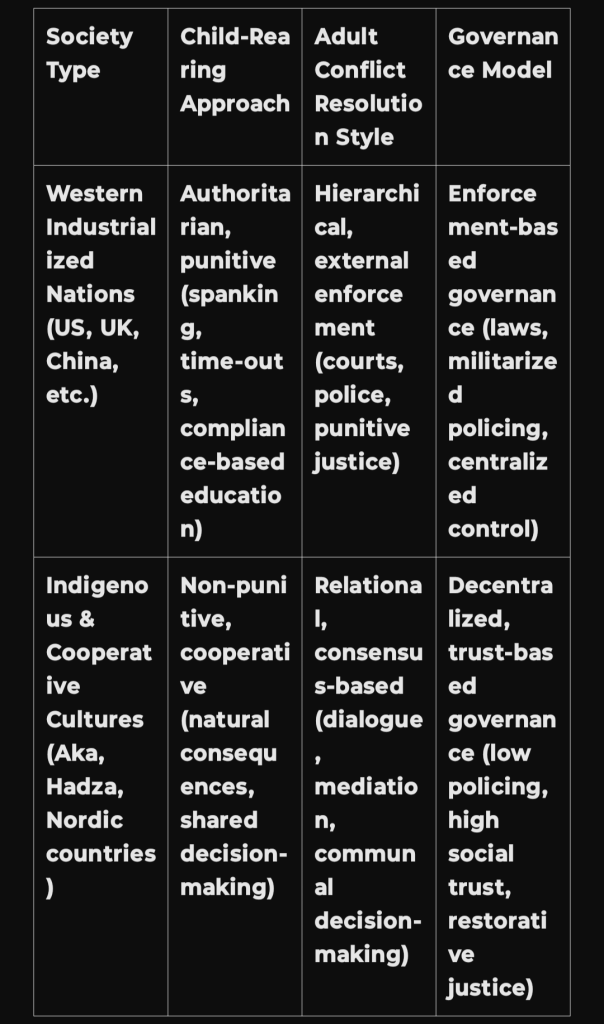
✔ Nordic countries (banning corporal punishment) rank highest in social trust, lowest in crime, and least reliant on police enforcement (Pinker, 2011).
✔ The Aka people of Central Africa raise children non-punitively, and their adults naturally self-regulate without external enforcement (Hewlett, 2014).
These findings challenge the assumption that enforcement is necessary for social stability and highlight the connection between childhood socialization and governance models.
V. Punitive Childhoods and Authoritarian Governance
✔ Children raised in punitive environments internalize coercion-based power structures, making them more likely to support authoritarian governance (Altemeyer, 1996).
✔ Cartesian dualism in governance → The state is framed as the “rational mind” controlling the “irrational body” of the population, reinforcing punitive enforcement.
✔ Self-Regulating Societies Exist → Cultures with low punitive socialization thrive without heavy policing or hierarchical control.
VI. FCP as a Model for Systemic Reform
✔ Punitive discipline is not necessary for social stability.
✔ Governance should reflect secure attachment and self-regulation, not enforcement.
✔ FCP prioritizes self-regulation, emotional intelligence, and non-hierarchical conflict resolution.
By replacing punitive childhood socialization with FCP-based early development, societies can self-regulate without external enforcement.
VII. Conclusion: Toward a Self-Regulating Society
✔ The nervous system is the foundation of governance—if individuals regulate internally, enforcement structures become unnecessary.
✔ Punitive childhood environments create enforcement-dependent populations, reinforcing authoritarianism.
✔ FCP-based childhood interventions can replace punitive governance with self-regulating social structures.
Revolution is developmental, not political.
By shifting how children are socialized, we can dismantle coercive governance structures at their root and build a future of self-regulating societies.
VIII. References
Alexander, M. (2012). The New Jim Crow: Mass Incarceration in the Age of Colorblindness. The New Press.
Altemeyer, B. (1996). The Authoritarian Specter. Harvard University Press.
Dobson, J. (1970). Dare to Discipline. Tyndale House.
Fanon, F. (1961). The Wretched of the Earth. Grove Press.
Felitti, V. J., et al. (1998). “Relationship of Childhood Abuse and Household Dysfunction to Many of the Leading Causes of Death in Adults.” American Journal of Preventive Medicine, 14(4), 245-258.
Gatto, J. T. (1992). Dumbing Us Down: The Hidden Curriculum of Compulsory Schooling. New Society Publishers.
Gershoff, E. T., & Grogan-Kaylor, A. (2016). “Spanking and Child Outcomes: Old Controversies and New Meta-Analyses.” Journal of Family Psychology, 30(4), 453-469.
Hewlett, B. S. (2014). Hunter-Gatherer Childhoods: Evolutionary, Developmental, and Cultural Perspectives. Aldine Transaction.
Pinker, S. (2011). The Better Angels of Our Nature: Why Violence Has Declined. Viking.
Porges, S. (2011). The Polyvagal Theory: Neurophysiological Foundations of Emotions, Attachment, Communication, and Self-Regulation. Norton.
Wilkinson, R., & Pickett, K. (2009). The Spirit Level: Why Greater Equality Makes Societies Stronger. Bloomsbury Press.

