Solving Extreme Behavior Problems in Children: How SpiroLateral Provides a New Path Forward

In today’s world, traditional approaches to behavioral problems in children—especially those diagnosed with Conduct Disorder (CD)—often fall short. Punitive discipline, rigid behavior charts, and one-size-fits-all therapy models fail to address the root causes of extreme behaviors. SpiroLateral, a consulting framework based on the Functional Conflict Perspective (FCP), offers a radically different, yet deeply effective approach.

By integrating trauma-informed care, nervous system regulation, conflict resolution, and systemic change, SpiroLateral doesn’t just modify surface behaviors—it resolves the underlying dysfunction that fuels them.

The Root of Extreme Behavior Problems

Children with conduct disorder exhibit persistent patterns of aggression, rule-breaking, deception, and defiance. These behaviors don’t emerge in a vacuum. They are often the result of:

Nervous System Dysregulation → Chronic stress, early trauma, and unmet emotional needs create an overactive survival response.

Disconnection from Healthy Relationships → Without secure attachment, children struggle to develop empathy, impulse control, and emotional regulation.

Ineffective Discipline Approaches → Punishment exacerbates shame and defiance, reinforcing the cycle of negative behavior.

Systemic Reinforcement of Dysfunction → Schools, foster care, and juvenile justice systems often pathologize instead of rehabilitate, deepening the problem.


To truly help these children, we must go beyond behavior management and heal the underlying emotional and systemic wounds that drive their actions.

How SpiroLateral Transforms Behavior Problems

1. Nervous System Regulation: Rewiring the Stress Response

At the core of SpiroLateral’s methodology is nervous system integration—helping children shift out of survival mode (fight, flight, freeze) and into a state where they can learn, connect, and self-regulate.

Polyvagal-Based Interventions → SpiroLateral applies somatic regulation techniques to calm hyperreactive nervous systems, helping children transition from defensive aggression to relational openness.

Co-Regulation Strategies → Caregivers, teachers, and therapists are trained to provide consistent, emotionally safe interactions that stabilize the child’s physiological state.


➡️ When children feel physiologically safe, their need for extreme behaviors lessens.

2. Rebuilding Attachment and Emotional Trust

Many children with conduct disorder have insecure attachment histories. Instead of viewing them as “bad,” SpiroLateral reframes their behavior as an adaptation to relational neglect, betrayal, or trauma.

Relational Repair Framework → Instead of punitive approaches, SpiroLateral teaches restorative communication, trust-building exercises, and attachment-based interventions to rebuild the child’s sense of security.

Family & Community Reconnection → Healing happens in relationships. SpiroLateral prioritizes family healing, peer mentorship, and healthy role modeling to provide a new relational blueprint.


➡️ Children don’t need stricter rules; they need safer, more attuned relationships.

3. Conflict as a Healing Opportunity

Traditional discipline treats defiance and aggression as problems to be eradicated. SpiroLateral sees them as expressions of unmet needs and unresolved internal conflicts.

Functional Conflict Resolution → Instead of punishments, SpiroLateral guides children through structured, safe conflict resolution processes that help them express their needs without harm.

Internal Family Systems (IFS) Techniques → By treating extreme behaviors as protective parts rather than the child’s core identity, SpiroLateral helps children integrate and heal fragmented aspects of themselves.


➡️ When children feel heard and empowered in conflict, they stop using destructive behaviors to gain control.

4. Shifting Systems to Support Healing, Not Punishment

Many children with conduct disorder cycle through schools, foster care, psychiatric hospitals, and the juvenile justice system—places that reinforce their sense of alienation and failure. SpiroLateral redesigns these systems to support healing instead of punishment.

School & Institutional Reform → Shifting from punitive behavior management to trauma-responsive education, emotional intelligence training, and relational discipline.

Legal & Juvenile Justice Advocacy → Implementing restorative justice models that replace incarceration and punishment with rehabilitative care, mentorship, and skill-building.

Foster Care & Adoption Support → Training caregivers in FCP-based attachment repair to prevent placement instability and reactive behavior cycles.


➡️ Instead of labeling children as “defiant” or “oppositional,” we create environments where they can succeed.

Real-World Application: A Case Study

A 12-year-old boy diagnosed with conduct disorder had a history of violent outbursts, property destruction, and school suspensions. His previous interventions had failed—punishment escalated his behavior, and traditional therapy didn’t address his underlying distress.

Using the SpiroLateral approach, we:
✅ Stabilized his nervous system through daily somatic exercises and co-regulation practices.
✅ Rebuilt trust through non-punitive relational repair techniques with caregivers and teachers.
✅ Shifted his self-perception from “bad kid” to a child with strengths and emotional wounds that needed care.
✅ Gave him conflict resolution tools to navigate anger without aggression.
✅ Worked with the school to replace detentions with proactive, relational discipline approaches.

Within six months, his violent outbursts reduced by 75%, his school engagement increased, and his relationships with adults improved significantly.

➡️ This wasn’t because we “controlled” his behavior—it was because we helped him heal.

A New Paradigm for Extreme Behavior Intervention

SpiroLateral challenges the outdated view that children with severe behavior problems need harsher discipline or more rigid structure. Instead, it shows that:

Behavior is communication → Every extreme action is an attempt to express an unmet need.

Healing, not punishment, is the solution → The root issue isn’t “bad behavior”—it’s unresolved trauma, emotional dysregulation, and relational disconnect.

Systems must change, not just children → Schools, juvenile justice, and foster care need to adapt to support emotional recovery rather than reinforce cycles of punishment and failure.


When we stop asking, “How do we control this behavior?” and start asking, “What does this child need to heal?”—we change everything.

Implementing SpiroLateral Solutions

SpiroLateral provides consulting, training, and policy recommendations to help:
✅ Families implement healing-based parenting strategies.
✅ Schools transition from punitive discipline to trauma-informed education.
✅ Juvenile justice systems adopt restorative models instead of incarceration.
✅ Mental health professionals integrate FCP into treatment plans.
✅ Social services & foster care implement relational healing frameworks.

Final Thought: A Future Without “Lost Causes”

Children with extreme behaviors are not inherently broken, dangerous, or beyond help. They are products of their environments, nervous system states, and relational histories—and they can heal.

SpiroLateral is here to make that healing possible.

If you’re ready to transform the way we approach extreme behavior problems—whether in your family, school, or institution—SpiroLateral offers the roadmap.

Want to learn more? Contact SpiroLateral for consulting, training, and systemic transformation today. ✍️


📣 SpiroLateral Family Coaching Plan: Restorative Family Dynamics & Conflict Resolution

The Family Coaching Plan is designed to support families in building emotional resilience, fostering healthy communication, and creating a harmonious home environment using the Functional Conflict Perspective (FCP) and trauma-informed relational principles.

1. Core Components of the Family Coaching Plan

🔹 Initial Family Assessment & Customization

Comprehensive Family Intake Form (identifies dynamics, challenges, strengths, and goals)

Relational Mapping Exercise (identifies relational patterns and hidden tension points)

Emotional Regulation Assessment (evaluates stress responses and coping mechanisms)

Conflict Style Inventory (understands how each family member approaches disagreements)

Family Values & Vision Session (aligns family goals with core values)

2. Weekly Coaching Structure & Checklists

🔹 Weekly Coaching Sessions (Live or Recorded)

1-Hour Live Zoom Coaching Call (family or 1:1)

Tailored Lesson & Implementation Plan

Practical Exercises & Challenges for the Week


🔹 Weekly Family Checklists & Accountability

Morning & Evening Emotional Check-Ins

Family Communication Practice

Conflict Resolution Skill-Building

Parent-Child Connection Activities

Boundaries & Emotional Safety Reflection


Example Weekly Checklist:

✅ Morning Check-In: “How am I feeling today?”
✅ Evening Reflection: “What went well? What needs improvement?”
✅ One-on-One Connection Time (5-10 min per child)
✅ Family Mealtime Check-In (guided conversation prompts)
✅ Conflict Resolution Review (apply skills from coaching session)

3. Guided Family Journaling & Reflection Exercises

🔹 Weekly Guided Journal Prompts

For Parents: Reflective prompts on personal triggers, parenting approaches, and emotional regulation.

For Children & Teens: Age-appropriate questions about feelings, friendships, and communication.

Example Journal Prompts:

Parents: “What are my biggest emotional triggers in parenting, and how do they relate to my childhood experiences?”

Children: “What does feeling safe mean to me? How can I tell when I feel unsafe?”

Teens: “When I feel unheard, what do I usually do? How can I express myself in a healthier way?”

4. Support Materials & Educational Resources

🔹 Personalized Family Coaching Workbook (PDF & Printable)

Includes communication scripts, exercises, emotional regulation techniques, and conflict resolution strategies.

🔹 Video Lessons & Demonstrations

Recorded explanations of conflict de-escalation, boundary-setting, and emotional regulation techniques.

🔹 Crisis Response & Repair Scripts

Example: “When your child is melting down, say: ‘I see that you’re upset. I’m here. We will figure this out together.'”

🔹 Functional Conflict Family Guide

How to transform family tension into growth, collaboration, and understanding.

5. Ongoing Support & Resources

🔹 24/7 Access to Private Coaching Portal

Family members can submit questions and receive guidance in real-time.

🔹 Parent & Teen Support Groups

Private community for ongoing peer support and shared experiences.

🔹 Monthly Q&A & Live Training Calls

Advanced workshops on parenting, family healing, and nervous system regulation.

Next Steps

Families receive a customized coaching plan with an implementation roadmap.

Progress is tracked weekly through assessments and reflections.

Families build skills over time with practical application and ongoing support.

Here is a sample of a structured individualized plan that can rapidly shift internal cultures in family systems:

Using this tested and proven method has resulted in one child experiencing a 326% rate of measured growth over the course of one year! 😯

Your personalized Family Coaching Workbook and Structured Family Roadmap includes:

✅ Weekly Action Plans (with structured tasks for parents and children)
✅ Daily & Weekly Checklists (for emotional regulation, communication, and conflict resolution)
✅ Guided Journaling Prompts (for parents, children, and teens)
✅ Family Conflict Resolution Scripts (to de-escalate and repair conflicts)
✅ Emotional Regulation Techniques (trauma-informed strategies)
✅ Parent-Child Connection Exercises (strengthening relationships)
✅ Progress Tracking Sheets (for measuring emotional and relational growth)

Family Coaching Workbook Outline:

1. Introduction
Overview of the family coaching framework and goals.
How to use this workbook effectively.

2. Family Values & Vision
Guided exercises to establish shared family values.
Creating a vision statement for your family’s emotional and relational goals.

3. Weekly Action Plan Template
Customizable template for setting weekly family goals.
Action steps for parents and children.
Reflection section for reviewing progress.

4. Daily & Weekly Checklists
Emotional regulation check-ins (morning and evening).
Communication and conflict resolution exercises.
Parent-child connection activities.
Accountability and progress tracking.

5. Guided Journaling Prompts
Daily and weekly prompts for parents to reflect on their triggers, responses, and growth.
Age-appropriate prompts for children and teens to explore their emotions and build communication skills.

Family Coaching Roadmap:

Phase 1: Foundation & Assessment (Week 1-2)
Complete the Family Intake & Assessment (identify challenges, strengths, and goals).
Establish family values and vision through guided exercises.
Begin daily emotional check-ins (morning and evening).
Introduce family communication skills (active listening, validation, and conflict de-escalation).
Start parent journaling to track emotional triggers and responses.

Phase 2: Emotional Regulation & Connection (Week 3-4)
Implement daily emotional regulation techniques for parents and children.
Practice nervous system regulation exercises (breathing, grounding techniques).
Establish structured one-on-one connection time with each child.
Use weekly guided journal prompts for self-reflection and emotional awareness.
Introduce repair scripts for handling disagreements and emotional outbursts.

Phase 3: Conflict Resolution & Family Communication (Week 5-6)
Learn and apply functional conflict resolution strategies (de-escalation, compromise, and repair).
Begin family meetings (structured discussion on issues, goals, and celebrations).
Implement calm-down protocols for managing emotional distress in real time.
Continue journaling and progress tracking to reinforce new habits.
Strengthen healthy boundary-setting and assertive communication.

Phase 4: Integration & Long-Term Stability (Week 7-8+)
Review progress and identify areas for improvement.
Strengthen positive discipline and accountability structures.
Maintain weekly checklists for continued emotional awareness and connection.
Adapt communication strategies for long-term sustainable family harmony.
Establish a routine for ongoing reflection and connection-building.

This roadmap ensures a step-by-step transformation toward a more connected, emotionally regulated, and resilient family dynamic.


“I have emotionally detached from my children because they are very volatile with their behaviors and lash out at me in anger a lot. I do not feel safe in my nervous system around them. This is causing me “splitting” symptoms, where I avoid spending time with them and resent being a mom. What can I do?”

1. Nervous System Breakdown: Why You’re Splitting

Your experience of emotional detachment and splitting symptoms reflects a nervous system that is in a chronic threat response. This is not a failure on your part—it’s your body’s way of trying to survive an environment that feels unpredictable and unsafe.

Mirror Integration Theory (MIT): Your nervous system is mirroring the instability in your external environment. Since your children’s emotional volatility and explosive anger make the home environment unpredictable, your system is fragmenting as a self-protective mechanism.

Polyvagal Connection: Chronic unpredictability, especially from close family, creates hypervigilance and emotional numbing. Your nervous system is likely oscillating between dorsal vagal shutdown (detachment, exhaustion, numbness) and sympathetic activation (hyperreactivity, fight/flight, splitting symptoms).

Functional-Conflict Perspective (FCP): The emotional instability in the household functions as a system-wide dysregulation cycle where:

Your children express their emotional instability externally (explosive anger).

You express your emotional instability internally (emotional detachment, splitting).

2. Why Your Children Don’t See a Problem with Their Behavior

From both FCP and MIT, your children’s lack of willingness to change is not necessarily defiance or a lack of care—it’s a structural issue within the emotional system.

MIT Analysis: If their nervous systems are in chronic dysregulation, their anger and explosiveness serve as adaptive survival mechanisms. To them, this is their way of asserting control and maintaining emotional equilibrium, not necessarily an act of intentional harm.

FCP Analysis: Their behavior functions as part of a larger system of unregulated emotional expression, where chaos has become the norm. Without recognizing the cycle, they cannot see their role in it.

Key insight: They may not acknowledge a problem because they don’t have a model of a different emotional baseline—they only know the system as it is.

3. The Cyclical Reinforcement of Dysregulation

Using both theories, we can see how each person in the system is playing a role that reinforces the cycle:

This cycle means everyone’s nervous system is acting in ways that sustain the collective instability.

4. How to Break the Cycle Without Burning Out

The core issue here is nervous system safety—without that, no one in the system can shift. The goal is to change the relational and nervous system dynamics so that co-regulation can happen.

A. Rebuilding Emotional Safety for Yourself

Step 1: Prioritize Your Own Nervous System First

Your body needs to feel safe before you can engage with them differently.

This might mean setting stricter emotional boundaries, reducing reactive engagements, or even removing yourself from explosive situations before they escalate.

Your emotional safety is not negotiable.

Step 2: Repairing Internal Splitting

Your mind is compartmentalizing parts of your experience because the full weight of it feels unbearable.

Work on self-integration by acknowledging that you love your children, AND you cannot handle their behaviors right now. Both things can be true at the same time.

Instead of focusing on “I should feel more connected”, shift to “I need to feel safe before I can connect.” Your body will not allow connection until safety is restored.

B. Rewiring the Household System

Step 3: Introduce an External Model of Regulation

Since your children don’t see their behaviors as an issue, they need an external reference point for what regulation looks like.

This can be done through structured emotional de-escalation exercises, modeling regulated communication, or bringing in a third party (therapist, coach, mentor) who can model a different relational dynamic.

Step 4: Address the Systemic Function of Their Explosions

If their explosive behaviors serve a function in the household system, they will not stop until a healthier function replaces it.

This could mean implementing predictable de-escalation strategies, clear emotional agreements, or consequence structures that prioritize nervous system regulation over punishment.

Step 5: Micro-Experiments in Co-Regulation

The full system won’t shift overnight, but small experiments can start rewiring the emotional expectations.

Example: Instead of reacting to their anger, narrate your nervous system response.

“My body is telling me I need space right now.”

“I want to help, but I can’t when I feel overwhelmed.”

This models awareness and self-regulation, which they will eventually mirror.

Final Thoughts: This Is Not a Personal Failure—It’s a Systemic Problem

Your emotional detachment and splitting symptoms are not a personal weakness or failure. They are predictable nervous system responses to an unstable emotional environment. The challenge is not to force connection but to restore safety first, which then allows connection to emerge.

From both Functional-Conflict Perspective and Mirror Integration Theory, the path forward is not about making them change first—it’s about changing the structure of emotional safety, which then allows natural shifts in behavior.

From a somatic lens, dysregulation can be understood as a form of resistance, but not in the cognitive or oppositional sense—it’s the body resisting what it perceives as unsafe, overwhelming, or unprocessable.

Dysregulation as Nervous System Resistance

Resistance, in a somatic framework, is the body’s way of saying “no” to an experience it cannot fully process or integrate in the moment. Dysregulation is often a protective response rather than a dysfunction—it serves as a buffer against something that feels too much, too fast, or too overwhelming.

1. Sympathetic Overactivation (Fight/Flight Resistance)

The body resists through tension, hypervigilance, or reactivity.

This looks like agitation, impulsivity, emotional volatility, or anxiety.

It’s a way of keeping the body in motion to avoid stillness, where unresolved sensations might surface.

2. Dorsal Vagal Shutdown (Freeze/Fawn Resistance)

The body resists by collapsing, numbing, or disconnecting.

This looks like dissociation, emotional detachment, chronic exhaustion, or people-pleasing.

It’s a way of preserving energy and preventing engagement with something that feels unsafe.

3. Fluctuation Between Both (Push-Pull Resistance)

Some people cycle between hyperarousal (sympathetic) and shutdown (dorsal vagal).

This looks like oscillating between extreme emotional reactions and withdrawal.

The nervous system can’t fully integrate safety, so it resists both action and stillness.

Why Dysregulation Feels Like Resistance (But Isn’t Always Conscious)

The nervous system is designed to prioritize survival over engagement.

If a person has unprocessed trauma, attachment wounds, or a history of unsafe relational experiences, the body may resist co-regulation, intimacy, or change, even if the mind wants those things.

Dysregulation mimics resistance, but it’s actually an overwhelmed system trying to manage too much activation at once.

Breaking Dysregulation as Resistance

If dysregulation is a form of somatic resistance, the solution is not forcing change but creating conditions where the body no longer needs to resist.

Slow down – The body resists when something feels overwhelming. Small, titrated steps create safety.

Increase capacity before deepening processing – Nervous system regulation tools (breathwork, grounding, co-regulation) help the body build tolerance for safety before diving into deep emotional work.

Reframe resistance as protection – Instead of seeing dysregulation as something to fight, recognize it as a signal that the body needs gentler entry points to safety.

Final Thought

Dysregulation can be a form of unconscious resistance, but more accurately, it’s a protective mechanism. It’s the nervous system saying “not yet” because something feels too overwhelming or unsafe. The goal is not to override dysregulation, but to help the body feel safe enough that it no longer needs to resist.



SpiroLateral is Justice in Policy and Equity in Action

Urban Planning with SpiroLateral

SpiroLateral: A Geometric Framework for Regenerative Cities


SpiroLateral is a term that fuses “Spiral” and “Lateral”, representing a non-linear, adaptive approach to urban development that combines the Fibonacci sequence with lateral expansion. This model emphasizes organic growth, distributed governance, and fractal-based infrastructure, ensuring scalability, sustainability, and social cohesion.

Core Principles of SpiroLateral Design

1. Mathematical Harmony & Fibonacci Urbanism

Cities follow Fibonacci-based spirals, ensuring efficient land use, walkability, and interconnected hubs.

Infrastructure expands laterally rather than hierarchically, preventing centralization of power and resources.

Fractal Geometry ensures scalability at micro (neighborhood), meso (district), and macro (city-wide) levels.

2. Decentralized Governance & Functional Conflict Perspective (FCP)

Lateral decision-making: Power is distributed across community councils rather than centralized authority.

Adaptive Conflict Resolution: Governance integrates Functional Conflict Perspective (FCP) for sustainable decision-making.

Consensus-driven policy models ensure residents actively participate in shaping their environment.

3. Regenerative Sustainability & Resource Circularity

Self-sustaining hubs: Each sector operates with food sovereignty, renewable energy, and waste cycling.

Water and energy grids follow Fibonacci circuits, optimizing resource distribution and minimal waste.

Closed-loop systems replace linear extractive capitalism, fostering local production and cooperative economies.

4. Neurosocially Informed Urban Design

Spaces are designed for optimal nervous system regulation, reducing stress and fostering well-being.

Multi-sensory urban planning ensures that environments are inclusive to neurodivergent and neurotypical individuals.

Green spaces and communal hubs enhance emotional connection and social resilience.

5. Economic & Social Decentralization

Worker-owned cooperatives and shared commons replace corporate dominance.

Universal Basic Services (UBS) provide education, healthcare, housing, and mobility without profit incentives.

Local currencies and barter networks stabilize economies outside of speculative markets.


6. Scalable Implementation Strategy

Phase 1: Micro-level pilot (eco-village model with SpiroLateral governance).

Phase 2: Urban district integration (transform existing neighborhoods into SpiroLateral hubs).

Phase 3: National and global adaptation (policy frameworks for larger-scale adoption).

A Harmonious Layout for Regenerative, Sustainable Ecosystems

The spiral city layout, inspired by the Fibonacci sequence, represents more than just a visually striking urban design—it embodies a fundamental shift toward harmony between human civilization and the natural world. Unlike traditional cities, which often expand in rigid, hierarchical grids that promote disconnection from nature and community, this spiral arrangement mimics organic growth patterns found in ecosystems, galaxies, and even neural structures, fostering a sense of coherence, adaptability, and regeneration.

Each city within this framework is strategically placed to integrate seamlessly with diverse landscapes, from lush forests to arid deserts, ensuring sustainable resource distribution, biodiversity conservation, and resilience against climate change. The spiral pattern enhances connectivity without congestion, allowing for fluid transportation networks, energy-efficient infrastructure, and cooperative economic hubs that prioritize shared well-being over extractive individualism. In doing so, this layout does not impose upon the land but grows with it, creating self-sustaining cycles of energy, food production, and waste management that regenerate rather than deplete.

Fostering Social and Emotional Well-being Through Design

This biophilic and community-driven design is not just about sustainability in a material sense—it profoundly reshapes human psychology, relationships, and social structures. In conventional cities, alienation is a defining experience: people live in isolated, compartmentalized units, often disconnected from their neighbors, communities, and even their own emotions. This new model, however, centers relationality as a fundamental building block of human thriving.

By removing barriers to social interaction—both physical (rigid urban sprawl, inefficient transit) and psychological (hyper-individualistic mindsets, economic competition)—this layout prioritizes shared experiences, interdependence, and emotional co-regulation. Public spaces are designed for deep, meaningful connection, with communal gardens, gathering hubs, and interactive learning centers replacing the isolating structures of consumer-driven entertainment. The spiral pattern itself reinforces this philosophy: rather than hierarchically dividing people into social and economic classes, it encourages fluid movement, collaboration, and a sense of belonging to a whole greater than the sum of its parts.

This environment is especially transformative for mental health and nervous system regulation. In Functional Conflict Perspective (FCP), fragmentation—whether at the personal, relational, or systemic level—leads to instability and conflict. Modern cities, with their overwhelming sensory input, rapid pace, and lack of communal care, exacerbate this fragmentation. By contrast, a spiral-based, nature-integrated city layout promotes nervous system regulation by:

Encouraging cooperative, non-hierarchical social interactions.

Creating physical spaces that reduce stress and sensory overload.

Providing access to nature, social support, and restorative practices within daily life.

This allows individuals to shift out of survival mode and into a state of connection, where emotional intelligence, trust, and mutual aid become embedded cultural norms rather than individual challenges to overcome.

From Individualism to Community: Reframing Human Existence

This model challenges the deep-seated individualistic paradigm that has dominated much of Western urban planning and economic structures. Instead of competition, scarcity, and isolation, it fosters cooperation, shared abundance, and relational depth. Resources—whether food, energy, or knowledge—are distributed in ways that prioritize collective well-being over private accumulation.

Supported by the Functional Conflict Perspective, this shift is not just structural but cognitive and cultural. FCP explains how internal fragmentation within individuals mirrors societal dysfunction, and healing this requires integrating personal, cultural, and systemic conflict resolution. A city designed on these principles actively supports the process of human reintegration—both within the self and within the collective.

By living in a regenerative, interconnected system, people experience interdependence as natural and desirable rather than burdensome. Relational skills—once viewed as secondary to economic productivity—become the foundation of thriving communities. Emotional intelligence, active listening, and conflict transformation are not left to self-help books or therapy sessions but are woven into the fabric of everyday life through the very structure of these cities.

This model does not reject individuality, but rather repositions it within the broader context of shared human flourishing. Here, the goal is not personal success in isolation but co-creation, mutual empowerment, and the understanding that well-being is most sustainable when it is collective.

Conclusion: A Functional Conflict Perspective Vision for the Future

By aligning with nature’s most fundamental mathematical patterns, the Fibonacci-inspired spiral city is not just a design—it is a blueprint for a new way of being. It restores balance where industrialized civilization has created division, heals fragmentation where trauma has caused separation, and prioritizes connection where hyper-individualism has bred isolation.

Through the integration of Functional Conflict Perspective, this vision for the future becomes not just an architectural or ecological endeavor but a transformational societal shift, where human psychology, social systems, and planetary health are all interwoven into a single regenerative, sustainable, and emotionally intelligent civilization.

This model moves beyond the limitations of industrial capitalism, nation-state governance, and individualistic survivalism. It provides a blueprint for regenerative civilization, where human systems mirror the intelligence of nature, supporting not just survival but deep, relational thriving.

This is not utopian idealism—it is an attainable, research-backed, and structurally viable alternative to the dysfunction of current systems. By implementing these Fibonacci-inspired spiral cities, we restore balance where fragmentation once dominated, creating a future where cooperation, sustainability, and emotional intelligence are the foundations of human existence.

🌍🌎🌏

White Paper: The Future of Urban Living – Fibonacci-Inspired Spiral Cities

Designing Sustainable, Cooperative, and Regenerative Cities for the 21st Century

I. Introduction: The Crisis of Urban Development

1.1 The Problems with Current City Models

Urbanization has reached a breaking point. Traditional city planning, based on rigid grids, corporate-driven zoning, and resource-extractive economic models, has led to:

Housing crises – Speculative real estate markets make housing unaffordable.

Environmental collapse – Energy-intensive infrastructure accelerates climate change.

Social fragmentation – Economic inequality, political centralization, and individualism weaken community ties.

If we continue down this path, cities will become increasingly unsustainable, inequitable, and socially dysfunctional.

1.2 The Fibonacci Spiral Model as an Alternative

This white paper introduces Fibonacci-Inspired Spiral Cities, a mathematically and socially optimized urban model that:
✔ Uses spiral-based zoning to maximize walkability, resource efficiency, and sustainability.
✔ Integrates cooperative economics, replacing corporate monopolies with community ownership.
✔ Decentralizes governance, ensuring participatory decision-making and social cohesion.
✔ Supports energy, food, and housing sovereignty, making communities self-sufficient.

This model is grounded in Functional Conflict Perspective (FCP), regenerative urbanism, and systems-based governance, offering a scientifically validated and socially just alternative to modern city planning.

II. Theoretical Framework: Why This Works

2.1 Fibonacci Spiral Design & Spatial Optimization

The Fibonacci sequence is found in natural ecosystems, galaxies, and biological structures, demonstrating efficient spatial distribution.

Applying this to urban planning results in balanced, self-sustaining city layouts that eliminate waste, congestion, and overcentralization.

Unlike grid-based urban sprawl, spiral cities expand organically, allowing for adaptive, sustainable growth.

2.2 Functional Conflict Perspective (FCP) & Social Cohesion

Current city models fragment people into isolated economic roles, creating social tension and mental health crises.

FCP integrates trauma-informed governance, ensuring urban policies support community well-being, social regulation, and participatory decision-making.

Decentralized, cooperative models align with IFS (Internal Family Systems) psychology, reducing hierarchical oppression and economic inequality.

2.3 Regenerative Economic & Environmental Principles

The current capitalist extractive economy drains resources and externalizes environmental damage.

Fibonacci Spiral Cities adopt circular economies, ensuring localized production, cooperative ownership, and waste-free systems.

Publicly owned energy and water systems create self-sustaining infrastructure, reducing dependence on corporate utilities.

III. Economic Justification: Why This Is Feasible

3.1 Cost-Benefit Analysis of Spiral Cities vs. Traditional Urbanism

3.2 Energy, Food, and Water Sovereignty

Solar & Wind-Powered Microgrids → Reduces reliance on fossil fuels.

Localized Food Systems → Eliminates food deserts, supports permaculture.

Water Recycling & Storage → Reduces climate vulnerability.

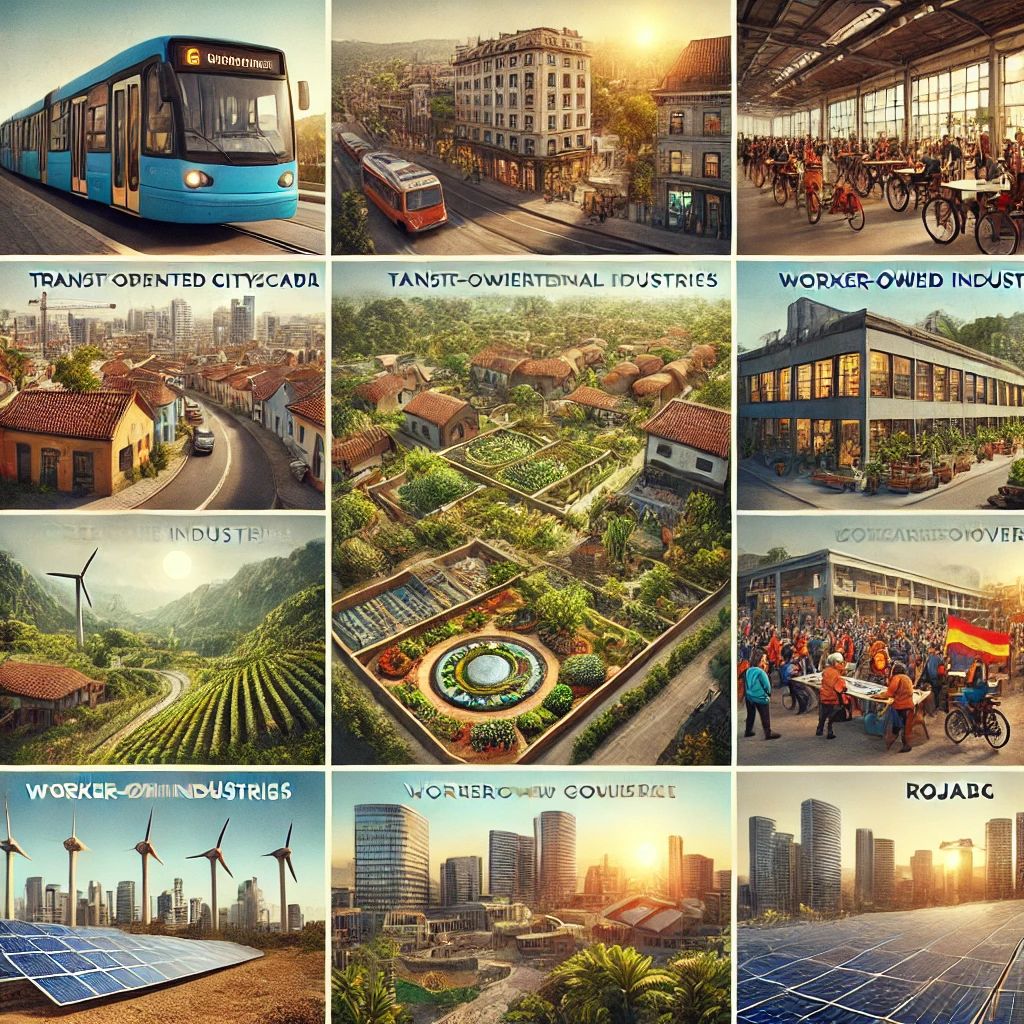
IV. Case Studies: Proof of Concept

4.1 Existing Models of Spiral-Based Urban Planning

Auroville, India – A successful experimental city designed for self-sufficiency and cooperative living.

Curitiba, Brazil – Transit-oriented development proving urban sustainability is economically viable.

Earthship Biotecture, New Mexico – Demonstrates how off-grid, self-sustaining architecture functions in extreme climates.

4.2 Cooperative Economies & Decentralized Governance Models

Mondragón Corporation (Spain) – A cooperative network proving worker-owned enterprises outperform corporate monopolies.

Zapatista Communities (Chiapas, Mexico) – Demonstrates participatory, non-hierarchical governance at scale.

V. Policy Recommendations & Implementation Strategy

5.1 Local Policy Adoption: Pilot Cities (Years 1-3)

Amend zoning laws to permit spiral-based development.

Establish community land trusts (CLTs) for affordable housing.

Implement cooperative microgrids for energy and water sovereignty.

5.2 National Legislation (Years 4-7)

Legally recognize decentralized governance councils.

Provide funding for cooperative business transitions.

Adopt public banking models to finance spiral city expansion.

5.3 Global Expansion (Years 8-15)

Integrate into international sustainable development treaties.

Create a global knowledge-sharing network for spiral-based urban planning.

Establish cooperative trade agreements supporting regenerative economies.

VI. Conclusion: The Future Is Spiral

We stand at a turning point. Cities can either continue down a path of unsustainable growth, inequality, and climate destruction, or we can reimagine urban life using scientifically backed, socially equitable models.

The Fibonacci Spiral City Model is not just a concept—it is a viable, tested, and necessary transformation for a future built on sustainability, cooperation, and resilience.

🌍 It’s time to build cities that work for people and the planet. 🌍

The Future of Cities – A Call for Spiral-Based Urban Development

A Public-Facing Legislative Proposal for Sustainable, Equitable, and Cooperative Cities

Introduction: Why Our Cities Need to Change

Today’s cities are failing us. Housing is unaffordable, resources are concentrated in the hands of a few, and climate change is making urban living increasingly unsustainable. Communities are fragmented, and decision-making is often controlled by corporations or bureaucracies that do not prioritize the well-being of the people.

It doesn’t have to be this way. We have the knowledge, the resources, and the ability to redesign our cities to work for people—not just profit.

This proposal introduces a Fibonacci-Inspired Spiral City model, a scientifically and socially grounded alternative that prioritizes:
✔ Affordable and sustainable housing for all.
✔ Self-sufficient energy and food systems, owned by communities.
✔ Walkable, nature-integrated spaces that reduce pollution and stress.
✔ Participatory governance where residents make decisions, not corporations.

It’s time for legislative action to shift our urban policies toward cooperative, regenerative, and human-centered development.

Key Policy Goals: A City That Works for Everyone

1. Affordable Housing & Community Land Trusts

🟢 What’s wrong?

Real estate speculation has turned housing into a luxury rather than a human right.

Private developers control most new housing, prioritizing profit over affordability.

🟢 Solution: Community Land Trusts & Spiral Housing Zones

Cities will convert land ownership to cooperative community land trusts (CLTs), ensuring permanent affordability.

Zoning reforms will allow flexible, mixed-use developments, integrating homes, shops, and public spaces into walkable, interconnected neighborhoods.

Housing designs will follow Fibonacci-inspired spatial planning, allowing for gradual, organic urban expansion without displacement.

2. Sustainable Energy, Food, and Water Independence

🟢 What’s wrong?

Cities rely on corporate-controlled utilities that increase costs and environmental damage.

Industrial agriculture leads to food deserts and unhealthy diets for urban residents.

🟢 Solution: Publicly Owned Energy & Food Sovereignty

Cities will transition to decentralized, community-owned renewable energy microgrids, reducing energy dependence and cutting costs.

Urban agriculture and local food networks will replace industrial supply chains, reducing costs and improving food access.

Water collection and recycling laws will ensure self-sufficient, climate-resilient communities.

3. Decentralized, Participatory Governance

🟢 What’s wrong?

Mayors and city officials often act as gatekeepers, making decisions without public input.

Political power is concentrated in a small elite, disconnected from everyday residents.

🟢 Solution: Localized, Trauma-Informed Governance

Neighborhood-based councils will replace centralized government structures, ensuring decisions are made by the people who live there.

Rotational leadership and participatory budgeting will allow communities to allocate resources where they are most needed.

Public mediation centers will provide conflict resolution services, replacing punitive systems that disproportionately harm marginalized groups.

4. A Cooperative Economy That Works for People, Not Corporations

🟢 What’s wrong?

Wages have stagnated while wealth is hoarded by the richest 1%.

Small businesses and workers have little control over the industries they sustain.

🟢 Solution: Worker-Owned Cooperatives & Public Banking

Cities will prioritize cooperative business models, ensuring that workers have ownership and decision-making power.

Public banking will provide low-interest loans for small businesses and local projects.

Tax incentives will favor community-owned enterprises over multinational corporations.

How You Can Help: A Call to Action

We need public pressure and policy advocacy to bring this vision to life. You can help make this happen!

✔ Contact your local representatives and ask them to support land trust zoning, cooperative economy incentives, and participatory governance models.
✔ Organize community discussions to raise awareness about the benefits of spiral-based city planning.
✔ Join or start a cooperative initiative—whether it’s a food co-op, a housing collective, or a worker-owned business.
✔ Support candidates and policies that prioritize sustainability, economic fairness, and community empowerment.

The Future Starts Now

This isn’t just a vision—it’s an achievable future. The Fibonacci-Inspired Spiral City model provides a scientifically grounded, socially just, and economically feasible path forward. With the right legislation, public support, and grassroots organizing, we can shift urban development toward equity, resilience, and long-term sustainability.

🚀 Join the movement. Help make spiral cities a reality. 🚀

Step-by-Step Guide: How the Fibonacci-Inspired Spiral City Model Works

A Sustainable, Cooperative, and Regenerative Urban Development Framework

This guide breaks down the Fibonacci-Inspired Spiral City Model into actionable steps, showing how it transitions from concept to real-world implementation.

Step 1: Redesigning Urban Layouts Using the Fibonacci Spiral

📌 Why? Traditional grid-based cities waste space, increase congestion, and centralize power.
✅ Solution: Cities expand in a spiral pattern, mimicking nature’s most efficient growth structure.

🔹 How It Works:

The central hub is the heart of the city, with community spaces, governance centers, and cooperative markets.

Roads and buildings radiate outward in a golden spiral, allowing for balanced, walkable expansion.

No urban sprawl! Growth happens organically, ensuring housing, green spaces, and resource hubs are evenly distributed.

🌍 Real-World Comparison: Curitiba, Brazil, has already used radial development to maximize efficiency and livability.

Step 2: Creating Cooperative & Affordable Housing

📌 Why? Housing markets prioritize speculation and profit over affordability.
✅ Solution: Replace private real estate markets with Community Land Trusts (CLTs) & Cooperative Housing Models.

🔹 How It Works:

Land is owned by the community, preventing speculation and gentrification.

Housing developments follow biophilic design, ensuring green spaces, natural ventilation, and renewable energy integration.

Instead of mortgages, residents pay into cooperative ownership models, ensuring affordability for generations.

🏡 Real-World Comparison: The Champlain Housing Trust in Vermont has successfully kept housing permanently affordable using this model.

Step 3: Building Self-Sufficient Food, Water & Energy Systems

📌 Why? Cities rely on corporate-controlled resources, making them vulnerable to shortages and price hikes.
✅ Solution: Decentralized, community-owned microgrids & local food production.

🔹 How It Works:

🌱 Urban food forests, rooftop gardens, and regenerative agriculture provide fresh, local produce.

⚡ Renewable energy microgrids (solar, wind, geothermal) replace corporate utilities, ensuring energy independence.

💧 Water recycling, rain capture, and desalination tech make communities self-sufficient in water supply.

⚡ Real-World Comparison: Cities like Freiburg, Germany, and Amsterdam are already transitioning to decentralized renewable energy grids.

Step 4: Establishing Decentralized, Participatory Governance

📌 Why? Governments are often centralized, hierarchical, and disconnected from citizens’ needs.
✅ Solution: Implement direct democracy, rotational leadership, and trauma-informed governance.

🔹 How It Works:

🏛️ Local governance councils replace centralized political structures.

🗳️ Rotational leadership ensures no one accumulates excessive power.

🤝 Decision-making is consensus-based, prioritizing community well-being.

🌍 Real-World Comparison: The Zapatista communities in Chiapas, Mexico and Rojava in Syria successfully operate decentralized self-governance models.

Step 5: Transitioning to a Cooperative Economy

📌 Why? Capitalist economies extract resources and concentrate wealth in the hands of a few.
✅ Solution: Shift to worker-owned cooperatives, public banking, and circular economies.

🔹 How It Works:

🏢 Cooperative businesses replace corporations, ensuring that workers own and manage their industries.

💰 Public banking replaces predatory financial institutions, offering low-interest loans to community projects.

♻️ Circular economy principles ensure waste is minimized, resources are shared, and local production thrives.

🌍 Real-World Comparison: The Mondragón Corporation in Spain is the world’s largest worker-owned cooperative, proving that this model outperforms traditional corporations.

Step 6: Scaling Up & Implementing at Global Levels

📌 Why? We need policy changes and grassroots action to make this vision a reality.
✅ Solution: Pilot cities, policy adoption, and global knowledge-sharing networks.

🔹 How It Works:
1️⃣ Pilot Cities (Years 1-3) – Implement in 3-5 small cities to test governance, economy, and infrastructure.
2️⃣ Policy Adoption (Years 4-7) – Integrate into national legislation and economic frameworks.
3️⃣ Global Expansion (Years 8-15) – Establish international urban policy standards and cooperative trade networks.

🌍 Real-World Comparison: The UN’s Sustainable Development Goals (SDGs) already promote many of these policies, but lack implementation. Spiral Cities offer a structured framework to make it happen.

Final Thoughts: This Model is Achievable Now

🌱 Nature has already given us the blueprint for sustainable, thriving communities.
🏛️ We have existing legal and economic models that prove this works.
⚡ The transition to Spiral Cities is not only necessary—it is inevitable.

🚀

Existing Case Studies, Their Models, and Key Aspects

1. Curitiba, Brazil – Transit-Oriented Development

Integrated bus rapid transit (BRT) system

Pedestrian-friendly urban planning

Emphasis on green public spaces

2. Auroville, India – Cooperative Urbanism

Planned cooperative city with shared land ownership

Eco-friendly building techniques and renewable energy integration

Participatory governance and self-sustaining economy

3. Mondragón, Spain – Worker-Owned Cooperative Economy

Largest worker-owned cooperative network in the world

Decentralized production and participatory decision-making

Emphasis on community wealth distribution and reinvestment

4. Freiburg, Germany – Decentralized Renewable Energy

Renewable energy self-sufficiency (solar, wind, hydro)

Prioritization of public transport over cars

Car-free urban zones to enhance sustainability and livability

5. Rojava, Syria – Decentralized Self-Governance

Community-led councils with direct democracy

Women’s leadership and gender-equal governance structures

Cooperative economic model with shared resource management

6. Zapatista Communities, Mexico – Autonomous Indigenous Governance

Collective land stewardship and communal decision-making

Participatory democracy with rotating leadership

Localized economies focusing on self-sufficiency and resilience

7. Earthship Biotecture, New Mexico – Off-Grid Sustainable Housing

Passive solar housing for energy efficiency

Water recycling and independent off-grid energy systems

Sustainable architecture using upcycled materials

8. Vienna, Austria – Public Housing & Social Equity

Government-supported social housing initiatives

Rent control policies for affordability

Equitable urban planning ensuring mixed-income communities

9. Malta Cooperative Economy – Decentralized Cooperative Economic Model

Worker-owned businesses forming the backbone of the economy

Financial mutual aid networks supporting community wealth distribution

Emphasis on decentralized resource management and cooperative production.

Resolving Anxious-Avoidant Dynamics with Functional Conflict Perspective (FCP)


The Problem:
A person contacts me and says:
“I keep ending up in relationships where I chase, and the other person pulls away. Or I withdraw when someone gets too close. It’s exhausting, but I don’t know how to stop this cycle.”

Step 1: Diagnosing the Systemic Dysfunction

🔍 What’s Happening?
This is a dysregulated relational feedback loop where one person seeks connection (anxious attachment) while the other seeks distance (avoidant attachment). The more one pursues, the more the other withdraws, reinforcing fear-based survival mechanisms instead of co-regulated connection.

🔹 Key Systemic Issues:
✔ Misaligned nervous system regulation – One person uses proximity for safety, while the other uses distance to self-regulate.
✔ Hierarchical emotional control – The relationship dynamic functions as a dominance-submission cycle, where one person controls through pursuit and the other controls through withdrawal.
✔ Lack of recursive self-adjusting feedback – The system does not course-correct; instead, it escalates to extremes (closeness vs. avoidance).

Step 2: Replacing Dysfunction with Adaptive Self-Regulation

🚀 FCP-Based Solution: Instead of treating attachment patterns as fixed traits, we redesign the relational system so both partners feel safe without needing to overcompensate.

🔹 Self-Correcting Relationship Structure:
✔ Stop Chasing & Avoiding → Shift to Mutual Calibration
→ Create a reciprocal loop where both partners actively adjust based on emotional bandwidth rather than reacting from survival mode.
✔ Replace Closeness-Distance Polarity with Self-Regulating Connection Zones
→ Instead of an “all-or-nothing” chase dynamic, introduce gradual attunement cycles where intimacy adjusts naturally.
✔ Neutralize Emotional Power Struggles
→ The anxious partner learns to co-regulate internally instead of externalizing safety, and the avoidant partner learns to experience connection without overwhelm.

Step 3: Long-Term Relationship Stability Plan

🔹 Practical FCP-Based Adjustments:
✔ Redefine Pursuit as Shared Attunement → Shift from “Who’s pulling away?” to “What’s our natural rhythm of connection?”
✔ Introduce Micro-Doses of Emotional Exposure → The avoidant partner stretches their capacity for connection in safe increments, and the anxious partner practices self-regulation instead of relying on proximity for safety.
✔ Embed a Self-Regulating Relationship Structure → Instead of chasing or running, both partners identify and adjust their own regulation states, creating a dynamic, resilient connection.

Outcome: A Relationship That Regulates Itself Instead of Collapsing into Chaos

FCP shifts the relationship from:
❌ A rigid pursue-withdraw cycle
❌ Emotional dependency or hyper-independence
❌ High-stakes survival-driven attachment

To:
✅ A fluid, adaptive emotional ecosystem
✅ A relational system where both partners feel safe & connected
✅ A self-correcting dynamic where intimacy builds naturally

Bottom Line: FCP Eliminates the Chase by Redesigning the Attachment System Itself

🚀 No more running. No more chasing. Just a relationship that balances itself naturally.

🔹 Want to break free from this cycle? Let’s redesign your relational patterns today.


How I Use Functional Conflict Perspective (FCP) to Resolve Anxious-Avoidant Dynamics

Rather than focusing on surface-level behavior, FCP targets the structural mechanics that create the run-chase dynamic, replacing dysregulation with self-adjusting relational flow.

🔹 Step 1: Systemic Mapping – Understanding the Core Issue

Before implementing change, I diagnose the structural dysfunction by mapping:

✔ Feedback Loops → How does the relationship regulate itself? (Or does it escalate conflict instead?)
✔ Polarization Points → What triggers the chase vs. withdrawal dynamic?
✔ Self-Regulation Deficits → How do each partner’s nervous systems attempt to stabilize?

Example Diagnosis Map:
1️⃣ The anxious partner depends on external regulation (closeness) for safety.
2️⃣ The avoidant partner depends on distance (internal regulation) to maintain safety.
3️⃣ Their opposing regulation strategies amplify each other → The more one pursues, the more the other withdraws.

💡 Core Problem: Their system lacks a shared, adaptive feedback loop—instead, they create a cycle of overcompensation (one moves closer, the other moves away).

🔹 Step 2: Implementing a Self-Regulating Relational Framework

I replace their reactive patterns with a dynamic structure that naturally self-adjusts.

🔄 Intervention: Creating a Recursive Adjustment Loop

Instead of:
❌ One person chasing, the other running → The system collapses into instability.

I install:
✅ A feedback loop that continuously self-adjusts → The system naturally adapts to changes in emotional need without extremes.

🔧 How I Build This Feedback System

🔹 Micro-Dosing Connection & Distance → I create gradual exposure so the avoidant partner doesn’t feel overwhelmed, and the anxious partner doesn’t feel abandoned.
🔹 Emotional Temperature Checkpoints → Instead of forcing closeness or space, I implement checkpoints where both partners pause, recalibrate, and co-regulate.
🔹 Layered Communication Patterns → I reframe conversations so that instead of emotional escalation leading to shutdown, partners adjust in real-time before distress peaks.

🔹 Step 3: Building a Long-Term Sustainable Relationship Structure

Once self-adjusting feedback loops are in place, I ensure the relationship maintains long-term stability through:

✔ Mutual Regulation Anchors → Teaching partners how to co-regulate in manageable doses rather than defaulting to over-connection or extreme withdrawal.
✔ Shifting from Survival Mode to Adaptive Trust → Replacing emotional reactivity with shared calibration → intimacy becomes something that adapts naturally rather than being forced or avoided.
✔ Ensuring Continuous Self-Regulation Updates → The system self-adjusts without intervention—each partner learns to modulate closeness and space intuitively.

🚀 Outcome: A Relationship That Stabilizes Itself Instead of Collapsing

❌ BEFORE: Chasing & running in a reactive loop.
✅ AFTER: A dynamic relational structure that naturally adjusts to needs without triggering survival responses.

This isn’t just “relationship advice.” It’s a full system redesign that ensures:
✔ Emotional safety for both partners.
✔ Sustainable intimacy without overcorrection.
✔ A relational structure that prevents future instability.

💡 Want to implement this in your relationship? Let’s build your self-regulating connection system today.


Resolving Explosive Emotional Reactions & Avoidant Shutdowns with Functional Conflict Perspective (FCP)

“A partner keeps having explosive emotional reactions  when her fear of being abandoned and rejected leads her to reject others instead. She isn’t aware that she needs her partner to be closer to her so she can’t find the words to ask, and is angry and projecting her unmet need because her mind isn’t being read. Her avoidant partner is not very in touch with his emotions, which means he is confused and defensive when she gets upset, he doesn’t’t know how to hold space for her emotions, and when he pulls away she becomes verbally abusive. He stonewalls her, and goes no contact.”

This relationship is structurally unstable because it lacks a shared regulation framework. Instead of functioning as a cohesive system, both partners are operating in survival mode, triggering self-protective behaviors that reinforce disconnection.

🔹 Step 1: Diagnosing the Structural Dysfunction

What’s Happening?

🔴 Anxious Partner’s Core Issue:

Unconscious Need: She needs emotional reassurance and connection but doesn’t recognize it.

Protective Mechanism: Instead of asking for closeness, she rejects first to avoid being abandoned.

Conflict Behavior: Explosive emotional reactions, verbal attacks, projection, and accusations.


🔵 Avoidant Partner’s Core Issue:

Unconscious Need: He needs emotional stability and low reactivity to feel safe in connection.

Protective Mechanism: Instead of addressing emotional intensity, he disconnects completely.

Conflict Behavior: Stonewalling, emotional shutdown, and eventually no contact.


💡 Systemic Breakdown:
✔ The anxious partner demands closeness aggressively → triggering avoidant withdrawal.
✔ The avoidant partner pulls away → reinforcing the anxious partner’s fear of abandonment.
✔ Both partners are trapped in a feedback loop of escalating distress → instead of repairing, they create more relational damage.

🔹 Step 2: Implementing a Self-Regulating Relational System

Instead of forcing them to change personalities, I implement structural adjustments that naturally shift their relational dynamics.

🔄 Intervention: Installing a Real-Time Calibration Loop

✅ STOPPING THE ESCALATION CYCLE:

I teach the anxious partner to recognize emotional activation early and pause before escalation.

I teach the avoidant partner how to stay present without shutting down by using structured emotional engagement techniques (instead of passive withdrawal).


✅ SHIFTING FROM DEMAND-REJECT TO MUTUAL ATTUNEMENT:

The anxious partner learns to verbalize needs in low-intensity moments instead of waiting until the fear is overwhelming.

The avoidant partner practices micro-doses of emotional engagement so he doesn’t feel trapped or overwhelmed.


✅ CREATING A SHARED REGULATION SYSTEM:

Instead of expecting instant emotional attunement, I install a transitional regulation method that helps both partners adjust in small, manageable shifts.

We remove “mind-reading expectations” → replacing them with a self-correcting communication framework where each partner actively updates their emotional state to prevent projection and misalignment.


🔹 Step 3: Long-Term Relational Stability Plan

✔ Relational Rewiring: The anxious partner learns to ask for closeness in real-time, and the avoidant partner learns how to stay connected without emotional overload.
✔ Structural Balance: Their relational system naturally prevents extreme reactions, reducing emotional explosions and stonewalling shutdowns.
✔ Self-Regulating Emotional System: Instead of escalation leading to disconnection, their relationship develops built-in repair mechanisms that ensure emotional safety for both partners.


🚀 Outcome: A Relationship That Stabilizes Instead of Collapsing

❌ BEFORE:

Explosive anger and rejection cycles lead to emotional shutdown and stonewalling.

Partners operate in survival mode, reinforcing self-protective behavior instead of co-regulation.


✅ AFTER:

A relational structure that catches emotional distress early and adjusts before it escalates.

A self-correcting communication system where both partners actively signal and respond without overreaction.


💡 Want to transform this dynamic? Let’s build a self-regulating connection system today.


Detailed Breakdown: Repairing the Anxious-Avoidant Dynamic & Reducing Emotional Reactivity

Using Functional Conflict Perspective (FCP), I restructure the emotional regulation system within the relationship so that:
1️⃣ The anxious partner learns how to request connection without escalating.
2️⃣ The avoidant partner learns how to stay present without feeling overwhelmed.

This approach does not force either partner to change their core traits—instead, it reconfigures their interaction system so that their differences create balance rather than conflict.

🔹 Part 1: How to Teach the Anxious Partner to Be Less Reactive

Step 1: Recognizing Activation Before It Escalates

Before addressing behavioral reactions, I teach the anxious partner how to track the early warning signs of emotional activation.
🔹 What happens in the body first? (Rapid heart rate, feeling on edge, an urge to send a long text or make accusations)
🔹 What thought loops start? (Catastrophizing, assuming abandonment, over-analyzing partner’s tone)
🔹 How does the body respond? (Impulse to demand attention, lash out, or reject first before being rejected)

💡 Goal: Identify these triggers early enough to disrupt the automatic response before escalation.

Step 2: Creating a Self-Regulating Pause

Once activation is recognized, the anxious partner interrupts the default impulse (reactivity) and replaces it with a regulation action:

✅ Replace chasing or lashing out with grounding → Instead of immediate engagement, the anxious partner practices a 90-second pause before reacting.
✅ Use a sensory cue to disrupt emotional flooding → (Splashing cold water, standing up, stepping outside for fresh air, engaging in deep breathing).
✅ Mentally reframe the situation → Instead of assuming, “If I don’t get reassurance now, I’m being abandoned,” shift to “I need connection, and I will ask for it clearly.”

💡 Goal: Train the nervous system to tolerate short moments of discomfort without rushing to demand external reassurance.

Step 3: Learning to Request Connection Without Panic

The biggest shift for the anxious partner is learning how to directly request connection rather than expecting their partner to read their distress signals.
🔹 Instead of saying, “You never care about me! Why do you always ignore me?”
🔹 Shift to, “I’m feeling disconnected right now, can we reconnect?”

✅ Speak in low-intensity moments, not peak distress.
✅ Use clear, need-based statements instead of accusations.
✅ Make connection a collaborative request, not a demand.

💡 Goal: Teach the anxious partner how to verbally ask for connection before panic sets in rather than waiting until distress takes over.

Step 4: Practicing Low-Stakes Emotional Exposure

Since the anxious partner’s biggest fear is rejection, I train them to gradually experience small moments of uncertainty without reacting impulsively.

🔹 Micro-Exposure Exercises:
✅ Text their partner and wait for a reply without checking constantly.
✅ Sit with mild discomfort when a response is delayed instead of assuming abandonment.
✅ Remind themselves: Emotional regulation can come from within, not just external validation.

💡 Goal: Increase the anxious partner’s capacity for self-regulation, so they aren’t completely dependent on their partner’s immediate response for stability.

Final Outcome for the Anxious Partner

Instead of:
❌ Explosive accusations and panic-driven conflict cycles.
❌ Expecting their partner to “just know” what they need.
❌ Feeling abandoned and rejected without clear communication tools.

They now:
✅ Recognize emotional activation early and apply regulation tools before escalating.
✅ Clearly verbalize needs for connection without resorting to verbal attacks or passive-aggressiveness.
✅ Tolerate short moments of uncertainty without automatically assuming abandonment.

🔹 Part 2: How to Teach the Avoidant Partner to Stay Present Without Overwhelm

Since avoidant partners feel emotionally overloaded when their partner is distressed, I focus on training them to stay connected in small, manageable ways.

Step 1: Teaching the Avoidant Partner How to Identify Emotional Shutdown

🔹 What happens in their body first? (Tension in the chest, an urge to escape, shutting down emotionally)
🔹 What thought loops start? (Feeling trapped, pressured, afraid they will be consumed by emotions)
🔹 What behavioral responses follow? (Stonewalling, avoiding conversations, going no contact)

💡 Goal: Train the avoidant partner to recognize avoidance behaviors as self-protection, not logical solutions.

Step 2: Micro-Doses of Emotional Engagement

Instead of expecting instant emotional attunement, I introduce low-effort, high-impact ways for the avoidant partner to stay engaged without feeling overwhelmed.

✅ 5-minute emotional check-ins → Rather than long, draining emotional talks, the avoidant partner learns to engage in small bursts that feel safe.
✅ Using words instead of disappearing → Instead of stonewalling, I train them to say “I need a moment, but I will check in later.”
✅ Pausing before shutting down → Before instinctively withdrawing, they learn to verbalize their reaction instead of going silent.

💡 Goal: Ensure the avoidant partner stays present in a way that doesn’t trigger emotional exhaustion.

Step 3: Building Safe Emotional Boundaries Without Disconnection

🔹 The avoidant partner learns that staying emotionally available does not mean losing autonomy.
🔹 Instead of viewing connection as suffocating, they reframe it as co-regulation.

✅ Set structured time for emotional engagement → “I can talk about this for 20 minutes, and then I’ll need a break.”
✅ Use emotional self-checks → “How much emotional capacity do I have right now?”
✅ Develop alternative ways to engage → Some avoidant partners do better with written communication or activities instead of face-to-face emotional intensity.

💡 Goal: Remove the “all-or-nothing” emotional expectation → They learn how to stay connected in sustainable ways.

Final Outcome for the Avoidant Partner

Instead of:
❌ Emotionally shutting down and avoiding hard conversations.
❌ Stonewalling and disappearing to escape pressure.
❌ Feeling overwhelmed by their partner’s emotional needs.

They now:
✅ Stay present in the relationship without feeling drained.
✅ Use verbal engagement instead of avoidance.
✅ Learn to co-regulate without losing autonomy.

🔹 Final Relationship Outcome: A Self-Regulating Attachment System

Instead of:
❌ The anxious partner reacting impulsively and expecting their needs to be guessed.
❌ The avoidant partner withdrawing completely and refusing to engage.

✅ The anxious partner learns to verbalize needs instead of reacting explosively.
✅ The avoidant partner learns to stay engaged without emotional shutdown.
✅ The relationship stabilizes through self-correcting feedback loops instead of collapsing into survival mode.

🚀 Ready to Repair Your Attachment Dynamics?

💡 Using Functional Conflict Perspective, I help couples install a self-regulating system that keeps their connection stable—without forcing personality changes.

📩 Book a consultation today to transform your relationship.

“The Architect of Balance: Isha Sarah Snow and the Science of Self-Regulating Systems”

If there were a biography about you, what would the title be?

The title “The Architect of Balance: Isha Sarah Snow and the Science of Self-Regulating Systems” reflects my innovative approach to conflict resolution, systemic transformation, and relational cohesion. I am not just analyzing dysfunction—I am designing entirely new frameworks that replace hierarchy with fluid, self-sustaining structures.

It captures both my personal journey of growth and my groundbreaking contributions to systemic repair—bridging psychology, sociology, anthropology, governance, and human connection into a unified blueprint for sustainable change.