
Introducing Wernicke-ACC-Informed Therapy (WAIT): A Neurodevelopmental Alternative to ABA
Recent neuroscience research has shed light on the anterior cingulate cortex (ACC) as a key player in affective empathy, emotional regulation, and social cognition. Studies show that the ACC activates both when we experience pain ourselves and when we observe pain in others, highlighting its crucial role in empathy and relational understanding. This aligns with previous findings on the ACC’s role in self-monitoring, emotional co-regulation, and error detection, suggesting that it is not just responsible for cognitive control but also for fostering meaningful social interactions. Meanwhile, Wernicke’s Area, traditionally associated with language comprehension, plays a parallel role in interpreting social meaning, pragmatics, and contextual understanding—all of which are essential for adaptive communication.
This emerging understanding of neurobiology calls for a shift in how we approach autism therapy and social learning interventions. Rather than relying on compliance-based models like Applied Behavior Analysis (ABA), which focus on external reinforcement, Wernicke-ACC-Informed Therapy (WAIT) integrates natural language processing, emotional attunement, and self-regulation strategies to build authentic, meaningful social engagement. By targeting error detection, conflict resolution, and affective co-regulation, WAIT helps individuals develop internalized self-monitoring skills without coercion. This approach leverages the brain’s natural pathways for communication and empathy, offering a more neurologically-aligned, trauma-informed alternative that respects intrinsic motivation and relational growth.
Developing an Alternative to ABA: A Neurodevelopmental Approach Centered on Wernicke’s Area & ACC
Instead of Applied Behavior Analysis (ABA), which primarily focuses on external reinforcement and compliance, we can design a neurologically-informed, relational, and language-centered alternative that integrates Wernicke’s Area (language comprehension) and the Anterior Cingulate Cortex (ACC) (self-monitoring, emotional regulation, and error detection).
This approach would focus on authentic communication, emotional co-regulation, and self-driven learning, rather than behavioral conditioning.
Core Principles of Our Alternative Model (Wernicke-ACC-Informed Therapy, WAIT)
1. Language as an Internal Guide for Self-Regulation
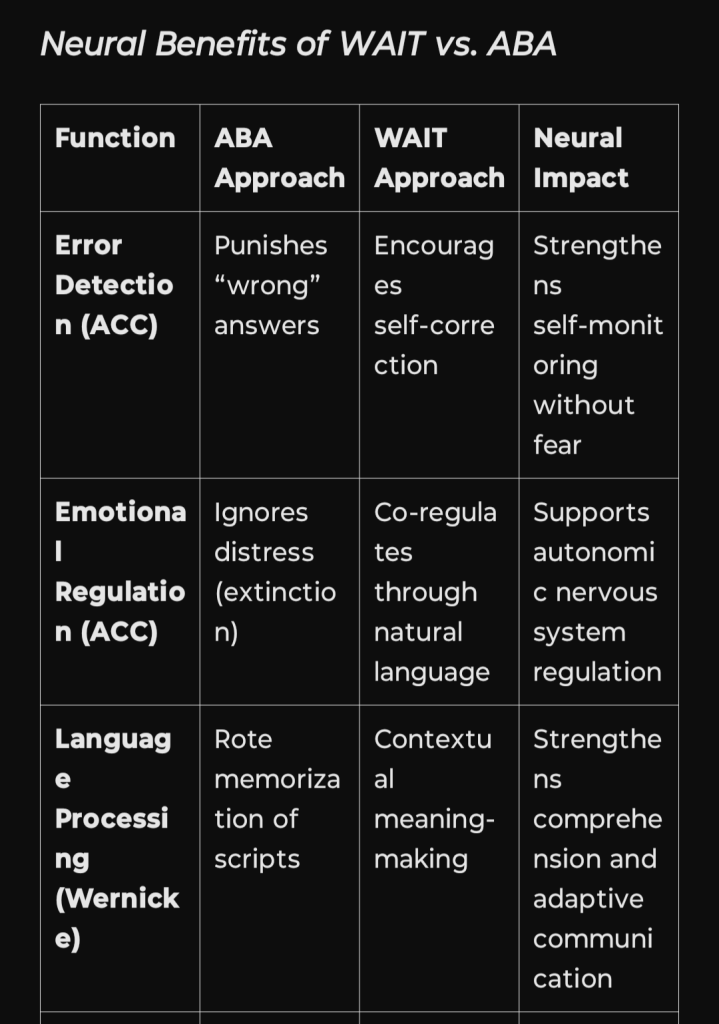
Instead of external compliance training, therapy would strengthen internal speech and self-monitoring mechanisms by activating Wernicke’s Area for meaning comprehension and the ACC for error detection and correction.
Example: Rather than using discrete trials (“Touch your nose”), we use guided self-talk:
Therapist: “I see you’re frustrated. Can you say what’s wrong?”
Child: “I don’t like this.”
Therapist: “You don’t like this? What would help?”
2. Emotional Co-Regulation Through Natural Language Processing
The ACC regulates emotional tone and social adaptation. Instead of using “planned ignoring” (ABA’s extinction strategy) for meltdowns, we engage in relational co-regulation that helps build internal error-correction without shame or suppression.
Example: A child struggling with frustration would be guided to verbalize distress (“This is hard, I need a break”) rather than being ignored until they comply.
3. Conflict Resolution & Meaning-Based Adaptation
Wernicke’s Area processes ambiguity and meaning, while the ACC resolves conflict. Rather than rewarding scripted responses, we support comprehension-based problem-solving.
Example:
ABA: “Say ‘thank you’ when someone gives you something.” (rote memorization)
WAIT: “How do we show appreciation when someone helps us?” (meaning-based interaction)
4. Intrinsic Motivation Over Extrinsic Compliance
Instead of rewards/punishments, WAIT fosters internal motivation through curiosity, social engagement, and contextual understanding.
Example:
ABA: “Do 5 tasks, get a token.”
WAIT: “Let’s explore how this works! What do you notice?”
5. Adapting Speech Processing & Pragmatics
Many autistic individuals struggle with pragmatic language processing, meaning they may take things literally or have difficulty with social context shifts.
WAIT uses neuro-aligned scaffolding, ensuring that abstract social norms are broken down into comprehensible, meaningful frameworks (not just memorized scripts).
Example:
Instead of forcing eye contact, we guide an understanding of social signaling without pressure:
“You don’t have to look at me, but can you listen to my words and tell me what you think?”
Neural Benefits of WAIT vs. ABA

Implementation & Training for WAIT
To implement WAIT as a viable alternative to ABA, we would:
1. Train Therapists & Educators
Teach neurodevelopmental approaches rooted in language processing, emotional co-regulation, and self-monitoring strategies.
2. Develop Personalized Learning Paths
Each child’s linguistic and cognitive profile would guide therapy, rather than using standardized compliance-based curricula.
3. Measure Progress via Comprehension & Emotional Flexibility
Instead of tracking task completion rates, we would assess comprehension, emotional adaptability, and problem-solving skills.
4. Scale & Replace ABA in Schools & Therapy Programs
WAIT-based interventions would be designed for early intervention, school inclusion, and family-based support.
Final Thought
This Wernicke-ACC-Informed Therapy (WAIT) re-centers language, self-regulation, and emotional understanding as the foundation for neurodivergent support—rejecting compliance models and instead fostering true autonomy, self-awareness, and meaningful social engagement.

 Spirolateral