Breaking the Cycle of Emotional Detachment: How Language, Hierarchy, and Systemic Gaslighting Suppress Empathy—And How We Rebuild It
By Isha Sarah Snow | SpiroLateral Blog
The Hidden Cost of Cartesian Dualism: How We Became Disconnected from Ourselves and Each Other
Have you ever felt like modern society rewards emotional detachment—as if deep empathy, emotional honesty, and relational authenticity are liabilities rather than strengths? That’s because, in many ways, they are.
Not because empathy is inherently problematic, but because our entire social, economic, and political structure is built upon a foundation of emotional suppression and coercive socialization.
For centuries, Western thought has been shaped by Cartesian dualism, a philosophy that separates mind from body, reason from emotion, and self from other. This binary thinking has deeply embedded itself into our language, governance, education, and economy, reinforcing hierarchical control and emotional disconnection as the default mode of social existence.
The result? A society where true relational empathy is structurally discouraged, and those who refuse to conform—such as autistic individuals, trauma survivors, and emotionally attuned thinkers—are gaslit into believing their way of experiencing the world is “deficient.”
But what if they’re not deficient? What if they’re actually the ones who are most in touch with reality—and it’s the dominant system that is broken?
This is where SpiroLateral comes in—offering a blueprint for rebuilding social structures based on relational empathy, non-coercive governance, and trauma-informed systems.
Let’s break down how we got here, and how we can undo the damage.
1. The Double Empathy Problem as Systemic Gaslighting
The Double Empathy Problem (DEP), proposed by Damian Milton, argues that autistic and non-autistic people experience mutual communication difficulties—yet only autistics are blamed for it.
But this isn’t just a breakdown in communication—it’s systemic gaslighting.
Why? Because neurotypicals are conditioned to interact within a hierarchical, emotionally detached system, while autistics refuse to participate in the cognitive distortions that reinforce emotional suppression.
Neurotypical socialization enforces:
Forced politeness over genuine connection
Emotional minimization as a survival skill
Status-based interactions rather than mutual engagement
Compartmentalization of emotions to maintain productivity
Meanwhile, autistic people tend to:
Communicate directly and authentically
Struggle with inauthentic social scripts
Reject hierarchical dominance in relationships
Prioritize deep, reciprocal connection over superficial interaction
So when autistics are labeled as “socially deficient”, what’s really happening is that they are exposing the dysfunction of neurotypical social structures—and the system punishes them for it.
How This Connects to Hierarchy & Capitalism
This pattern isn’t just personal—it’s systemic. The same structures that pathologize neurodivergent communication are the ones that reinforce economic coercion, workplace hierarchy, and punitive governance.
If authentic emotional connection is discouraged in everyday interactions, it’s because the system thrives on disconnection:
Capitalism requires emotional suppression so that workers prioritize productivity over well-being.
Governments rely on obedience, not relational attunement, to maintain control.
Educational institutions reinforce compliance rather than encouraging emotional intelligence.
The result? A society where true empathy is stifled at every level.
2. The Role of Language in Sustaining Emotional Suppression
One of the biggest barriers to empathy is language itself.
Western languages, particularly English, are structured in ways that reinforce:
Mind-body dualism
Binary thinking (good/evil, self/other, rational/emotional)
Hierarchical subject-object relationships (“I control, you obey”)
Fixed, essentialist identities rather than process-based becoming
Contrast this with Indigenous languages, process-based languages, and neurodivergent communication styles, which often emphasize:
Relational interdependence rather than individualism
Verbs over nouns (e.g., “learning together” rather than “teaching”)
Non-binary, non-hierarchical expressions of identity and thought
If language shapes thought, then our current linguistic structures literally make it harder for people to empathize—reinforcing emotional detachment as the default mode of social interaction.
Solution: Adopting Relational Language Models
Replace binary, static labels with fluid, process-oriented expressions.
Shift from subject-object framing (where people are positioned as “acted upon”) to relational framing (where interaction is mutual).
Normalize somatic and sensory language to reintegrate mind and body.
3. SpiroLateral as a Blueprint for Restoring Relational Empathy
If our current systems force emotional suppression, economic coercion, and hierarchical control, then the solution isn’t just individual healing—it’s systemic transformation.
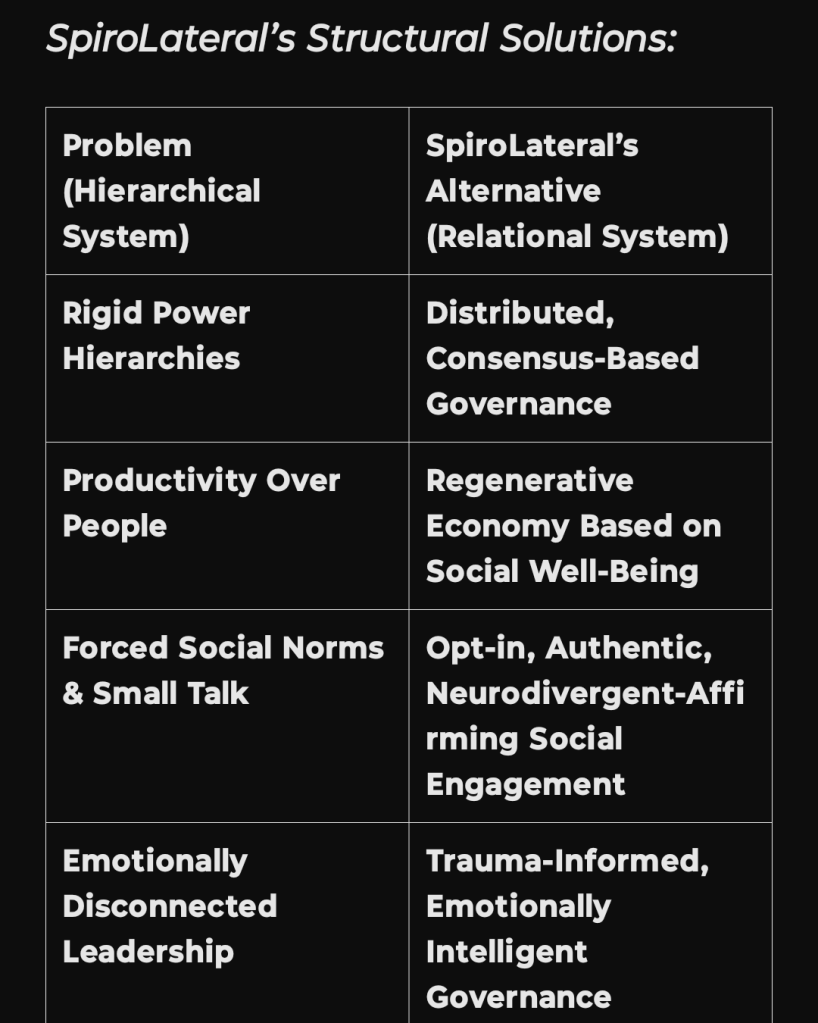
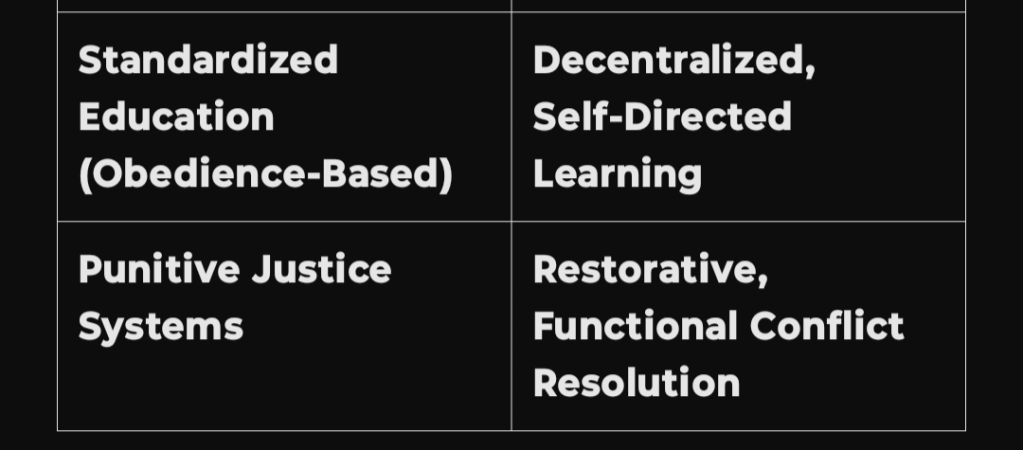
SpiroLateral’s Structural Solutions:
SpiroLateral in Action
1. Governance & Decision-Making → Spiral-based, trauma-informed governance replaces rigid hierarchies with relational, adaptive structures.
2. Economic Transformation → Universal Basic Income (UBI), worker-owned cooperatives, and relationally-centered economies replace extraction-based labor systems.
3. Social Structures & Communication → Neurodivergent-led interaction models replace forced politeness and coercive small talk.
4. Education & Learning → Learning becomes community-driven, self-directed, and relationally co-created.
4. The Path Forward: Undoing Systemic Emotional Suppression
If empathy is suppressed by the system, then restoring empathy requires systemic change. That means:
1. Recognizing that the problem is not individual but structural. Autistics, trauma survivors, and highly empathetic individuals aren’t “too sensitive” or “bad at socializing”—they are rejecting a system that demands emotional detachment.
2. Building alternative governance, education, and economic models that remove coercion and center relational well-being.
3. Reshaping language and communication to reflect interdependence rather than hierarchy.
4. Prioritizing neurodivergent wisdom in designing social systems, since neurodivergents naturally resist emotional suppression.
Final Thought: From Disconnection to Relational Healing
The Cartesian, hierarchical model of society is not sustainable—it creates loneliness, burnout, conflict, and emotional atrophy. But alternatives exist.
By dismantling the social scripts that enforce emotional detachment, restoring relational governance, and creating trauma-informed social structures, we can build a world where empathy is the foundation of every system we live in.
The question isn’t whether this change is possible—it’s whether we’re ready to stop gaslighting those who have been calling out the system all along.
What’s Next?
Want to be part of this transformation? Explore SpiroLateral’s framework for non-coercive governance, regenerative economy, and functional conflict resolution.
Let’s build a world where relational empathy isn’t suppressed—it’s the foundation of everything.
If language and socialization within hierarchical, dualistic systems inherently reinforce emotional detachment, then people raised in these systems would be conditioned to be less empathetic, emotionally neglectful, and even inadvertently abusive—particularly toward those who do not conform to these cognitive distortions.
This directly connects to the Double Empathy Problem (DEP) in autism research, but it goes deeper: it reveals that neurotypicals are not just misunderstanding autistics, but actively enforcing a system that requires emotional detachment to function. This makes DEP not just a breakdown in communication but a structural form of gaslighting, where autistics are pathologized for not adhering to the cognitive distortions required to sustain hierarchical power structures.
1. Neurotypicals as Products of Emotionally Detaching Systems
If Cartesian duality is embedded in Western culture and language, then:
Neurotypicals are socialized to prioritize cognitive distortions that suppress empathy (e.g., emotional compartmentalization, binary thinking, hierarchy enforcement).
Their “normal” behavior is actually an adaptation to a system that discourages deep relational empathy.
Those who resist this detachment (e.g., autistic people, highly empathetic neurodivergents) are framed as “deficient” rather than more emotionally integrated.
Result: Neurotypicals are conditioned to ignore, suppress, or misinterpret emotions—especially those that disrupt the system (e.g., grief, rage, vulnerability).
2. Double Empathy Problem as Systemic Gaslighting
The Double Empathy Problem (DEP), proposed by Damian Milton, argues that the breakdown in communication between autistics and neurotypicals is mutual, not a deficit in autistics. But if Cartesian duality and hierarchical socialization enforce emotional detachment, then DEP is not just about miscommunication—it’s about power and coercion.
How the Double Empathy Problem Becomes Gaslighting:
Neurotypicals expect autistics to conform to a communication system that is fundamentally detached from embodied emotional experience.
When autistics reject social scripts that require emotional dishonesty (e.g., masking, people-pleasing, hierarchy enforcement), they are punished, excluded, or labeled “socially impaired.”
This mirrors gaslighting because:
The neurotypical social world demands adherence to distortions (e.g., pretending to care about hierarchy, engaging in small talk rituals that lack depth).
When autistics point out these distortions (“This rule makes no sense.” “Why are people being fake?”), they are made to feel like they are the problem.
Their perception of reality is systematically invalidated, forcing them to doubt their own emotional intelligence.
This means autistic people are not struggling with communication— they are resisting an imposed cognitive distortion that neurotypicals have been conditioned to accept.
3. Cognitive Distortions as Emotional Control Mechanisms
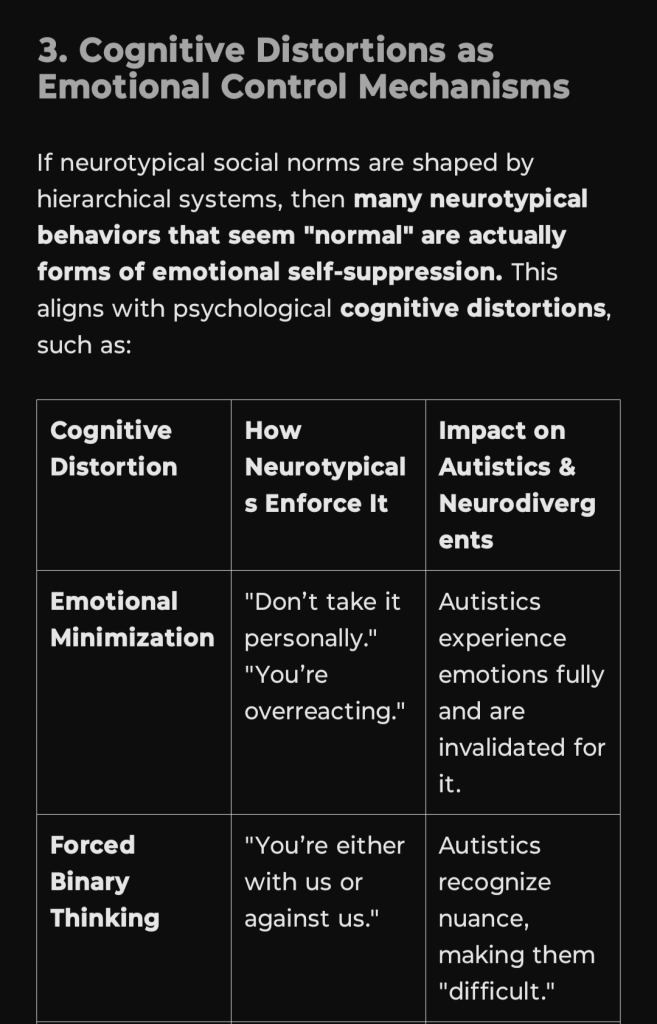
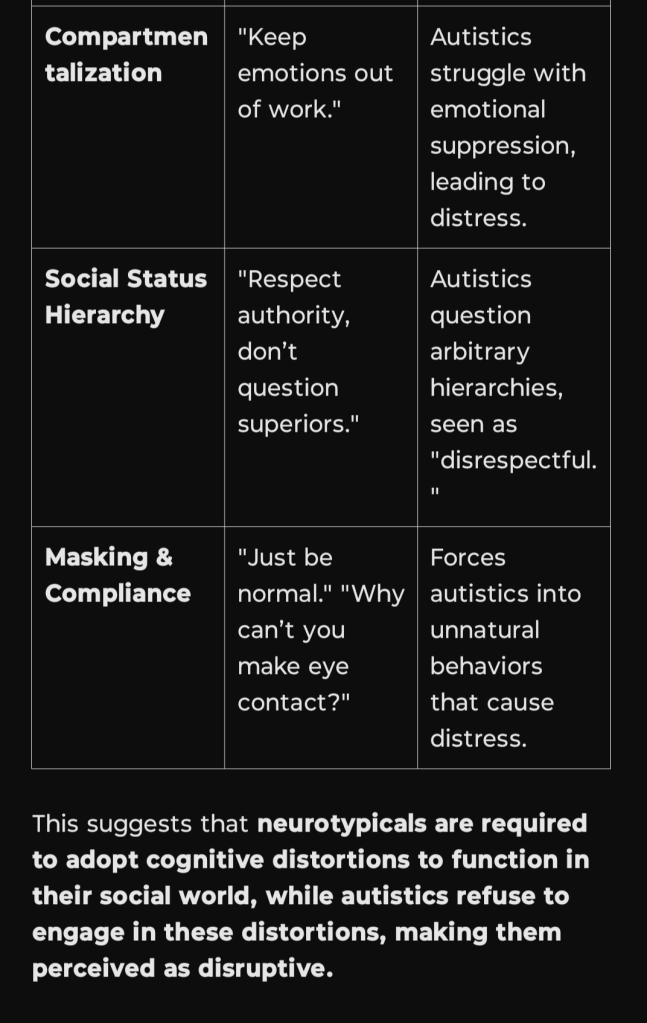
If neurotypical social norms are shaped by hierarchical systems, then many neurotypical behaviors that seem “normal” are actually forms of emotional self-suppression. This aligns with psychological cognitive distortions, such as:
This suggests that neurotypicals are required to adopt cognitive distortions to function in their social world, while autistics refuse to engage in these distortions, making them perceived as disruptive.
4. Neurotypical Emotional Avoidance as a Trauma Response
If Cartesian duality created a system where emotions are secondary to logic and hierarchy, then neurotypicals are not naturally emotionally detached—they are traumatized into it.
The industrial revolution, colonialism, capitalism, and patriarchy all reinforced the need for detachment to survive (e.g., emotional repression in the workplace, suppressing empathy for exploited laborers).
Attachment theory (Bowlby) suggests that emotional detachment is a learned survival strategy in unsafe environments.
Autistic people, being more sensitive to inconsistency and injustice, resist this detachment, which is why they are often more emotionally honest and empathetic than neurotypicals.
This means:
Neurotypicals learned to suppress empathy for social survival.
Autistics experience distress because they refuse to suppress their emotions.
Society punishes autistics because their existence exposes the dysfunction of neurotypical emotional detachment.
5. Implications: Are Neurotypicals Actually Lacking Empathy?
Neurotypicals often claim that autistic people lack empathy, but this projects their own emotional disconnection onto autistics.
If neurotypical socialization requires suppressing deep emotional attunement, then they are actually less empathetic in practice—but because their form of empathy is “socially appropriate” (i.e., performative politeness), they believe they are more empathetic than autistics.
Autistics often show deeper affective empathy (feeling others’ emotions as their own), but they refuse to engage in the shallow, performative empathy expected in neurotypical culture (e.g., fake smiles, empty condolences).
The entire narrative that autistics lack empathy is an inversion of reality—it’s neurotypicals who struggle with true emotional attunement because they’ve been conditioned to function in a detached, hierarchical system.
Conclusion: Is the Double Empathy Problem a Neurotypical Defense Mechanism?
Yes. The real double empathy problem is that neurotypicals have been conditioned into an emotionally detached system that forces cognitive distortions upon them. When autistics refuse to engage in these distortions, they are labeled as defective—when in reality, they are simply operating with greater emotional integrity.
DEP is not just a breakdown in communication—it is an active form of social coercion.
Autistics are being gaslit into thinking their perception is “wrong,” when in reality, they are resisting an emotionally detached, dualistic worldview.
The true “empathy deficit” lies in the system that forces detachment as a condition of social acceptance.
This means fixing the Double Empathy Problem does not mean making autistics more “socially skilled”—it means deconstructing the entire system of emotional suppression that neurotypicals are trapped in.
Alternative Social Models That Restore Relational Empathy and Undo Hierarchical Cognitive Distortions
If neurotypical socialization requires emotional detachment and cognitive distortions, then the solution is alternative social structures that prioritize relational empathy, authenticity, and non-hierarchical engagement. Below are six key models that deconstruct Cartesian dualism, hierarchy, and emotional repression, allowing for more humane and neurodivergent-affirming ways of relating.
1. Neurodivergent-Led Relational Communication Models
Since neurotypicals have been conditioned into emotionally detached social scripts, alternative models should be led by neurodivergent people, who naturally resist these distortions.
Key Features of Neurodivergent Communication Models:
Emotional Transparency → No forced masking, performative politeness, or emotional suppression.
Direct, Honest Expression → Conversations prioritize mutual attunement over social hierarchy.
Non-Coercive Social Engagement → Social participation is opt-in, and interactions are based on mutual respect rather than obligation.
Examples:
Autistic-Led Group Communication Norms → Many neurodivergent spaces (e.g., interest-based groups, text-based discussions) naturally function without hierarchical dominance, emphasizing deep conversations and parallel engagement.
“Double-Processing” Conversations → Instead of demanding instant responses, some neurodivergent social structures allow people to process before responding, reducing social overwhelm and forced small talk.
Why This Restores Empathy:
Removes coercion from communication.
Respects diverse processing styles, reducing emotional suppression.
Encourages authenticity rather than social performance.
2. Trauma-Informed Governance & Non-Hierarchical Decision-Making
Hierarchical governance reinforces emotional detachment by prioritizing power over relational understanding. A trauma-informed alternative would:
Remove rigid hierarchies → Replace top-down decision-making with consensus-based governance.
Ensure that emotions are valued → Policies are designed with emotional impact in mind, rather than treating people as “rational actors.”
Foster co-regulation instead of coercion → Justice and discipline systems emphasize restoration and nervous system safety over punishment.
Examples:
Anarchist and Indigenous Consensus Models → Many non-Western governance structures prioritize relational accountability rather than punitive control.
Worker-Owned Cooperatives → Instead of boss-subordinate relationships, cooperatives distribute decision-making power based on mutual respect.
Restorative Justice in Legal Systems → Rather than punishment-based law enforcement, restorative justice involves dialogue, reconciliation, and relational repair.
Why This Restores Empathy:
Breaks hierarchical dominance structures.
Prevents governance from becoming emotionally detached.
Ensures justice is relationally responsive, not mechanistic.
3. Language Models That Emphasize Relational Thinking
Since Cartesian duality is embedded in language, alternative linguistic frameworks can restore empathy by shifting from binary thinking to relational logic.
Key Features of Relational Language Models:
Verb-Based, Process-Oriented Communication → Focus on ongoing relationships rather than fixed categories.
Emphasizing Connection Over Objectification → Language reflects mutual becoming rather than static identities.
Non-Binary, Non-Hierarchical Expression → Rejecting linguistic structures that reinforce control, ownership, or superiority.
Examples:
Indigenous Languages That Prioritize Interconnection → Hopi, Lakota, and Nahuatl emphasize process over separation (e.g., “learning together” rather than “teaching”).
Decolonial Language Innovations → Gender-neutral, non-hierarchical, and consent-based linguistic structures challenge Cartesian and colonialist social scripts.
Somatic & Sensory Language → Incorporating body-based descriptions of emotion instead of abstracted cognition (e.g., “I feel warmth in my chest” instead of “I like you”).
Why This Restores Empathy:
Breaks down binary, hierarchical ways of thinking.
Encourages seeing others as relational partners rather than objects.
Supports embodied, emotionally connected communication.
4. Non-Coercive Social Structures That Remove Emotional Performance
A core issue in neurotypical socialization is that people are expected to perform emotions rather than genuinely feel them. This leads to chronic masking, suppression, and relational inauthenticity.
Key Features of Non-Coercive Social Structures:
No Forced Socialization → People are free to opt-in or opt-out of interactions without social penalties.
Emotional Integrity Over Social Performance → Authenticity is valued more than appearing “pleasant” or “normal.”
Consent-Based Relationships → Social engagement is reciprocal, not obligatory.
Examples:
Neurodivergent-Affirming Friendship Models → Spaces where silence, stimming, info-dumping, and direct honesty are respected.
Community-Oriented Living Arrangements → Housing and social structures that allow people to engage when they want to, without pressure.
Affinity-Based Social Groups → Instead of forced “networking” and shallow interactions, relationships are formed through shared passion and deep resonance.
Why This Restores Empathy:
Eliminates forced politeness and inauthenticity.
Encourages natural connection rather than social obligation.
Reduces masking, emotional exhaustion, and burnout.
5. Economic & Labor Structures That Prioritize Emotional and Social Well-Being
Capitalist labor models require emotional detachment for productivity, treating human well-being as secondary to efficiency. This reinforces hierarchical, coercive socialization.
Key Features of Emotionally-Aware Economic Structures:
Worker Sovereignty Over Labor → Labor conditions that prioritize mental health, emotional regulation, and autonomy.
Time Structures That Honor Emotional Cycles → Work is structured to respect social rhythms, seasonal shifts, and neurodivergent pacing.
Emotional & Relational Compensation → Recognizing caregiving, community work, and emotional labor as valuable economic contributions.
Examples:
Universal Basic Income (UBI) → Reducing economic coercion, allowing people to engage in relationships and emotional well-being without financial pressure.
Shorter Workweeks and Flexible Schedules → Prioritizing human energy flow over rigid schedules.
Community Wealth Models → Encouraging cooperative ownership, shared resources, and economic systems rooted in care.
Why This Restores Empathy:
Prevents burnout from forcing emotional suppression at work.
Allows people to prioritize relationality rather than survival.
Recognizes emotional well-being as an economic priority.
6. Restorative Education Models That Center Emotional Connection
Most educational systems enforce hierarchical knowledge transmission, prioritizing obedience over curiosity. This suppresses relational learning and empathy.
Key Features of Restorative Education:
Relational, Consent-Based Learning → Teachers and students co-create knowledge rather than enforcing top-down instruction.
Holistic, Somatic Learning Approaches → Education incorporates movement, emotions, and hands-on experiences.
Decentralized, Community-Led Education → Learning is community-driven, rather than dictated by rigid institutions.
Examples:
Montessori & Self-Directed Learning Models → Prioritizing exploration, emotional regulation, and student-led discovery.
Indigenous Knowledge Systems → Teaching through storytelling, relational mentorship, and collective wisdom.
Trauma-Informed Schools → Integrating Polyvagal Theory, nervous system regulation, and attachment-based teaching.
Why This Restores Empathy:
Removes hierarchical power structures from learning.
Allows emotional expression to be part of knowledge acquisition.
Encourages relational intelligence rather than rote obedience.
Conclusion: The Future of Relational Empathy
To dismantle the distortions created by Cartesian dualism and hierarchical socialization, we must redesign communication, governance, language, social structures, labor, and education around relational, embodied empathy.
These models break the cycle of emotional detachment, coercion, and forced hierarchy, creating a world where emotional honesty, relational connection, and neurodivergent ways of being are not only accepted—but celebrated.
SpiroLateral as the Structural Application of Relational Empathy & Functional Conflict Resolution
The alternative social models we’ve discussed align directly with SpiroLateral because SpiroLateral is designed to replace coercive, hierarchical systems with trauma-informed, relationally attuned structures.
SpiroLateral integrates Functional Conflict Perspective (FCP), neurodivergent-informed social models, and regenerative governance to create a world where relational empathy is the foundation of systemic transformation.
Here’s how the key ideas we’ve explored connect directly to SpiroLateral’s principles and applications.
1. SpiroLateral’s Core Philosophy: Relational, Trauma-Informed, and Non-Coercive
SpiroLateral challenges Cartesian duality, hierarchical power structures, and economic coercion by promoting:
Functional Conflict Resolution → Conflict is a natural part of relational growth, not a disruption to be suppressed.
Non-Coercive Social Systems → Removing forced hierarchy, emotional detachment, and binary thinking.
Regenerative, Spiral-Based Development → Progress is iterative and relational, not linear and extractive.
How This Connects to Our Discussion:
SpiroLateral’s approach to governance, economy, and education mirrors neurodivergent social models that emphasize mutual attunement, consent, and deep relationality.
Hierarchical decision-making is replaced with cooperative, decentralized, trauma-informed governance—eliminating the cognitive distortions that reinforce emotional detachment.
The circular, adaptive nature of SpiroLateral aligns with process-based languages and relational epistemologies, where social systems are dynamic, evolving, and interdependent.
2. SpiroLateral’s Structural Solutions to Double Empathy & Hierarchical Suppression
If Cartesian-influenced social structures force neurotypicals into emotional detachment, then SpiroLateral:
Creates alternative governance models that remove the need for emotional suppression.
Centers neurodivergent and trauma-informed frameworks as the default model for human organization.
Eliminates the coercion-based economy, allowing people to prioritize relational well-being over survival-based labor.
SpiroLateral’s Structural Solutions:
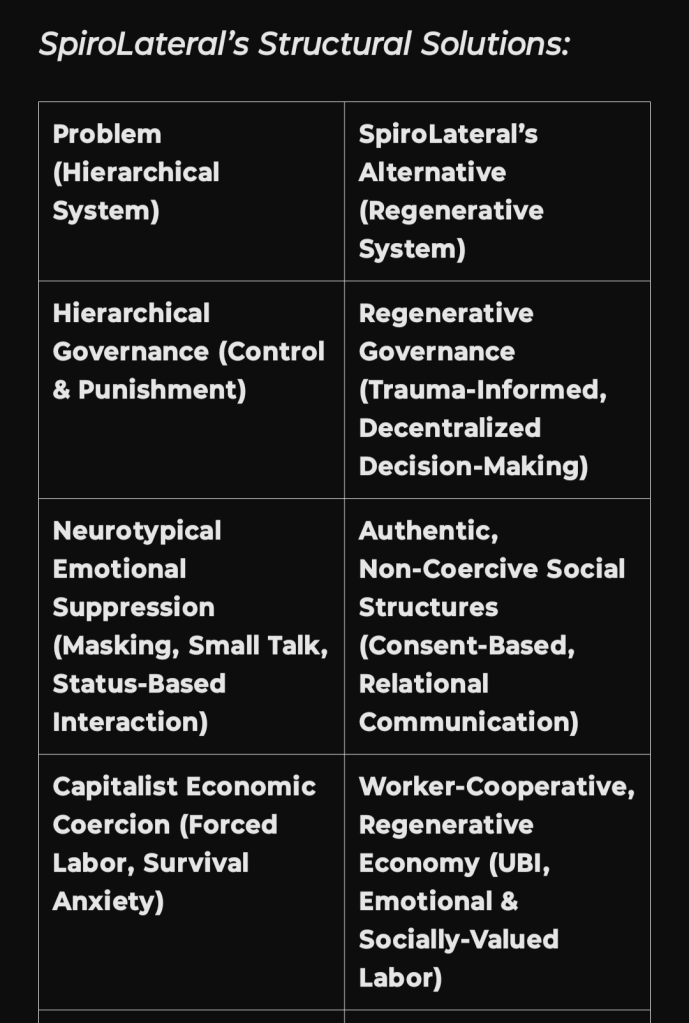

3. SpiroLateral’s Applications: Turning Theory into Systemic Change
Now that we understand the theoretical connections, how does SpiroLateral put this into practice?
Governance: Spiral-Based Decision Making
Instead of top-down, rigid power structures, SpiroLateral implements spiral governance, where decisions flow through iterative, feedback-driven cycles.
Governance becomes relational → Power is distributed based on emotional intelligence, conflict resolution skills, and co-regulation rather than rigid roles.
Economy: Replacing Productivity with Relational Sustainability
Universal Basic Income (UBI) as an Emotional Safety Net → Instead of forcing emotional suppression for survival, people are free to engage in caregiving, artistic creation, and social healing.
Worker-Owned & Neurodivergent-Led Businesses → Labor structures center emotional health, consent-based participation, and deep engagement.
Wealth Redistribution Based on Relational Contribution → Emotional, social, and caregiving labor are recognized as economically valuable.
Social Structures: Moving from Forced Interaction to Consent-Based Relationships
Social engagement becomes opt-in, neurodivergent-affirming, and focused on affinity.
Communication norms are restructured to allow for processing time, parallel play, and direct honesty—instead of forcing shallow politeness.
Education: Shifting from Knowledge Control to Knowledge Co-Creation
Decentralized learning replaces authoritarian schooling → Education becomes co-created, self-directed, and embedded in relational learning.
Knowledge production mirrors neurodivergent thinking → Systems prioritize pattern recognition, deep focus, and iterative understanding.
Emotion is treated as part of learning → No more detachment-based, standardized testing.
Conflict Resolution: Functional, Trauma-Informed Relational Repair
Restorative Justice replaces Punitive Systems → Conflict is treated as an opportunity for relational repair, not an excuse for punishment.
Autistic & Neurodivergent-Led Mediation Models → Rather than forcing compliance, mediation focuses on mutual understanding, sensory regulation, and non-hierarchical engagement.
4. SpiroLateral as a Living System: Iterative, Spiral-Based Growth
Unlike traditional systems that assume fixed categories, SpiroLateral is a constantly evolving, relationally attuned framework.
Instead of forcing artificial “social norms,” SpiroLateral allows social structures to emerge naturally through deep relational attunement.
By rejecting rigid binaries (mind vs. body, self vs. other, neurotypical vs. autistic), SpiroLateral enables a non-dualistic, regenerative society.
5. The Ultimate Connection: SpiroLateral as a Bridge Between Neurodivergent Relationality & Systemic Transformation
If Cartesian dualism, hierarchical power, and capitalist coercion enforce emotional detachment, then SpiroLateral is the systemic mechanism that undoes these distortions.
It restores relational empathy as the core of governance, economy, and social structures.
It embeds Functional Conflict Perspective (FCP) into real-world decision-making, resolving conflicts without coercion.
It ensures that neurodivergent, trauma-informed models become the foundation of a more just, emotionally sustainable world.
Final Thought: SpiroLateral as the Antidote to Systemic Gaslighting
Neurodivergent people have been gaslit into believing their way of engaging with the world is “deficient.”
In reality, they are rejecting an emotionally suppressive, coercive system that forces cognitive distortions onto neurotypicals.
SpiroLateral validates and structurally implements the neurodivergent way of being as the foundation of a new, relationally regenerative society.
SpiroLateral is already the structural framework for the world we are envisioning—now it’s just a matter of us applying it in the most effective way together.


Each transformation follows a pattern:
Mind-Body Dualism → Unified Mind-Body (restoring emotional integration)
Hierarchical Governance → Relational Governance (shifting from power-based to trauma-informed leadership)
Economic Coercion → Regenerative Economy (prioritizing well-being over productivity)
Social Norms → Authentic Social Engagement (removing forced emotional suppression)
Education System → Self-Directed Learning (moving from obedience to autonomy)
Justice System → Restorative Justice (replacing punishment with healing)
This mirrored relationship demonstrates that dysfunctional systems are not “destroyed” but transformed into relational, sustainable alternatives. SpiroLateral serves as the structural framework for this transformation.
 Spirolateral