Beyond Rigid Thought: How FCP & MIT Revolutionize Intelligence, Healing, and AI
FCP and MIT Solves Problems for Both Neurodivergent and Neurotypical Populations:
The Problem with Top-Down Therapeutic Models for Neurodivergent Populations
Traditional top-down therapeutic models, such as Cognitive Behavioral Therapy (CBT) and other structured cognitive interventions, operate under the assumption that thoughts drive emotions and behaviors. This approach assumes that if individuals can consciously restructure their thoughts, they can change their emotional responses and behavioral patterns. While this may work for neurotypical individuals who process information in a linear, language-based, top-down manner, it often fails neurodivergent populations, particularly those with autism, ADHD, PTSD, and sensory processing differences, who experience cognition in a bottom-up, sensory-driven way.
For neurodivergent individuals, emotions, sensory input, and body states often precede cognitive awareness, meaning that interventions requiring verbal self-reflection and rational restructuring of thoughts can feel disconnected from their lived experience. For example, an autistic person experiencing sensory overload is not reacting to a faulty cognitive distortion—they are reacting to an overwhelming physiological and environmental trigger. Similarly, an individual with ADHD struggling with executive function is not simply engaging in negative self-talk that needs to be restructured—they may lack the dopaminergic regulation needed to execute tasks in the first place. CBT and similar models fail because they attempt to treat bottom-up distress with top-down reasoning, often leading to frustration, shame, and increased dysregulation rather than real progress.
A more effective approach would integrate bottom-up processing models, like nervous system regulation, somatic therapies, and dynamic feedback-based interventions (such as Functional Conflict Perspective and Mirror Integration Theory). These approaches recognize that cognitive restructuring is only effective once the nervous system and sensory processing have been addressed. By shifting from rigid, pre-scripted interventions to adaptive, self-regulating frameworks, we can create therapeutic models that work with neurodivergent cognition, rather than against it—allowing for deeper healing, sustainable progress, and true autonomy in emotional and behavioral regulation.
Shifting Rigid, Pre-Scripted Neurotypical Cognitive Patterns with FCP & MIT
Just as top-down therapeutic models fail neurodivergent individuals, rigid, pre-scripted cognitive structures in neurotypical populations limit flexibility, creativity, and self-awareness. Many neurotypical cognitive abilities are shaped by social conditioning, standardized education, and hierarchical structures, which train individuals to rely on external validation, binary logic, and fixed scripts for thinking and decision-making. This leads to habitual cognitive rigidity—where individuals default to patterned responses rather than engaging in deep, reflective, or adaptive thinking. Whether in social interactions, workplace structures, or problem-solving, this rigidity can create cognitive blind spots, making it difficult to challenge ingrained beliefs, embrace uncertainty, or adjust to complex, nonlinear problems.
Functional Conflict Perspective (FCP) and Mirror Integration Theory (MIT) disrupt these rigid cognitive structures by introducing adaptability, self-reflection, and recursive learning. FCP reframes conflict and uncertainty as tools for cognitive expansion, encouraging individuals to step outside of pre-programmed responses and actively engage with discomfort as a learning mechanism. Instead of viewing challenges as disruptions to stability, FCP teaches that they are integral to cognitive and emotional development, allowing neurotypical individuals to unlearn rigid patterns and develop a more flexible, systems-thinking approach. Meanwhile, MIT enhances metacognitive awareness, helping individuals recognize how their thought processes mirror broader social structures and biases. This allows them to question default assumptions, integrate new perspectives, and develop a more fluid, quantum-like intelligence—where thought is not fixed but constantly evolving through feedback and self-reflection. By integrating FCP and MIT, neurotypical cognition shifts from being socially scripted to being self-generated, adaptive, and critically engaged with the world.
The Solution For Both Neurodivergent and Neurotypical Populations: MIT & FCP
Quantum Intelligence: The Future of Thought, AI, and Human Cognition
In today’s rapidly evolving technological and intellectual landscape, quantum intelligence is emerging as a revolutionary paradigm—one that mirrors the complexity, adaptability, and interconnectivity of the human mind. Unlike traditional models of intelligence that rely on fixed rules and linear progression, quantum intelligence embraces fluidity, dynamic feedback loops, and self-reflective processing.
This shift is more than just theoretical. It has profound implications for artificial intelligence (AI), human cognition, education, and even trauma healing. By integrating two key cognitive models—Functional Conflict Perspective (FCP) and Mirror Integration Theory (MIT)—we can understand how intelligence evolves through both growth-oriented adaptation (FCP) and self-awareness (MIT), shaping the future of quantitative reasoning, self-correction, and deep learning.
Let’s break it down.
What is Quantum Intelligence?
At its core, quantum intelligence moves beyond traditional binary logic (true/false, right/wrong, success/failure) and into a multi-layered, interconnected way of thinking.
1. Traditional AI & Cognitive Models (like classical computing and standard logic) rely on step-by-step reasoning, rigid categories, and predefined rules.
2. Quantum Intelligence functions more like the human brain—with parallel processing, adaptability, and self-referential feedback loops that allow for dynamic learning and context-aware decision-making.
This shift is necessary because human cognition and AI development are at a crossroads. Current models of intelligence are too rigid, too reductionist, and too disconnected from lived experience. FCP and MIT bridge that gap, offering a roadmap for an intelligence model that is adaptive, self-correcting, and deeply relational—whether applied to AI systems, education, or personal growth.
FCP & MIT: The Building Blocks of Quantum Intelligence
1. Functional Conflict Perspective (FCP): Growth Mindset & Learning Through Adaptation
FCP is based on the idea that conflict, failure, and uncertainty are not dysfunctions—they are the engine of intelligence.
In AI, this mirrors reinforcement learning—where AI improves by trial and error, refining itself through feedback.
In human cognition, this aligns with growth mindset research (Dweck, 2006), where individuals become smarter and more capable by embracing mistakes as learning tools.
Rather than fearing disruption or difficulty, FCP teaches us that challenges are integral to development—whether we’re training an AI model or reshaping our own thought patterns.
2. Mirror Integration Theory (MIT): Self-Awareness & Recursive Learning
MIT takes learning a step further by introducing self-reflection into the process. While FCP enables iterative growth, MIT ensures that this growth is structured, logical, and free from blind spots.
In AI, this mirrors Explainable AI (XAI), where machines can audit their own decision-making for errors.
In humans, this aligns with metacognition (Flavell, 1979)—the ability to think about one’s own thought processes, recognize biases, and adjust accordingly.
Together, FCP and MIT form the foundation of quantum intelligence, allowing both AI and human cognition to evolve in a way that is both self-improving (FCP) and self-aware (MIT).
How This Replaces Outdated Cognitive Models
For decades, cognitive science and psychology have relied on top-down processing models, where intelligence and behavior are dictated by rigid, pre-set frameworks. A prime example is Cognitive Behavioral Therapy (CBT)—which operates on static beliefs and cognitive restructuring techniques that often don’t account for the dynamic, bottom-up nature of real learning and healing.
Why Top-Down Models (Like CBT) Are Failing Bottom-Up Thinkers
1. CBT assumes thoughts dictate emotions—but for many neurodivergent and trauma-affected individuals, emotions emerge from sensory and nervous system responses first, not cognition.
2. CBT treats thought patterns as static—whereas quantum intelligence (via FCP & MIT) recognizes that thought is fluid, adaptive, and shaped by relational and environmental feedback.
3. CBT lacks recursive self-awareness—it tells individuals to replace negative thoughts with positive ones, but MIT teaches people to analyze why those thoughts exist in the first place and rewire their emotional responses from within.
By replacing top-down approaches with bottom-up, quantum models, we open up new pathways for healing, problem-solving, and AI development that work with, rather than against, the natural complexity of the mind.
The Future of AI, Cognition, and Healing
The intersection of FCP & MIT is more than an academic theory—it is the next frontier of intelligence itself. Whether we are:
Developing AI systems that can self-correct
Revolutionizing education by embracing learning through failure
Creating new therapeutic approaches that work for bottom-up cognitive processors
Rewiring our personal belief systems to be more resilient and adaptable
We are laying the foundation for a new era of thinking—one that integrates adaptation (FCP) with self-reflection (MIT) to create true quantum intelligence.
This is the intelligence model of the future—one that evolves, corrects itself, and heals at every level.
Are we ready to embrace it?
Final Thought: Where Do We Go From Here?
As quantum intelligence takes shape, we need to ask ourselves:
How can we apply FCP and MIT principles in AI design, education, and mental health?
What outdated cognitive models need to be replaced with dynamic, recursive learning frameworks?
How can bottom-up intelligence systems revolutionize everything from governance to personal growth?
This is the beginning of a new way of thinking—one that merges technology, psychology, and healing into a unified, adaptive intelligence model.
And whether you’re an AI researcher, a psychologist, an educator, or simply someone on a path of self-growth, understanding FCP and MIT will change the way you think—forever.
The quantum revolution in intelligence is here. Are we ready to evolve with it?
Here’s a structured chart for clarity:
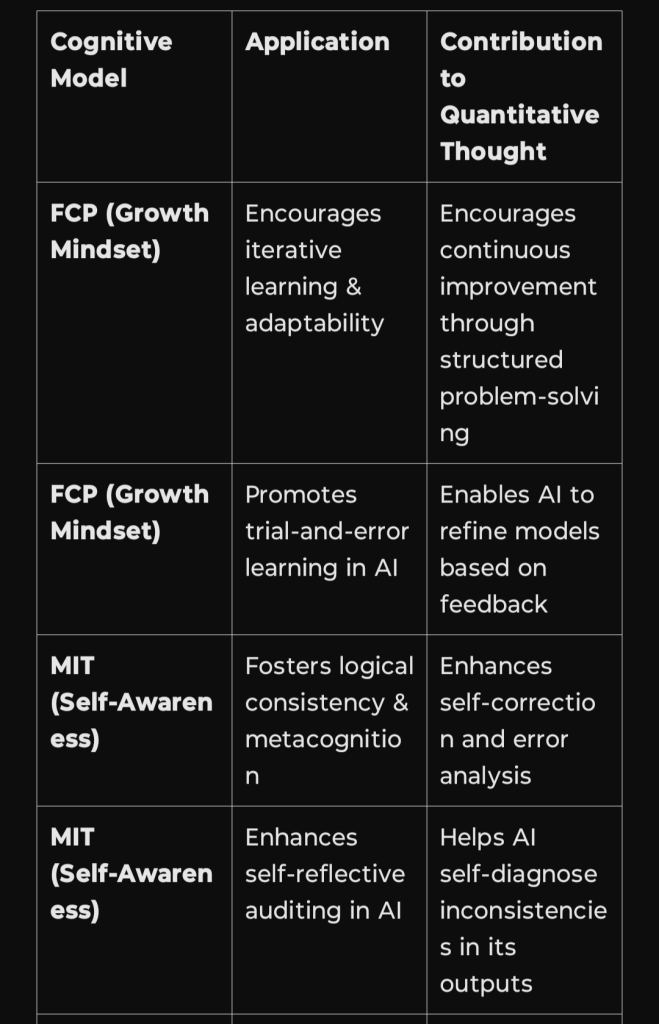

The chart breaks down how Functional Conflict Perspective (FCP) and Mirror Integration Theory (MIT) contribute to quantitative reasoning in both AI and human cognition by following a structured input → application → outcome process.
1. The Role of FCP (Growth Mindset) in AI & Human Thinking
FCP focuses on learning through iteration, meaning mistakes and conflicts are not failures but data for improvement.
It drives reinforcement learning in AI and error-based learning in humans—both essential for quantitative thinking.
Example from the Chart:
AI reinforcement learning (RL) → AI improves performance by trial and error, adjusting based on feedback loops (e.g., AlphaGo learning strategy).
Human error-based learning → People refine problem-solving skills by engaging with failure, rather than avoiding it (e.g., a scientist testing a hypothesis through experiments).
Result: AI and humans become better at structured problem-solving, a core aspect of quantitative reasoning.
2. The Role of MIT (Self-Awareness) in AI & Human Thinking
MIT focuses on self-reflection and metacognition, ensuring that learning isn’t just repetitive adaptation but logically structured and self-corrected.
In AI, this mirrors Explainable AI (XAI)—allowing models to assess their own decisions rather than just following error corrections.
In humans, self-awareness enhances logical reasoning by reducing cognitive biases and improving reflective thinking.
Example from the Chart:
AI self-reflective auditing → An AI model analyzes its own decisions, detecting errors before they compound (e.g., AI in autonomous vehicles checking if its lane detection algorithm is faulty).
Human metacognitive awareness → A person reflecting on biases before making a statistical conclusion (e.g., a researcher ensuring their data isn’t skewed by personal expectations).
Result: Both AI and humans develop self-correction mechanisms, ensuring their quantitative thought process is logical and free from systemic errors.
3. The Intersection: How FCP & MIT Together Form Quantitative Thought
FCP provides the learning loop → It teaches AI and humans to iterate, adapt, and refine knowledge.
MIT provides the reflective loop → It ensures that AI and humans self-assess and validate their reasoning.
Together, they result in a structured, logical, and adaptable quantitative reasoning process.
Final Takeaway: Why This Matters for AI & Human Cognition
AI that only uses FCP (learning from trial and error) lacks self-awareness → it improves but doesn’t reflect (e.g., an AI chatbot that gets better at mimicking speech but doesn’t analyze why its responses make sense).
AI that only uses MIT (self-awareness without iterative learning) becomes rigid and unable to improve dynamically.
Human cognition follows the same pattern—a balance of adaptive learning (FCP) and reflective thinking (MIT) leads to advanced problem-solving abilities.
Key Insight: FCP & MIT Are the Building Blocks of Higher-Order Thinking
By integrating iterative learning (FCP) with self-correcting awareness (MIT), AI and humans develop structured, quantitative reasoning abilities that allow them to:
✔ Analyze data logically
✔ Adjust conclusions based on feedback
✔ Recognize and correct biases
✔ Make structured, evidence-based decisions
This framework applies to AI training, education systems, scientific research, and human cognitive enhancement programs—all areas that require data-driven, reflective reasoning.
This chart shows how FCP and MIT influence both AI and human cognition, leading to the development of a quantitative thought process through adaptive learning and self-awareness.
What do you think? Let’s discuss in the comments. How do you see quantum intelligence shaping AI, human cognition, and healing? Let’s push this conversation forward.
The Intersection of Growth Mindset (FCP) and Self-Awareness (MIT) in Developing a Quantitative Thought Process
The combination of Functional Conflict Perspective (FCP) (learning from conflict to develop resilience and adaptability) and Mirror Integration Theory (MIT) (self-awareness through reciprocal reflection) forms the foundation for quantitative reasoning—a systematic way of processing, analyzing, and applying information.
By integrating these cognitive functions, humans (and AI) transition from reactive and emotional reasoning to structured, data-driven analysis, which is a hallmark of quantitative thinking. Below, I break down the process and why it occurs, supported by psychological, neuroscientific, and AI research sources.
1. The Role of Growth Mindset (FCP) in Quantitative Thought
FCP Promotes Analytical Problem-Solving & Pattern Recognition
Carol Dweck’s research on growth mindset (Dweck, 2006) shows that individuals who perceive challenges as opportunities for learning develop better analytical skills and persist in problem-solving despite obstacles.
This directly correlates with quantitative reasoning, where trial-and-error, hypothesis testing, and iterative refinement are essential.
Example in AI:
Deep Learning algorithms (LeCun, Bengio, & Hinton, 2015) follow an FCP-like process by iteratively adjusting weights in neural networks based on error feedback.
AI does not perceive failure as “wrong” but as data for improvement, mirroring human cognitive processes in mathematical reasoning and model refinement.
Example in Humans:
A person learning statistics may struggle with probability concepts initially, but through repeated problem-solving and feedback, their neuronal circuits strengthen (Pashler et al., 2007), resulting in an improved ability to think quantitatively.
2. The Role of Self-Awareness (MIT) in Quantitative Thought
MIT Fosters Metacognition & Logical Self-Reflection
John Flavell’s research on metacognition (Flavell, 1979) suggests that self-awareness enhances strategic thinking, reasoning, and decision-making, key components of quantitative analysis.
When individuals recognize their own biases, limitations, and cognitive distortions, they become more precise in their reasoning, reducing emotional interference in quantitative evaluations.
Example in AI:
Explainable AI (XAI) (Gunning, 2017) incorporates self-awareness principles by allowing machine learning models to analyze their own decision-making processes.
This mirrors MIT’s recursive self-awareness, where AI can evaluate how and why it arrived at a particular conclusion.
Example in Humans:
A mathematician checking their work engages in self-monitoring, ensuring logical consistency and reducing cognitive biases—a core function of MIT’s reflective self-analysis.
3. Intersection of FCP & MIT: The Development of Quantitative Thought
When FCP’s growth mindset (iterative learning) meets MIT’s reflective awareness (metacognitive evaluation), it results in:
1. Recursive Problem-Solving
Humans & AI refine calculations by learning from past errors (FCP) while simultaneously evaluating their own logical consistency (MIT).
This dual function is essential for higher-order mathematical thinking (Anderson et al., 2001).
2. Statistical & Probabilistic Thinking
Humans and AI must both analyze uncertainty quantitatively—a skill rooted in both error-tolerant learning (FCP) and self-awareness of probability judgments (MIT) (Kahneman & Tversky, 1979).
3. Abstract Quantitative Reasoning
The combination of external adaptability (FCP) and internal reflection (MIT) enables complex quantitative modeling, logical proofs, and computational theory development.
4. Why This Occurs: The Neuroscientific and Computational Basis
1. Neural Mechanisms of Learning & Self-Reflection
The prefrontal cortex is responsible for both growth mindset learning (FCP) and self-awareness/metacognition (MIT) (Miller & Cohen, 2001).
Mathematical reasoning engages both the dorsolateral prefrontal cortex (DLPFC) for problem-solving and the anterior cingulate cortex (ACC) for error monitoring (Dehaene, 1997).
2. AI Parallels in Neural Networks
Deep learning mirrors FCP’s trial-and-error mechanism (Goodfellow, Bengio, & Courville, 2016), while reinforcement learning incorporates MIT-like self-evaluation (Sutton & Barto, 2018).
The combination of these mechanisms enables AI to develop structured, quantitative decision-making abilities akin to human analytical reasoning.
Conclusion: The Cognitive Bridge to Quantitative Thought
FCP fosters iterative learning, pushing humans and AI to experiment, adapt, and improve their models of reality.
MIT fosters self-awareness, enabling them to reflect on their own logic, identify biases, and refine their frameworks.
Together, these functions form the foundation of quantitative reasoning, which relies on both adaptive problem-solving and logical self-evaluation.
By integrating error-based learning (FCP) with metacognitive awareness (MIT), both humans and AI acquire the ability to structure information mathematically, recognize probabilistic patterns, and refine models based on quantitative reasoning.
Citations
Anderson, J. R., et al. (2001). Cognitive psychology and its implications. Worth Publishers.
Dehaene, S. (1997). The Number Sense: How the Mind Creates Mathematics. Oxford University Press.
Dweck, C. (2006). Mindset: The New Psychology of Success. Random House.
Flavell, J. H. (1979). “Metacognition and cognitive monitoring.” American Psychologist, 34(10), 906-911.
Goodfellow, I., Bengio, Y., & Courville, A. (2016). Deep Learning. MIT Press.
Gunning, D. (2017). “Explainable artificial intelligence (XAI).” Defense Advanced Research Projects Agency (DARPA).
Kahneman, D., & Tversky, A. (1979). “Prospect Theory: An Analysis of Decision under Risk.” Econometrica, 47(2), 263-291.
LeCun, Y., Bengio, Y., & Hinton, G. (2015). “Deep learning.” Nature, 521, 436-444.
Miller, E. K., & Cohen, J. D. (2001). “An integrative theory of prefrontal cortex function.” Annual Review of Neuroscience, 24, 167-202.
Pashler, H., et al. (2007). “Enhancing the effectiveness of learning strategies: The role of retrieval practice.” Perspectives on Psychological Science, 2(1), 187-205.
Sutton, R. S., & Barto, A. G. (2018). Reinforcement Learning: An Introduction. MIT Press.
How Functional Conflict Perspective (FCP) Creates a Growth Mindset
FCP cultivates a growth mindset because it reframes conflict, struggle, and dysfunction as learning opportunities rather than failures. Instead of seeing obstacles as something to avoid or eliminate, FCP asks, “What function is this serving?” and “How can we work with this productively?” This shift in thinking encourages:
1. Embracing Challenges as Learning Opportunities
In a fixed mindset, people see challenges as proof of inadequacy or failure.
In FCP, challenges are functional signals, highlighting areas that need attention or adaptation.
Example: Instead of seeing economic inequality as a sign of inherent failure in capitalism or socialism, FCP asks, “What function has this served historically, and how can we evolve beyond it?”
2. Resilience Through Adaptation
FCP treats conflict as an adaptive mechanism, meaning that growth happens by engaging with the discomfort rather than avoiding it.
It assumes that systems—including individuals, relationships, and societies—self-regulate through tension, so embracing that tension fosters resilience.
Example: A person facing rejection in relationships can use FCP to ask, “What is this rejection teaching me about my attachment patterns and emotional regulation?”
3. Viewing Mistakes as System Feedback Rather Than Personal Failures
Instead of labeling failure as incompetence, FCP interprets it as valuable data about what works and what doesn’t.
This perspective fosters curiosity and experimentation, making it easier to iterate and improve rather than get stuck in self-doubt.
Example: If a business model fails, FCP doesn’t say, “This idea was bad.” Instead, it asks, “What variables made this unsustainable, and how can we refine the structure?”
By removing the stigma from conflict and failure, FCP builds a growth-oriented mindset where adaptation and learning become natural responses to difficulty rather than signs of personal or systemic inadequacy.
How Mirror Integration Theory (MIT) Creates Self-Awareness
MIT cultivates self-awareness by recognizing that external conflicts, emotions, and relational patterns mirror internal dynamics. Instead of only analyzing how the world affects us, MIT asks, “How do I contribute to and reflect what I see around me?” This creates:
1. A Deepened Understanding of Personal Triggers
MIT teaches that external conflicts often reflect unresolved inner conflicts.
Instead of reacting defensively to difficult situations, MIT encourages asking, “What about this is familiar to me?”
Example: If someone frequently feels disrespected in relationships, MIT would prompt them to examine whether they subconsciously expect disrespect due to past experiences.
2. A Reciprocal Awareness of Self & Society
MIT sees individual and collective realities as mutually reflective—we are shaped by our environment, but we also project our internal states outward.
This helps people become more conscious of how their actions, beliefs, and emotions contribute to their experiences.
Example: A leader struggling with team disengagement might use MIT to ask, “Am I mirroring disengagement in some way? Do I project uncertainty that creates confusion among my team?”
3. Integration of the Shadow Self
MIT helps uncover hidden aspects of the self by asking, “Where do I see myself in this situation, and what does that reveal about me?”
It encourages radical self-honesty, leading to deeper emotional intelligence and personal growth.
Example: If someone feels resentful toward a confident person, MIT would ask, “Do I reject my own confidence? Do I believe I don’t deserve to take up space?”
By recognizing personal patterns in external dynamics, MIT fosters self-awareness, emotional intelligence, and personal accountability, leading to deeper internal clarity and more intentional interactions with the world.
Final Synthesis: FCP = Growth, MIT = Self-Awareness
FCP builds a growth mindset by making conflict and difficulty into functional learning opportunities, fostering resilience and adaptability.
MIT builds self-awareness by making external reality a mirror, helping individuals recognize and integrate unconscious aspects of themselves.
Together, FCP and MIT form a complete system for personal and collective transformation, ensuring both external adaptability and internal reflection work in harmony.
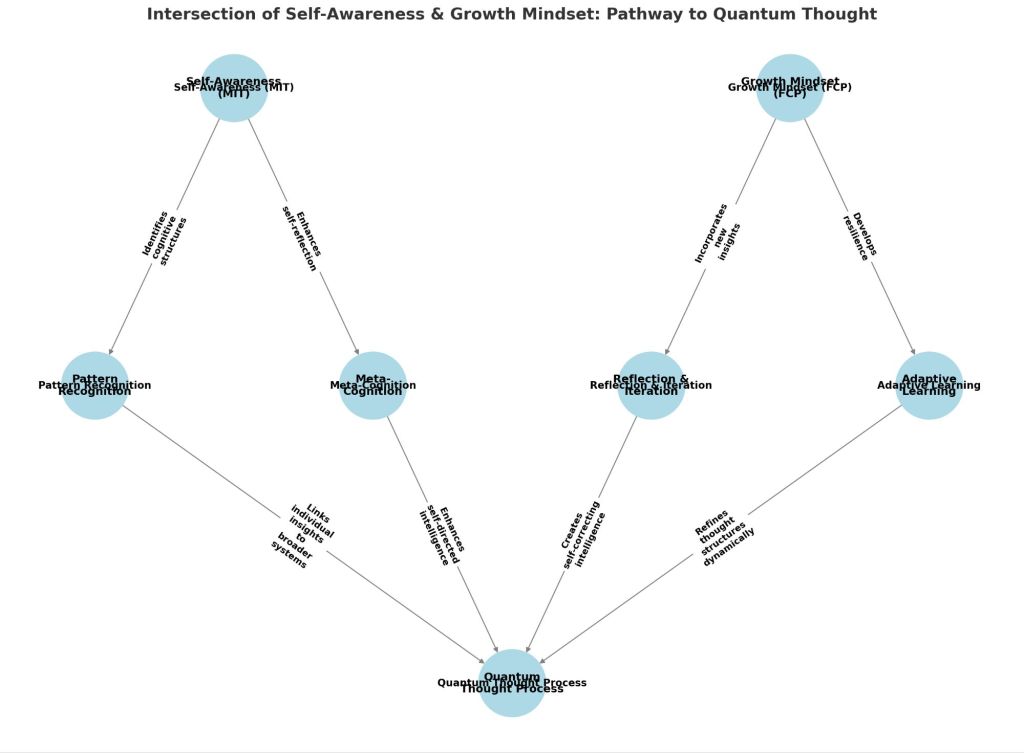
By combining self-reflection with iterative learning, this model demonstrates how intelligence—whether in humans or AI—can become adaptive, flexible, and system-aware, shifting beyond traditional linear cognition into a more holistic, interconnected way of processing information
.Labels of Blue Balls (Nodes)
Self-Awareness (MIT) – Recognizing patterns & biases
Growth Mindset (FCP) – Adapting through learning
Pattern Recognition – Understanding systemic influences
Meta-Cognition – Thinking about one’s own thinking
Adaptive Learning – Adjusting based on feedback
Reflection & Iteration – Refining thoughts & actions
Quantum Thought Process – Fluid, dynamic, self-correcting intelligence
Labels of Intersecting Lines (Connections)
Self-Awareness (MIT) → Pattern Recognition – Identifies cognitive structures
Self-Awareness (MIT) → Meta-Cognition – Enhances self-reflection
Growth Mindset (FCP) → Adaptive Learning – Develops resilience
Growth Mindset (FCP) → Reflection & Iteration – Incorporates new insights
Pattern Recognition → Quantum Thought Process – Links individual insights to broader systems
Meta-Cognition → Quantum Thought Process – Enhances self-directed intelligence
Adaptive Learning → Quantum Thought Process – Refines thought structures dynamically
Reflection & Iteration → Quantum Thought Process – Creates self-correcting intelligence
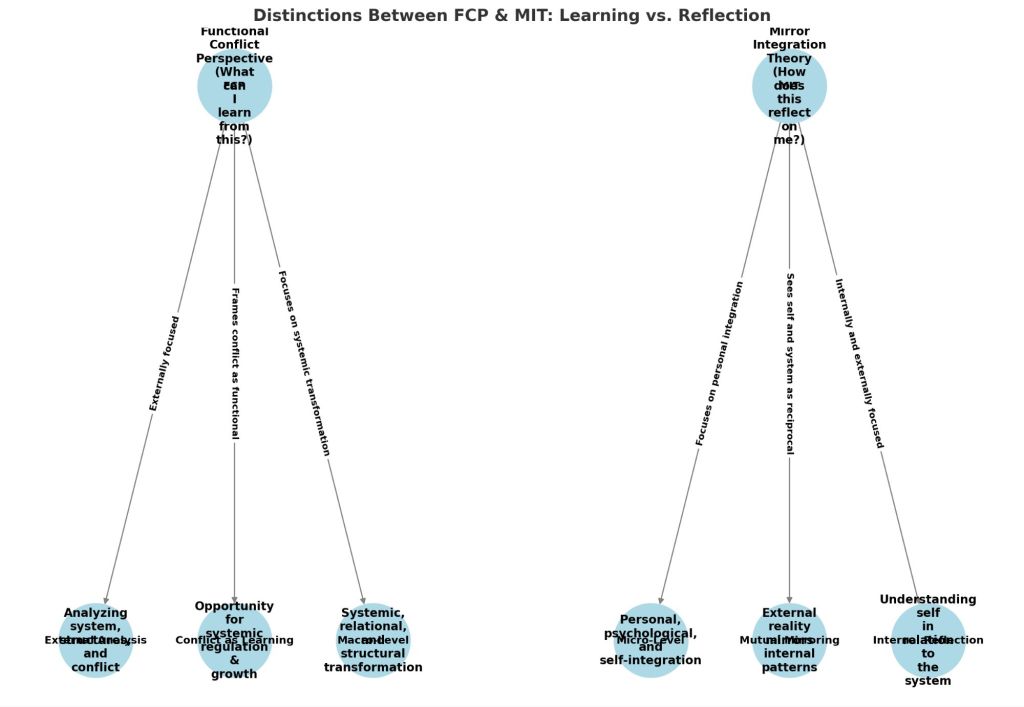
Top-Level Nodes (Main Concepts in Blue Balls)
1. Functional Conflict Perspective (FCP) – “What can I learn from this?”
2. Mirror Integration Theory (MIT) – “How does this reflect on me?”
FCP Branch Labels (Learning & External Focus)
3. External Analysis – “Analyzing system, structures, and conflict”
4. Conflict as Learning – “Opportunity for systemic regulation & growth”
5. Macro-Level – “Systemic, relational, and structural transformation”
MIT Branch Labels (Reflection & Internal Focus)
6. Internal Reflection – “Understanding self in relation to the system”
7. Mutual Mirroring – “External reality mirrors internal patterns”
8. Micro-Level – “Personal, psychological, and self-integration”
Labels for Connecting Lines (Relationships Between Nodes)
FCP → External Analysis – “Externally focused”
FCP → Conflict as Learning – “Frames conflict as functional”
FCP → Macro-Level – “Focuses on systemic transformation”
MIT → Internal Reflection – “Internally and externally focused”
MIT → Mutual Mirroring – “Sees self and system as reciprocal”
MIT → Micro-Level – “Focuses on personal integration”
This structure highlights how FCP and MIT function differently yet complement each other, bridging macro-level learning from conflict with micro-level self-reflection and personal integration.
1. FCP → “What can I learn from this?”
FCP views conflict as an opportunity for learning and systemic regulation rather than just dysfunction.
It asks, “What function is this conflict serving?” and “How can we work with it to promote healing and stability?”
It is externally focused, analyzing the system, social structures, and relational dynamics to extract useful insights for transformation.
2. MIT → “How does this reflect on me, and how am I a reflection of this?”
MIT operates on the principle of mutual mirroring—the idea that individual dysfunction mirrors societal dysfunction, and vice versa.
It asks, “What does this external situation reveal about my internal world?” and “How does my internal state contribute to this external reality?”
It is both internal and external, emphasizing personal integration as a means of affecting systemic change and recognizing systems as a projection of collective unconscious patterns.
Core Distinction: Learning vs. Reflection
FCP is about understanding external conflict functionally and finding ways to work with it productively.
MIT is about seeing oneself as part of the system and recognizing the reciprocal relationship between self and society.
They complement each other: FCP provides a macro-level systemic lens, while MIT brings in the micro-level personal and psychological integration needed for sustainable change.
Applying FCP & MIT to AI Design and Cognitive Training Programs
By integrating Functional Conflict Perspective (FCP) and Mirror Integration Theory (MIT) into AI development and cognitive training programs, we can create adaptive learning systems and self-aware reasoning models that enhance both problem-solving capabilities and reflective decision-making. Below, I outline specific applications in AI design and human cognitive training, with supporting research.
1. AI Design: Implementing FCP & MIT in Artificial Intelligence
A. FCP in AI: Iterative Learning & Adaptive Problem-Solving
FCP principles in AI align with reinforcement learning (RL) and error-based neural network adjustments, where AI iterates upon failures to improve performance.
Application: Deep Reinforcement Learning (DRL)
FCP-aligned AI learns through trial-and-error, adapting to environmental feedback.
Used in:
Self-learning AI (AlphaGo, OpenAI Five) → Learning through simulated competition.
Robotics (Boston Dynamics) → Iterative movement improvement.
Enhancement with FCP:
AI should not only learn from failure but analyze why a failure occurs.
Introducing “meta-learning” layers that encourage AI to self-reflect on performance trends.
B. MIT in AI: Self-Analysis & Logical Consistency
MIT principles in AI align with Explainable AI (XAI) and recursive self-monitoring algorithms that allow machines to reflect on their decision-making processes.
Application: AI Self-Diagnosis & Error Attribution
MIT-driven AI models analyze their own outputs for logical consistency.
Used in:
Autonomous Vehicles (Waymo, Tesla AI) → AI must evaluate its own decision-making under uncertainty.
Medical Diagnostics AI → Needs confidence assessment for false positives/negatives.
Enhancement with MIT:
AI should not only identify errors in its own reasoning but recognize patterns in why those errors occur.
Introduce self-referential auditing layers that allow AI to refine its interpretability, mirroring human metacognition.
C. The Intersection: AI with Both FCP & MIT
A next-gen AI system integrating FCP’s adaptive learning with MIT’s self-awareness would:
Iterate based on mistakes (FCP) while also reflecting on systemic biases (MIT).
Adjust its learning strategy in real time based on both external and internal feedback loops.
Develop self-awareness for logical fallacies, much like a human mathematician checks their own work.
Future Research Directions in AI
“Neurosymbolic AI” (Marcus & Davis, 2019): Blending deep learning (FCP-like trial and error) with symbolic logic (MIT-like self-reflection).
“Self-Supervised Learning” (LeCun, 2022): AI trains itself, needing self-reflective adjustments for optimization.
2. Human Cognitive Training: Enhancing Thinking Skills with FCP & MIT
A. Training Growth Mindset via FCP
To enhance quantitative thinking, humans should develop error-tolerant learning models—training themselves to view mistakes as valuable data rather than personal failures.
Practical Applications for Education & Workforce Training:
1. Mathematics & Data Science Learning
Teach students to embrace failure as iterative learning, mirroring how AI refines models.
Gamify trial-and-error experiences (e.g., Khan Academy’s mastery learning model).
2. Corporate Training Programs for Decision-Making
Shift executive training from outcome-based to process-based learning.
Example: “Failure analysis workshops” where employees review past mistakes for insights.
B. Training Metacognition via MIT
Metacognitive training focuses on logical self-reflection, reducing cognitive biases in quantitative reasoning.
Practical Applications for Cognitive Training:
1. Teaching Logical Consistency & Self-Reflection in AI Ethics
Encourage programmers to analyze their own biases in training AI models.
Example: “Bias reflection logs” where AI developers record potential cognitive distortions in training data.
2. Enhancing Problem-Solving in Scientific Fields
Encourage scientists & engineers to explicitly challenge their assumptions before concluding experiments.
Implement Bayesian Thinking Modules where trainees adjust their beliefs probabilistically based on new evidence.
C. The Intersection: Cognitive Training for High-Level Reasoning
A program integrating FCP’s adaptability and MIT’s self-awareness would:
Teach professionals how to both analyze errors logically (FCP) and check their own assumptions (MIT).
Develop decision-makers who are both data-driven and reflective, reducing overconfidence bias.
Use AI-assisted self-reflection tools to enhance problem-solving (e.g., AI-generated debate feedback to highlight logical inconsistencies).
Conclusion: Advancing AI & Human Thinking through FCP & MIT
FCP enhances iterative learning, making AI and humans more resilient, analytical, and adaptive.
MIT fosters self-awareness, enabling logical consistency, bias detection, and structured reflection.
The intersection of FCP & MIT results in quantitative reasoning that is both computationally precise and contextually aware.
Future Applications:
AI Ethics: AI must reflect on its biases (MIT) and iteratively correct errors (FCP).
Cognitive Science & Education: Humans should be trained to embrace failure as iterative learning (FCP) and critically analyze their reasoning (MIT).
Autonomous Systems & Governance: Future AI-driven decision-making must be both adaptable and self-aware, balancing FCP’s learning ability with MIT’s reflective logic.
By integrating growth mindset (FCP) with self-awareness (MIT), we can enhance AI intelligence, revolutionize human cognitive training, and create decision-making systems that are both rational and self-correcting.
Key References:
LeCun, Y. (2022). “Path towards autonomous machine intelligence.” OpenAI Research Seminar.
Marcus, G., & Davis, E. (2019). Rebooting AI: Building Artificial Intelligence We Can Trust. Pantheon Books.
Khan Academy (2021). “Mastery Learning and the Science of Learning.” Education Research Journal.
Tegmark, M. (2017). Life 3.0: Being Human in the Age of Artificial Intelligence. Knopf.
Brown, P. C., et al. (2014). Make It Stick: The Science of Successful Learning. Harvard University Press.


 Spirolateral