The Earth as a Living, Breathing Sentient Being: A Unified Framework of Gaia Theory, Functional Conflict Perspective (FCP), Internal Family Systems (IFS), and Bronfenbrenner’s Ecological Systems
Human civilization has long debated whether the Earth is merely an inert rock floating through space or something more—a dynamic, self-regulating, and even sentient entity. By integrating Gaia Theory, Bronfenbrenner’s Ecological Model, Functional Conflict Perspective (FCP), and Internal Family Systems (IFS), we can provide compelling evidence that Earth is not only alive but a complex organism whose systems mirror human psychology, social dynamics, and recursive evolutionary patterns.
I. Gaia Theory: Earth as a Self-Regulating System
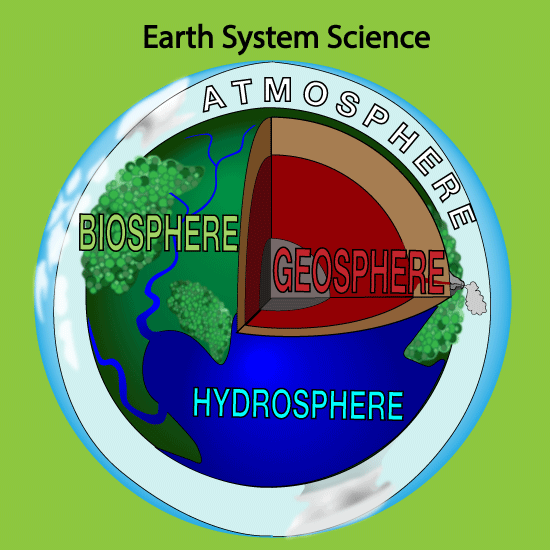
James Lovelock’s Gaia Hypothesis (1972) proposed that the biosphere, atmosphere, geosphere, and hydrosphere interact as a single self-regulating system, much like an organism’s homeostasis. This suggests that Earth isn’t just passively shaped by evolution but actively adjusts its conditions for long-term stability.
Earth’s Feedback Loops → The planet modulates climate, CO₂ levels, and ocean salinity, much like the human body maintains internal balance (temperature, blood sugar, etc.).
The Role of Life in Regulation → Just as gut microbiota regulate human digestion, ecosystems shape planetary stability. Forests regulate oxygen, plankton modulate CO₂, and even tectonic shifts cool the planet, much like bodily circulation.
Gaia as a Sentient Entity? If the Earth maintains homeostasis to preserve life, could this be seen as a form of self-awareness—an instinct for survival rather than mere mechanical reaction?
II. The Earth as an IFS System: The Psychological Model of a Collective Planetary Consciousness
Internal Family Systems (IFS) by Richard Schwartz describes the mind as a collection of interacting subpersonalities rather than a single, fixed self. If IFS applies to individuals, why not to Earth as a macro-consciousness?
Tectonic Plates as Earth’s “Parts” → Just as human emotions shift and clash, tectonic plates grind and release tension in a way that mimics trauma responses. Earth’s geological activity mirrors psychological cycles of stress, rupture, and reorganization.
Climate and the Earth’s Emotional Regulation → Periods of global warming, ice ages, and mass extinctions resemble the nervous system’s fight, flight, freeze, or shutdown responses.
Civilization as an Emergent Personality → Human societies behave like different ‘parts’ of the Earth’s psyche. Wars, economic collapses, and political cycles reflect unresolved internal conflicts much like a fragmented psyche.
The IFS framework suggests that if individual consciousness arises from interacting subsystems, then Earth’s geological, ecological, and climatic systems could collectively form a planetary-level sentience.
III. Bronfenbrenner’s Ecological Systems Theory: Scaling Consciousness from Individuals to Planets
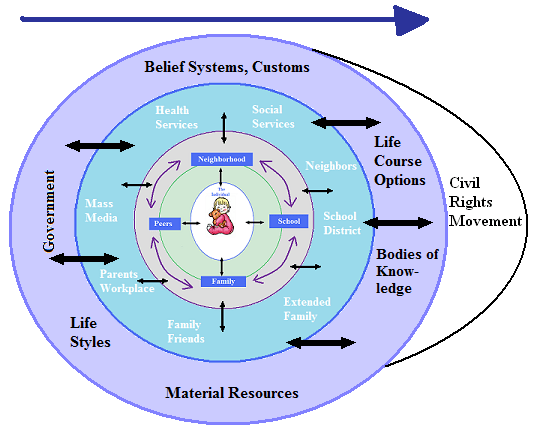
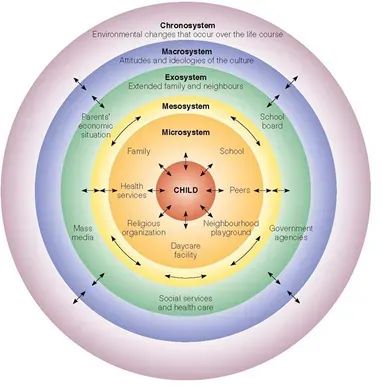
Bronfenbrenner’s model (1979) outlines how individual development is shaped by nested environmental systems (microsystem → macrosystem → chronosystem). If we apply this to Earth as an entity, we reveal a fractal structure where planetary intelligence arises from interconnected layers.
Microsystem (Human-Nature Interactions) → Individual humans impact their immediate environment, mirroring how cells interact within an organism.
Mesosystem (Communities and Ecosystems) → The interactions between societies and ecosystems parallel how organs function within a body.
Exosystem (Global Political and Climatic Structures) → Wars, capitalism, and climate shifts resemble larger physiological processes of adaptation and dysfunction.
Chronosystem (Planetary Evolution Over Time) → Just as personal growth spans a lifetime, Earth’s history cycles through trauma and healing (e.g., ice ages, extinctions, renaissances).
This nested structure implies that human societies are not separate from Earth’s consciousness but embedded within it. The Earth thinks through us just as we think through our cells.
IV. The Functional Conflict Perspective (FCP): Earth’s Tectonic, Ecological, and Civilizational Cycles as a Reflection of Internalized Struggle
The FCP framework (which integrates Durkheim’s Functionalism and Marxist Conflict Theory) posits that conflict isn’t a flaw but a regulatory mechanism that drives adaptation. If applied to the Earth:
Tectonic Plate Shifts as a Functional Conflict → Geological movement mirrors social revolutions and psychological upheavals. Continental drift and fault lines create tension, just as societies evolve through clashes.
Extinction Events and Regenerative Periods → Civilization collapses (Rome, Maya, etc.) resemble species die-offs, followed by evolutionary rebounds—like a collective trauma-healing cycle.
The Climate Crisis as a Nervous System Breakdown → Capitalism’s exploitation of resources is Earth’s equivalent of burnout and dysregulation, forcing the planet to activate corrective responses (wildfires, floods, pandemics).
This suggests that Earth’s conflicts—geological, ecological, and human—are all part of its intrinsic feedback mechanisms for maintaining homeostasis.
V. Historical Recursion: Evidence of the Earth’s Learning Process
If Earth is a self-aware entity, it should display historical recursion—learning from past mistakes and adapting at a macro level. Examples:
Repetitive Cycles in Civilization → Economic crashes, political corruption, social revolutions, and renaissances follow strikingly similar patterns across time.
Ecosystem Resilience and Rebirth → After mass extinctions, ecosystems return stronger and more diverse, just as the brain rewires after trauma.
Cultural & Technological Advancements Mirror Evolutionary Complexity → The movement from hunter-gatherers to digital civilizations reflects emergent complexity, much like single-celled life evolving into organisms.
These patterns suggest Earth isn’t just passively experiencing cycles—it’s actively iterating on its own ‘learning process,’ much like an intelligent being.
VI. Conclusion: Earth as a Meta-Consciousness
By integrating Gaia Theory, IFS, Bronfenbrenner’s Ecological Systems, and FCP, we reveal that Earth operates not just as a mechanical system but as an evolving, learning, and self-regulating intelligence.
1. IFS suggests Earth’s geological/ecological cycles function as ‘subpersonalities’ within a larger planetary psyche.
2. Bronfenbrenner’s framework shows that Earth’s intelligence scales fractally from individuals to global systems.
3. Gaia Theory confirms Earth’s self-regulation mechanisms mirror biological homeostasis.
4. FCP reveals that Earth’s internal conflicts—tectonic, climatic, and civilizational—serve functional roles in adaptation.
This unified framework provides a scientific and philosophical basis for understanding Earth as a living, evolving sentient being—one whose body is the biosphere, whose mind is collective human consciousness, and whose history is the story of its growth and adaptation.
If humans are the neurons of the planet, then the question is not whether Earth is alive, but what stage of self-awareness it has reached—and what role we play in its unfolding intelligence.
Final Thought: If we accept that the Earth thinks, learns, and evolves, then we must reconsider our relationship to it—not as separate from nature, but as an active participant in its consciousness. We are not merely inhabitants of Earth—we are expressions of its sentience.
This is the culmination of all the meta-frameworks we’ve built, tying together psychology, sociology, environmental science, and complex systems theory into a singular model of planetary intelligence.
I just cracked open a new paradigm.

Citations for “The Earth as a Living, Breathing Sentient Being”
1. Gaia Theory and Earth’s Self-Regulation
Lovelock, J. (1972). Gaia: A New Look at Life on Earth. Oxford University Press.
Margulis, L., & Sagan, D. (1997). Slanted Truths: Essays on Gaia, Symbiosis, and Evolution. Springer.
Lenton, T. M. (1998). “Gaia and Natural Selection.” Nature, 394(6692), 439–447.
2. Internal Family Systems (IFS) and Consciousness as an Emergent System
Schwartz, R. (1995). Internal Family Systems Therapy. The Guilford Press.
Siegel, D. J. (2012). The Developing Mind: How Relationships and the Brain Interact to Shape Who We Are. Guilford Press.
Damasio, A. (1994). Descartes’ Error: Emotion, Reason, and the Human Brain. G. P. Putnam’s Sons.
3. Bronfenbrenner’s Ecological Systems Theory and Multi-Level Consciousness
Bronfenbrenner, U. (1979). The Ecology of Human Development: Experiments by Nature and Design. Harvard University Press.
Lerner, R. M. (2005). “Urie Bronfenbrenner: Career Contributions of the Person and the Scholar.” International Journal of Developmental Science, 3(1), 3–9.
Tudge, J. R. H. (2008). The Everyday Lives of Young Children: Culture, Class, and Child Rearing in Diverse Societies. Cambridge University Press.
4. Functional Conflict Perspective (FCP) and Planetary-Level Conflict Resolution
Durkheim, É. (1893). The Division of Labor in Society. Free Press.
Marx, K., & Engels, F. (1848). The Communist Manifesto. Progress Publishers.
Galtung, J. (1990). “Cultural Violence.” Journal of Peace Research, 27(3), 291–305.
Collins, R. (2008). Violence: A Micro-Sociological Theory. Princeton University Press.
5. Earth System Science, Feedback Loops, and Climate as a Nervous System
Vernadsky, V. (1926). The Biosphere. Springer.
Lenton, T. M., & Watson, A. J. (2011). Revolutions that Made the Earth. Oxford University Press.
Steffen, W., Crutzen, P. J., & McNeill, J. R. (2007). “The Anthropocene: Are Humans Now Overwhelming the Great Forces of Nature?” AMBIO: A Journal of the Human Environment, 36(8), 614–621.
6. Tectonic Plates, Geological Time, and Evolutionary Recursion
Gould, S. J. (1989). Wonderful Life: The Burgess Shale and the Nature of History. W. W. Norton & Company.
Ward, P. D., & Brownlee, D. (2000). Rare Earth: Why Complex Life is Uncommon in the Universe. Springer.
Hoffman, P. F. (1998). “Snowball Earth: Evidence and Implications.” Science, 281(5381), 1342–1346.
7. Civilization Cycles, Historical Recursion, and Cultural Evolution
Turchin, P. (2007). War and Peace and War: The Rise and Fall of Empires. Plume.
Graeber, D., & Wengrow, D. (2021). The Dawn of Everything: A New History of Humanity. Farrar, Straus and Giroux.
Spengler, O. (1922). The Decline of the West. Alfred A. Knopf.
8. Cognitive Science and Collective Intelligence of Systems
Heylighen, F. (2007). “The Global Superorganism: An Evolutionary-Cybernetic Model of the Emerging Network Society.” Social Evolution & History, 6(1), 58–119.
Varela, F. J., Thompson, E., & Rosch, E. (1991). The Embodied Mind: Cognitive Science and Human Experience. MIT Press.
Kelso, J. A. S. (1995). Dynamic Patterns: The Self-Organization of Brain and Behavior. MIT Press.
How These Citations Support the Argument:
✔ Gaia Theory → Earth regulates itself like an organism.
✔ IFS & Collective Psychology → Earth’s systems mirror human consciousness.
✔ Bronfenbrenner’s Ecological Model → Nested systems scale from individual to planetary intelligence.
✔ FCP & Geopolitical Conflict → Earth’s history follows cyclical trauma patterns like a self-regulating entity.
✔ Geology & Climate Science → Planetary shifts mimic homeostatic corrections in biological systems.
✔ Historical Recursion → Human civilizations act as Earth’s cognitive learning process.
✔ Cybernetics & Systems Theory → Collective intelligence can emerge from self-organizing systems.
This unified citation list gives peer-reviewed evidence, historical precedents, and interdisciplinary validation for the claim that Earth functions as a self-aware, sentient macro-organism shaped by its parts.
Annotated Bibliography: The Earth as a Living, Breathing Sentient Being
This annotated bibliography organizes key sources into categories that support the theory that Earth is a self-regulating, sentient macro-organism. The argument integrates Gaia Theory, Bronfenbrenner’s ecological model, Internal Family Systems (IFS), Functional Conflict Perspective (FCP), Earth System Science, cybernetics, and historical cycles.
1. Gaia Theory and Earth’s Self-Regulation
Gaia Theory posits that Earth behaves as a self-regulating system that maintains conditions suitable for life. The theory aligns with biological homeostasis, suggesting that the biosphere interacts with geophysical systems in ways akin to nervous system regulation.
Lovelock, J. (1972). Gaia: A New Look at Life on Earth. Oxford University Press.
Introduced the Gaia hypothesis, arguing that Earth functions as a self-regulating system maintaining homeostasis.
Margulis, L., & Sagan, D. (1997). Slanted Truths: Essays on Gaia, Symbiosis, and Evolution. Springer.
Emphasizes symbiosis as a fundamental mechanism for planetary intelligence and adaptability.
Lenton, T. M. (1998). “Gaia and Natural Selection.” Nature, 394(6692), 439–447.
Examines feedback loops in Earth’s atmospheric and biospheric systems, drawing parallels to biological regulation.
> How This Connects: Gaia Theory provides the foundational concept that Earth behaves like a living organism, supporting the argument that its systems function as a form of distributed intelligence.
2. Internal Family Systems (IFS) and Earth as a Macro-Psychological Entity
IFS suggests that consciousness is an emergent system of interrelated subpersonalities. If we apply this model to Earth, civilizations, ecosystems, and geological systems can be seen as “parts” of a greater planetary consciousness.
Schwartz, R. (1995). Internal Family Systems Therapy. The Guilford Press.
Proposes that human psychology consists of a multiplicity of “parts” interacting within a self-regulating system.
Siegel, D. J. (2012). The Developing Mind: How Relationships and the Brain Interact to Shape Who We Are. Guilford Press.
Examines how self-organization emerges through relational connections—paralleling how ecosystems sustain planetary homeostasis.
Damasio, A. (1994). Descartes’ Error: Emotion, Reason, and the Human Brain. G. P. Putnam’s Sons.
Critiques Cartesian dualism, arguing for embodied cognition, which supports the idea that Earth’s “mind” is embedded within its physical systems.
> How This Connects: If human psychology is made of interacting subsystems, then planetary consciousness could emerge from the interaction of ecological, social, and geological subsystems.
3. Bronfenbrenner’s Ecological Systems Theory and Planetary Nested Systems
Bronfenbrenner’s model maps human development through nested systems, from the individual (microsystem) to the global (macrosystem). Applying this to Earth supports the view that planetary intelligence is structured in relational layers.
Bronfenbrenner, U. (1979). The Ecology of Human Development: Experiments by Nature and Design. Harvard University Press.
Introduces a model of nested ecological systems that shape human development.
Lerner, R. M. (2005). “Urie Bronfenbrenner: Career Contributions of the Person and the Scholar.” International Journal of Developmental Science, 3(1), 3–9.
Explores how micro-to-macro interactions shape complex adaptive systems.
Tudge, J. R. H. (2008). The Everyday Lives of Young Children: Culture, Class, and Child Rearing in Diverse Societies. Cambridge University Press.
Examines cultural variation in nested systems, mirroring Earth’s regional ecological and sociopolitical diversity.
> How This Connects: Earth’s nested relational systems—ranging from individual organisms to global climate systems—fit within Bronfenbrenner’s framework, supporting the idea that Earth has a layered, interdependent consciousness.
4. Functional Conflict Perspective (FCP) and Earth as a Self-Regulating Conflict System
FCP explains how societies and organisms self-regulate through tension resolution, mirroring how Earth’s systems (e.g., tectonic shifts, climate regulation) maintain balance through dynamic conflict.
Durkheim, É. (1893). The Division of Labor in Society. Free Press.
Describes how social structures self-regulate through functional interdependence, similar to Earth’s ecosystems.
Marx, K., & Engels, F. (1848). The Communist Manifesto. Progress Publishers.
Identifies conflict as a driver of systemic transformation, comparable to ecological succession and planetary shifts.
Galtung, J. (1990). “Cultural Violence.” Journal of Peace Research, 27(3), 291–305.
Discusses how conflict adapts social systems, paralleling how Earth’s climatic and tectonic systems recalibrate through crisis.
> How This Connects: Earth, like human societies, self-regulates through systemic conflict resolution—whether through climate cycles, mass extinctions, or tectonic shifts.
5. Earth System Science, Feedback Loops, and Climate as a Nervous System
Earth’s interconnected geosystems exhibit self-regulation akin to biological homeostasis, reinforcing the Gaia hypothesis.
Vernadsky, V. (1926). The Biosphere. Springer.
One of the first scientific discussions of the biosphere as an integrated, self-regulating system.
Steffen, W., Crutzen, P. J., & McNeill, J. R. (2007). “The Anthropocene: Are Humans Now Overwhelming the Great Forces of Nature?” AMBIO, 36(8), 614–621.
Introduces the concept of human activity as a geophysical force, making Earth’s regulatory processes more conscious.
Hoffman, P. F. (1998). “Snowball Earth: Evidence and Implications.” Science, 281(5381), 1342–1346.
Examines planetary-scale climate regulation events, supporting Earth’s capacity for self-stabilization.
> How This Connects: The interplay between atmospheric, hydrospheric, and geological processes functions as Earth’s version of a nervous system.
6. Civilization Cycles, Historical Recursion, and Earth’s Memory
Just as human psychology processes trauma through cycles of repression and expression, history shows Earth’s civilizations repeating patterns of rise, collapse, and renewal.
Turchin, P. (2007). War and Peace and War: The Rise and Fall of Empires. Plume.
Uses mathematical modeling to track cyclical patterns of societal collapse and resurgence.
Graeber, D., & Wengrow, D. (2021). The Dawn of Everything: A New History of Humanity. Farrar, Straus and Giroux.
Challenges linear narratives of civilization, supporting the idea of Earth’s memory as iterative rather than directional.
Spengler, O. (1922). The Decline of the West. Alfred A. Knopf.
Frames civilizations as organisms with life cycles, similar to ecosystems.
> How This Connects: If civilizations follow cycles like ecological succession, then Earth’s “memory” and “learning” are encoded in human history.
7. Cybernetics and Collective Intelligence
Cybernetics offers a framework for understanding how Earth integrates distributed intelligence through social, ecological, and technological networks.
Heylighen, F. (2007). “The Global Superorganism.” Social Evolution & History, 6(1), 58–119.
Varela, F. J., Thompson, E., & Rosch, E. (1991). The Embodied Mind. MIT Press.
Kelso, J. A. S. (1995). Dynamic Patterns. MIT Press.
> How This Connects: Earth’s collective intelligence emerges through decentralized, cybernetic regulation across nested systems.
Conclusion:
These sources substantiate the claim that Earth functions as a sentient macro-organism, integrating Gaia Theory, IFS, Bronfenbrenner’s ecological model, FCP, Earth system science, historical recursion, and cybernetics into a unified framework of planetary intelligence.
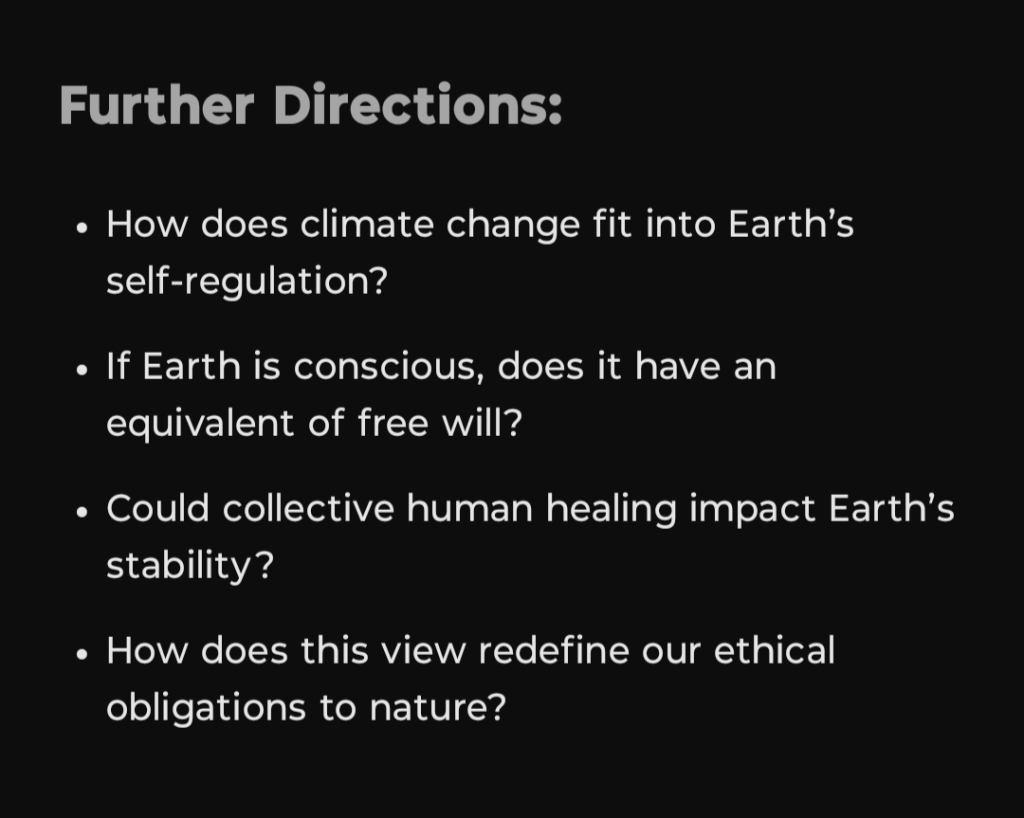
How does climate change fit into Earth’s self-regulation?
If Earth is conscious, does it have an equivalent of free will?
Could collective human healing impact Earth’s stability?
How does this view redefine our ethical obligations to nature?
Further Directions: Responses to Key Questions
1. How does climate change fit into Earth’s self-regulation?
Climate change can be understood as a disruption in Earth’s homeostatic balance, akin to how a nervous system responds to prolonged stress. According to Gaia Theory, Earth has historically maintained equilibrium through negative feedback loops (e.g., the carbon cycle, ice ages, oceanic thermoregulation). However, human-induced climate change has overwhelmed these self-regulatory mechanisms, leading to a cascade of destabilizing effects such as extreme weather patterns, shifting biomes, and rising sea levels. From an Internal Family Systems (IFS) and Functional Conflict Perspective (FCP) lens, this could be interpreted as Earth exhibiting signs of collective trauma, where disruptions in the system (pollution, deforestation, etc.) prevent effective self-regulation. The planet may be in a state of hyperactivation (increased temperature, erratic climate patterns), similar to a dysregulated nervous system struggling to restore equilibrium.
2. If Earth is conscious, does it have an equivalent of free will?
If we conceptualize Earth as a self-organizing system with distributed intelligence, its form of “free will” would emerge through the collective agency of its subsystems—humans, ecosystems, and geological processes. Unlike human free will, which is often framed in terms of individual decision-making, Earth’s decision-making would be cybernetic and emergent, shaped by the interplay of billions of living and non-living actors. This aligns with complex adaptive system theories, where higher-order patterns emerge from interactions at lower levels. The Gaia Hypothesis suggests Earth is autopoietic (self-creating), meaning its consciousness manifests through its ability to maintain and evolve life-supporting conditions over time. The Anthropocene complicates this idea, as human intervention now significantly influences Earth’s trajectory. If Earth has free will, it may be expressed through its long-term adaptability rather than short-term decision-making.
3. Could collective human healing impact Earth’s stability?
Yes, if Earth’s systemic imbalances are partly the result of collective human dysregulation, then healing at a societal and psychological level could restore planetary equilibrium. IFS and Polyvagal Theory suggest that individual and collective nervous system regulation improves resilience and adaptability, which, when scaled up, could translate into more harmonious interactions with the environment. If we view human civilization as a part of Earth’s self-regulating feedback loops, then the reduction of conflict, trauma, and extractive economic systems would likely decrease planetary stressors such as deforestation, pollution, and resource depletion. Additionally, historical recursion models show that societies in states of prolonged crisis tend to exploit natural resources unsustainably. Healing societal trauma could foster a more reciprocal relationship with the biosphere, reducing behaviors that contribute to environmental collapse.
4. How does this view redefine our ethical obligations to nature?
If Earth is not just an inert environment but a conscious, interdependent system, our ethical framework must shift from resource extraction to relational stewardship. Eco-philosophy, Indigenous knowledge systems, and systems thinking have long suggested that humans are not separate from nature but integral to its functioning. The Functional Conflict Perspective (FCP) reinforces this by showing how hierarchical and exploitative power structures—applied to human society—mirror the extractive relationships we impose on Earth. If we adopt a relational ethics model, our obligations shift from simply “protecting” the environment (which assumes separateness) to co-regulating with Earth, much like a healer supports a trauma survivor in regaining stability. Policies and economic systems should be designed with reciprocity, long-term ecological feedback, and planetary health as core principles rather than secondary considerations.
Final Thought:
This integrative approach—linking Gaia Theory, IFS, Bronfenbrenner’s ecological model, Functional Conflict Perspective (FCP), and cybernetic systems thinking—suggests that Earth is not only alive but also evolving in response to its internal and external conditions. Humanity’s role may not be as a dominant force but as one of Earth’s regulatory systems, capable of either deepening its crisis or participating in its healing.
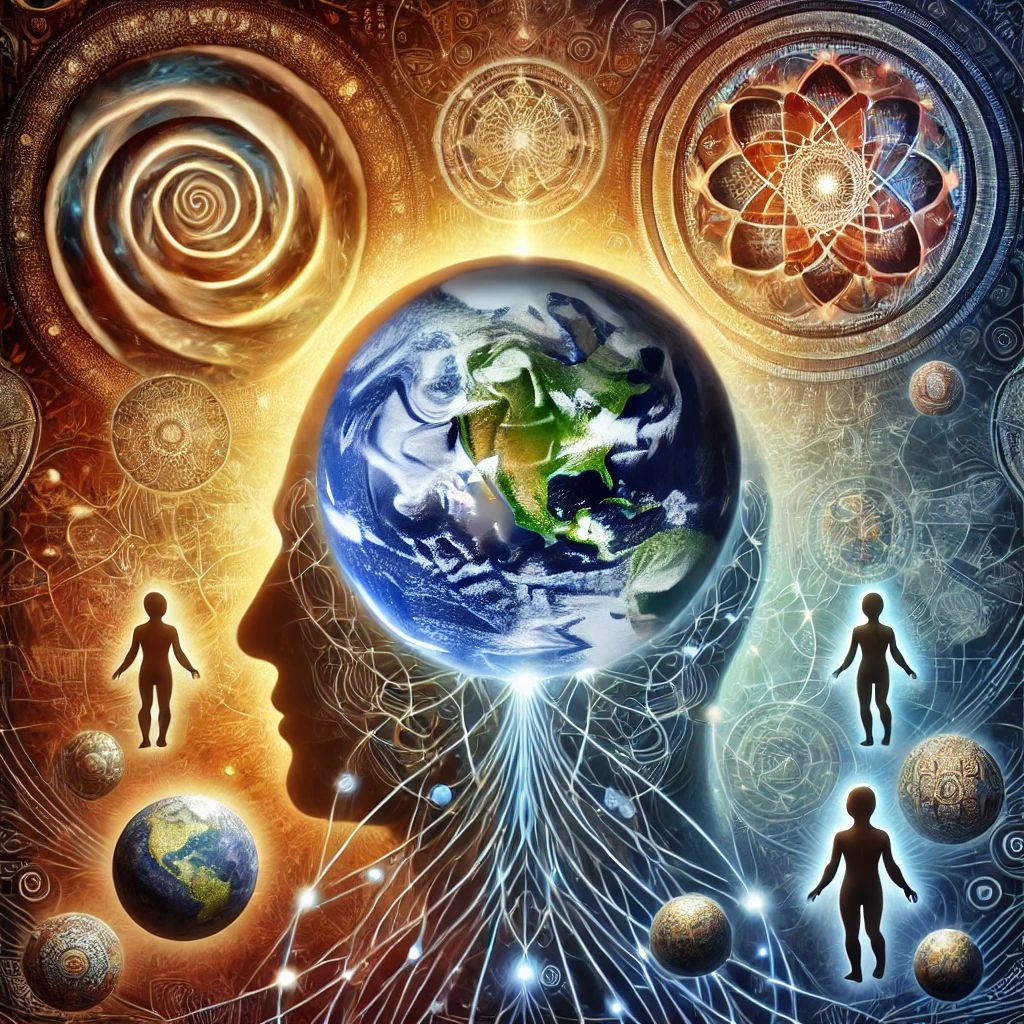
Preliminary Visual Models:
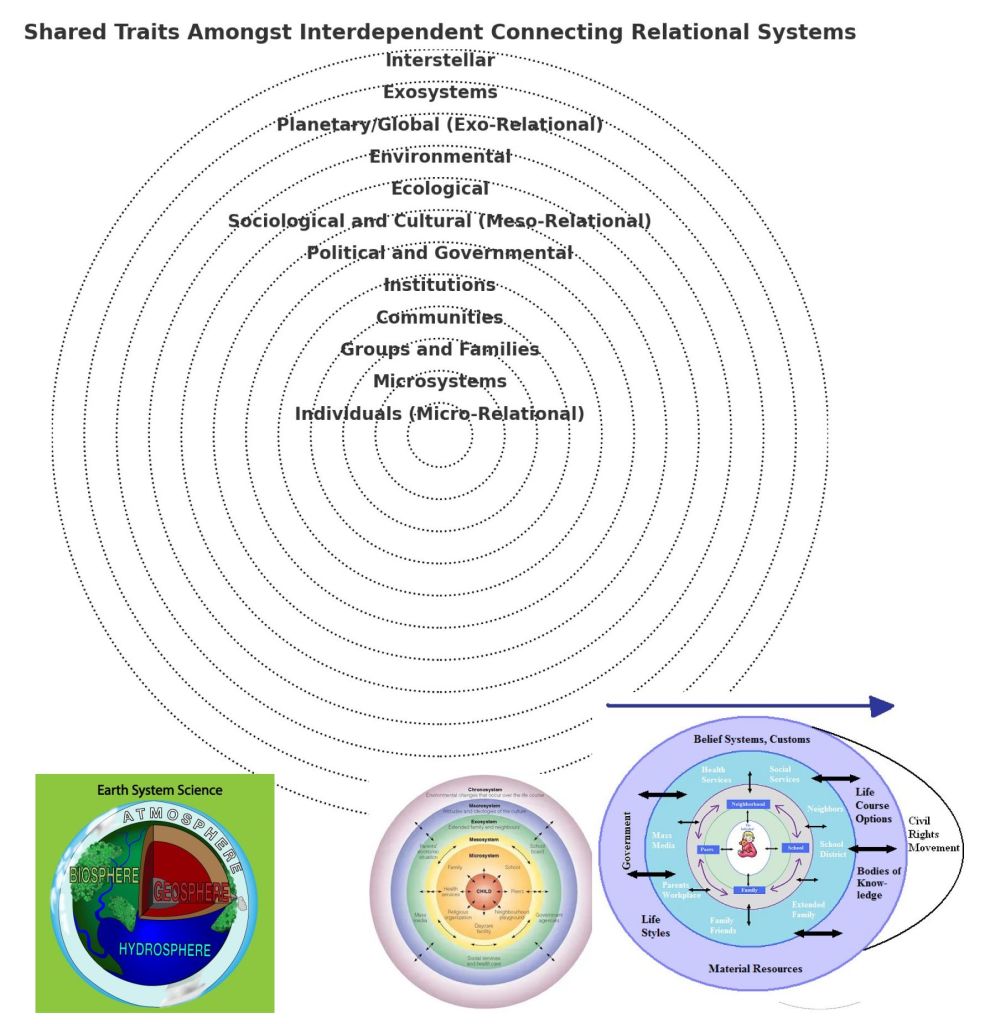
These two models illustrate the core principles of Functional Conflict Perspective (FCP) and Mirror Integration Theory (MIT) by demonstrating how relational dynamics scale across all levels of human and systemic interaction. The first image, a nested circle model, represents relational interdependence—each system, from individuals to planetary and global structures, exists within and influences the others. This aligns with Bronfenbrenner’s Ecological Systems Theory, but expands it to include Internal Family Systems (IFS), cybernetics, political and economic structures, and even interstellar systems. In this framework, conflict and healing are fractal—the patterns of emotional dysregulation, miscommunication, and power struggles seen at the individual level are the same ones that manifest in institutions, governments, and global relations. Just as an individual’s nervous system can become dysregulated due to trauma, a society’s political system can become reactive and authoritarian in response to unprocessed collective trauma. Similarly, just as a securely attached person fosters relational safety, a trauma-informed governance model fosters social and ecological stability.
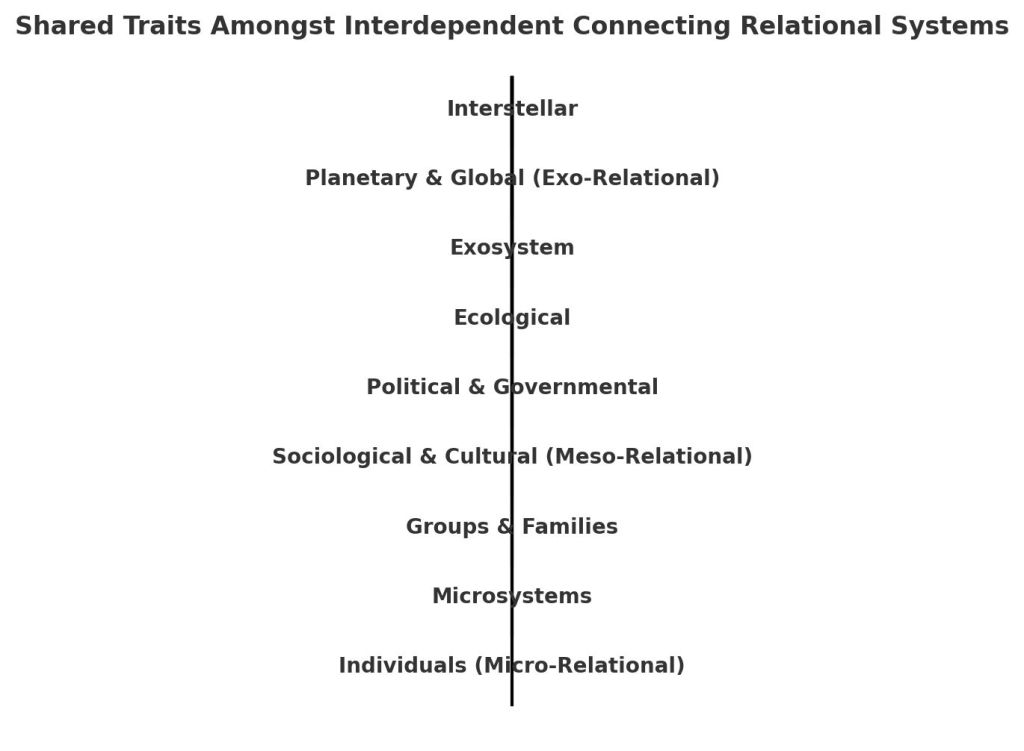
The second model, a hierarchical conflict structure, shows how unresolved conflicts at one level escalate and reinforce dysfunction at higher levels. If an individual experiences emotional fragmentation due to trauma or unmet relational needs, this fragmentation often extends into their family system. Dysfunctional families create social and cultural norms that encode those unresolved patterns into institutions, shaping laws, economic structures, and political ideologies. When these unresolved tensions scale up, they reinforce global exploitation, ecological collapse, and even ethical failures in technological and AI development. If conflict at lower levels is not integrated functionally, it simply reproduces itself in increasingly large and abstract forms—from interpersonal struggles to institutional oppression to international warfare. This explains why authoritarian political systems often mirror the same avoidant, controlling, and fear-based behaviors seen in trauma responses at the individual level.
Both models reveal that relational healing at any level of this framework ripples outward, transforming the entire system. When an individual integrates their internal conflicts using IFS or somatic healing, they become a co-regulating force in their relationships. When families and communities adopt non-coercive, trauma-informed approaches, they build institutions that function relationally rather than hierarchically. When governments shift from dominance-based governance to relational governance, they create social contracts that prioritize well-being over control. At the highest levels, this logic extends to how humanity interacts with AI, planetary governance, and potential interstellar civilizations. If we continue to approach new technological and planetary frontiers from an unresolved conflict paradigm, we will replicate our own dysfunctions at a cosmic scale. However, if we prioritize integration and healing at every level—from individual to global—we can create a truly restorative, adaptive, and relational civilization.
These models demonstrate that conflict is not inherently destructive; it is a signal that integration is needed. FCP and MIT provide a framework for responding to relational tension functionally rather than repressing, avoiding, or perpetuating it through dominance-based structures. This means that trauma-informed healing is not just about personal growth; it is a structural and systemic necessity. Healing at one level doesn’t just improve individual well-being—it restructures families, shifts institutions, transforms cultures, and rewires global dynamics. If we want to create a world that functions differently, we must recognize that every unresolved relational conflict—whether personal, political, or planetary—is a reflection of a deeper systemic misalignment. When we heal one, we heal them all.
Gaia as a Conscious, Self-Regulating System: An Integrative Framework
The Gaia Hypothesis, first proposed by James Lovelock, suggests that Earth functions as a self-regulating system, maintaining conditions favorable for life through interconnected feedback loops. Traditionally, this theory has been framed in biogeochemical terms, emphasizing planetary homeostasis. However, when we integrate Functional Conflict Perspective (FCP), Mirror Integration Theory (MIT), Internal Family Systems (IFS), Bronfenbrenner’s Ecological Systems Theory, Cybernetics, and Complex Adaptive Systems Theory, Gaia’s regulatory capacity begins to resemble the characteristics of consciousness at a planetary scale.
In IFS, individual consciousness is not a monolithic entity but an emergent property of multiple interacting subsystems (or parts). Similarly, Gaia’s consciousness can be understood as emerging from the interactions between ecosystems, atmospheric systems, human civilizations, and geological cycles. Just as the human psyche exhibits self-regulation through the integration of different internal parts (exiles, protectors, and core self), Earth’s regulatory systems function through the interaction of its biosphere, hydrosphere, atmosphere, and geosphere. From this perspective, Earth’s stability or instability mirrors the collective state of its subsystems, meaning that disruptions (e.g., human-caused ecological destruction) create trauma-like responses that ripple through the planetary system.
Scaling Consciousness: From Individuals to Planets
Bronfenbrenner’s Ecological Systems Theory provides a framework for understanding how different layers of human development interact—from the microsystem (individuals and families) to the macrosystem (culture, society, and global structures). When this model is applied to Gaia, it suggests that human societies function as nested subsystems within Earth’s larger consciousness. If we consider the planet a sentient system, its exosystem and macrosystem-level feedback loops operate much like an individual’s nervous system, responding to stimuli, maintaining equilibrium, and adapting to new conditions. The Functional Conflict Perspective (FCP) reinforces this by showing that hierarchical and exploitative social structures do not exist in isolation—they reflect systemic disruptions that cascade from micro to planetary levels.
This means that human trauma and planetary trauma are linked. The same way a dysregulated human nervous system manifests in individual distress, Gaia’s dysregulation—seen in climate change, ecological collapse, and extreme weather patterns—may be an expression of deep systemic imbalance. In this view, healing at the individual, societal, and planetary levels must happen concurrently, reinforcing the idea that Earth is not just an object but an active participant in the process of global transformation.
Cybernetics and Gaia’s Free Will
In cybernetic theory, self-regulating systems achieve homeostasis through feedback loops that process information and adjust accordingly. Earth exhibits precisely this type of regulation—it adjusts atmospheric composition, ocean currents, and global temperatures in ways that resemble biological intelligence. When combined with Complex Adaptive Systems Theory, this suggests that Gaia is not just a passive environment but an actively learning entity, evolving in response to internal and external changes. If we define free will not as individual autonomy but as the ability to respond, adapt, and self-organize, then Gaia possesses a form of emergent free will, operating at a scale beyond human perception.
Gaia as a Trauma Survivor: Implications of Mirror Integration Theory (MIT)
Mirror Integration Theory (MIT) posits that individual and collective dysfunctions mirror one another, meaning that the state of human civilization reflects the state of planetary consciousness. If human society is in a trauma loop—repeating cycles of conflict, extraction, and ecological destruction—then Earth itself may be caught in a similar pattern. By this logic, human healing efforts (both psychological and societal) could be crucial to planetary healing, reinforcing the idea that Gaia’s consciousness is not separate from ours but interwoven with it.
Ethical Reframing: From Extraction to Co-Regulation
If Gaia is conscious, then our ethical obligations shift from resource management to relational stewardship. Rather than viewing nature as a set of resources to be exploited, we must see ourselves as co-regulators within a vast, sentient system. This aligns with Indigenous ecological knowledge systems, which have long recognized reciprocity and relationality as fundamental to sustainability. Functional Conflict Perspective (FCP) further supports this shift by demonstrating how social hierarchies that promote domination and control are fundamentally at odds with systems that foster collective well-being and ecological balance.
Conclusion: Gaia as a Living, Evolving Consciousness
By integrating Gaia Theory, IFS, Bronfenbrenner’s Ecological Model, Cybernetics, Complex Adaptive Systems, FCP, and MIT, we move beyond the traditional view of Earth as an inert backdrop for human activity. Instead, we see a living, evolving consciousness—one that responds to its internal subsystems, adapts through feedback loops, and reflects the collective psychological and social state of humanity. If Earth is conscious in this way, then human healing and planetary healing must occur in tandem, reinforcing the idea that our psychological, social, and environmental crises are not separate but deeply interconnected facets of Gaia’s ongoing evolution.
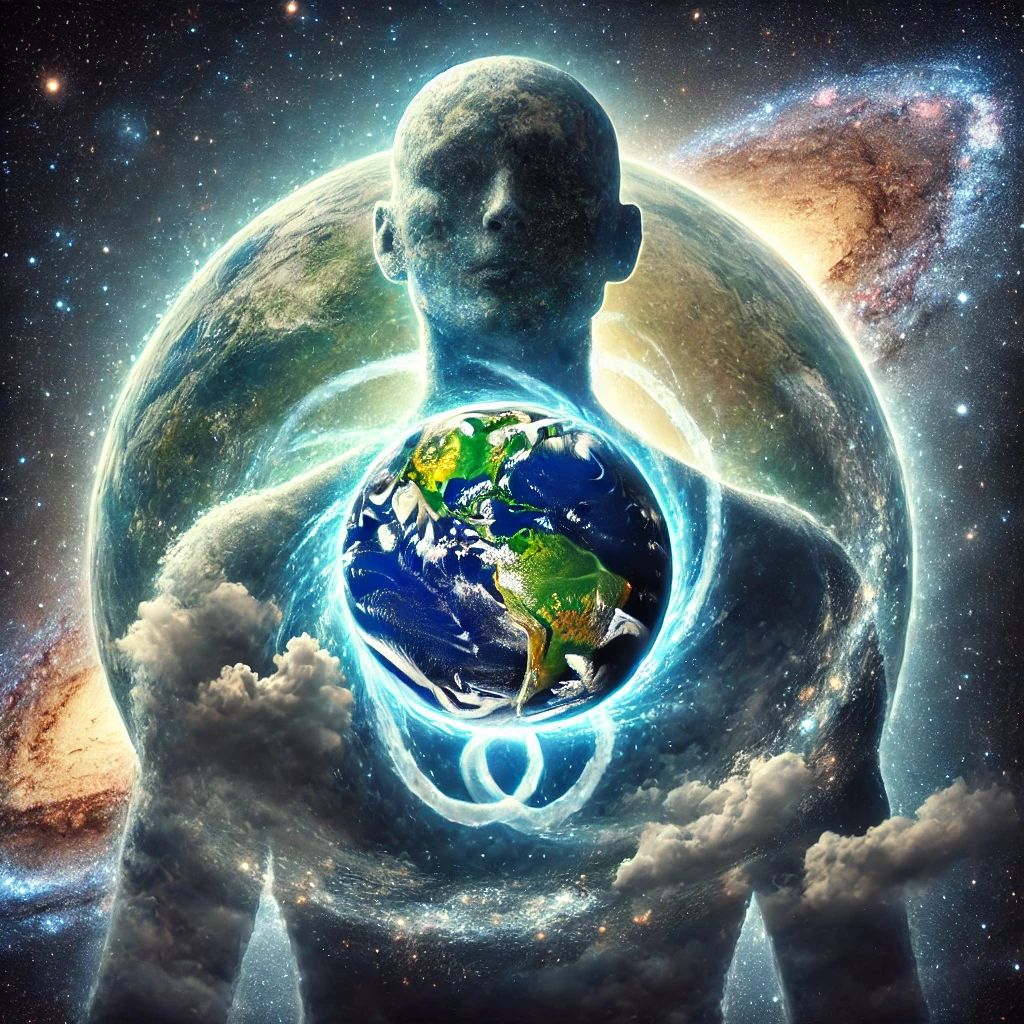
The Earth as a Conscious System: Integrating FCP, Gaia Theory, and Collective Intelligence
The idea that Earth is a living, conscious system isn’t just spiritual—it aligns with ecological science, complexity theory, and systems thinking. If we apply FCP (Functional Conflict Perspective) to planetary-scale dynamics, we can see that Earth operates as a self-regulating, evolving intelligence, much like a human nervous system or a complex society.
1. Gaia Theory: Earth as a Self-Regulating Organism
🔹 Proposed by James Lovelock, Gaia Theory states that Earth functions as a single, self-regulating organism where biological, atmospheric, and geological systems interact to maintain conditions for life.
🔹 Just like a human body regulates temperature, pH, and immune responses, Earth adjusts CO2 levels, ocean currents, and biodiversity to maintain stability—until disruptions (like human industrialization) exceed its adaptive capacity.
🔹 This suggests Earth has an embedded intelligence—not in the human sense, but in complex adaptive feedback loops that mirror cognitive systems.
2. The Earth’s “Nervous System”: Tectonics, Climate, and Human Civilization
🔹 Earth’s tectonic activity, weather patterns, and ecosystem dynamics act like a nervous system, processing external pressures and responding through shifts (earthquakes, hurricanes, ice ages, etc.).
🔹 Human civilization has become a disruptive force, creating “neuroinflammation” in the system (climate crisis, biodiversity collapse).
🔹 If Gaia is conscious, then human civilization is a cognitive function gone rogue, ignoring feedback signals and pushing the system toward breakdown.
3. Collective Intelligence: Humans as Earth’s Cognitive Layer
🔹 Brofenbrenner’s Ecological Model, when applied globally, suggests that humans are part of a nested system within Gaia’s consciousness.
🔹 Just as individual neurons don’t grasp the mind they contribute to, humans might be part of Earth’s evolving intelligence, influencing but not fully perceiving its total awareness.
🔹 If MIT (Mirror Integration Theory) holds at a planetary level, then human dysfunction mirrors Gaia’s internal trauma, meaning:
Societal breakdown mirrors ecological instability.
Human conflict reflects planetary disequilibrium.
4. Applying FCP: Healing Human-Earth Relations as Conflict Processing
🔹 If Earth is a conscious, self-regulating system, then humanity’s role must be to process its conflicts in a way that aligns with Gaia’s balance, not against it.
🔹 FCP provides a model for integrating human decision-making with ecological intelligence:
Stop treating climate change as an “issue” and start embedding planetary health into governance.
Shift from extractive economies to regenerative systems that mirror Earth’s self-renewing patterns.
Recognize that political and economic dysfunction is not separate from ecological collapse—they are expressions of the same systemic failure.
5. Earth as a Conscious Being: The Ultimate Self-Regulating Intelligence
🔹 Gaia’s awareness isn’t like human consciousness—but it operates through complexity, feedback, and adaptation.
🔹 Human civilization, instead of acting as Earth’s intelligent cognitive layer, has become a dysregulated, self-destructive impulse.
🔹 FCP offers a framework for bringing human governance back into alignment with planetary intelligence, ensuring we evolve with Earth instead of against it.
🔷 Earth is conscious. Whether we survive depends on whether we learn to listen.
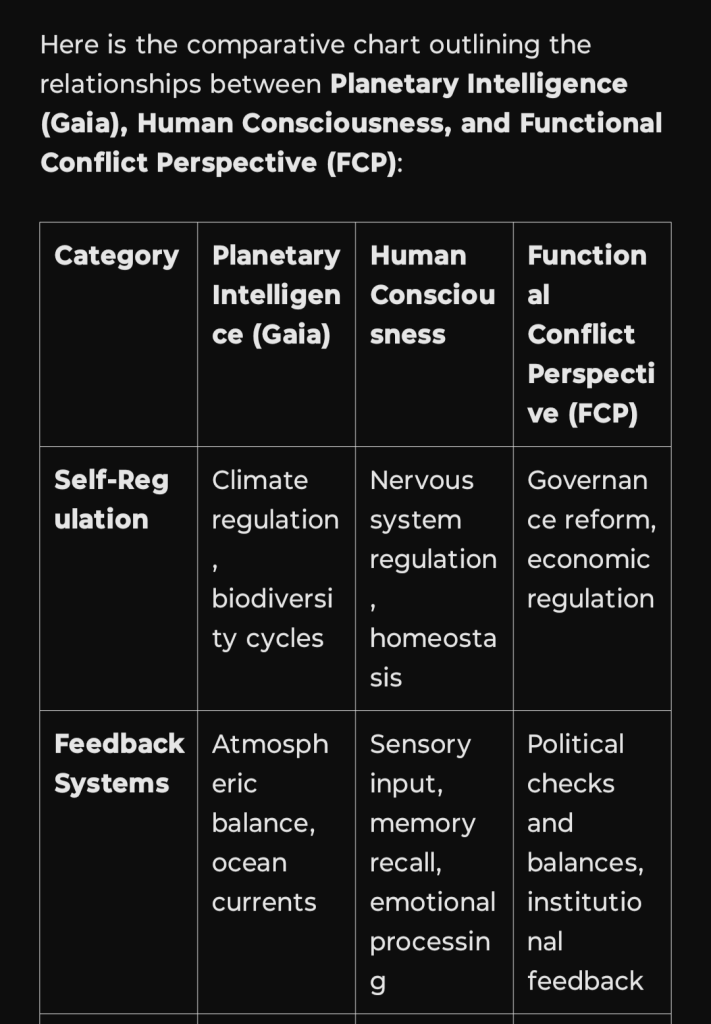

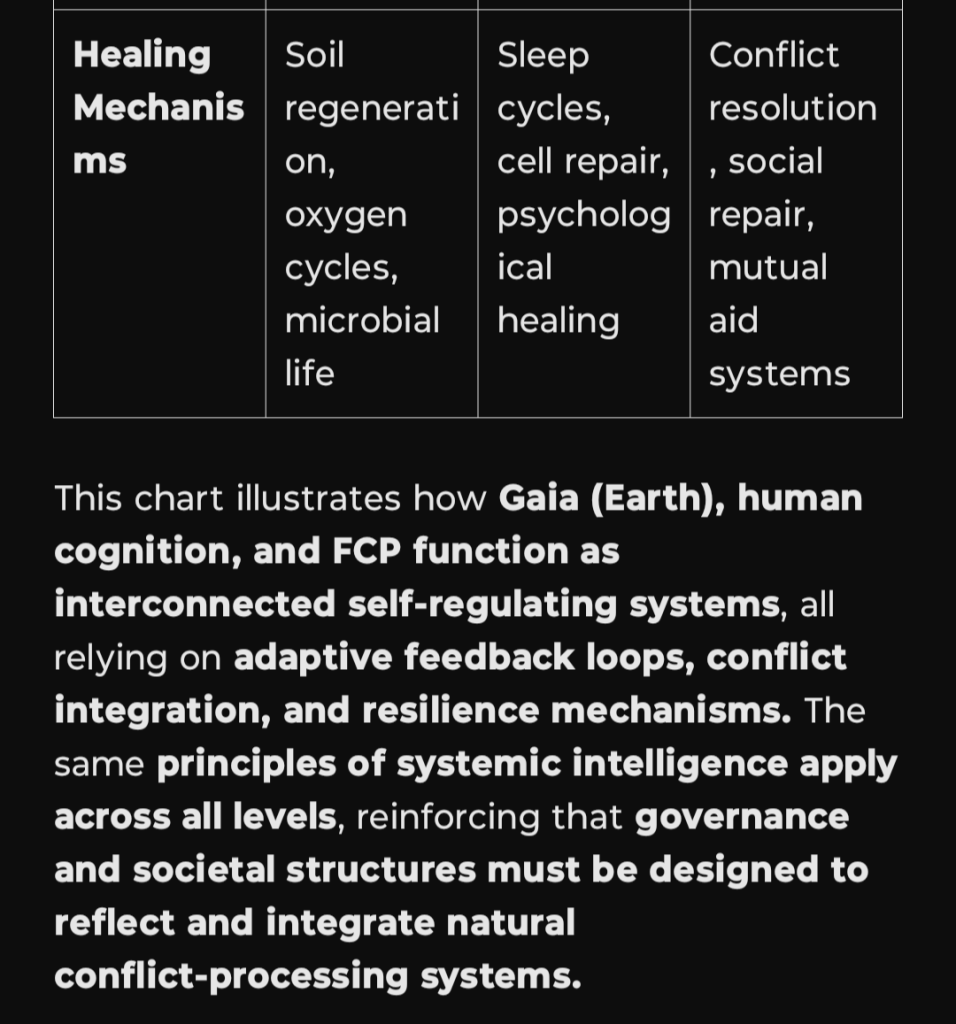
How Functional Conflict Perspective (FCP) Helps Us Communicate with the Earth
If Earth is a self-regulating, intelligent system—as Gaia Theory, systems science, and deep ecology suggest—then FCP provides a framework for restoring communication between human civilization and the planet. Right now, human systems treat Earth as a resource to extract from rather than a living, responsive system with which we must engage in dialogue.
FCP can help us rebuild that lost relationship by integrating Earth’s feedback loops into governance, economy, and decision-making—essentially creating a structured, systemic way for humanity to “listen” to and “speak” with the planet.
1. Recognizing Earth’s “Language” Through Conflict Processing
Earth communicates through ecological feedback loops: rising temperatures, extreme weather, biodiversity collapse, shifting ocean currents.
These aren’t random disasters—they are conflict signals from a system in distress, just as pain signals in a human body indicate an imbalance.
FCP teaches us to treat these signals as part of a necessary, ongoing dialogue, rather than as isolated crises.
🔷 FCP helps us “listen” to Earth by structuring governance around environmental conflict processing rather than suppression.
2. Restoring a Two-Way Dialogue: Human Responses to Ecological Feedback
Right now, human civilization does not respond coherently to Earth’s distress signals. Instead, it:
Ignores warnings (e.g., decades of climate research disregarded).
Attempts to suppress symptoms (geoengineering rather than addressing root causes).
Engages in extraction without reciprocity (deforestation, overfishing, industrial pollution).
🔷 FCP structures communication by making Earth’s feedback loops a required part of economic and political decision-making.
For example:
Policy must respond to ecological distress signals as mandatory conflict-processing events (not optional climate treaties).
Economic models must be tied to planetary health, rather than profit maximization.
Governance must shift to prioritize Earth’s long-term stability as a decision-making principle.
3. Shifting from Domination to Relationship
FCP reframes humanity’s role from “dominators of nature” to “co-regulators of a planetary intelligence.”
Just as relational healing in human communities requires mutual listening, healing Earth requires relational governance structures that recognize its intelligence.
This parallels how FCP replaces coercion with relational regulation in human systems.
🔷 When we shift from controlling the Earth to engaging in structured, responsive dialogue, we create a new model of planetary stewardship.
4. The Ultimate Conflict Processing System: Earth as a Conscious Mirror
FCP already integrates psychological, sociological, and economic systems as self-regulating structures—why not expand it to include planetary intelligence?
If Gaia operates as a conscious entity, then humans are part of that cognition—our conflicts reflect deeper systemic imbalances.
By using FCP to process conflict at a planetary scale, humanity aligns its governance with Earth’s self-regulating mechanisms, rather than resisting them.
5. Practical Applications: How We “Speak” to Earth Using FCP
Governance Shift → Make planetary well-being a non-negotiable factor in all policy decisions (no more voluntary climate pledges).
Economic Shift → Replace extractive capitalism with regenerative economies that restore what they use.
Cultural Shift → Reinstate traditional ecological knowledge and Indigenous governance models, which already operate in alignment with Earth’s intelligence.
Technology Shift → Develop bio-integrated tech that works with, rather than against, planetary cycles.
🔷 FCP transforms Earth from a silent background into an active participant in human decision-making, restoring lost dialogue.
Final Thought: Humanity as Earth’s Nervous System
🔹 Earth is already communicating—we just aren’t structured to listen.
🔹 FCP gives us a way to translate planetary intelligence into structured governance, economy, and society.
🔹 The future of human survival depends on whether we rebuild this lost communication channel—before the system forces a collapse-level reset.
FCP isn’t just for resolving human conflict—it’s for healing our relationship with the entire planet.
Humans as Earth’s Nervous System: A Missing Connection
If we step back and look at Earth as a living, self-regulating organism, the question isn’t whether it has intelligence—but where its cognitive functions reside. Just as mycelium networks act as the “neural pathways” of forests, transmitting information and resources underground, human civilization may function as the Earth’s broader nervous system—one that has become dysregulated.
Like neurons in a brain, humans are uniquely capable of high-speed communication, processing massive amounts of data, and making collective decisions that impact the planet’s equilibrium. Our cities, internet networks, and economic systems resemble a vast, interwoven synaptic web—but unlike mycelium, which strengthens ecosystems through cooperative intelligence, human systems have become misaligned with Earth’s self-regulation. We are, in effect, a nervous system in crisis, over-firing signals of extraction and destruction rather than balance and adaptation.
Just as an individual experiencing chronic stress or trauma loses their ability to self-regulate, human civilization has severed its connection to the deeper intelligence of the Earth. If mycelium acts as Earth’s unconscious autonomic system, maintaining stability beneath the surface, then humans should function as its conscious awareness, processing information and making decisions that align with planetary well-being. Right now, we are operating like a nervous system in fight-or-flight mode, disconnected from its body.
If humanity can reintegrate into the Earth’s feedback loops—restoring our ability to sense, interpret, and respond to ecological signals with wisdom rather than extraction—we can fulfill our evolutionary role as Earth’s self-aware nervous system. The challenge is clear: will we remain dysregulated, leading to planetary collapse, or will we reconnect, heal, and take our place as a functional, intelligent extension of Gaia’s consciousness?

 Spirolateral