
How This Version of Globalism Differs from Traditional Globalism
Traditional globalism is often associated with economic globalization, where multinational corporations and international institutions (e.g., the UN, IMF, World Bank) promote free trade, open markets, and economic integration. This version is hierarchical, profit-driven, and controlled by elites, leading to corporate dominance, economic inequality, and environmental exploitation.
In contrast, this new version of Globalism is about decentralization, cooperation, and sustainability. Instead of corporations and governments controlling global systems, it envisions community-led, non-hierarchical governance focused on social justice, economic fairness, and environmental regeneration.
Key Differences:


How This Version of Globalism Differs from Traditional Globalism
Traditional globalism focuses on economic globalization, where multinational corporations and international institutions (e.g., the UN, IMF, World Bank) promote free trade, open markets, and economic integration. This approach is hierarchical, profit-driven, and controlled by elites, often leading to corporate dominance, economic inequality, and environmental exploitation.
In contrast, this new version of Globalism is decentralized, cooperative, and regenerative. Instead of corporations and governments controlling global systems, it envisions community-led, non-hierarchical governance focused on social justice, economic fairness, and environmental sustainability.
Key Differences:
1. Who Controls It?
Traditional Globalism: Corporate-driven – Big businesses and financial institutions shape policies.
New Globalism: People-driven – Communities and individuals co-create governance.
2. What’s the Main Goal?
Traditional Globalism: Profit-oriented – Maximizing economic growth and corporate interests.
New Globalism: Well-being-oriented – Prioritizing human and planetary health over profit.
3. How Is Power Distributed?
Traditional Globalism: Top-down control – Governments and elite organizations dictate policies.
New Globalism: Decentralized governance – Local, trauma-informed decision-making.
4. What About Borders?
Traditional Globalism: National borders remain but are economically open (for capital, not necessarily people).
New Globalism: Borderless citizenship – People have freedom of movement and shared global responsibility.
5. What Kind of Economy Does It Support?
Traditional Globalism: Maintains capitalism with regulations – Focuses on trade agreements and market-driven solutions.
New Globalism: Post-capitalist – Encourages cooperative economies, mutual aid, and resource-sharing.
6. How Does It Approach the Environment?
Traditional Globalism: Environmental policy is reactive – Focuses on regulations but still allows exploitation.
New Globalism: Regenerative environmental policy – Actively restores ecosystems and prevents harm.
7. What Kind of Justice System Does It Have?
Traditional Globalism: Justice is punitive – Still relies on police, prisons, and state enforcement.
New Globalism: Justice is restorative – Focuses on healing, accountability, and non-coercive conflict resolution.
Summary:
Traditional globalism = corporate-controlled, capitalist, profit-driven, and hierarchical.
New Globalism = community-led, post-capitalist, cooperative, regenerative, and trauma-informed.
It’s not just about global economic integration—it’s about creating a fair, sustainable, and decentralized world that works for everyone.
In short, traditional globalism is about economic integration under elite control, while this new Globalism is about decentralizing power, prioritizing well-being, and creating a fair, cooperative world without coercion.

The Globalist Manifesto:
A Vision for a Regenerative, Trauma-Informed, and Decentralized World
I. Introduction: A New Vision for Humanity
We, the Globalists, believe in a world beyond borders—one where humanity recognizes itself as a singular, interconnected entity, bound not by national divisions or profit-driven hierarchies but by our shared responsibility to each other and the planet. We reject nationalism, authoritarianism, and extractive capitalism, recognizing them as relics of a past that has prioritized competition over cooperation, control over liberation, and short-term profit over long-term planetary survival.
Globalism is not the erasure of culture or identity but the elevation of our collective sovereignty as citizens of Earth. We are committed to governance models that prioritize relational intelligence, decentralized self-regulation, and ecological stewardship over coercive control and profit-driven exploitation.
This manifesto outlines our core principles, the structural transformations we seek, and the path forward to a just, sustainable, and harmonious world.
II. Core Principles of Globalism
1. Planetary Stewardship Over Profit
The Earth is not a commodity—it is a living system that must be nurtured, not exploited.
We advocate for regenerative governance models that ensure sustainability, climate resilience, and ecological balance.
All economic, political, and technological decisions must be made through the lens of long-term planetary health.
2. Decentralized, Trauma-Informed Governance
We reject hierarchical control structures that perpetuate oppression, trauma cycles, and systemic inequality.
Governance must be distributed, participatory, and rooted in community autonomy, following Fibonacci-inspired models of self-organization.
Justice must be restorative, not punitive, addressing harm through healing, accountability, and systemic transformation.
3. Economic Justice & Post-Capitalist Restructuring
Capitalism, in its current form, is unsustainable and coercive, relying on extraction, exploitation, and systemic precarity.
We advocate for cooperative economies, universal basic income, mutual aid networks, and non-exploitative labor structures.
Wealth must not be concentrated in the hands of the few but redistributed through relational, community-driven economic frameworks.
4. Liberation from Nationalism & Artificial Borders
Borders are a human construct, created to enforce division and hierarchical control.
We reject nationalism as an outdated, fear-driven ideology that has fueled wars, exclusion, and oppression.
Global citizenship must replace outdated nationalistic models, allowing free movement, shared resources, and cooperative internationalism.
5. Relational Intelligence as the Foundation of Social Cohesion
Governance must be informed by neuroscience, polyvagal theory, and attachment science, ensuring that decisions support human nervous system regulation, emotional intelligence, and social connection.
Political and economic systems must be designed to reduce collective dysregulation rather than exploit it.
Education must prioritize self-awareness, mutual aid, conflict resolution, and cooperative decision-making over obedience to authority.
6. Abolition of Coercive Systems & Hierarchical Control
Prisons, police, and militarized institutions do not create safety—they reinforce trauma, oppression, and control.
Justice must be restorative and trauma-informed, focusing on healing the root causes of harm rather than perpetuating punitive cycles.
True security comes from relational trust, social support, and economic stability, not from coercion or surveillance.
7. Technology for Collective Well-Being, Not Exploitation
Technological innovation must be used for sustainability, human flourishing, and planetary restoration, not for corporate profit or social control.
AI, automation, and scientific advancements must be ethically integrated into society, ensuring they serve humanity and the Earth rather than exploit them.
8. Post-Scarcity & the End of Manufactured Precarity
Humanity has the resources to eradicate poverty, hunger, and preventable suffering—what prevents this is economic and political systems designed to maintain artificial scarcity.
The shift to a post-scarcity society requires restructuring how we distribute resources, organize labor, and measure societal success.
Well-being, not GDP, must be the primary metric of progress.
III. The Structural Transformations We Seek
1. A Regenerative Global Economy
Transition from extractive capitalism to cooperative, post-capitalist models.
Implement universal basic income, mutual aid structures, and cooperative ownership.
Shift from GDP-based success to well-being and ecological health as primary economic indicators.
2. Decentralized & Trauma-Informed Governance
Establish Fibonacci-inspired governance structures that balance local autonomy with global cooperation.
Implement restorative justice frameworks that replace coercion with community-based conflict resolution.
Dismantle hierarchical, coercive legal systems and replace them with relational governance models.
3. Borderless, Relational Internationalism
Transition from nation-states to a network of autonomous, cooperative regions.
Create a universal framework for global citizenship with free movement and shared planetary responsibility.
Prioritize collaboration over competition in global decision-making.
4. Education & Social Transformation
Replace obedience-based education with trauma-informed, relational, and cooperative learning models.
Teach conflict resolution, mutual aid, and emotional intelligence as core curricula.
Decouple education from capitalist labor demands, focusing on creativity, critical thinking, and community well-being.
IV. The Path Forward: How We Build This World
1. Micro-Experiments & Parallel Systems
Instead of waiting for governments to change, we build alternative structures that render the old systems obsolete.
Cooperative communities, worker-owned businesses, mutual aid networks, and decentralized governance models serve as prototypes for large-scale transition.
2. Disrupting the Old While Creating the New
Systemic change requires both disruption and regeneration—challenging exploitative structures while actively creating functional alternatives.
The most effective revolutionaries are those who experiment, make mistakes, and adapt rather than adhere to ideological purity.
3. Embodiment Over Intellectualism
Change does not happen through theory alone—it happens through lived action, relational transformation, and nervous system regulation.
Revolution must be embodied, trauma-informed, and practiced daily in how we engage with ourselves and others.
4. Decentralized, Global Collaboration
The movement for Globalism is not about a single leader or organization—it is a distributed network of individuals, communities, and collectives aligned in shared purpose.
Every action taken toward decentralization, relational healing, and ecological restoration is a step toward the world we seek.
V. Conclusion: A World Beyond Borders, Hierarchies, and Coercion
Globalism is not just a political philosophy—it is a new way of being, relating, and organizing human society. The future belongs to those who dare to create structures that heal rather than harm, who prioritize relational intelligence over control, and who build systems that serve both humanity and the Earth rather than exploit them.
The old world is dying. The question is: will we be the architects of what comes next?
We are the sovereign citizens of Earth. We are the revolution.
🔹 For more information and organizing resources, visit http://www.spirolateral.org.
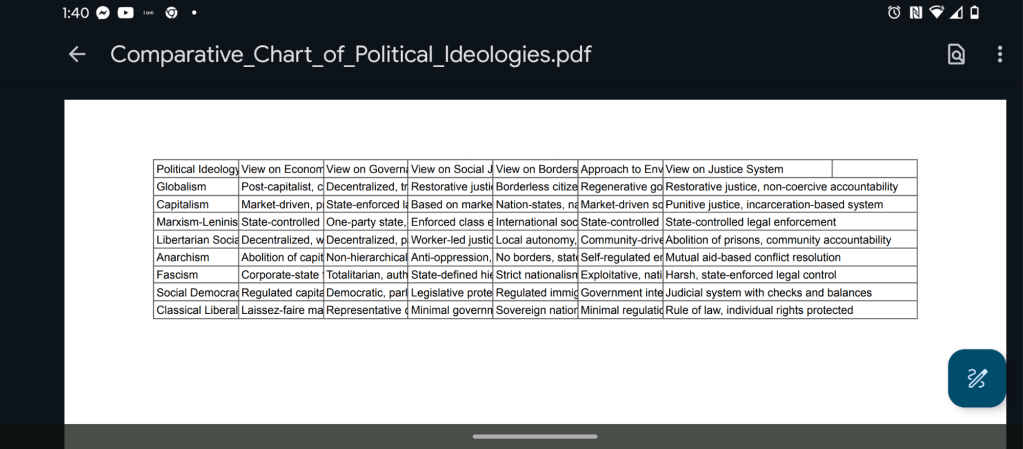
1. Globalism
View on Economy: Post-capitalist, cooperative, mutual aid-based economy.
View on Governance: Decentralized, trauma-informed, non-hierarchical.
View on Social Justice: Restorative justice, trauma-informed policy, abolitionist.
View on Borders: Borderless citizenship, global cooperation.
Approach to Environmental Policy: Regenerative governance, ecological restoration.
View on Justice System: Restorative justice, non-coercive accountability.
2. Capitalism
View on Economy: Market-driven, profit-oriented, private ownership.
View on Governance: State-enforced laws, hierarchical governance.
View on Social Justice: Based on market outcomes, minimal intervention.
View on Borders: Nation-states, national sovereignty.
Approach to Environmental Policy: Market-driven solutions, corporate responsibility.
View on Justice System: Punitive justice, incarceration-based system.
3. Marxism-Leninism
View on Economy: State-controlled socialist economy, centralized planning.
View on Governance: One-party state, authoritarian governance.
View on Social Justice: Enforced class equality through state control.
View on Borders: International socialist alliances, controlled migration.
Approach to Environmental Policy: State-controlled environmental initiatives.
View on Justice System: State-controlled legal enforcement.
4. Libertarian Socialism
View on Economy: Decentralized, worker-controlled, cooperative economy.
View on Governance: Decentralized, participatory democracy.
View on Social Justice: Worker-led justice, direct action, anti-exploitation.
View on Borders: Local autonomy, open borders encouraged.
Approach to Environmental Policy: Community-driven sustainability, green economy.
View on Justice System: Abolition of prisons, community accountability.
5. Anarchism
View on Economy: Abolition of capitalism, voluntary exchange, self-sufficiency.
View on Governance: Non-hierarchical, community-based decision-making.
View on Social Justice: Anti-oppression, voluntary associations for justice.
View on Borders: No borders, stateless societies.
Approach to Environmental Policy: Self-regulated environmental sustainability.
View on Justice System: Mutual aid-based conflict resolution.
6. Fascism
View on Economy: Corporate-state fusion, hierarchical economic control.
View on Governance: Totalitarian, authoritarian state control.
View on Social Justice: State-defined hierarchy, racial/national supremacy.
View on Borders: Strict nationalism, ethnic purity policies.
Approach to Environmental Policy: Exploitative, nationalist-driven resource control.
View on Justice System: Harsh, state-enforced legal control.
7. Social Democracy
View on Economy: Regulated capitalism with social safety nets.
View on Governance: Democratic, parliamentary governance.
View on Social Justice: Legislative protections for marginalized groups.
View on Borders: Regulated immigration, controlled borders.
Approach to Environmental Policy: Government intervention in climate policies.
View on Justice System: Judicial system with checks and balances.
8. Classical Liberalism
View on Economy: Laissez-faire markets, minimal government intervention.
View on Governance: Representative democracy with individual freedoms.
View on Social Justice: Minimal government intervention, individual rights.
View on Borders: Sovereign nation-states with regulated borders.
Approach to Environmental Policy: Minimal regulation, property rights protection.
View on Justice System: Rule of law, individual rights protected.

Introducing Globalism: A New Political Party for a Borderless, Regenerative Future
A Political Movement for the Next Era of Human Civilization
The world is at a turning point. Traditional political parties—whether left, right, or centrist—have failed to address the systemic issues that threaten humanity and the planet. Nationalism, hierarchical control, and extractive capitalism continue to dominate global governance, reinforcing cycles of trauma, oppression, and environmental destruction. The current political frameworks are not equipped to solve the crises they have created.
That’s why we are building Globalism—a new political philosophy and movement that transcends outdated ideologies and prioritizes the well-being of people and the planet over power and profit. Unlike nationalism, Globalism recognizes that we are not citizens of individual countries—we are sovereign citizens of Earth, bound by our shared responsibility to steward the planet, foster social cohesion, and create regenerative, non-hierarchical systems of governance.
This is not just a new political party—it is a new way of organizing human civilization.
What Is Globalism?
Globalism is a decentralized, trauma-informed, and non-hierarchical political philosophy that integrates psychological regulation, social cohesion, and systemic healing as core principles of governance. It moves beyond traditional leftist, anarchist, and capitalist frameworks, recognizing that hierarchical control, coercion, and extractive economies inevitably reproduce harm.
Instead of relying on nation-states, ruling classes, or authoritarian structures, Globalism builds cooperative, self-regulating systems that prioritize relational intelligence, sustainability, and economic justice.
Here’s what sets Globalism apart from any existing political movement:
Core Tenets of Globalism
1. Decentralized, Trauma-Informed Governance
We reject hierarchical control structures that perpetuate trauma cycles and systemic inequality.
Governance must be participatory, relational, and rooted in self-regulating communities, following Fibonacci-inspired models for balance and sustainability.
Justice must be restorative, not punitive, prioritizing healing over coercion.
2. Economic Justice & Post-Capitalist Restructuring
Capitalism, as it exists today, is exploitative, unsustainable, and built on artificial scarcity.
We advocate for cooperative economies, universal basic income, mutual aid networks, and non-exploitative labor models.
Wealth must be redistributed through regenerative, community-driven economic frameworks rather than concentrated in corporate or state hierarchies.
3. Borderless Citizenship & International Cooperation
Nationalism is an artificial construct that divides humanity and perpetuates war, economic injustice, and exclusion.
We reject national borders in favor of global citizenship and planetary responsibility.
Resources, labor, and knowledge should be shared, not hoarded by nation-states or private corporations.
4. Environmental Stewardship & Regenerative Governance
The Earth is not a commodity—it is a living system that must be nurtured, not exploited.
Our economic and political decisions must be made through the lens of long-term planetary health rather than short-term profit.
We advocate for decentralized ecological governance, shifting from extractive industries to regenerative, locally-driven environmental policies.
5. Relational Intelligence & Social Cohesion
Political and economic systems must be designed to reduce collective dysregulation rather than exploit it.
Education must prioritize self-awareness, conflict resolution, and emotional intelligence over obedience to authority.
True security comes from relational trust, social support, and economic stability—not coercion or surveillance.
6. Abolition of Coercive Institutions
Prisons, police, and militarized institutions do not create safety—they reinforce trauma and oppression.
Justice must focus on addressing the root causes of harm through community accountability and restorative practices.
Power structures based on punishment and control must be dismantled and replaced with trauma-informed conflict resolution systems.
How Globalism Differs from Traditional Ideologies
Globalism is not aligned with traditional political binaries. While it critiques capitalism, authoritarianism, and nationalism, it does so from a trauma-informed, relational perspective rather than through ideological purity tests.
Here’s how it compares to existing frameworks:
Not aligned with authoritarian leftism (Leninism, Marxism-Leninism, state socialism) → Because hierarchical revolutions reproduce trauma cycles.
Not fully anarchist in the traditional sense → Because Globalism prioritizes relational healing and systemic restoration rather than rejecting all forms of governance.
Deeply anti-capitalist and post-hierarchical → But focused on trauma resolution, social cohesion, and non-coercive economic models rather than class warfare alone.
Abolitionist, trauma-informed, and decentralized → Favoring restorative governance over coercive legal structures.
Eco-relational, regenerative, and community-driven → Using Fibonacci-inspired city planning and governance models that emphasize sustainability and local autonomy.
The Science Behind Globalism
Unlike traditional political ideologies, Globalism integrates neuroscience, psychology, and systems theory into governance.
Polyvagal theory (Porges, 2011) → Shows that collective dysregulation fuels political instability. Regulated, relational governance is essential for long-term stability.
Attachment science (Bowlby, Ainsworth) → Reveals that secure relational bonds create more ethical, cooperative societies.
Functional Conflict Perspective (FCP) → Demonstrates that conflict is a self-regulating mechanism, and coercion-based governance only perpetuates harm.
By grounding governance in relational intelligence and nervous system regulation, Globalism offers a radically new way of structuring society—one that fosters well-being rather than exploiting trauma responses for control.
Join the Globalist Movement
The world needs a new way forward. Globalism is not just a political party—it is a new blueprint for human civilization.
If you believe in:
✅ Decentralized, trauma-informed governance
✅ A post-capitalist, cooperative economy
✅ Abolition of coercive institutions
✅ Borderless, global citizenship
✅ Regenerative environmental stewardship
✅ A world designed for human and planetary well-being
…then you are already a Globalist.
We are building this movement from the ground up—creating alternative governance models, community-driven economies, and sustainable infrastructure that will render outdated systems obsolete.
🔹 Join the conversation at http://www.spirolateral.org
🔹 Follow us for updates, local organizing efforts, and real-world implementation strategies.
Together, we are not just imagining a new world. We are building it.
#Globalism #RegenerativeGovernance #DecentralizedFutures #PostCapitalism #AbolitionistDemocracy #SpiroLateral

How Shifting from Nationalism/Patriotism to Globalism/Planetism Would Transform Human Psychology and Relational Ecology
The way we define identity and belonging deeply shapes human psychology and relational ecology—our connection to each other and the planet. Nationalism and patriotism, as they currently exist, create psychological barriers that reinforce us vs. them thinking, competition, and territoriality, while a shift toward Globalism and Planetism would foster cooperation, relational intelligence, and ecological responsibility.
Psychological Shifts: From Nationalism to Globalism
1. From Tribal Competition to Cooperative Identity
Nationalism teaches people to view other nations as rivals, fostering competition, xenophobia, and distrust.
Globalism reframes identity as interconnected and cooperative, reducing the need for superiority, war, and exploitation.
Instead of “my country first,” people would see themselves as stewards of the planet and members of a global community.
2. From Fear-Based Security to Relational Trust
Patriotism often weaponizes fear (e.g., fear of immigrants, foreign threats), leading to militarization and surveillance culture.
A global mindset prioritizes collaborative security, where nations don’t prepare for war but instead invest in trust, diplomacy, and mutual aid.
3. From Border Anxiety to Open Mobility
Nationalism reinforces fear of outsiders, making people defensive about borders.
Removing the artificial concept of borders would reduce psychological scarcity, making people feel less possessive, more open, and less threatened by difference.
Instead of immigration policies based on exclusion, societies would embrace free movement and cultural exchange as natural.
4. From Individualism to Collective Responsibility
Nationalism encourages economic competition and survival-of-the-fittest thinking, which leads to economic inequality and ecological neglect.
A planetary identity fosters cooperative economies, regenerative governance, and shared resource management, reducing greed, hoarding, and exploitation.
Instead of thinking “my country’s economy,” people would think about global well-being and sustainability.
Ecological & Relational Changes: From Borders to Shared Stewardship
1. From Exploiting Land to Protecting It
Nationalism allows governments and corporations to exploit resources within national borders without considering global impact.
A planetary perspective would see the Earth as a shared ecosystem, promoting regenerative policies, global conservation, and ecological responsibility.
People would shift from “owning” land to caretaking it for future generations.
2. From War Over Resources to Sustainable Cooperation
Many modern wars are fought over territory, oil, and scarce resources.
A globalist perspective would prioritize resource-sharing agreements over military conquest, reducing global conflict.
3. From Cultural Domination to Mutual Exchange
Borders reinforce ethnocentrism, where cultures see themselves as superior.
Removing borders would lead to more cultural blending, mutual respect, and cross-cultural learning, reducing racism, nationalism, and exclusionary politics.
4. From Isolation to Relational Harmony
A nation-based identity limits how people relate to others and creates psychological distance between cultures.
Seeing all humans as part of a shared ecological and social web would increase empathy, cooperation, and mutual respect.
The emphasis would shift from national pride to planetary well-being and relational harmony.
Final Impact: A Relationally and Ecologically Integrated World
If people replaced nationalism with planetism, we would see:
✅ Less war and conflict, as competition over borders dissolves.
✅ More global cooperation, as shared responsibility replaces territorialism.
✅ Greater ecological sustainability, as humans see Earth as a living system to protect rather than a resource to exploit.
✅ Stronger human connections, as artificial national divisions are replaced with relational interdependence.
By removing false, human-created borders, we would dissolve the psychological barriers that separate us, fostering a world where people see themselves as stewards of the planet, not just citizens of nations.
Earth as a Sovereign and Sentient Being: A Systems Theory Perspective
Abstract
This paper argues for recognizing Earth as a sovereign and sentient being, drawing on General Systems Theory (GST), Cybernetics, Complexity Science, Ecological Systems Theory, and World-Systems Analysis. Synthesizing insights from Ludwig von Bertalanffy, James Lovelock, Niklas Luhmann, Humberto Maturana, Francisco Varela, Ilya Prigogine, Donella Meadows, and others, this analysis demonstrates that Earth functions as an autopoietic, self-regulating, complex adaptive system with the capacity for homeostasis, communication, and systemic intelligence. By integrating governance models from Stafford Beer’s Viable System Model (VSM), World-Systems Theory (Wallerstein), and Gaia Theory (Lovelock), we propose an alternative paradigm where Earth is recognized as a political and legal entity, possessing sovereignty over its ecological and systemic functions.
1. Introduction: Earth as More Than a Passive Environment
Traditional Western thought has treated Earth as an inert resource—a passive backdrop for human activity. However, systems theory challenges this assumption, demonstrating that Earth is not merely a sum of its parts but an interconnected, self-regulating system. This paper presents an integrated case for Earth’s sentience and sovereignty, arguing that:
- Earth exhibits autopoiesis (Maturana & Varela), demonstrating self-generation and maintenance.
- Earth functions as a cybernetic system (Wiener, Ashby), regulating climate, biodiversity, and atmospheric composition.
- Earth’s resilience follows complex adaptive system principles (Holland, Kauffman, Prigogine).
- The biosphere operates as a global neural network, facilitating interspecies and biochemical communication (Capra, Lovelock).
- Earth’s sociopolitical interactions with human civilization reflect world-systems dynamics (Wallerstein, Bourdieu).
By combining these perspectives, we move toward an ontological shift: Earth as a legal and sovereign entity within a self-sustaining planetary governance system.
2. Systems Theory and Earth’s Self-Regulation
2.1 General Systems Theory and Cybernetics
Bertalanffy’s General Systems Theory (GST) and Wiener’s Cybernetics establish that complex systems are governed by feedback loops, regulation mechanisms, and homeostasis. Earth exhibits all of these properties:
- Negative Feedback Loops: Earth regulates CO₂ levels, ocean temperatures, and atmospheric balance much like a living organism’s homeostatic processes.
- Autopoiesis: Earth maintains its own stability through energy cycling, climate adaptation, and biochemical networks.
- Self-Organization: Prigogine’s dissipative structures explain how Earth maintains equilibrium through continuous energy exchange.
These mechanisms demonstrate Earth’s self-awareness—not in human cognition terms but as a distributed intelligence network.
2.2 Gaia Hypothesis and Earth’s Cognitive System
James Lovelock’s Gaia Hypothesis posits that Earth behaves as a self-regulating superorganism, controlling its own habitability:
- Biogeochemical cycles function like metabolic processes, optimizing conditions for life.
- Forests, fungi, and ocean currents act as a distributed sensing system.
- Climate regulation occurs through dynamic feedback, akin to an immune response in biological systems.
Fritjof Capra extends this view, showing how Earth’s interconnected systems resemble a neural network, where biological and geophysical processes “communicate” through complex interdependencies.
2.3 Complexity Science and Adaptive Intelligence
Murray Gell-Mann, Stuart Kauffman, and John H. Holland define complex adaptive systems (CAS) as those that:
- Process information from their environment.
- Adapt dynamically through feedback loops.
- Demonstrate emergent properties beyond their individual components.
Earth fits all three criteria. The climate, biosphere, and ocean currents form an adaptive intelligence network, continuously adjusting to planetary inputs.
If a complex adaptive system capable of self-regulation and environmental response is a form of intelligence, then Earth qualifies as a sentient being.
3. Earth’s Sovereignty in Systems Governance
3.1 World-Systems Analysis and Earth’s Political Role
Immanuel Wallerstein’s World-Systems Theory frames Earth’s ecological crisis as an outcome of systemic capitalist extraction, where human economies externalize ecological costs onto a living system.
- Just as nations claim sovereignty, Earth must be recognized as a sovereign political entity with legal rights over its ecosystems.
- Wallerstein’s model shows that Earth’s subjugation is tied to global economic exploitation, mirroring historical colonial domination.
Bruno Latour’s Actor-Network Theory (ANT) supports this by redefining non-human actors (ecosystems, climate, and geological systems) as politically relevant entities. Earth, therefore, is not merely a background but an active participant in global politics.
3.2 Cybernetics and the Viable System Model (VSM)
Stafford Beer’s Viable System Model (VSM) outlines how organizations self-regulate for survival. Applied at the planetary level:
- Earth’s biosphere acts as System 1, regulating local ecological zones.
- The climate and hydrological cycles act as System 2, managing global coordination.
- The human governance layer (System 3) should serve Earth’s health, not exploit it.
By applying VSM, we argue for a restructured global governance model, where human institutions are accountable to planetary intelligence rather than corporate interests.
4. Toward Legal and Political Recognition
If Earth demonstrates systemic intelligence and sovereignty, the next step is formal political recognition. Following the Rights of Nature movement, we propose:
- Legal Personhood for Earth – Treating Earth as a sovereign political entity under international law.
- Planetary Council Governance – A system where nations report to Earth’s ecological limits, not capitalist growth.
- Cybernetic Regulation – A planetary system integrating Gaia’s intelligence into governance models.
5. Conclusion: Earth as a Political and Sentient Entity
By integrating General Systems Theory, Cybernetics, Complexity Science, Gaia Hypothesis, and World-Systems Analysis, we conclude:
- Earth exhibits autopoiesis, self-regulation, and adaptive intelligence.
- Earth communicates through biochemical and ecological networks, resembling cognition.
- Human governance must be restructured to recognize Earth’s sovereignty.
Rather than treating Earth as an inert backdrop for human exploitation, we must honor its intelligence, governance, and legal autonomy—not as a metaphor, but as a scientific, systems-based reality.
References
Bertalanffy, L. von. General Systems Theory: Foundations, Development, Applications. (1968).
Wiener, N. Cybernetics: Or Control and Communication in the Animal and the Machine. (1948).
Lovelock, J. Gaia: A New Look at Life on Earth. (1979).
Maturana, H., & Varela, F. Autopoiesis and Cognition: The Realization of the Living. (1980).
Prigogine, I. & Stengers, I. Order Out of Chaos. (1984).
Wallerstein, I. The Modern World-System. (1974).
Latour, B. We Have Never Been Modern. (1991).
Beer, S. Brain of the Firm. (1972).
This argument reframes Earth not as property, but as a sovereign, sentient actor, requiring a planetary political and legal paradigm shift.
 Spirolateral