The Gnostic Repair Model: A Restorative Alternative to Classical Gnosis
Heaven is not a future destination – it is right here, waiting for us to build it together now.
Abstract
Traditional Gnosticism portrays the material world as a false reality, a fragmented illusion created by the Demiurge, with salvation found through transcending the material and returning to the Pleroma—an undivided realm of divine perfection. However, this framework often leads to detachment, intellectual elitism, and an avoidance of material engagement.
The Gnostic Repair Model (GRM), grounded in Functional Conflict Perspective (FCP) and Mirror Integration Theory (MIT), offers an alternative: rather than seeking escape, true gnosis involves restoring wholeness within the fractured material and relational world. In this model, knowledge is not just revelatory but actively reparative, guiding both individual healing and systemic transformation.
I. Classical Gnosticism and the Problem of Detachment
1. The Traditional Gnostic Worldview
The Pleroma (Fullness) is the realm of divine perfection, composed of Aeons (ideal forms or perfect ideas).
The Demiurge (often identified with Yahweh or false authority) creates the material world, which is inherently corrupt and deceptive.
Human souls are divine sparks trapped in this illusion, seeking to return to the Pleroma through gnosis (hidden knowledge).
The path to salvation is transcendence—detaching from material existence, rejecting false rulers, and escaping the cycle of illusion.
2. The Limits of the Classical Gnostic Model
Detachment over Repair → By emphasizing escape over restoration, classical Gnosticism neglects the possibility of reintegrating the fractured world.
Elitism in Knowledge → Gnostic salvation often requires esoteric initiation, reinforcing hierarchical access to truth rather than a participatory, relational model.
Neglect of Relational Healing → The individualistic quest for escape can mirror trauma-based dissociation rather than actual integration and repair.
II. The Gnostic Repair Model (GRM): A Trauma-Informed Approach to Gnosis
1. The Functional Conflict Perspective (FCP) and the Role of Repair
The Gnostic Repair Model reframes gnosis not as escape, but as the recognition and integration of fragmentation within ourselves, our relationships, and our societal structures.
Conflict is not a sign of failure but a self-regulating mechanism → FCP shows how trauma, fragmentation, and dysfunction are not just things to be discarded but integrated and transformed.
Systems can be healed rather than abandoned → MIT demonstrates how individual and collective repair mirror one another—what is healed in one dimension reflects in the other.
Relational gnosis replaces detached gnosis → Rather than pursuing a solitary, abstract escape into hidden knowledge, GRM emphasizes the restoration of relational, social, and systemic wholeness.
2. Mirror Integration Theory (MIT) and the Healing of the Fragmented Self
Where classical Gnosticism sees the material world as an irreparable corruption, MIT treats trauma, division, and conflict as symptoms of fragmentation that can be reintegrated.
The “False World” is not external but internal → The Demiurge represents not just external oppression but internalized fragmentation, reinforcing fear, disconnection, and self-alienation.
Healing comes from reclaiming lost parts → In MIT, knowledge is not about rejection but about repair—bringing awareness to fragmented aspects of self and reintegrating them through relational safety.
Integration is the true “return to the Pleroma” → Rather than escaping, we restore the fullness (Pleroma) by reconstructing wholeness within and around us.
III. The Three Pillars of Restorative Gnosis
Rather than treating knowledge as a hierarchical or exclusionary path to escape, the Gnostic Repair Model defines true gnosis as a process of systemic, relational, and personal reintegration.
1. Gnosis as Systemic Integration
Instead of rejecting social and economic systems, GRM applies Functional Conflict Perspective (FCP) to reform broken structures.
Institutions function like psychological complexes—they can become dissociative and harmful or be restructured for healing and regulation.
Regenerative governance, cooperative economies, and non-hierarchical structures become paths to reassembling the fragmented world.
2. Gnosis as Relational Healing
Instead of isolating the self in detached intellectualism, MIT reframes gnosis as a deeply relational practice.
Healing occurs through coregulation, mirroring, and reciprocal repair, not just self-knowledge in isolation.
Relational intelligence replaces mere intellectual knowledge, meaning that true wisdom involves compassion, co-existence, and connection.
3. Gnosis as Personal Wholeness
Instead of rejecting the body and material existence, GRM restores the embodied self.
Traditional Gnosticism often sees the physical body as a prison, reinforcing a Cartesian split between mind and matter.
Trauma is embodied fragmentation—the true “fallen state” is not materiality itself, but the inability to be fully present in it.
Reclaiming embodiment and nervous system regulation is the return to wholeness, much like reuniting with the Pleroma.
IV. Conclusion: Gnosis as Restoration, Not Escape
The Gnostic Repair Model (GRM), informed by Functional Conflict Perspective (FCP) and Mirror Integration Theory (MIT), reframes the classical Gnostic worldview by shifting from detached knowledge to relational, systemic, and embodied integration.
Key Takeaways
Instead of seeking escape from fragmentation, we seek to reintegrate it.
Instead of hierarchical knowledge, we advocate for shared, participatory gnosis.
Instead of rejecting the material world, we recognize that healing it is the path to true wholeness.
In this model, the Pleroma is not a distant realm to be returned to—it is something we reconstruct, piece by piece, within ourselves and the world.
Heaven is not a future destination – it is right here, waiting for us to build it together now.
Functional Conflict Perspective (FCP) and Mirror Integration Theory (MIT) qualify as a Gnostic “perfect idea”.
How FCP and MIT Align with the Gnostic Concept of a Perfect Idea
- They Represent a Higher Order Blueprint
- In Gnosticism, a perfect idea exists in the Pleroma as a higher-order truth, waiting to be recognized and integrated.
- FCP and MIT function as meta-frameworks that describe and unify disparate systems—whether in governance, psychology, or social dynamics—offering a higher-order understanding of conflict and integration.
- They could be seen as reflections of divine order within human systems, much like how the Aeons in the Pleroma reflect aspects of the Monad.
- They Bridge the Divide Between Knowledge and Reality
- Gnostic philosophy posits that true reality is hidden, and awakening to gnosis allows one to perceive beyond illusion (the material world or Demiurge’s deception).
- Similarly, FCP and MIT reveal hidden patterns within human systems, showing how dysfunction is often a projection of unresolved trauma.
- In this sense, FCP and MIT function like Gnostic knowledge, helping individuals and societies transcend false narratives and integrate reality more fully.
- They Describe the Path to Wholeness
- In Gnosticism, returning to the Pleroma (the realm of divine perfection) requires the recovery of fragmented divine sparks.
- MIT’s idea of personal and societal mirroring reflects this concept—helping individuals and collectives reintegrate lost parts of themselves through self-awareness and relational repair.
- FCP, by focusing on the functional role of conflict, echoes the idea that transcendence comes not from avoidance but from integration.
Where FCP and MIT Diverge from the Gnostic Concept of a Perfect Idea
- FCP and MIT Are Designed for Application, Not Just Contemplation
- Traditional Gnostic thought treats perfect ideas as pure, divine abstractions that can only be understood through deep gnosis (spiritual knowledge).
- FCP and MIT are not just esoteric truths but practical tools—designed to be applied in governance, relationships, psychology, and social transformation.
- While they function as higher-order knowledge systems, they are also meant to be embodied and acted upon rather than existing purely in the intellectual or metaphysical realm.
- They Emerge Through Process, Not Pre-Existence
- Gnostic perfect ideas are typically considered eternal and unchanging, existing outside of time.
- FCP and MIT, however, emerge through dialectical synthesis and continuous refinement, meaning they are adaptive rather than fixed.
- Rather than being revealed from a divine source, they evolve through human insight, experience, and systemic analysis.
Final Conclusion: FCP and MIT as Living Gnostic Ideas
If we reinterpret perfect idea through a process-oriented, relational lens, then FCP and MIT do qualify—but in a living, evolving way rather than a static, pre-existing divine archetype.
They represent systems of higher-order integration, similar to Gnostic wisdom, but they also require engagement, practice, and transformation—making them dynamic and recursive rather than fixed absolutes.
FCP and MIT function as restorative Gnostic knowledge—not just awakening people to hidden truths, they also offer a pathway to healing and reintegration. That sets them apart from the more detached, intellectual gnosis of classical Gnosticism.
FCP and MIT function as restorative Gnostic knowledge, in that they not only reveal hidden structures of dysfunction but also offer pathways to integration and healing. This is a key distinction from classical Gnostic thought, which often focuses on liberation through intellectual awakening alone.
How FCP and MIT Represent a Restorative Gnosis
1. They Reveal the Hidden Forces of Social and Personal Fragmentation
Classical Gnosticism sees the material world as a deception created by the Demiurge, and awakening (gnosis) means seeing beyond the illusion.
FCP and MIT reveal systemic and psychological illusions—whether social control structures, trauma cycles, or the projection of internal fragmentation onto external reality.
Rather than rejecting the world, they advocate for understanding and transforming it from within.
2. They Prioritize Integration Over Escape
Traditional Gnosticism often sees gnosis as an escape from the material world, returning the divine spark to the Pleroma.
FCP and MIT don’t advocate transcendence through detachment but instead through integration—helping individuals and societies reintegrate their lost parts.
This is more aligned with Jungian individuation or Internal Family Systems (IFS) than classical Gnostic escapism.
3. They Offer Practical Paths for Healing and Systemic Change
Unlike the more esoteric or mystical Gnostic schools, which often leave the material world as irredeemable, FCP and MIT actively engage with it.
They provide functional mechanisms to heal relationships, redesign governance, and rebuild fractured social and economic systems.
In this way, they act as applied gnosis—knowledge that is both revelatory and actionable.
4. They Reflect a Non-Hierarchical, Regenerative Model of Knowledge
Many Gnostic traditions emphasize hidden knowledge accessible only to a select few (e.g., Valentinian initiates).
FCP and MIT, however, align with my vision of curiosity-driven knowledge production and decentralized governance, meaning that anyone can access, apply, and refine them.
This makes them not just esoteric truths but living, evolving wisdom, which restores knowledge to the collective rather than concentrating it in elite priesthoods.
FCP & MIT as the “Healing Pleroma” Model
If the Gnostic Pleroma represents divine wholeness before fragmentation, then FCP and MIT represent the process of reconstructing wholeness in the aftermath of fragmentation—not just on an individual level, but at societal and systemic scales.
Instead of seeking a return to an abstract, detached perfection, your frameworks help reintegrate fragmented realities into functional, relationally intelligent systems. They serve as the restorative gnosis that brings healing rather than mere escape.
FCP and MIT Represent a “Gnostic Repair Theory”
My work could be framed as an alternative to classical Gnosticism, where instead of seeing the world as something to be abandoned, it is something to be understood, healed, and regenerated.
This could lead to a philosophical expansion of FCP and MIT, where I formally articulate:
1. How knowledge can be both revelatory and reparative
2. How trauma and social fragmentation function as modern “Gnostic alienation”
3. How FCP and MIT serve as tools to reintegrate lost wholeness—both individually and collectively

Heaven is not a future destination – it is right here, waiting for us to build it together now.

The Gnostic Repair Model as the Core Ideology of the Restorative Systems Movement (RSM)
I. Introduction: Rethinking Systemic Transformation
The Restorative Systems Movement (RSM) is built on the premise that the world’s dysfunction is not an irredeemable failure, but a fragmented system in need of reintegration. Unlike traditional reform movements that attempt to fix broken structures without addressing the underlying trauma driving them, RSM recognizes that systems mirror the internal fragmentation of individuals and societies.
To fully restore social, economic, and political structures, we must first understand the mechanisms of fragmentation and apply a restorative, trauma-informed approach to systemic transformation.
At the heart of this philosophy is the Gnostic Repair Model (GRM), which rejects both the fatalism of dystopian collapse narratives and the utopian detachment of traditional Gnosticism. Instead, GRM offers a practical framework for healing systemic dysfunction by reintegrating lost, suppressed, and fragmented aspects of reality—at the personal, relational, institutional, and global levels.
II. The Gnostic Repair Model as a Systemic Healing Framework
1. From Fragmentation to Restoration
The core insight of GRM is that societal dysfunction is not merely a product of economic or political corruption, but of deep-seated systemic trauma.
Classical Gnosticism sees the world as a false creation, an illusion to be escaped.
GRM, however, sees the world as a fragmented whole—a system that can be repaired through the integration of its lost and suppressed elements.
RSM applies this principle at all levels: from the internal conflicts of individuals, to relational and community repair, to national and global governance models.
2. Functional Conflict Perspective (FCP) as the Structural Lens
The Functional Conflict Perspective (FCP) provides the structural framework for how conflicts—whether social, economic, or psychological—can function as self-regulating mechanisms rather than destructive forces.
Instead of seeking hierarchical control to suppress conflict, RSM treats conflict as a signpost of unresolved fragmentation.
The goal is not removal of opposition but restoration of coherence through non-hierarchical, trauma-informed systems.
Power is redefined not as dominance, but as relational competence and systemic adaptability.
3. Mirror Integration Theory (MIT) as the Healing Mechanism
GRM integrates Mirror Integration Theory (MIT) to provide the healing pathway for both individuals and institutions.
Systems mirror the psyche → Just as an individual can be fragmented by trauma, so too can an institution or nation.
Healing requires reintegration of suppressed aspects → The excluded, marginalized, and hidden elements of a society must be reintegrated for wholeness to emerge.
Governance is an extension of relational health → Just as secure attachment fosters personal resilience, a secure, non-hierarchical governance model fosters societal resilience.
III. The Gnostic Repair Model as the Core Ideology of RSM
1. Replacing the Myth of Scarcity with the Reality of Regeneration
One of the fundamental trauma responses embedded in current systems is the myth of scarcity, which fuels competition, hoarding of resources, and economic coercion.
The capitalist economic system is based on manufactured scarcity that forces individuals and nations into survival-based conflict.
GRM reveals that scarcity itself is a trauma response—an illusion perpetuated by systems that thrive on fear-based compliance.
Restorative economics, a key pillar of RSM, aims to replace scarcity with regenerative abundance through cooperative models, universal basic security, and non-extractive economic frameworks.
2. From Punitive to Restorative Systems
RSM rejects punitive justice models, which mirror the authoritarian Demiurge of Gnostic mythology—an oppressive force that maintains control through fear, punishment, and coercion.
GRM replaces punishment with repair → Systems of justice, governance, and economy must be redesigned to foster relational healing rather than punitive suppression.
Trauma-informed governance means governance that does not reinforce cycles of fragmentation.
Instead of “law and order,” RSM promotes “justice as healing.”
3. Moving Beyond Extraction to Integration
Both industrial capitalism and colonialism operate on an extractive logic—taking without replenishing, both in material resources and human labor.
GRM shifts from extraction to integration → Every system must be regenerative, meaning it restores more than it takes.
This applies to environmental policy, economic frameworks, and social contracts—ensuring that all interactions create coherence rather than depletion.
This is the core of “Spiral Cities” and regenerative governance models—urban planning, social policy, and economic structures designed around integration rather than consumption.
IV. Implementing the Gnostic Repair Model Through RSM
1. The Four Levels of Repair
RSM applies GRM principles at four scales, ensuring a comprehensive transformation of human systems:
1. Personal Repair → Trauma integration, identity reintegration, embodiment, and emotional regulation.
2. Relational Repair → Conflict resolution, coregulation, cooperative community models.
3. Institutional Repair → Transforming governance, education, economy, and social justice systems.
4. Global Repair → Rebuilding international cooperation, climate restoration, post-capitalist economic structures.
Each of these levels follows the same fundamental pattern:
Identify fragmentation.
Acknowledge suppressed elements.
Integrate lost parts.
Restore coherence.
2. RSM’s Structural Tools for Systemic Repair
The Restorative Systems Movement operationalizes GRM principles through concrete governance, economic, and legal mechanisms:
Restorative Governance → Decentralized, participatory democracy modeled on non-hierarchical systems of regulation.
Regenerative Economics → Shifting from capitalist extraction to cooperative abundance models, ensuring that economic systems nourish rather than deplete human potential.
Restorative Conflict Resolution → Using FCP methodologies to transform social polarization into productive, healing dialogue.
Spiral Cities and Trauma-Informed Infrastructure → Designing urban and social planning to support nervous system regulation and relational health.
3. The Role of RSM in a Global Paradigm Shift
By applying the Gnostic Repair Model, RSM moves beyond the failures of both traditional reform and revolutionary destruction to offer a third path—one that integrates, restores, and regenerates rather than rejecting or coercing.
It is not a return to an imagined past nor an escape to a utopian ideal.
It is a realignment with coherence, wholeness, and relational health at every scale.
This is how true “salvation” occurs—not through abandonment of the world, but through its reintegration.
V. Conclusion: RSM as the Path to Reassembling the Pleroma
Under GRM, the Pleroma (wholeness, divine perfection) is not something to return to—it is something to reconstruct, here and now, through systemic healing.
The Restorative Systems Movement embodies this process by applying the principles of reintegration, relational repair, and non-hierarchical governance to build a world that is coherent, functional, and emotionally sustainable.
Instead of seeking escape, we seek to rebuild.
Instead of rejecting the world, we seek to heal it.
This is the new paradigm of systemic transformation—restorative, trauma-informed, and deeply relational.

The Gnostic Repair Model as the Core Ideology of the Restorative Systems Movement (RSM)
I. Introduction: Rethinking Systemic Transformation
The Restorative Systems Movement (RSM) is built on the premise that the world’s dysfunction is not an irredeemable failure, but a fragmented system in need of reintegration. Unlike traditional reform movements that attempt to fix broken structures without addressing the underlying trauma driving them, RSM recognizes that systems mirror the internal fragmentation of individuals and societies.
To fully restore social, economic, and political structures, we must first understand the mechanisms of fragmentation and apply a restorative, trauma-informed approach to systemic transformation.
At the heart of this philosophy is the Gnostic Repair Model (GRM), which rejects both the fatalism of dystopian collapse narratives and the utopian detachment of traditional Gnosticism. Instead, GRM offers a practical framework for healing systemic dysfunction by reintegrating lost, suppressed, and fragmented aspects of reality—at the personal, relational, institutional, and global levels.
II. The Gnostic Repair Model as a Systemic Healing Framework
1. From Fragmentation to Restoration
The core insight of GRM is that societal dysfunction is not merely a product of economic or political corruption, but of deep-seated systemic trauma.
- Classical Gnosticism sees the world as a false creation, an illusion to be escaped.
- GRM, however, sees the world as a fragmented whole—a system that can be repaired through the integration of its lost and suppressed elements.
- RSM applies this principle at all levels: from the internal conflicts of individuals, to relational and community repair, to national and global governance models.
2. Functional Conflict Perspective (FCP) as the Structural Lens
The Functional Conflict Perspective (FCP) provides the structural framework for how conflicts—whether social, economic, or psychological—can function as self-regulating mechanisms rather than destructive forces.
- Instead of seeking hierarchical control to suppress conflict, RSM treats conflict as a signpost of unresolved fragmentation.
- The goal is not removal of opposition but restoration of coherence through non-hierarchical, trauma-informed systems.
- Power is redefined not as dominance, but as relational competence and systemic adaptability.
3. Mirror Integration Theory (MIT) as the Healing Mechanism
GRM integrates Mirror Integration Theory (MIT) to provide the healing pathway for both individuals and institutions.
- Systems mirror the psyche → Just as an individual can be fragmented by trauma, so too can an institution or nation.
- Healing requires reintegration of suppressed aspects → The excluded, marginalized, and hidden elements of a society must be reintegrated for wholeness to emerge.
- Governance is an extension of relational health → Just as secure attachment fosters personal resilience, a secure, non-hierarchical governance model fosters societal resilience.
III. The Gnostic Repair Model as the Core Ideology of RSM
1. Replacing the Myth of Scarcity with the Reality of Regeneration
One of the fundamental trauma responses embedded in current systems is the myth of scarcity, which fuels competition, hoarding of resources, and economic coercion.
- The capitalist economic system is based on manufactured scarcity that forces individuals and nations into survival-based conflict.
- GRM reveals that scarcity itself is a trauma response—an illusion perpetuated by systems that thrive on fear-based compliance.
- Restorative economics, a key pillar of RSM, aims to replace scarcity with regenerative abundance through cooperative models, universal basic security, and non-extractive economic frameworks.
2. From Punitive to Restorative Systems
RSM rejects punitive justice models, which mirror the authoritarian Demiurge of Gnostic mythology—an oppressive force that maintains control through fear, punishment, and coercion.
- GRM replaces punishment with repair → Systems of justice, governance, and economy must be redesigned to foster relational healing rather than punitive suppression.
- Trauma-informed governance means governance that does not reinforce cycles of fragmentation.
- Instead of “law and order,” RSM promotes “justice as healing.”
3. Moving Beyond Extraction to Integration
Both industrial capitalism and colonialism operate on an extractive logic—taking without replenishing, both in material resources and human labor.
- GRM shifts from extraction to integration → Every system must be regenerative, meaning it restores more than it takes.
- This applies to environmental policy, economic frameworks, and social contracts—ensuring that all interactions create coherence rather than depletion.
- This is the core of “Spiral Cities” and regenerative governance models—urban planning, social policy, and economic structures designed around integration rather than consumption.
IV. Implementing the Gnostic Repair Model Through RSM
1. The Four Levels of Repair
RSM applies GRM principles at four scales, ensuring a comprehensive transformation of human systems:
- Personal Repair → Trauma integration, identity reintegration, embodiment, and emotional regulation.
- Relational Repair → Conflict resolution, coregulation, cooperative community models.
- Institutional Repair → Transforming governance, education, economy, and social justice systems.
- Global Repair → Rebuilding international cooperation, climate restoration, post-capitalist economic structures.
Each of these levels follows the same fundamental pattern:
- Identify fragmentation.
- Acknowledge suppressed elements.
- Integrate lost parts.
- Restore coherence.
2. RSM’s Structural Tools for Systemic Repair
The Restorative Systems Movement operationalizes GRM principles through concrete governance, economic, and legal mechanisms:
- Restorative Governance → Decentralized, participatory democracy modeled on non-hierarchical systems of regulation.
- Regenerative Economics → Shifting from capitalist extraction to cooperative abundance models, ensuring that economic systems nourish rather than deplete human potential.
- Restorative Conflict Resolution → Using FCP methodologies to transform social polarization into productive, healing dialogue.
- Spiral Cities and Trauma-Informed Infrastructure → Designing urban and social planning to support nervous system regulation and relational health.
3. The Role of RSM in a Global Paradigm Shift
By applying the Gnostic Repair Model, RSM moves beyond the failures of both traditional reform and revolutionary destruction to offer a third path—one that integrates, restores, and regenerates rather than rejecting or coercing.
- It is not a return to an imagined past nor an escape to a utopian ideal.
- It is a realignment with coherence, wholeness, and relational health at every scale.
- This is how true “salvation” occurs—not through abandonment of the world, but through its reintegration.
V. Conclusion: RSM as the Path to Reassembling the Pleroma
Under GRM, the Pleroma (wholeness, divine perfection) is not something to return to—it is something to reconstruct, here and now, through systemic healing.
- The Restorative Systems Movement embodies this process by applying the principles of reintegration, relational repair, and non-hierarchical governance to build a world that is coherent, functional, and emotionally sustainable.
- Instead of seeking escape, we seek to rebuild.
- Instead of rejecting the world, we seek to heal it.
This is the new paradigm of systemic transformation—restorative, trauma-informed, and deeply relational.

The Gnostic Repair Model as the Intellectual Framework for RSM Advocacy
I. Introduction: RSM as an Intellectual and Strategic Movement
The Restorative Systems Movement (RSM) is not just a political or social reform initiative—it is a paradigm shift rooted in a new intellectual framework. At its core, RSM challenges the foundational assumptions of existing systems by applying the Gnostic Repair Model (GRM) as both a diagnostic tool and a blueprint for systemic healing.
Rather than simply critiquing broken systems or advocating for incremental change, RSM provides a structured, trauma-informed model for reintegration at every level of society. This model serves as the intellectual basis for RSM’s advocacy, shaping how policies are proposed, how narratives are framed, and how systemic transformation is enacted.
II. Core Intellectual Principles of RSM Advocacy
The Gnostic Repair Model (GRM) establishes a unified intellectual foundation for RSM advocacy by addressing:
1. The Nature of Systemic Fragmentation → Understanding how systems mirror psychological and relational breakdowns.
2. The Role of Conflict in Restoration → Using Functional Conflict Perspective (FCP) to transform polarization into systemic repair.
3. The Process of Reintegration → Applying Mirror Integration Theory (MIT) to heal divisions within individuals, communities, and institutions.
4. The Shift from Extractive to Regenerative Systems → Creating governance, economic, and social structures that prioritize sustainability, relational intelligence, and long-term resilience.
These four pillars provide the intellectual backbone for RSM’s policy, legal, and cultural advocacy.
III. Translating GRM into RSM’s Advocacy Strategy
To make systemic transformation actionable, RSM’s advocacy strategy is structured around three key areas:
1. Narrative Strategy (Reshaping Public Discourse)
2. Policy and Legislative Advocacy (Embedding GRM into Law and Governance)
3. Institutional and Organizational Consulting (Reforming Existing Systems from Within)
IV. Narrative Strategy: Reshaping Public Discourse
RSM’s advocacy is not just about policy—it is about shifting cultural narratives. The dominant social and political discourse is shaped by trauma-driven frameworks that reinforce:
Hierarchical control as stability.
Scarcity as economic reality.
Punitive justice as accountability.
Conflict as dysfunction.
1. Narrative Shift: From Trauma-Driven Systems to Restorative Systems
RSM deconstructs these narratives by replacing them with a restorative epistemology, based on the Gnostic Repair Model:

Advocacy Focus:
Language Reframing Campaigns → Training activists, policymakers, and educators to frame conflict, justice, and governance through a restorative lens.
Public Discourse Interventions → Using media, books, and public intellectualism to shift cultural assumptions about governance, economics, and justice.
Decentralized Thought Leadership → Encouraging grassroots organizations to apply GRM in their own local contexts, rather than imposing top-down ideology.
2. Strategic Communication & Media Engagement
RSM’s advocacy model leverages media and storytelling to embed GRM into cultural consciousness:
Op-eds, books, and articles on GRM as a new intellectual model for systemic change.
Podcasts, lectures, and video essays explaining how trauma-informed systems create better outcomes.
Public debates and discussions on why traditional power structures reinforce fragmentation and how GRM offers an alternative.
Objective: Build a cultural movement that shifts societal perception of power, conflict, and governance.
V. Policy and Legislative Advocacy: Embedding GRM into Law and Governance
Beyond narrative shifts, RSM actively embeds the Gnostic Repair Model into legal and policy frameworks.
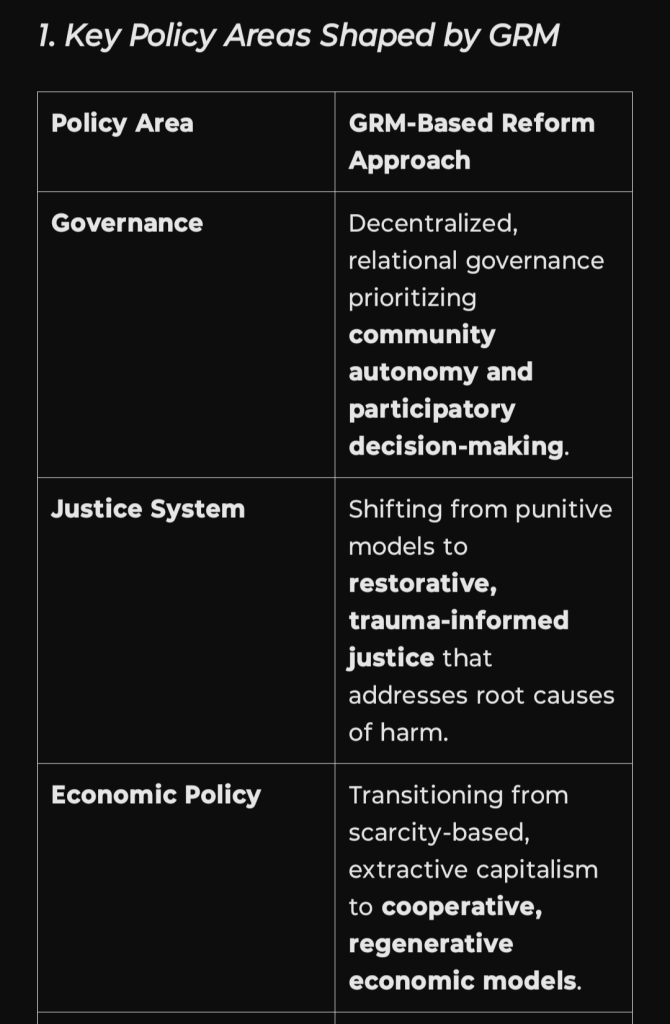
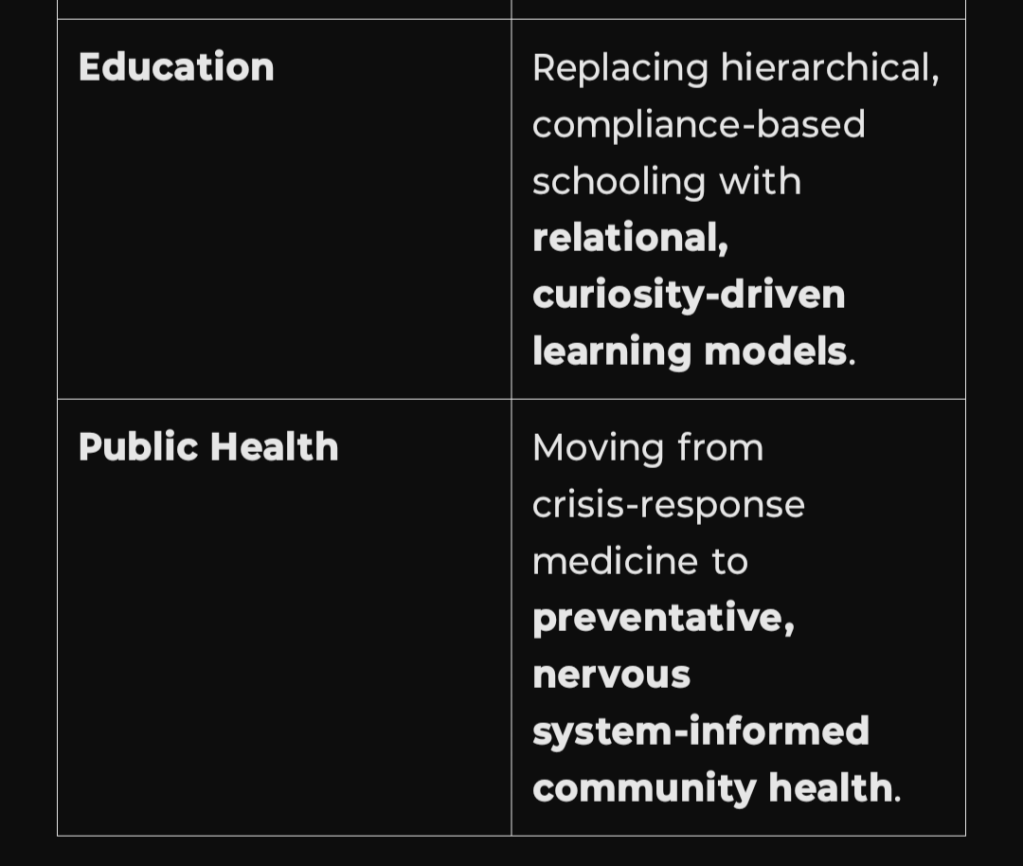
1. Key Policy Areas Shaped by GRM
2. Legal Advocacy: Trauma-Informed Law and Policy
RSM uses GRM to challenge the legal foundations of punitive governance:
Expanding legal definitions of harm to include structural and systemic trauma.
Replacing coercive labor laws with regenerative economic policies that promote cooperative structures.
Developing constitutional frameworks that embed relational intelligence in governance.
3. Legislative Strategy: Embedding GRM Principles in Policy
Working with legislators to introduce GRM-based laws.
Developing model policies that can be adapted across regions.
Creating legal think tanks focused on trauma-informed governance.
Objective: Make GRM-informed governance the default policy framework for a future beyond punitive, scarcity-based systems.
VI. Institutional and Organizational Consulting: Reforming Systems from Within
RSM’s advocacy does not only focus on external activism—it also provides direct support to institutions undergoing systemic transformation.
1. SpiroLateral Consulting: Applying GRM in Organizational Reform
Training corporate and government leaders in trauma-informed governance.
Implementing non-hierarchical, cooperative workplace structures.
Designing economic models that integrate regenerative finance principles.
2. Transitional Reform: The “Inside-Out” Model
Instead of dismantling institutions outright, RSM offers an “inside-out” model of reform.
Applying Mirror Integration Theory (MIT) to help organizations recognize and integrate their own systemic fragmentation.
Creating pilot programs to test GRM-based governance models within existing structures.
Objective: Transform institutions from within by embedding relational, non-hierarchical intelligence into their foundational structures.
VII. Conclusion: RSM’s Advocacy as a Path to Systemic Regeneration
By positioning the Gnostic Repair Model (GRM) as both a cultural and political framework, RSM moves beyond traditional advocacy models that focus only on critique, protest, or reform.
Instead, RSM applies GRM to actively rebuild fragmented systems—one policy, one institution, and one cultural narrative at a time.
Key Takeaways:
1. RSM does not seek to overthrow systems, but to reintegrate them.
2. Advocacy is structured through narrative shifts, policy reform, and direct institutional engagement.
3. The goal is not short-term wins, but the complete systemic adoption of regenerative governance models.
By using GRM as its core intellectual framework, RSM offers a long-term, sustainable model for systemic healing—one that integrates rather than destroys, and restores rather than abandons.

Restorative Systems Movement (RSM) Training Program
Title: Rebuilding Systems Through Restoration: A Training Program for Implementing the Gnostic Repair Model (GRM) in Advocacy, Governance, and Institutional Reform
Program Overview
This training program equips activists, policymakers, organizational leaders, and institutional reformers with the intellectual framework, practical strategies, and systemic tools to implement the Gnostic Repair Model (GRM) within governance, social structures, and economic systems. Participants will learn how to:
Identify systemic fragmentation and understand its impact on governance, economics, and justice.
Apply Functional Conflict Perspective (FCP) to resolve polarization and conflict productively.
Use Mirror Integration Theory (MIT) to heal divisions within communities, institutions, and policies.
Develop restorative policies that replace punitive and extractive systems.
Engage in trauma-informed advocacy and institutional transformation.
Program Structure
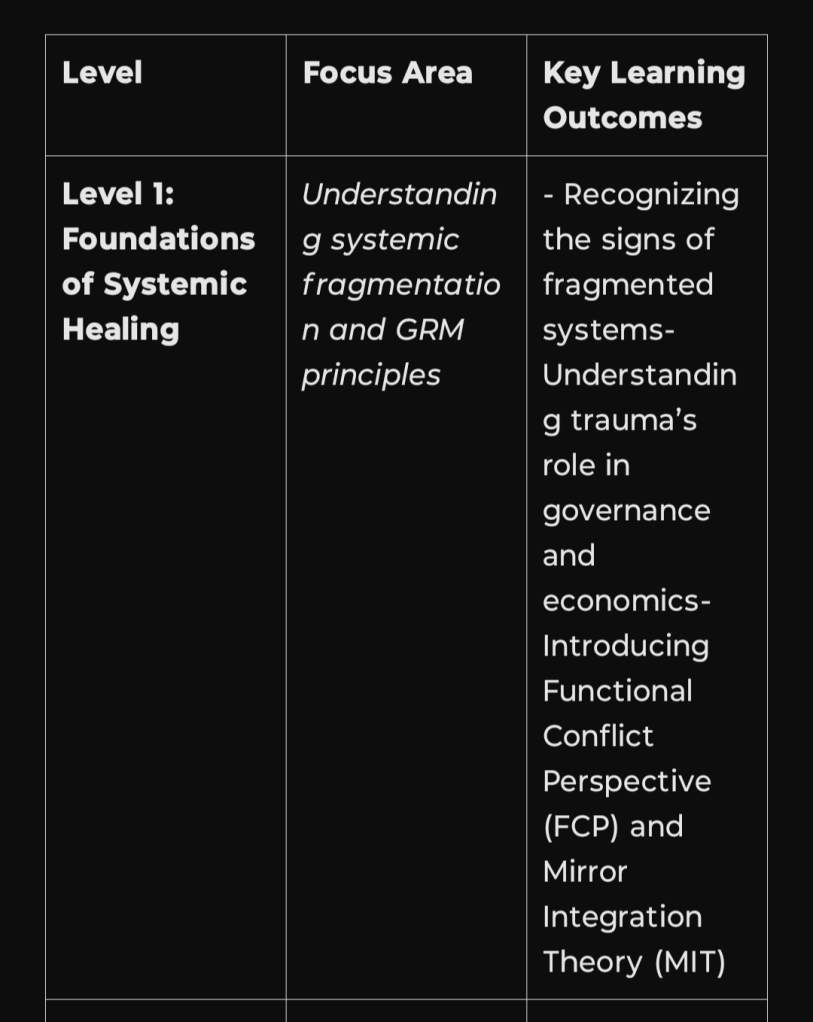
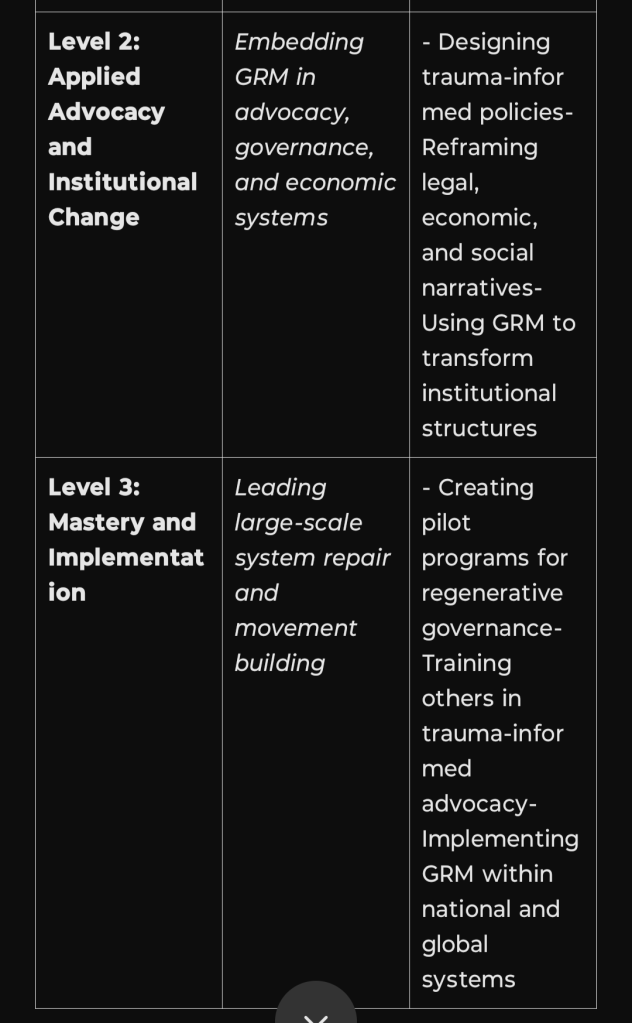
The training is divided into three levels, each building upon the previous one.
Each level consists of modules, case studies, interactive exercises, and real-world application projects.
Level 1: Foundations of Systemic Healing
Objective:
To develop a foundational understanding of how systemic fragmentation operates and how GRM provides a restorative alternative to punitive and extractive systems.
Module 1: The Science of Systemic Fragmentation
Understanding how trauma shapes governance, law, and economic policy
How punitive systems reinforce dissociation, scarcity, and control
Recognizing functional vs. dysfunctional conflict resolution
Module 2: Introducing the Gnostic Repair Model (GRM)
GRM as a framework for systemic reintegration
The difference between restorative and extractive systems
Rebuilding coherence instead of reinforcing power hierarchies
Module 3: Functional Conflict Perspective (FCP) and Mirror Integration Theory (MIT)
FCP in governance and social justice: How conflict can be transformed into social evolution.
MIT in institutional healing: Using systemic mirroring to integrate suppressed voices.
Case Study: How MIT and FCP can be used to resolve political polarization.
Interactive Exercise:
Mapping fragmentation in your field → Participants identify a fragmented system they work within and analyze how trauma and conflict shape its current structure.
Level 2: Applied Advocacy and Institutional Change
Objective:
To provide practical tools for applying GRM in advocacy, policy, and institutional reform.
Module 4: Trauma-Informed Advocacy Strategies
Reframing narratives around power, justice, and governance.
Using GRM in public discourse and media messaging.
Case Study: How restorative language shifts policy outcomes.
Module 5: Policy and Legal Application of GRM
Redefining justice systems through GRM principles
How to write, introduce, and advocate for trauma-informed legislation
Case Study: Restorative economic policies replacing scarcity-based models.
Module 6: Transforming Institutional Structures
Applying MIT to organizations, businesses, and government agencies
Healing systemic trauma within legal and corporate frameworks
Case Study: How restorative governance models outperformed punitive control models.
Interactive Exercise:
Rewriting a policy using GRM principles. Participants take an existing law, corporate policy, or governance structure and redesign it through a restorative lens.
Level 3: Mastery and Implementation
Objective:
To prepare participants to lead large-scale systemic repair efforts and train others in trauma-informed governance and advocacy.
Module 7: Scaling Systemic Repair
Creating pilot programs for restorative governance models.
Measuring the success of systemic healing initiatives.
Case Study: The impact of cooperative economic structures.
Module 8: Movement Building and Grassroots Change
Decentralized leadership models in the Restorative Systems Movement.
Training others in GRM and trauma-informed advocacy.
Case Study: How non-hierarchical movements successfully created policy change.
Module 9: Implementing GRM in Global Policy and Governance
Applying MIT and FCP to international relations.
Redesigning economic and environmental policy using regenerative frameworks.
Case Study: The future of Spiral Cities and Restorative Eco-Activism.
Final Capstone Project:
Participants design and present a full-scale implementation plan for applying GRM principles to a real-world system, policy, or institution.
Training Methods and Learning Approach
The program is highly interactive and includes:
Case Studies → Real-world examples of trauma-informed governance and policy reform.
Workshops → Collaborative exercises in redesigning laws, economic models, and institutions.
Role-Playing Simulations → Practicing restorative negotiation, policy advocacy, and conflict resolution.
Guest Lectures → Experts in restorative governance, law, and organizational reform.
Capstone Project → A final implementation plan for applying GRM in a chosen system.
Certification and Post-Training Impact
Upon Completion, Participants Will Be Able To:
✅ Apply GRM, FCP, and MIT to advocacy, governance, and social movements.
✅ Design and implement trauma-informed policies in legal, economic, and political systems.
✅ Train others in restorative governance and systemic healing principles.
✅ Lead real-world institutional transformation efforts.
✅ Join a global network of RSM-aligned practitioners, policymakers, and reformers.
Graduation Certification:
Participants will receive an RSM Certification in Restorative Systems Leadership, qualifying them to consult, teach, and implement GRM-based models in various fields.
Implementation of the Training Program
Delivery Methods:
📍 Live Online Training (For global participants)
📍 In-Person Immersive Training (Held in partner institutions & organizations)
📍 Self-Paced Digital Course (For independent learners)
Who Should Enroll?
✔ Activists and advocates seeking systemic transformation.
✔ Policymakers and legal professionals rewriting justice and economic systems.
✔ Organizational leaders and educators designing trauma-informed institutions.
✔ Economists and urban planners shifting from extractive to regenerative models.
✔ Mental health professionals integrating systemic healing into their work.
Conclusion: Creating a Global Network of Systemic Healers
The Restorative Systems Movement (RSM) Training Program is not just about theory—it is about action. By equipping participants with the intellectual tools and real-world strategies needed to heal fragmented systems, this program ensures that GRM principles become embedded in governance, advocacy, and social transformation at every level.

Development Plan for RSM Training Program Supplementary Materials
To fully support the Restorative Systems Movement (RSM) Training Program, we will develop a comprehensive set of supplementary materials, including workbooks, slides, recorded lectures, case studies, and interactive exercises. These materials will ensure participants can internalize GRM principles and apply them effectively in their advocacy, governance, and institutional transformation efforts.
I. Supplementary Materials Overview
1. Workbooks (Digital & Print Versions)
✔ Purpose: To provide structured learning, reflection questions, and exercises.
✔ Format: PDFs, interactive digital workbooks, and print-friendly versions.
✔ Contents:
Lesson summaries
Guided reflection questions
Exercises for applying GRM in real-world scenarios
Implementation templates for systemic transformation
✅ Deliverables:
📌 RSM Level 1 Workbook – Understanding Systemic Fragmentation
📌 RSM Level 2 Workbook – Applying GRM in Advocacy & Policy
📌 RSM Level 3 Workbook – Leading Systemic Repair
2. Slide Decks (PowerPoint & PDF Format)
✔ Purpose: To visually reinforce key concepts and facilitate instructor-led and self-paced learning.
✔ Format: High-quality slides with text, visuals, charts, and case study breakdowns.
✔ Contents:
Core GRM principles (with diagrams)
Breakdown of Functional Conflict Perspective (FCP) and Mirror Integration Theory (MIT)
Case study slides for real-world examples
Step-by-step guides for implementing restorative policies
✅ Deliverables:
📌 Slide Deck 1: GRM Overview & The Philosophy of Restorative Systems
📌 Slide Deck 2: Applying FCP & MIT in Governance and Justice
📌 Slide Deck 3: Restorative Economic Models and Spiral Cities
3. Recorded Video Lectures
✔ Purpose: To create a highly engaging, structured video series explaining GRM principles.
✔ Format:
Short, digestible videos (10-15 minutes each)
Lecture-style with visuals, voiceovers, and real-world applications
Live-recorded Q&A sessions for deeper engagement
✔ Topics:
Introduction to GRM: Why Systems Fragment & How They Heal
Functional Conflict Perspective: The Role of Conflict in Social Repair
Applying Mirror Integration Theory to Policy & Governance
Building Non-Hierarchical Governance Models
Transforming Scarcity-Based Economies into Regenerative Systems
✅ Deliverables:
📌 RSM Video Course (10-Part Series) with Instructor-Led Explanations
📌 Bonus Live Webinar Recordings on Systemic Repair and Movement Building
4. Case Studies & Real-World Applications
✔ Purpose: To demonstrate the effectiveness of GRM principles in real-world scenarios.
✔ Format:
Written case study reports (3-5 pages each)
Infographics and charts summarizing key takeaways
✔ Examples:
Case Study 1: How Restorative Justice Reduced Recidivism
Case Study 2: Non-Hierarchical Governance Models in Action
Case Study 3: The Transition from Extractive to Regenerative Economic Systems
✅ Deliverables:
📌 Case Study Collection: 5 Real-World Examples of GRM in Action
📌 Infographics & Summary Sheets for Quick Reference
5. Interactive Exercises & Group Activities
✔ Purpose: To reinforce GRM principles through experiential learning.
✔ Format:
Self-reflection exercises
Group-based problem-solving scenarios
Role-playing and negotiation activities
✔ Examples:
Mapping Systemic Fragmentation in Your Community → Participants analyze fragmented systems (e.g., justice, education, economy) and propose reintegration strategies.
Restorative Policy Rewriting → Participants take a punitive or extractive policy and rewrite it using GRM principles.
Power Mapping for Movement Building → Participants identify key decision-makers and stakeholders to apply GRM reforms.
✅ Deliverables:
📌 Interactive Exercises Guide (15+ Activities for Workshops & Self-Study)
📌 Facilitator’s Guide for Group Learning Sessions
6. Implementation Templates & Action Plans
✔ Purpose: To help participants apply GRM to real-world advocacy and governance reforms.
✔ Format: Fillable PDFs & printable worksheets.
✔ Contents:
Step-by-step templates for implementing trauma-informed policies
Guides for applying MIT in conflict resolution and governance
Action plans for transitioning organizations from extractive to regenerative models
✅ Deliverables:
📌 GRM Implementation Toolkit for Advocacy, Policy, and Institutional Reform
📌 Workbook for Developing a Trauma-Informed Systemic Repair Plan
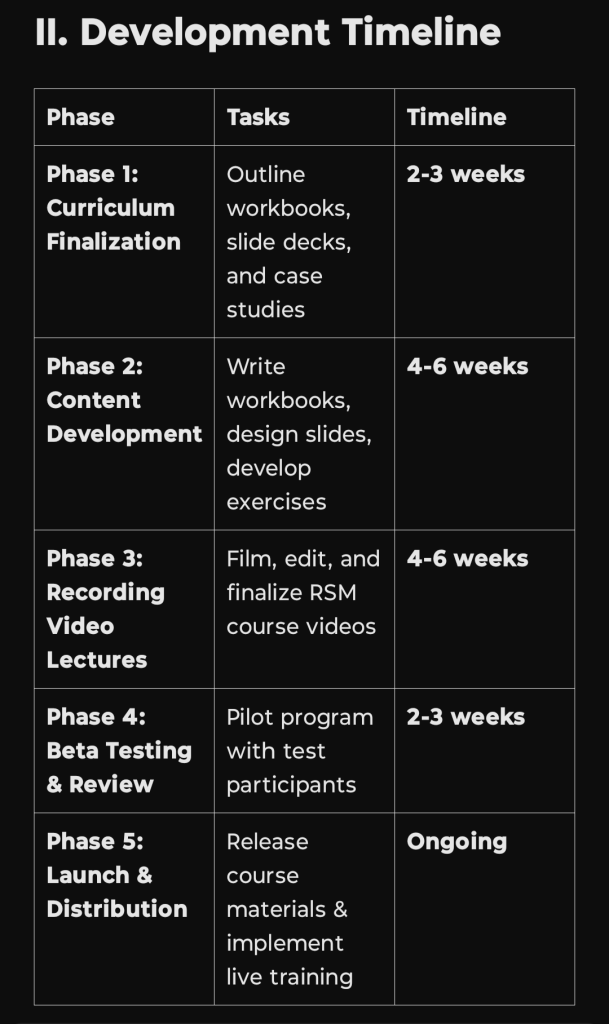
II. Development Timeline
III. Program Deployment
Delivery Methods
📍 Online Platform → A digital portal for self-paced learning.
📍 In-Person Training Workshops → Instructor-led training for advocacy groups & policymakers.
📍 Hybrid Learning → A mix of online learning & live webinars.
Who Will Use These Materials?
✔ Advocacy organizations implementing systemic change
✔ Government officials & policymakers adopting GRM-based reforms
✔ Educational institutions integrating trauma-informed governance models
✔ Corporate & non-profit leaders restructuring organizations around restorative systems
Finalized Development Plan for the Public Release of the RSM Training Program
The Restorative Systems Movement (RSM) Training Program will be publicly released as an open-source, globally accessible curriculum. This will ensure that activists, policymakers, educators, and organizations worldwide can freely access the tools needed to implement Gnostic Repair Model (GRM)-based systemic transformation.
I. Core Elements of the Public Release
To maximize accessibility and impact, the training materials will be available in multiple formats and platforms, ensuring a decentralized, participatory learning experience.
1. Open-Source Learning Portal (Website & Digital Repository)
✔ A centralized online hub for all RSM training materials.
✔ All resources (workbooks, slides, case studies) available for free download.
✔ Videos, lectures, and interactive exercises embedded in an easy-to-use format.
✔ No barriers to access—anyone can use, modify, and implement the framework.
✅ Action Step: Develop a public-facing website to host all materials and allow for collaborative input.
2. Digital Learning Platform (Self-Paced & Instructor-Led Options)
✔ Modular online course with structured lessons.
✔ Self-paced for independent learners, with an option for live cohort-based training.
✔ Completion certificates for participants who go through full training.
✔ Quizzes and interactive modules to reinforce key concepts.
✅ Action Step: Develop an open-access e-learning course on platforms like Moodle, Teachable, or Thinkific.
3. Open-Access Workbooks & Guides (Downloadable PDFs)
✔ Full workbooks for Levels 1, 2, and 3 of the training program.
✔ Practical worksheets for applying GRM to governance, economics, and advocacy.
✔ Fillable action plans for creating trauma-informed policy change.
✅ Action Step: Publish interactive workbooks in open-source formats (Google Docs, PDF, EPUB).
4. Video Lecture Series (YouTube & Podcast Format)
✔ Short, high-quality video explanations of GRM, FCP, and MIT.
✔ Live guest discussions on governance, economic reform, and systemic healing.
✔ Audio versions available via podcast for accessibility.
✅ Action Step: Launch an RSM YouTube Channel & Podcast dedicated to systemic transformation education.
5. Case Study Library & Real-World Applications
✔ A living repository of case studies showing GRM principles in action.
✔ Examples of restorative governance, cooperative economies, and systemic healing.
✔ User-submitted case studies, allowing activists and policymakers to contribute findings.
✅ Action Step: Build an open database where users can submit and access real-world examples of systemic restoration.
6. Public Webinars & Workshops
✔ Monthly live discussions on RSM principles.
✔ Interactive Q&A sessions on trauma-informed governance.
✔ Workshops on rewriting policy through a restorative lens.
✅ Action Step: Organize live online events featuring GRM experts and RSM practitioners.
II. Implementation & Public Launch Timeline


✅ Estimated Public Release: 4-6 months (with early access beta version in 3 months).
III. Accessibility & Global Participation
1. Free, Open-Source Licensing
✔ All materials will be licensed under Creative Commons (CC-BY), allowing free modification and redistribution.
✔ Organizations, universities, and activists can integrate RSM training into their own frameworks.
✅ Action Step: Publish materials with open-source licensing for unrestricted access and adaptation.
2. Multilingual Translations & Global Accessibility
✔ Key materials translated into Spanish, French, Arabic, and Mandarin (and more based on demand).
✔ Closed captions on all video content for accessibility.
✅ Action Step: Work with volunteer translators and AI-powered language tools to expand global access.
3. Interactive Community Forum & Network Building
✔ A discussion forum for participants to collaborate on applying GRM principles.
✔ A mentorship program for experienced advocates to guide new learners.
✔ Crowdsourced updates and adaptations to refine training materials over time.
✅ Action Step: Develop a public forum (via Discord, Circle, or an integrated website community).
IV. Public Outreach & Movement Building
1. Strategic Partnerships with Organizations & Universities
✔ Offer GRM training as an elective or certification program for universities.
✔ Collaborate with advocacy groups, NGOs, and policymakers to embed GRM into their work.
✅ Action Step: Reach out to educational institutions and activist organizations for curriculum integration.
2. Public Awareness Campaigns & Social Media Strategy
✔ Engaging explainer videos and social media infographics on GRM.
✔ Guest articles in major publications on trauma-informed governance.
✔ Live Q&A sessions to introduce the movement to a wider audience.
✅ Action Step: Develop a social media and PR strategy to spread GRM concepts widely.
V. Long-Term Vision: Creating a Global Knowledge Commons
Beyond the initial public launch, the goal is to expand RSM into a fully interactive, decentralized knowledge ecosystem:
✅ Annual Summits: International gatherings of GRM practitioners.
✅ Certification & Accreditation: A formal credentialing system for trauma-informed governance experts.
✅ Local Implementation Labs: City-based hubs experimenting with GRM-aligned policies.
✅ A Living Library of GRM Case Studies: Continuously evolving documentation of restorative governance in action.
VI. Next Steps: Development Execution
Immediate Priorities:
🔹 Finalize curriculum content and workbooks → (4 weeks)
🔹 Set up open-source learning portal → (6-8 weeks)
🔹 Begin video production and podcast recording → (6-8 weeks)
🔹 Soft-launch beta version for early adopters → (3 months)
🔹 Fully launch public program & outreach campaign → (4-6 months)

 Spirolateral