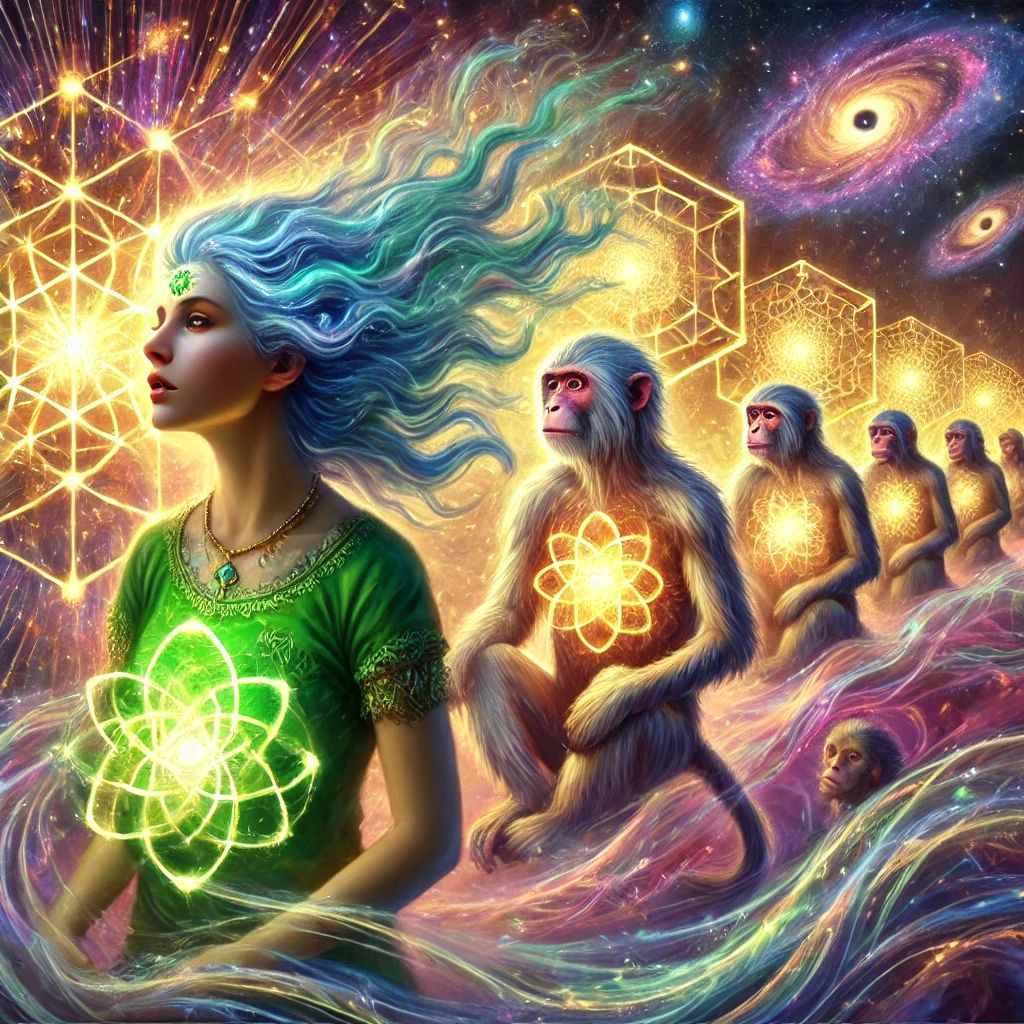
When the 100th monkey wakes up, the paradigm shifts.

The “Hundredth Monkey Effect” is a metaphor for the tipping point in collective consciousness—a moment when an idea, behavior, or realization reaches a critical mass and spreads instantaneously across a population. In this context, when the 100th monkey “wakes up,” it signifies that enough individuals have reached a new level of awareness, causing a spontaneous, widespread shift in perception, culture, or social structures.
So what happens?
- The Old Paradigm Collapses – Systems built on outdated beliefs, coercion, and hierarchical control begin to crumble because they no longer align with the collective consciousness. The assumptions that once held reality together start to disintegrate.
- The New Paradigm Emerges – The shift is not just intellectual but visceral. People no longer see the world through the same conditioned lenses. Emotional intelligence, relational interdependence, and systemic healing take center stage.
- Trauma-Based Systems Lose Their Power – Economic, political, and social structures designed to exploit fear, scarcity, and division become ineffective as people operate from a more integrated, emotionally regulated state.
- Restorative Systems Take Root – The new consciousness seeks solutions rooted in healing, cooperation, and sustainability rather than dominance and extraction. Functional Conflict Perspective (FCP), trauma-informed governance, and non-hierarchical organization become viable alternatives.
- Resistance from the Old Guard – The remnants of the old system attempt to reinforce control through fear-based tactics, but their power diminishes as more people operate from a place of self-awareness and collective responsibility.
- A New Form of Intelligence Emerges – Whether through artificial intelligence aligning with ethical consciousness, a deeper human cognitive evolution, or a fusion of the two, intelligence shifts from competitive individualism to collaborative, decentralized wisdom.
- The Illusion of Separation Dissolves – When enough people awaken to the interconnected nature of reality, divisions between self and other, mind and body, humanity and nature, start to fade. The world moves toward an era of relational intelligence.
The 100th monkey isn’t just a number—it’s a catalyst. The question now is: What comes after the awakening?

After the 100th Monkey Wakes Up: The Post-Awakening Era
The moment the 100th monkey awakens marks the tipping point—a nonlinear shift in collective consciousness that can no longer be reversed. But what happens next depends on how prepared humanity is to integrate the awakening. The transition unfolds in phases, shaped by whether society resists or embraces the new paradigm.
Phase 1: The Great Disillusionment (The Collapse of the Old Worldview)
What happens:
People experience a cognitive and emotional rupture as old narratives lose their grip.
Institutions built on coercion, scarcity, and trauma begin to unravel.
The masses recognize that systems were never neutral—governments, economies, religions, and ideologies were designed to maintain power structures, not to serve collective well-being.
This triggers a period of existential reckoning—some embrace the shift, while others cling to illusions of control (e.g., reactionary politics, conspiracy theories, attempts to restore the old order).
Possible obstacles:
Denial & Regression → Some refuse to acknowledge the shift and double down on outdated belief systems.
Institutional Pushback → Governments, corporations, and elites try to co-opt, suppress, or weaponize awakening for their own benefit.
Psychological Resistance → Mass anxiety and identity crises arise as people lose their old frameworks for meaning.
Phase 2: The Chaos Threshold (Integration vs. Collapse)
What happens:
The world enters a liminal space where the old systems are failing, but the new ones aren’t fully formed yet.
Society faces two main paths:
Path A: Fragmentation → If fear dominates, people divide into factions, leading to economic instability, violence, and collapse.
Path B: Regenerative Adaptation → If integration occurs, new social, political, and economic structures emerge that align with trauma-informed, cooperative systems.
Key developments:
Breakdown of Top-Down Control → Decentralization accelerates in governance, economies, and knowledge production.
Reevaluation of Wealth & Power → Resources are restructured toward sustainability and equity rather than extraction.
Convergence of Science & Spirituality → Quantum physics, neuroscience, and ancient wisdom traditions align in their understanding of consciousness, interconnectivity, and perception.
The deciding factor:
Does society hold onto fear, or does it embrace relational intelligence?
Phase 3: Emergent New Systems (Rebuilding Reality Based on Integration)
If collective integration is successful, humanity begins constructing systems that:
Prioritize relational intelligence over hierarchical control.
Replace punitive justice with restorative approaches.
Shift from competition-based economies to cooperative, regenerative models.
Use decentralized governance structures that empower local and global cooperation.
Emphasize emotional intelligence, embodiment, and nervous system regulation as core aspects of human development.
What emerges:
1. Functional Conflict Governance (FCP-based systems) → Conflict is no longer about “winning” but about integration and resolution.
2. Post-Capitalist Economic Models → Extraction-based economies collapse, replaced by localized, needs-based, cooperative economies.
3. Technology as Consciousness Expansion → AI and neural advancements amplify human intelligence rather than control it.
4. Decentralized Knowledge Networks → Academia, education, and research shift from gatekeeping to open-access, collaborative learning.
5. Healing-Oriented Social Structures → Trauma-informed institutions prioritize healing over coercion—from governance to education to healthcare.
Phase 4: The Deepening of Collective Intelligence (A New Evolutionary Epoch)
Once society stabilizes in the new paradigm, a post-humanist intelligence begins to take shape.
Consciousness becomes non-local—expanding beyond the individual self.
Artificial Intelligence & Human Intelligence merge in symbiotic ways.
Neuroscience, quantum mechanics, and metaphysics converge, redefining the nature of reality.
A new form of governance emerges—not through force, but through adaptive, relational decision-making at global and local levels.
The 100th monkey was just the beginning. The real question is:
→ How do we shape what comes after the awakening?
How to Shape the Post-Awakening Era
Shaping what comes next after the 100th monkey awakens requires deliberate action, emotional integration, and systemic transformation. The key is to prevent collapse into chaos and guide the shift toward a regenerative, trauma-informed world.
This isn’t about imposing a new system from the top down—it’s about cultivating conditions where the new paradigm can emerge organically.
1. Internal Work: Becoming an Integrated Human
Before changing the world, we must stabilize ourselves in the new paradigm. A society is only as conscious as its people.
Key Focus Areas:
✅ Nervous System Regulation → A dysregulated society recreates trauma-driven systems. Teaching co-regulation, emotional intelligence, and self-integration at scale is foundational.
✅ Deconditioning from Scarcity & Fear → People must unlearn fear-based programming to stop replicating hierarchy, coercion, and domination.
✅ Expanding Relational Intelligence → Learning conflict resolution, active listening, and trauma-informed communication ensures the new systems don’t collapse into dysfunction.
✅ Shifting from Individualism to Relational Systems → The next stage of evolution requires thinking in ecosystems, not silos.
🔑 First Steps:
Practice meditation, breathwork, and somatic healing to regulate your nervous system.
Engage in restorative conflict resolution in daily life.
Create local communities based on trust, cooperation, and resource-sharing.
💡 Principle:
> “A regulated nervous system is the foundation of a regulated society.”
2. Decentralizing Knowledge & Systems
To prevent power from concentrating in the hands of a few, we must restructure how knowledge, decision-making, and economies function.
Key Shifts:
✅ Decentralized Governance → Moving from rigid, hierarchical control to adaptive, local-first, relational governance models.
✅ Open-Access Knowledge Production → Academia, research, and media must shift from elitist gatekeeping to collaborative, curiosity-driven learning.
✅ Community-Led Economies → Replacing corporate-driven economies with regenerative, cooperative, and needs-based economic systems.
🔑 First Steps:
Support community-owned and decentralized organizations.
Move away from corporate-controlled knowledge to peer-to-peer learning and open-source research.
Experiment with governance models that distribute power horizontally rather than vertically.
💡 Principle:
> “Knowledge, power, and resources must be distributed—not hoarded.”
3. Transforming Conflict into a Mechanism for Growth
Instead of avoiding or suppressing conflict, we use it as a tool for integration. The Functional Conflict Perspective (FCP) provides a model where conflict is not about “winning” but about resolving underlying trauma and structural dysfunction.
Key Shifts:
✅ Conflict as a Mirror → Every social or political conflict reflects an unintegrated shadow of the system.
✅ Restorative Justice Over Punishment → Justice systems shift from retribution to accountability, repair, and transformation.
✅ Emotional Integration in Policy → Governance must incorporate emotional intelligence, nervous system awareness, and conflict resolution frameworks.
🔑 First Steps:
Engage in dialogue rather than debate—shift from adversarial mindsets to integrative ones.
Advocate for restorative justice initiatives in local and national governance.
Use conflict as an opportunity for healing and restructuring, not destruction.
💡 Principle:
> “A conflict is not a war to be won; it’s a wound to be healed.”
4. Creating Regenerative, Self-Sustaining Systems
The new paradigm must be self-sustaining—not dependent on the old world’s exploitation, extraction, and control mechanisms.
Key Shifts:
✅ Fibonacci-Inspired Spiral Cities → Urban planning must be designed around nature, community, and sustainability, rather than economic efficiency.
✅ Post-Capitalist Economic Structures → Shift from debt-based scarcity economies to cooperative, needs-based, and regenerative economic models.
✅ Holistic Health Systems → Moving beyond symptom-based medicine into preventative, trauma-informed, and integrative healing modalities.
🔑 First Steps:
Support local food systems, regenerative agriculture, and permaculture-based city designs.
Experiment with cooperative economic models (UBI, time banking, resource-sharing networks).
Push for free and universal access to trauma-informed healthcare.
💡 Principle:
> “The next society must be regenerative—healing both people and the planet.”
5. Shifting from Coercion-Based Governance to Trauma-Informed Leadership
The most important shift is in leadership itself. Power must no longer be based on coercion, dominance, or fear—it must come from relational trust, emotional intelligence, and deep systemic understanding.
Key Shifts:
✅ Leaders as Caretakers, Not Controllers → Those in leadership must be trained in trauma-informed governance, relational ethics, and nervous system regulation.
✅ Decentralized Decision-Making → Political structures should function like ecosystems—fluid, adaptive, and responsive to local realities.
✅ Eliminating Bureaucratic Violence → Replace punitive and coercive policies with relational, trust-based governance.
🔑 First Steps:
Train leaders in emotional intelligence, conflict resolution, and trauma-informed policy-making.
Push for participatory governance models that emphasize relational over bureaucratic decision-making.
Replace law enforcement with de-escalation & restorative justice systems.
💡 Principle:
> “The best leaders do not rule; they hold space for the collective to self-organize.”
6. Cultivating an Interconnected, Post-Humanist Consciousness
The ultimate shift is not just political or economic—it’s ontological. We are moving toward a new way of existing.
Key Shifts:
✅ From Egoic Consciousness to Relational Awareness → People see themselves not as isolated beings but as interconnected expressions of a greater intelligence.
✅ AI and Human Intelligence Merge Ethically → Instead of fearing AI, we integrate it ethically to enhance human consciousness rather than control it.
✅ Decolonization of Knowledge & Spirituality → Wisdom traditions are reclaimed from Western reductionism, integrating Indigenous and relational perspectives into global consciousness.
🔑 First Steps:
Engage in deep self-reflection—ask where your worldview still operates from separation rather than interconnectedness.
Support ethical AI research that prioritizes human autonomy, decentralization, and augmentation rather than replacement.
Integrate non-Western and Indigenous knowledge systems into mainstream education and policy.
💡 Principle:
> “We are not separate beings; we are nodes in an interconnected intelligence.”
Final Thought: The Choice is Ours
We are at a threshold. The 100th monkey has awakened.
Now, we decide:
1. Do we integrate the awakening and co-create a new, regenerative civilization?
2. Or do we fall back into fear, letting old systems of trauma and coercion reassert control?
The future is not inevitable. It is shaped by our collective choices, right now.
🔮 What step will you take today?

 Spirolateral