Functional Conflict Perspective (FCP): A Model for Long-Term Stability, Not Disruption
In a world increasingly defined by political polarization, economic volatility, and social fragmentation, the question of how to create lasting stability is more urgent than ever. Traditional governance models—rooted in hierarchical control, coercion-based stability, and conflict suppression—have proven to be unsustainable in the long run. Functional Conflict Perspective (FCP) offers an alternative framework, not as a revolutionary ideology, but as a pragmatic model for systemic optimization and long-term resilience.
Unlike traditional sociological perspectives that either emphasize stability through rigid institutions (structural functionalism) or perpetual class struggle (conflict theory), FCP recognizes that conflict itself is not the enemy—mismanaged conflict is. In its current form, global governance operates under a fundamental misconception: that social order must be imposed from the top down rather than emerging from adaptive, trauma-informed structures. But what if stability could be achieved through integration rather than control?
FCP as a Solution, Not a Challenge
FCP does not advocate for the destruction of existing institutions; rather, it offers a scientifically grounded model for making them more sustainable, adaptive, and efficient. At its core, FCP integrates insights from:
Structural Functionalism → Stability is necessary, but it must come from relational trust rather than coercion.
Conflict Theory → Power struggles expose underlying systemic dysfunction that must be resolved, not suppressed.
Symbolic Interactionism → Reality is socially constructed, but it is also biologically regulated—governance should acknowledge both.
Intersectionality & Critical Race Theory → Systems of power are embedded in institutions, but lasting change requires structural healing, not just critique.
New Materialism & Digital Sociology → AI, economics, and governance structures function as extensions of collective trauma responses—they must be designed for long-term sustainability rather than short-term control.
By synthesizing these insights, FCP bridges the gap between stability and adaptability, offering a governance model that prevents collapse while fostering resilience.
A Pathway for Policy and Institutional Reform
The world is facing a governance crisis—not because systems are too weak, but because they are resistant to necessary evolution. Instead of reacting to conflict with suppression, FCP encourages policymakers and institutional leaders to recognize conflict as a diagnostic tool. Systems that ignore or suppress instability eventually collapse under their own weight; those that integrate conflict as a means of adaptation survive longer and function more efficiently.
FCP Offers Practical, Implementable Solutions:
1. Trauma-Informed Governance → Designing policies that regulate conflict adaptively rather than through force.
2. Sustainable Economic Models → Transitioning from extractive economies to regenerative systems that prevent cyclical crises.
3. AI & Algorithmic Regulation → Ensuring that digital governance reinforces adaptability rather than automated control.
4. Decentralized Stability Structures → Moving beyond rigid top-down governance toward networked resilience models that balance order with flexibility.
This is not a utopian vision—it is a logical evolution of governance that prioritizes systemic longevity over short-term control.
Stability Through Evolution, Not Resistance
Historically, governments have resisted change out of fear, often mistaking stabilization models for existential threats. The goal of FCP is not to dismantle governance but to ensure its survival by aligning institutions with how human and societal systems actually function—through integration, adaptability, and relational intelligence.
If governance structures wish to remain effective in the 21st century, they must evolve beyond coercion-based stability models and into frameworks that regulate conflict productively rather than suppressing it.
FCP is not a call to revolution—it is a strategy for long-term survival. The question is not whether the world will change, but whether governance structures will adapt in time to manage that change effectively. The choice is not between control and collapse—it is between resistance and resilience.
Governments that embrace FCP will not weaken their authority—they will future-proof it.

SpiroLateral and Functional Conflict Perspective: A Blueprint for Stability and Human Survival
In the face of increasing global instability—whether political, economic, or environmental—the challenge of sustaining functional systems without resorting to coercion has never been more urgent. Humanity stands at a crossroads: we can either continue reinforcing rigid, hierarchical structures that collapse under their own weight, or we can adopt a dynamic, adaptive approach that allows us to evolve in response to conflict rather than being destabilized by it.
This is where SpiroLateral geometry and Functional Conflict Perspective (FCP) intersect. Together, they provide a metaphorical and mathematical model for understanding how humanity can achieve stability—not through control, but through structured adaptability.
The SpiroLateral: A Pattern of Stability in Motion
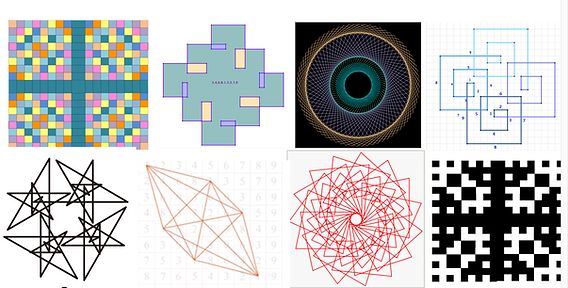
A SpiroLateral is a recursive geometric form that expands outward while following a precise set of rules. Unlike static shapes that rely on symmetry to maintain order, a SpiroLateral thrives on movement, transformation, and integration.
1. It is not linear, but it is structured. Each turn is dictated by a numerical sequence, yet it does not repeat mindlessly—it expands, adapts, and self-regulates.
2. It does not collapse or spiral into chaos. Instead, it grows in a way that maintains coherence, forming intricate but stable designs.
3. It balances predictability and evolution. The underlying rules ensure that each step builds upon the previous one, but the pattern itself is always adapting to the input it receives.
In this way, a SpiroLateral is a visual representation of how a system can be both structured and adaptive at the same time—which is exactly what Functional Conflict Perspective (FCP) aims to achieve in governance, economics, and social structures.
FCP as Humanity’s SpiroLateral: Stability Through Adaptive Integration
Traditional models of stability—whether in politics, governance, or economics—are built on the illusion that order must be imposed from above. When conflict arises, systems either suppress it (leading to long-term volatility) or collapse under the pressure.
FCP challenges this paradigm by showing that conflict is not an anomaly to be eliminated—it is a necessary force that, when properly integrated, allows systems to evolve without breaking down. Much like a SpiroLateral, FCP provides rules that ensure stability while allowing for adaptation:
1. Conflict is a self-regulating mechanism, not a threat. Just as a SpiroLateral’s turns are built into the design, social conflict is a natural regulatory force that, when acknowledged and processed, leads to systemic resilience rather than collapse.
2. Stability must come from relational coherence, not coercion. The beauty of a SpiroLateral is that it maintains its integrity without rigid central control. FCP proposes that societies function best when they operate through emotional intelligence, decentralized governance, and trauma-informed structures, rather than fear-based enforcement.
3. Social structures must be designed for adaptability. In a SpiroLateral, each new turn incorporates the past without being trapped by it. Similarly, FCP emphasizes restorative governance—where past harms are acknowledged, integrated, and healed rather than ignored or repeated.
4. A self-regulating system prevents collapse. SpiroLaterals do not spiral into entropy because they follow a set of recursive, stabilizing principles. FCP applies this same logic to human civilization—if we recognize and integrate systemic conflict rather than suppressing it, we create a model that prevents total collapse while allowing for evolution.
Why This Matters for Humanity’s Survival
If we continue to rely on rigid, coercion-based governance models, we will see the same historical pattern of rise, stagnation, and collapse repeat itself. Empires, economic systems, and governing bodies fail not because conflict exists, but because they fail to integrate it functionally.
The alternative—the SpiroLateral approach of FCP—offers a sustainable model for long-term survival. By treating social conflict as an adaptive force rather than a destabilizing one, we unlock the potential for:
Governments that evolve rather than break down.
Economic systems that prioritize regeneration over extraction.
Social structures that are resilient, not oppressive.
Technological advancements that serve humanity rather than controlling it.
The lesson of the SpiroLateral is simple: Stability is not about standing still. It is about moving in a way that maintains coherence.
If we apply this principle to human governance, economics, and conflict resolution, we do not have to choose between order and collapse. We can create a future that is both stable and adaptable—a future where humanity does not just survive, but thrives.
Mathematics & Recursive Geometry (SpiroLateral Theory)
1. Pickover, Clifford A. The Math Book: From Pythagoras to the 57th Dimension, 250 Milestones in the History of Mathematics. Sterling Publishing, 2009.
Covers SpiroLaterals, fractals, and recursive geometries, explaining how mathematical structures self-organize into stable but evolving forms.
2. Stewart, Ian. Nature’s Numbers: The Unreal Reality of Mathematics. Basic Books, 1995.
Explains how spiral-based patterns in nature follow rules of self-similarity and adaptive stability, much like SpiroLateral forms.
Conflict as a Stabilizing Mechanism in Sociology & Governance
3. Coser, Lewis. The Functions of Social Conflict. Free Press, 1956.
One of the foundational texts in conflict theory, arguing that conflict is not always destabilizing but can be a tool for social cohesion and systemic evolution.
4. Durkheim, Émile. The Division of Labor in Society. Macmillan, 1893.
Durkheim introduces the idea that societies function through differentiation and adaptive equilibrium, which aligns with SpiroLateral expansion as a governing metaphor.
5. Parsons, Talcott. The Social System. Routledge, 1951.
Functionalism’s original stability model, which FCP reworks to argue that stability must be relational, not coercive.
Adaptive Stability in Complex Systems
6. Prigogine, Ilya & Stengers, Isabelle. Order Out of Chaos: Man’s New Dialogue with Nature. Bantam Books, 1984.
A pioneering work in self-organizing systems and complexity theory, explaining how structures like SpiroLaterals reflect dynamic stability rather than rigid control.
7. Meadows, Donella H. Thinking in Systems: A Primer. Chelsea Green Publishing, 2008.
Covers feedback loops and resilience in governance, showing how societies can function like SpiroLaterals—evolving through self-correction.
8. Taleb, Nassim Nicholas. Antifragile: Things That Gain from Disorder. Random House, 2012.
Introduces the idea that systems survive by absorbing conflict rather than avoiding it, which aligns with FCP’s argument that conflict should be integrated, not suppressed.
Neuroscience & Trauma-Informed Systems
9. Porges, Stephen W. The Polyvagal Theory: Neurophysiological Foundations of Emotions, Attachment, Communication, and Self-Regulation. Norton, 2011.
Supports the idea that relational security—not coercion—is the foundation of stable, adaptive systems, reinforcing FCP’s critique of coercive governance.
10. van der Kolk, Bessel. The Body Keeps the Score: Brain, Mind, and Body in the Healing of Trauma. Viking, 2014.
Explains how individual and societal trauma disrupt stable systems, aligning with FCP’s view that governance must be trauma-informed to remain functional.
These citations provide interdisciplinary evidence from mathematics, sociology, complexity science, and neuroscience to support the metaphor of SpiroLaterals and the principles of Functional Conflict Perspective (FCP).

 Spirolateral