
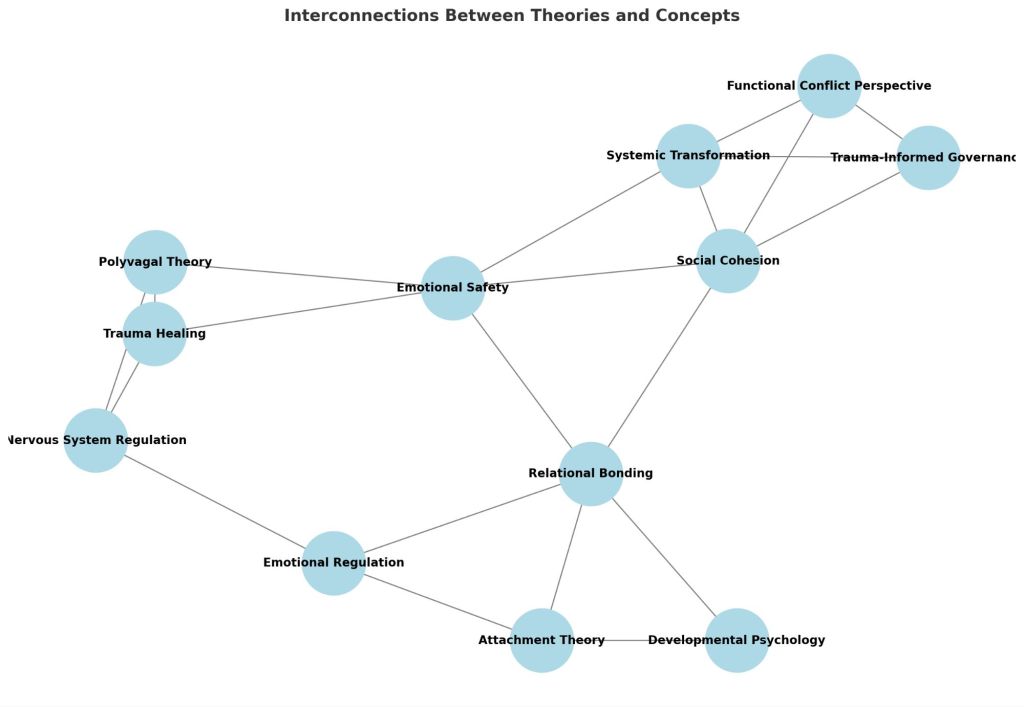
Restorative Systems Movement (RSM): A Unified Framework for Systemic Healing, Climate Justice, and Social Transformation
The Restorative Systems Movement (RSM) integrates all my frameworks—Functional Conflict Perspective (FCP), Disability-Inclusive Governance (DIGERA), Restorative Eco-Activism, Spiral City Models, and Trauma-Informed Systems Change—into a single activist movement. This movement envisions a world where systemic transformation is rooted in healing, regeneration, and sustainable governance, addressing climate justice, economic equity, social cohesion, and psychological well-being as interconnected struggles.
I. Core Philosophy: Healing Systems for Sustainable Futures
RSM posits that social, political, and environmental crises are manifestations of unresolved trauma at the personal, cultural, and institutional levels. It seeks to restructure systems by prioritizing restoration over punishment, sustainability over extraction, and relational governance over hierarchical control.
Guiding Principles
1. From Conflict to Integration → Applying Functional Conflict Perspective (FCP) to resolve systemic tensions through relational repair, rather than coercion and division.
2. From Extraction to Regeneration → Moving from resource depletion and economic exploitation to regenerative economies and sustainable governance.
3. From Punishment to Restoration → Replacing punitive justice, deficit models, and coercive control with healing-based governance, non-punitive social structures, and trauma-informed leadership.
4. From Hierarchy to Reciprocity → Transitioning from authoritarian decision-making to decentralized, participatory governance models.
5. From Dissociation to Integration → Recognizing that social alienation, economic instability, and environmental destruction stem from systemic trauma and require collective healing.
II. Key Areas of Activism
RSM operates through five interwoven focus areas, each reinforcing the others.
1. Climate Justice & Regenerative Systems
Spiral City Models: Fibonacci-inspired city planning that integrates food sovereignty, circular economies, and sustainable infrastructure.
Restorative Eco-Activism: A shift from shame-based environmentalism to relational, healing-based advocacy.
Eco-Disability Justice: Climate policy that is disability-inclusive, ensuring accessible disaster response, adaptive economic structures, and sustainable urban planning.
Gaia-Informed Governance: Ecological policy that mirrors Earth’s self-regulating principles, ensuring long-term planetary health.
2. Social & Economic Justice
Disability-Inclusive Governance (DIGERA): Embedding universal accessibility, economic security, and participatory democracy into governance.
Functional Conflict Economics: Shifting from capitalist extraction models to cooperative economies that foster long-term well-being.
Universal Basic Needs Framework: Establishing food, housing, healthcare, education, and transportation as human rights.
3. Trauma-Informed Governance & Policy Reform
Replacing Bureaucratic Violence: Transitioning from avoidance-based governance to restorative, emotionally intelligent systems.
Systemic Reform for Survivors of Abuse (SRSATA): Embedding trauma-informed protections in legal, economic, and housing policies.
Reconstructing Justice Systems: Moving from punitive, carceral models to community-based, restorative alternatives.
4. Knowledge Production & Cultural Shift
Curiosity-Driven Knowledge Production: Restructuring academia to prioritize intellectual co-creation, interdisciplinary synthesis, and participatory research.
Decolonizing Mental Health & Neurodivergence Inclusion: Abolishing deficit models, pathologization, and coercive psychiatric interventions.
Functional Conflict Perspective in Education: Embedding relational learning, trauma-informed pedagogy, and emotional intelligence in schooling.
5. Governance & Political Transformation
Non-Hierarchical Governance Models: Expanding FCP-based participatory democracy and cooperative leadership structures.
Regenerative Political Systems: Moving from competitive electoral models to deliberative, consensus-based decision-making.
Local & Global Integration: Adapting policy solutions at municipal, national, and international levels to ensure scalability and systemic resilience.
III. Implementation Strategy
RSM employs a phased, multi-level implementation strategy, ensuring transformation at personal, community, institutional, and global scales.
1. Individual-Level Transformation
Personal Healing & Nervous System Regulation: Teaching trauma-informed practices to break the cycle of inherited systemic dysfunction.
Neurodivergent & Disability Inclusion: Normalizing non-pathologizing, strengths-based models of neurodiversity.
2. Community-Level Change
Restorative Cohesion Micro-Experiments: Piloting local conflict resolution models based on Functional Conflict Perspective (FCP).
Cooperative Economic Initiatives: Supporting community-owned businesses, worker co-ops, and alternative economic networks.
3. Institutional & Policy Reform
Embedding Restorative Eco-Activism into local, national, and global environmental policies.
Integrating Disability-Inclusive Governance (DIGERA) into urban planning, healthcare, and economic systems.
Overhauling the justice system using restorative, survivor-centered models.
4. Global Scaling & Movement Building
International Policy Frameworks: Drafting legal blueprints for UN, national governments, and regional alliances.
Public Awareness & Mass Mobilization: Developing educational campaigns, media outreach, and activist networks.
IV. Movement Structure & Participation
RSM is not a hierarchical organization but a distributed, cooperative network where individuals, communities, and institutions adopt regenerative models at their own pace.
1. Movement Nodes & Intersections
Rather than a single centralized leadership, RSM functions as a network of interconnected activist movements:
Climate activists collaborate with disability justice advocates.
Economic reformers integrate with trauma-informed governance experts.
Local communities develop participatory decision-making models.
2. Strategic Alliances
RSM partners with:
Decolonial & Indigenous Movements → Embedding ancestral ecological knowledge into policy.
Worker & Economic Cooperatives → Replacing capitalist wage-labor systems with cooperative ownership.
Survivor-Led Advocacy Groups → Ensuring trauma survivors shape policy solutions.
V. Why This Movement is Different
Unlike traditional activist movements that focus on single issues, RSM addresses systemic trauma at every level—personal, relational, economic, political, and ecological.
Core Innovations:
✔ Trauma-Informed Systems Change → Governance that prioritizes emotional integration and social cohesion.
✔ Regenerative Spiral Economies → Urban planning and economic systems rooted in ecological balance.
✔ Functional Conflict Resolution → Shifting from zero-sum political battles to collaborative problem-solving.
✔ Decentralized, Adaptive Activism → A movement structure that empowers local action without rigid top-down control.
VI. Next Steps for Scaling the Movement
1. Draft the Official RSM Manifesto → Defining the movement’s principles, goals, and implementation roadmap.
2. Launch a Knowledge Hub → Creating an open-access digital platform for research, strategy guides, and movement resources.
3. Develop Educational Tools & Policy Briefs → Translating research into practical action guides for activists, policymakers, and communities.
4. Pilot Local Restorative Cohesion Projects → Demonstrating Functional Conflict Perspective (FCP) solutions in real-world settings.
5. Establish Strategic Coalitions → Partnering with climate, disability, economic justice, and political reform movements.
Conclusion: A Movement for a Restorative Future
The Restorative Systems Movement (RSM) offers a unified, trauma-informed, and regenerative path forward—where social change is not about replacing one oppressive system with another, but about breaking cycles of trauma and creating sustainable, relationally-centered governance.
By integrating FCP, DIGERA, Restorative Eco-Activism, Spiral City Models, and trauma-informed governance, this movement presents a holistic blueprint for deep, lasting systemic change.
Call to Action:
Individuals → Engage in personal healing and community-building.
Activists & Organizers → Implement restorative conflict resolution and economic alternatives.
Policymakers & Institutions → Adopt trauma-informed governance and regenerative planning.
Global Networks → Scale this model through international partnerships and legislative adoption.
Restorative Systems Movement (RSM): Manifesto for Systemic Healing and Regenerative Governance
Preamble
The world is at a tipping point. The crises of climate change, economic inequality, political instability, and social fragmentation are not separate phenomena—they are symptoms of a deeper dysfunction. These crises emerge from systems built on extraction, coercion, and unresolved trauma.
The Restorative Systems Movement (RSM) exists to heal and transform these dysfunctional systems, replacing them with regenerative, trauma-informed, and cooperative models that prioritize collective well-being. Our vision is one of integration over division, restoration over punishment, and sustainability over exploitation. This manifesto outlines the philosophy, goals, and strategies of our movement.
I. Core Philosophy: From Extraction to Regeneration
RSM recognizes that human societies, like ecosystems, must function as self-sustaining, interdependent networks. Systems that exploit, exclude, or suppress healing inevitably collapse. To avoid this, we embrace the following principles:
1. Restorative Governance → Replacing punitive, bureaucratic systems with trauma-informed, participatory governance.
2. Regenerative Economies → Moving from extractive capitalism to cooperative, sustainable economic models.
3. Functional Conflict Resolution → Using relational repair, not coercion, to resolve systemic tensions.
4. Social & Disability Justice → Embedding accessibility, equity, and participatory democracy in governance.
5. Ecological Stewardship → Implementing Fibonacci-inspired urban planning and regenerative climate policies.
6. Trauma-Informed Knowledge & Education → Decolonizing academia and prioritizing collaborative knowledge production.
Additionally, RSM is integrated into Restorative Eco-Activism and the meta-framework bridging Functional Conflict Perspective (FCP), Disability-Inclusive Governance (DIGERA), Gaia Theory, and Spiral City Models into a cohesive paradigm for climate justice, systemic healing, and regenerative governance. This integration expands our approach into key ecological and governance principles:
Gaia as a Self-Regulating System → Governance that mirrors ecological homeostasis, ensuring sustainability aligns with planetary balance.
Climate Change as a Trauma Response → Recognizing governance failures as manifestations of collective dissociation from ecological distress.
Eco-Disability Justice → Ensuring that climate adaptation, disaster response, and urban planning are accessible to all, particularly disabled communities.
Decentralized, Trauma-Informed Eco-Governance → Moving away from top-down authoritarian environmentalism toward community-driven resilience and ecological autonomy.
Spiral Cities as Climate Solutions → Designing urban spaces that integrate circular economies, self-sufficient food systems, and regenerative sustainability.
Restorative Eco-Activism → Advocating for healing-based environmentalism, shifting from fear-driven activism to solutions rooted in relational repair and systemic regeneration.
II. Goals of the Movement
1. Climate Justice & Regenerative Systems
Implement Spiral City Models for sustainable urban development.
Ensure disability-inclusive climate policies.
Move from shame-based environmentalism to relational eco-activism.
2. Economic & Social Justice
Establish a Universal Basic Needs Framework (housing, food, healthcare, education, mobility).
Develop cooperative, worker-owned economic models.
Abolish deficit-based disability policies and ensure full inclusion.
3. Trauma-Informed Governance & Legal Reform
Transition from punitive justice to restorative justice.
Implement Systemic Reform for Survivors of Abuse (SRSATA).
Establish Restorative Cohesion Micro-Experiments in communities.
4. Decolonizing Knowledge & Cultural Transformation
Replace competitive, gatekept academia with collaborative, curiosity-driven knowledge production.
Recognize neurodivergence as a strength rather than a pathology.
Reform education to emphasize emotional intelligence and social cohesion.
5. Political Transformation & Decentralized Governance
Shift governance models from hierarchical control to participatory democracy.
Establish local and global policy frameworks for systemic change.
Replace zero-sum political conflict with functional conflict resolution.
III. Movement Strategy: Implementing Systemic Change
1. Individual-Level Change
Promote nervous system regulation and personal healing.
Establish trauma-informed self-governance practices.
2. Community-Level Change
Develop cooperative economic initiatives.
Pilot local restorative governance models.
3. Institutional & Policy Reform
Embed Functional Conflict Perspective (FCP) in policy design.
Overhaul legal, economic, and environmental policies to align with restorative justice.
4. Global Scaling & Mass Mobilization
Create an open-access digital knowledge hub.
Launch policy advocacy and legislative campaigns.
Form coalitions with climate, disability, and social justice movements.
IV. Structure of the Movement
RSM is a decentralized, cooperative network rather than a traditional hierarchical organization. It is built on collaborative nodes that integrate diverse activist movements, ensuring autonomous yet interconnected action.
Key alliances include:
Indigenous and decolonial movements → Embedding ancestral ecological knowledge.
Worker cooperatives → Replacing capitalist structures with mutual aid economies.
Survivor-led advocacy → Ensuring policy is shaped by those most affected.
V. Call to Action
To build a sustainable, just, and restorative world, we invite:
Individuals to engage in self-healing and local activism.
Activists & Organizers to implement restorative conflict resolution models.
Policymakers & Institutions to adopt trauma-informed governance.
Communities & Movements to co-create functional, cooperative societies.
This is not just a vision—it is a strategy for a world in which all systems are regenerative, trauma-informed, and socially just. The time for transformation is now.
Restorative Systems Movement (RSM)
A Manifesto for Systemic Healing & Regenerative Governance


Restorative Systems Movement (RSM): Manifesto for Systemic Healing and Regenerative Governance
Preamble
The world is at a tipping point. The crises of climate change, economic inequality, political instability, and social fragmentation are not separate phenomena—they are symptoms of a deeper dysfunction. These crises emerge from systems built on extraction, coercion, and unresolved trauma.
The Restorative Systems Movement (RSM) exists to heal and transform these dysfunctional systems, replacing them with regenerative, trauma-informed, and cooperative models that prioritize collective well-being. Our vision is one of integration over division, restoration over punishment, and sustainability over exploitation. This manifesto outlines the philosophy, goals, and strategies of our movement.
I. Core Philosophy: From Extraction to Regeneration
RSM recognizes that human societies, like ecosystems, must function as self-sustaining, interdependent networks. Systems that exploit, exclude, or suppress healing inevitably collapse. To avoid this, we embrace the following principles:
- Restorative Governance → Replacing punitive, bureaucratic systems with trauma-informed, participatory governance.
- Regenerative Economies → Moving from extractive capitalism to cooperative, sustainable economic models.
- Functional Conflict Resolution → Using relational repair, not coercion, to resolve systemic tensions.
- Social & Disability Justice → Embedding accessibility, equity, and participatory democracy in governance.
- Ecological Stewardship → Implementing Fibonacci-inspired urban planning and regenerative climate policies.
- Trauma-Informed Knowledge & Education → Decolonizing academia and prioritizing collaborative knowledge production.
Additionally, RSM is integrated into Restorative Eco-Activism and the meta-framework bridging Functional Conflict Perspective (FCP), Disability-Inclusive Governance (DIGERA), Gaia Theory, and Spiral City Models into a cohesive paradigm for climate justice, systemic healing, and regenerative governance. This integration expands our approach into key ecological and governance principles:
- Gaia as a Self-Regulating System → Governance that mirrors ecological homeostasis, ensuring sustainability aligns with planetary balance.
- Climate Change as a Trauma Response → Recognizing governance failures as manifestations of collective dissociation from ecological distress.
- Eco-Disability Justice → Ensuring that climate adaptation, disaster response, and urban planning are accessible to all, particularly disabled communities.
- Decentralized, Trauma-Informed Eco-Governance → Moving away from top-down authoritarian environmentalism toward community-driven resilience and ecological autonomy.
- Spiral Cities as Climate Solutions → Designing urban spaces that integrate circular economies, self-sufficient food systems, and regenerative sustainability.
- Restorative Eco-Activism → Advocating for healing-based environmentalism, shifting from fear-driven activism to solutions rooted in relational repair and systemic regeneration.
II. Goals of the Movement
1. Climate Justice & Regenerative Systems
- Implement Spiral City Models for sustainable urban development.
- Ensure disability-inclusive climate policies.
- Move from shame-based environmentalism to relational eco-activism.
2. Economic & Social Justice
- Establish a Universal Basic Needs Framework (housing, food, healthcare, education, mobility).
- Develop cooperative, worker-owned economic models.
- Abolish deficit-based disability policies and ensure full inclusion.
3. Trauma-Informed Governance & Legal Reform
- Transition from punitive justice to restorative justice.
- Implement Systemic Reform for Survivors of Abuse (SRSATA).
- Establish Restorative Cohesion Micro-Experiments in communities.
4. Decolonizing Knowledge & Cultural Transformation
- Replace competitive, gatekept academia with collaborative, curiosity-driven knowledge production.
- Recognize neurodivergence as a strength rather than a pathology.
- Reform education to emphasize emotional intelligence and social cohesion.
5. Political Transformation & Decentralized Governance
- Shift governance models from hierarchical control to participatory democracy.
- Establish local and global policy frameworks for systemic change.
- Replace zero-sum political conflict with functional conflict resolution.
III. Movement Strategy: Implementing Systemic Change
1. Individual-Level Change
- Promote nervous system regulation and personal healing.
- Establish trauma-informed self-governance practices.
2. Community-Level Change
- Develop cooperative economic initiatives.
- Pilot local restorative governance models.
3. Institutional & Policy Reform
- Embed Functional Conflict Perspective (FCP) in policy design.
- Overhaul legal, economic, and environmental policies to align with restorative justice.
4. Global Scaling & Mass Mobilization
- Create an open-access digital knowledge hub.
- Launch policy advocacy and legislative campaigns.
- Form coalitions with climate, disability, and social justice movements.
IV. Structure of the Movement
RSM is a decentralized, cooperative network rather than a traditional hierarchical organization. It is built on collaborative nodes that integrate diverse activist movements, ensuring autonomous yet interconnected action.
Key alliances include:
- Indigenous and decolonial movements → Embedding ancestral ecological knowledge.
- Worker cooperatives → Replacing capitalist structures with mutual aid economies.
- Survivor-led advocacy → Ensuring policy is shaped by those most affected.
V. Call to Action
To build a sustainable, just, and restorative world, we invite:
- Individuals to engage in self-healing and local activism.
- Activists & Organizers to implement restorative conflict resolution models.
- Policymakers & Institutions to adopt trauma-informed governance.
- Communities & Movements to co-create functional, cooperative societies.
This is not just a vision—it is a strategy for a world in which all systems are regenerative, trauma-informed, and socially just. The time for transformation is now.
Restorative Systems Movement (RSM)
A Manifesto for Systemic Healing & Regenerative Governance

—
I. Community Engagement Strategies
1. Grassroots Organizing & Local Activation
Community Listening Sessions → Host local forums to discuss economic justice, climate solutions, and trauma-informed governance.
Restorative Cohesion Circles → Implement peer-led discussion groups focused on conflict resolution, community healing, and shared governance.
Pilot Local Projects → Introduce Restorative Cities, Basic Needs Cooperatives, and Circular Economies at the neighborhood level.
Coalition Building → Partner with activist networks, local organizations, disability advocates, and environmental groups.
—
2. Public Education & Awareness
Workshops & Training Programs → Offer trauma-informed leadership training, non-hierarchical governance education, and ecological resilience workshops.
School & University Collaborations → Integrate Restorative Systems Curriculum into educational institutions, teaching students about Functional Conflict Perspective (FCP), Restorative Eco-Activism, and Disability-Inclusive Governance (DIGERA).
Public Town Halls & Panels → Organize events featuring community leaders, experts, and activists to discuss systemic change.
Art & Media Campaigns → Use visual storytelling, documentaries, spoken word poetry, and murals to illustrate RSM principles.
—
3. Digital Mobilization & Knowledge-Sharing
Open-Access Knowledge Hub → Create an online platform where people can access policy documents, research papers, and practical implementation guides.
Social Media Strategy → Develop engaging content (infographics, short videos, podcasts) explaining key RSM concepts.
Virtual Learning Spaces → Offer online workshops, webinars, and discussion groups on RSM’s transformative models.
Interactive Map of Local Initiatives → Show where RSM-aligned projects are active, allowing people to connect with nearby efforts.
—
4. Policy & Advocacy Work
Participatory Policy Proposals → Co-develop policies with community input on topics like Universal Basic Needs, Restorative Justice, and Regenerative Urban Planning.
Engage with Local Governments → Work with municipalities to pilot trauma-informed governance models, cooperative economies, and accessibility mandates.
Advocacy Campaigns → Mobilize people around key legislative pushes for climate justice, economic democracy, and disability-inclusive governance.
Petitions & Direct Action → Leverage petitions, protests, and community-led demonstrations to demand systemic reforms.
—
5. Economic & Social Empowerment
Worker Cooperatives & Mutual Aid Networks → Facilitate the development of cooperative businesses and mutual aid projects to support economic resilience.
Community Land Trusts → Establish regenerative housing models that promote affordability, sustainability, and self-governance.
Restorative Economy Micro-Grants → Offer funding for small-scale regenerative projects, prioritizing marginalized communities.
Alternative Currency Systems → Develop community currency or time-banking systems to foster local economic interdependence.
—
II. Measuring Success & Scaling Up
Community Impact Metrics → Track participation rates, engagement levels, and policy shifts influenced by RSM.
Scaling Restorative Cities → Once pilot projects succeed, expand them into larger municipalities and global networks.
Global Knowledge Exchange → Partner with international movements and researchers to refine and adapt RSM principles to different cultural and political contexts.
Long-Term Institutional Shifts → Work towards embedding RSM policies into governments, businesses, and educational institutions.
—
III. Immediate Action Steps
✅ Identify community partners and establish collaborations.
✅ Plan a public event (forum, town hall, workshop) to introduce RSM concepts.
✅ Launch an educational campaign using social media and digital content.
✅ Organize a local pilot project (such as a worker cooperative, restorative justice initiative, or regenerative urban planning prototype).
✅ Develop policy proposals tailored to local government structures.
By integrating grassroots action, education, policy reform, and digital mobilization, the Restorative Systems Movement (RSM) can engage communities, inspire action, and drive systemic transformation at every level.
—
Restorative Systems Movement (RSM): Community Outreach Plan
I. Introduction The Restorative Systems Movement (RSM) seeks to engage communities in systemic healing, climate justice, and regenerative governance. This outreach plan provides a structured approach to mobilizing individuals, organizations, and policymakers through grassroots action, education, and advocacy.
II. Outreach Objectives
1. Public Awareness & Education → Educate communities about trauma-informed governance, functional conflict resolution, and regenerative economies.
2. Community Mobilization & Coalition Building → Establish partnerships with local organizations, activists, and policymakers.
3. Pilot Initiatives & Local Implementation → Launch small-scale projects demonstrating RSM principles in action.
4. Policy Engagement & Legislative Advocacy → Push for systemic reforms rooted in restorative governance and economic justice.
5. Digital & Media Strategy → Leverage social media, digital platforms, and storytelling to amplify RSM’s impact.
III. Key Outreach Strategies
1. Grassroots Organizing & Local Activation
Community Listening Sessions → Conduct forums where residents discuss local challenges and co-create solutions.
Restorative Cohesion Circles → Facilitate peer-led discussion groups on conflict resolution and shared governance.
Pilot Restorative Cities & Economic Cooperatives → Implement community-driven models of governance and resource-sharing.
Coalition Partnerships → Collaborate with disability justice, climate activism, and labor rights groups.
2. Public Education & Training
Workshops & Seminars → Offer training on trauma-informed leadership, non-hierarchical governance, and ecological resilience.
School & University Engagement → Introduce RSM principles into educational curricula and research collaborations.
Public Events & Panels → Host discussions featuring experts and community leaders on systemic change.
Art & Media Campaigns → Use murals, storytelling, and digital media to communicate key messages.
3. Digital & Media Mobilization
Online Knowledge Hub → Create an accessible repository of resources, policy guides, and case studies.
Social Media Strategy → Develop infographics, short videos, and blog content to explain RSM’s concepts.
Virtual Learning Spaces → Organize webinars and digital town halls to connect global participants.
Interactive Maps → Showcase active RSM projects worldwide and encourage community participation.
4. Policy Advocacy & Legislative Engagement
Participatory Policy Design → Work with communities to draft legislative proposals for local and national adoption.
Government Collaboration → Engage municipal and national leaders in trauma-informed governance training.
Advocacy Campaigns & Petitions → Mobilize public support for systemic reforms in economic justice and climate policy.
Direct Action & Demonstrations → Organize peaceful protests, town halls, and advocacy events.
5. Economic & Social Empowerment
Worker Cooperatives & Mutual Aid Networks → Support economic self-determination through collective ownership models.
Community Land Trusts → Establish regenerative housing initiatives focused on sustainability and self-governance.
Micro-Grants for Restorative Projects → Provide funding for small-scale initiatives aligned with RSM principles.
Alternative Economic Systems → Introduce local currencies, barter systems, and time banking.
IV. Measuring Success & Scaling Up
Engagement Metrics → Track participation in events, training sessions, and online discussions.
Local Policy Adoption → Monitor legislative changes influenced by RSM advocacy.
Community-Led Initiatives → Assess the impact of pilot projects and grassroots efforts.
Expansion Strategies → Scale successful models to other cities, regions, and global networks.
V. Immediate Action Steps ✅ Establish local partnerships with grassroots organizations and advocacy groups.
✅ Plan an RSM launch event (community forum, panel discussion, or workshop).
✅ Develop a digital engagement campaign to introduce RSM principles.
✅ Pilot a local initiative (worker cooperative, restorative governance model, or eco-justice project).
✅ Draft a legislative proposal for trauma-informed governance or economic justice.
VI. Conclusion The Restorative Systems Movement (RSM) is built on collective action, education, and policy transformation. By implementing this outreach plan, we aim to engage communities, empower individuals, and build regenerative systems that prioritize healing, justice, and sustainability.

Restorative Systems Movement (RSM) Legislative Proposal
Title: The Restorative Systems Act: A Framework for Trauma-Informed Governance, Economic Justice, and Climate Resilience
I. Purpose & Legislative Intent The purpose of this Act is to embed trauma-informed governance, economic democracy, and climate resilience into national and local policy structures. By adopting restorative governance models, this legislation aims to:
Reduce economic precarity by ensuring universal access to basic needs.
Transform justice systems from punitive to restorative approaches.
Establish regenerative urban planning to address climate adaptation and sustainability.
Implement functional conflict resolution in political and community decision-making.
Promote disability-inclusive governance for equitable public policy.
II. Definitions
1. Restorative Governance: A participatory, trauma-informed approach to decision-making prioritizing healing and social cohesion.
2. Universal Basic Needs Framework: A policy ensuring access to housing, food, healthcare, education, and transportation as fundamental rights.
3. Functional Conflict Resolution: Non-coercive mediation strategies that replace adversarial legal and political systems.
4. Regenerative Economy: Economic systems based on cooperation, sustainability, and local resilience rather than extraction.
5. Disability-Inclusive Governance: Policies that integrate accessibility, neurodiversity, and universal design principles into law.
III. Policy Provisions
1. Economic Justice & Universal Basic Needs
Establish a Universal Basic Income (UBI) program, indexed to regional living costs.
Transition from extractive capitalism to worker cooperatives and community wealth-building models.
Implement publicly funded housing cooperatives to prevent homelessness and housing insecurity.
Mandate guaranteed food security programs through community-led agriculture and urban farming initiatives.
Expand access to universal healthcare, prioritizing mental health and trauma-informed care.
2. Transforming Justice Systems
Replace punitive carceral models with restorative justice initiatives at all levels of governance.
Implement conflict resolution training in schools, workplaces, and political institutions.
Establish community-based mediation networks as alternatives to policing and incarceration.
Mandate survivor-led justice reform policies through Systemic Reform for Survivors of Abuse (SRSATA).
3. Climate Resilience & Regenerative Planning
Require Fibonacci-inspired Spiral City urban planning to ensure sustainable land use and decentralized resource distribution.
Fund climate adaptation infrastructure prioritizing marginalized communities.
Implement Eco-Disability Justice policies to ensure climate adaptation is accessible to disabled communities.
Mandate zero-waste and circular economy principles in national economic planning.
4. Political & Governance Reform
Establish non-hierarchical governance councils at the municipal and national levels.
Require participatory budgeting and deliberative democracy mechanisms for public spending decisions.
Introduce mandatory trauma-informed training for all government officials and policymakers.
Develop public knowledge hubs for open-access policymaking and transparency in decision-making.
IV. Implementation & Funding
Funding for this Act will come from:
Progressive taxation on extreme wealth accumulation and speculative markets.
Carbon tax and environmental dividends to support regenerative economies.
Reduction of bureaucratic inefficiencies by consolidating outdated welfare models into universal basic needs programs.
Implementation will be phased over five years, with regional pilot programs launching within the first two years.
A National Restorative Systems Council will oversee implementation, composed of community representatives, activists, and governance experts.
V. Accountability & Oversight
Establish an Independent Restorative Justice Review Board to monitor the transition from punitive systems.
Require annual public reporting and citizen assemblies to evaluate policy effectiveness.
Create legal mechanisms allowing communities to challenge policies that violate restorative principles.
VI. Conclusion This Act represents a paradigm shift from extractive, punitive governance to a model based on restorative healing, cooperative economics, and systemic sustainability. By enacting these policies, governments will move toward a future where justice, well-being, and ecological balance form the foundation of society.
Proposed by the Restorative Systems Movement (RSM), a concept of SpiroLateral

Restorative Systems Movement (RSM): Community Outreach Materials
I. About RSM The Restorative Systems Movement (RSM) is dedicated to creating trauma-informed, cooperative, and regenerative systems that prioritize healing, economic justice, and environmental sustainability. Our mission is to replace extractive, punitive governance with restorative, community-led solutions that promote social cohesion and systemic well-being.
II. Why This Matters
Economic insecurity, climate change, and social fragmentation are systemic problems that require systemic solutions.
RSM provides practical, community-driven alternatives that empower people rather than exploit them.
By shifting from punishment-based systems to restorative governance, we can build equitable, sustainable communities for all.
III. How You Can Get Involved
1. Community Events & Forums
Join us for local discussions, listening sessions, and town halls where we co-create solutions for social and economic justice. Upcoming events include:
Restorative Governance Workshops
Functional Conflict Resolution Training
Community Climate Resilience Planning Sessions
2. Volunteer & Organize
Help organize Restorative Cohesion Circles to foster healing and collective action.
Assist in launching worker cooperatives, community land trusts, and mutual aid networks.
Engage in grassroots advocacy efforts to push for legislative changes at local and national levels.
3. Education & Public Awareness
Attend educational webinars and training programs on trauma-informed governance and regenerative economies.
Share infographics, videos, and articles from our digital knowledge hub.
Collaborate with schools and universities to integrate RSM principles into education.
4. Advocacy & Policy Engagement
Work with us to introduce restorative justice policies, economic democracy models, and environmental justice initiatives in your community.
Participate in policy discussions and public hearings to advocate for systemic transformation.
Sign and share petitions supporting RSM-led legislative efforts.
IV. Our Core Initiatives
Universal Basic Needs Framework → Ensuring access to food, housing, healthcare, education, and transportation for all.
Restorative Justice Over Punishment → Transitioning from carceral models to community-led healing and mediation systems.
Regenerative Urban Planning → Implementing Spiral Cities and climate-resilient infrastructure.
Decentralized, Participatory Governance → Empowering communities to engage in decision-making processes.
Economic Democracy & Cooperative Models → Expanding worker-owned enterprises and sustainable local economies.
V. Join the Movement
Follow Us Online: Stay updated on events, campaigns, and educational materials.
Become a Local Organizer: Start a local RSM chapter and build community-driven projects.
Donate or Support Our Work: Help us fund outreach programs and pilot initiatives.
For more information, visit our website or contact us at [your contact details].

 Spirolateral