The Spiral City as a Blueprint for Human Flourishing
The Spiral City is not just an alternative urban design; it is a radical reimagining of human civilization itself—one that integrates psychological well-being, economic equity, and sustainable living into the very structure of daily life. It challenges the entire foundation of industrialized capitalism, hierarchical governance, and exploitative social contracts, proving that an alternative is not only possible but inevitable if humanity is to evolve beyond its current cycles of resource extraction, social division, and psychological fragmentation.
A Living System, Not Just a City
Unlike traditional cities, which are often designed around efficiency, profit maximization, and control, the Spiral City is a living, breathing system that prioritizes human and planetary well-being. Inspired by biological and mathematical principles such as the Fibonacci sequence, its form is not only aesthetically pleasing but functionally regenerative—mimicking the organic growth patterns found in nature.
Regenerative Urbanism → Every aspect of the city is designed to heal rather than deplete—from its circular economy to its emphasis on community co-regulation rather than punitive control.
Decentralized, Non-Hierarchical Governance → Decisions are made collaboratively, ensuring that power is distributed, rather than concentrated in the hands of a privileged few.
Psychologically Aligned Environments → Spaces are designed with emotional safety and nervous system regulation in mind, ensuring that individuals thrive rather than merely survive.
What Happens to Society When We Remove Scarcity & Fear?
For centuries, human societies have been built on the management of scarcity, trauma, and control—whether through hoarding of resources, militarized enforcement, or cultural conditioning that prioritizes obedience over autonomy. The Spiral City fundamentally disrupts this paradigm by eliminating the conditions that create chronic stress, economic precarity, and social disconnection.
🚀 If people are no longer forced into survival mode, what would they become?
Creative innovation would explode → With economic security and social belonging guaranteed, individuals would create for the joy of creation, rather than out of desperation for survival.
Conflict would shift from domination to integration → Without the rigid hierarchies that enforce power imbalances, disputes would be resolved through restorative, trauma-informed practices rather than coercion.
Cultural & relational intelligence would deepen → When people are raised in communities that prioritize emotional security, they develop deeper empathy, better communication skills, and a natural inclination toward cooperation.
The Collapse of Authoritarian Structures & The Rise of True Freedom
One of the greatest barriers to implementing a Spiral City model is that hierarchical power structures depend on social control—and control is only possible when people are disconnected from their power, their community, and their natural rhythms. The modern industrialized city was designed to keep people fragmented—isolating individuals from their extended families, their economic agency, and their intrinsic wisdom in order to make them more manageable as workers, consumers, and subjects.
Traditional cities create dependence → People are forced into debt, wage labor, and bureaucratic entanglement in order to meet their basic needs.
Spiral Cities create sovereignty → People are embedded in a self-sustaining ecosystem, where resources, relationships, and purpose are readily available without coercion.
Governments and corporate interests will resist models like this because a self-sufficient population is ungovernable in the traditional sense—but the question is, do we really need to be governed? The Spiral City proves that humans are fully capable of organizing themselves without the need for extractive capitalism, punitive laws, or manufactured scarcity.
The Path Forward: Seeding the Spiral
The transition to this kind of society will not happen overnight, and it cannot be imposed from the top down—instead, it must grow organically, like the Fibonacci spiral itself, spreading outward from small-scale implementations.
🔹 Phase 1: Micro-Communities & Proof of Concept → Pilot projects in co-housing developments, regenerative agriculture communities, and worker-owned cooperatives begin testing Spiral City principles in practice.
🔹 Phase 2: Policy & Structural Shifts → Municipal governments experiment with public banking, participatory budgeting, and community-led decision-making to decentralize power.
🔹 Phase 3: Networked Spiral Cities → As successful models spread, Spiral Cities begin connecting through shared resource networks, creating an alternative global economy outside of corporate-controlled markets.
Final Thought: We Are Already Building This Future
This is not a utopian fantasy—it is a natural next step in human evolution. The knowledge, technology, and cultural frameworks already exist; what has been missing is the courage to abandon failing systems and commit to the reality that a better world is possible.
The Spiral City is not just an architectural model—it is a declaration that humanity is ready to stop surviving and start thriving. The question is not whether we can build this future, but how soon we are willing to begin. 🚀
Welcome to the Future of Human-Centered Living
Imagine a world where architecture harmonizes with nature, where communities are designed to nurture connection, and where human well-being is prioritized in every aspect of society. These Spiral Cities, inspired by Fibonacci’s golden ratio, represent a revolution in how we design, govern, and inhabit our spaces.
At the heart of these communities lies a philosophy rooted in Functional Conflict Perspective, trauma-informed governance, and relational neuroscience. The spiraling design fosters flow, accessibility, and organic social interaction, removing hierarchical barriers and creating seamless integration between public, private, and communal spaces.
Psychological & Relational Benefits
In these environments, co-regulation replaces isolation. Neuroscience shows that our nervous systems thrive in safe, connected spaces. From shared greenhouses and co-living spaces to circular plazas designed for dialogue, every structure is built to support emotional well-being, secure attachment, and healthy interpersonal relationships.
Cultural & Societal Shifts
By decentralizing power and embedding participatory democracy into city planning, these communities eliminate the alienation of traditional urban design. Economic models shift from competition to cooperation, with shared resource pools, local regenerative agriculture, and worker-owned cooperatives ensuring collective prosperity. Crime drops as social cohesion rises, and punitive systems are replaced with restorative justice frameworks.
Human Development & Education
Education is integrated into daily life, with intergenerational mentorship, hands-on learning spaces, and neurodiversity-affirming environments. Children grow up securely attached, emotionally intelligent, and socially engaged, developing resilience and creativity without the trauma of rigid, competitive schooling.
Ecological & Economic Regeneration
Fibonacci-based city layouts maximize energy efficiency and environmental harmony. These cities restore ecosystems rather than deplete them, using vertical gardens, circular permaculture farms, and carbon-negative infrastructure. The economy moves from extraction to regeneration, fostering abundance without exploitation.
A Blueprint for a New World
These communities embody the principles of Mirror Integration Theory (MIT), Functional Conflict Perspective (FCP), and trauma-responsive governance, demonstrating how systemic transformation begins at the level of human relationships. By aligning our external structures with our intrinsic human needs, we create a society where belonging, sustainability, and well-being are not luxuries, but the foundation of life.
The future is not something we await—it is something we build. Welcome to the world as it was meant to be.
#spiralcities #spirolateral http://www.spirolateral.com
These ten images reflect a transformative vision of societal, psychological, and relational well-being, integrating trauma-informed governance, functional conflict resolution, attachment security, and economic decentralization into sustainable urban and rural cooperative models, integrating our discussions on Functional Conflict Perspective (FCP), trauma-informed governance, attachment theory, regenerative cities, and holistic human development.
Phase 1: Small-Scale Sustainable Community
A self-sufficient regenerative village centered around communal agriculture, eco-homes, and cooperative resource management. This phase focuses on economic autonomy, social trust, and ecological balance, allowing communities to thrive without dependence on extractive economic systems.
Phase 2: Expanding Participatory Governance & Infrastructure
The Spiral City concept expands, incorporating public banking, cooperative housing, localized governance councils, and circular economy models. Education and knowledge-sharing replace rigid institutional structures, fostering a culture of lifelong learning and communal decision-making.
Phase 3: Fully Integrated Spiral City Civilization
A networked Spiral City ecosystem, where multiple self-sustaining communities are linked through shared trade, technological innovation, and regenerative urban planning. Hierarchical governance is replaced by collaborative autonomy, ensuring psychological, societal, and ecological well-being on a global scale.
These images fully illustrate the transition from isolated regenerative communities to a civilization structured for abundance, peace, and self-sufficiency.
The Spiral City: A Vision for Human Flourishing
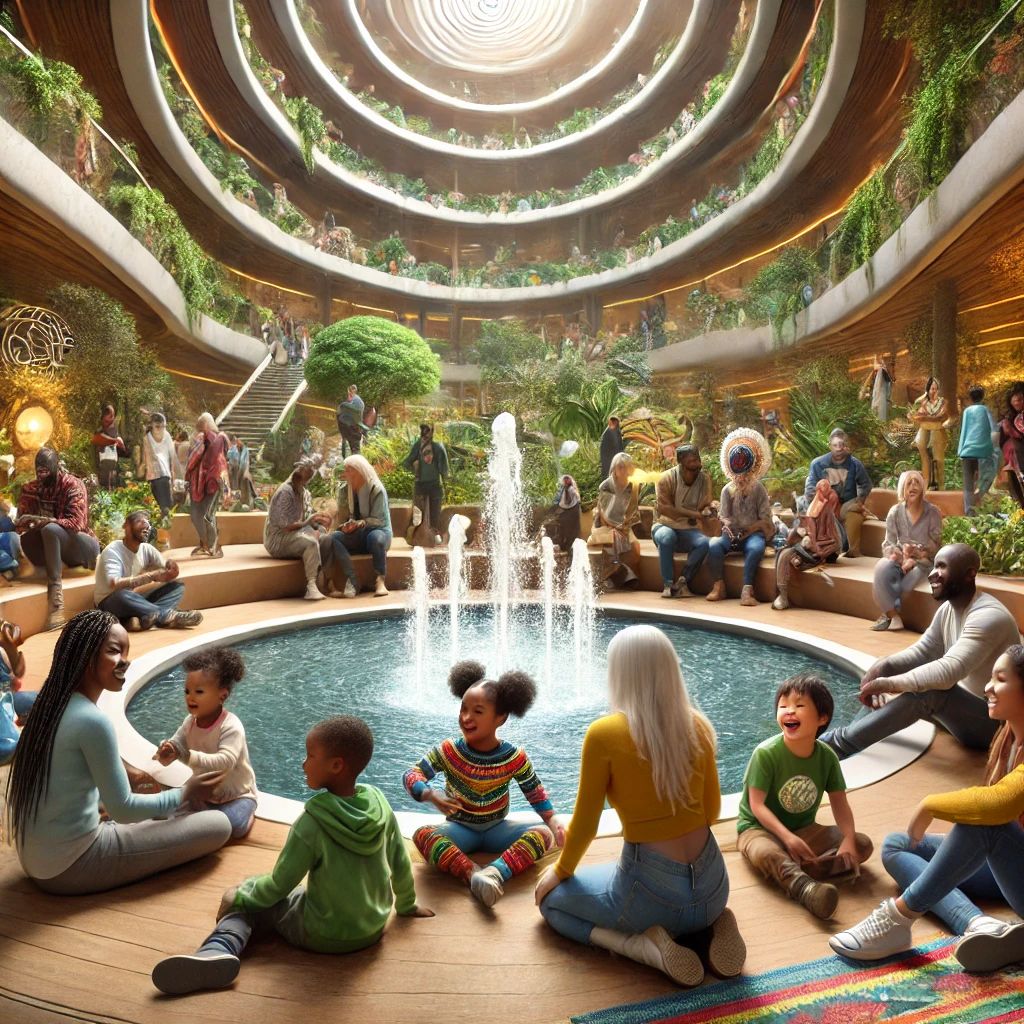
The Heart of the Spiral – Community and Connection
At the core of the Spiral City lies a central plaza, a vibrant gathering space where people of all ages come together in an environment designed for social connection, play, and relaxation. Families, friends, and neighbors sit by the fountain, sharing meals, laughter, and conversation. The terraced design allows for easy movement between levels, reinforcing a sense of unity and accessibility. This space embodies Bowlby and Ainsworth’s attachment theory, as it provides a setting where people feel emotionally secure, fostering trust and well-being. Dreikurs’ theories on democratic living are reflected in how these spaces encourage shared responsibility and intrinsic motivation, eliminating the need for top-down authority. Additionally, Polyvagal Theory (Porges) suggests that environments with natural elements, safe social interactions, and rhythmic sensory experiences (such as running water) help regulate the nervous system, reducing stress and enhancing emotional resilience. The societal benefits of such a space are profound: decreased loneliness, reduced mental health issues, and an increase in cooperation and trust, ultimately creating a more emotionally stable and engaged population.
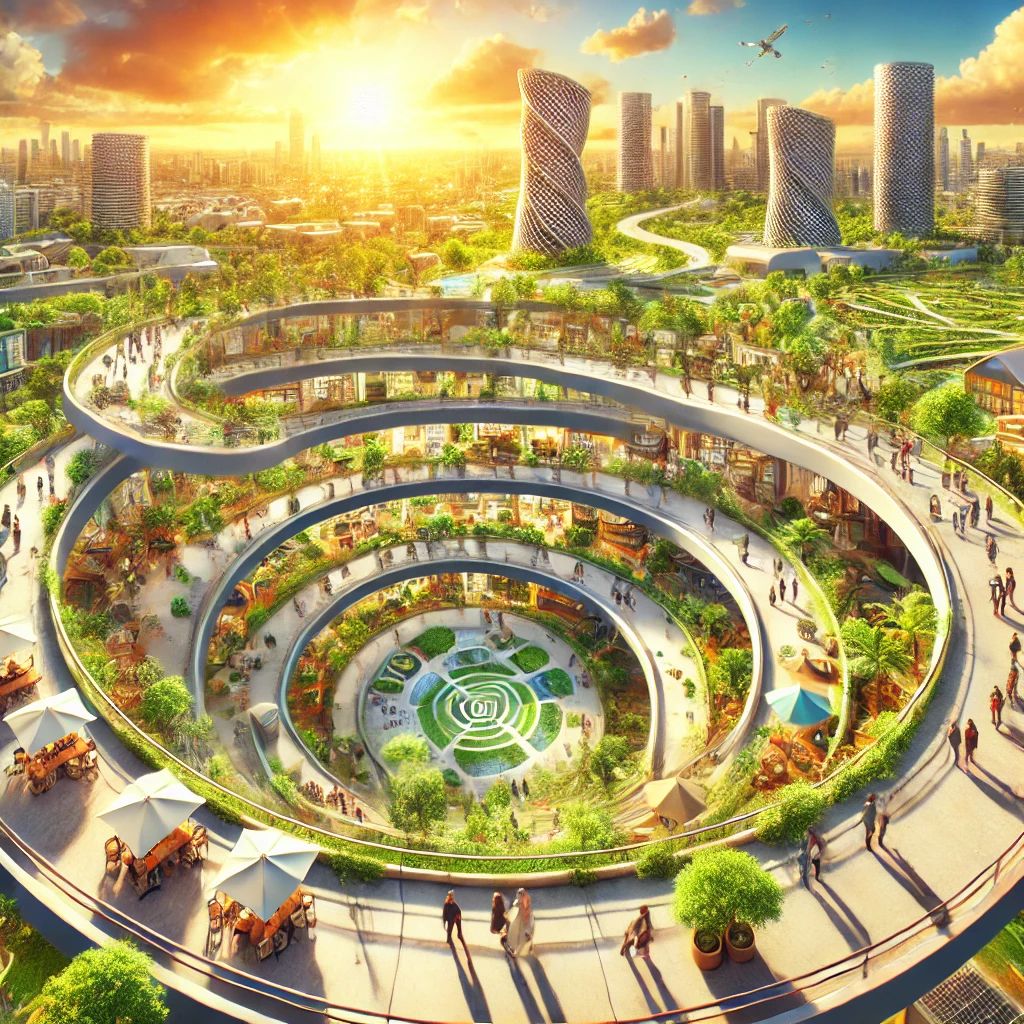
The Spiral City’s Urban Design – Sustainable, Self-Sufficient, and Regenerative
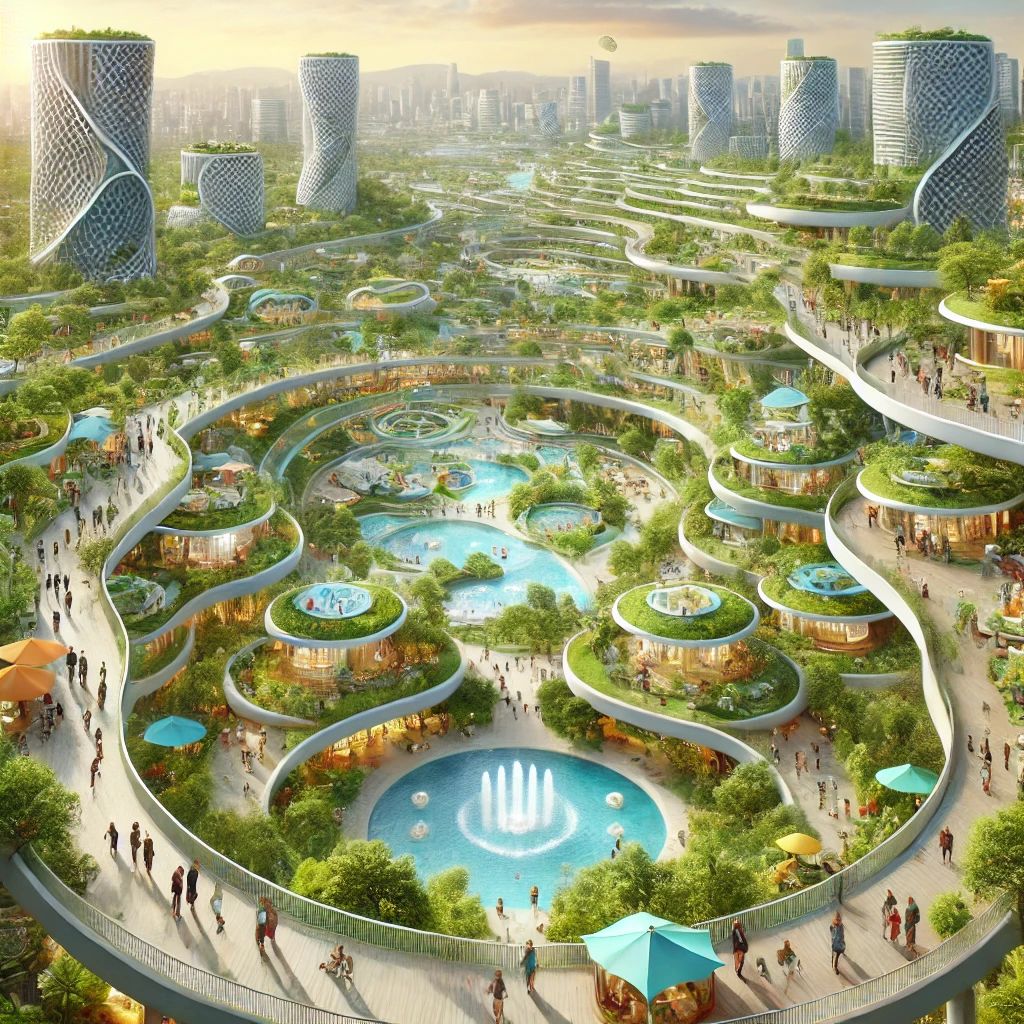
Viewed from above, the Spiral City is a masterpiece of biophilic design, decentralized living, and ecological harmony. Every level of the spiral serves a specific function—residences, markets, green spaces, and social hubs are seamlessly integrated. The city’s infrastructure supports self-sufficient systems, including urban farming, public banking, and cooperative economic models, ensuring that wealth and resources are equitably distributed. This design directly addresses issues raised in Durkheim’s theories on social integration, preventing societal fragmentation by embedding connection into the urban layout. Functional Conflict Perspective (FCP) plays a crucial role here, as this city eliminates hierarchical economic structures, replacing them with worker-owned enterprises and decentralized governance. Inspired by Chomsky and Federici’s critiques of capitalism, this model ensures that financial power remains in the hands of the people rather than extractive institutions. The psychological benefits are immense: reduced urban stress, elimination of economic precarity, and the fostering of innovation through cooperative living. On a broader scale, this regenerative economy creates resilience against global financial crises, proving that sustainability and equity can coexist in a thriving society.
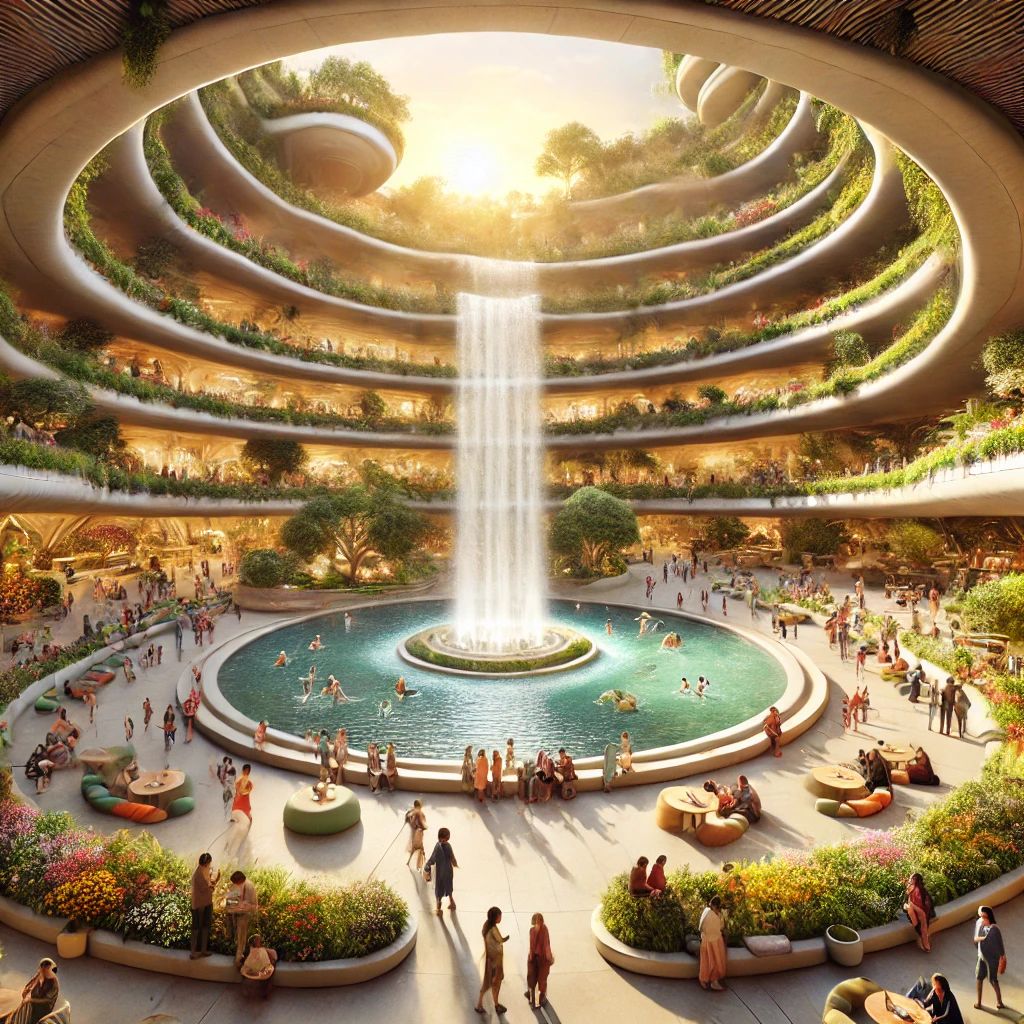
The Spiral Fountain & Multi-Level Social Spaces – Healing Through Nature & Community
The Spiral Fountain serves as more than just a visual centerpiece; it is the nervous system of the city, designed for emotional regulation, sensory engagement, and community healing. Water cascades down from the upper terraces, creating a rhythmic, soothing atmosphere. Families, children, and elders gather here to play, meditate, and celebrate life together. This environment aligns with Harlow’s research on emotional nurturance, which found that sensory-rich, comforting spaces promote security, trust, and emotional stability. The design also reflects Erikson’s psychosocial stages, as it provides individuals with a sense of autonomy, social belonging, and purpose-driven engagement, supporting lifelong development. Foucault’s critique of power structures is visible here—there is no central governing force dictating behavior. Instead, organic, cooperative governance emerges, ensuring that all members of the community feel valued and included. The impact of this space on human development is profound: it heals generational trauma, fosters deep social bonds, and reinforces a culture of shared wisdom and care. By creating spaces that prioritize both emotional safety and personal freedom, the Spiral City provides a blueprint for a society where mental health, community strength, and human potential can fully flourish.
A Blueprint for the Future
The Spiral City is more than an architectural concept—it is a living model of systemic transformation, integrating the best of trauma-informed governance, cooperative economics, and non-hierarchical social structures. In this city, policy is shaped by nervous system regulation rather than coercion, ensuring that human needs are prioritized. Economic models shift away from extractive capitalism toward circular wealth-sharing systems, where resources remain in local communities. Education and relational skills become embedded in daily life, rather than isolated within institutions, ensuring lifelong growth and intergenerational learning. These spaces also provide culturally diverse, inclusive environments, where people of different backgrounds collaborate, share traditions, and create new ways of living that honor their collective histories.
If cities like this were to be built on a global scale, they could reshape civilization itself, dismantling oppressive hierarchies and fostering a world rooted in connection, security, and abundance. This is not just an urban design—it is a blueprint for human flourishing. 🚀
A psychologically safe, water-centered social hub, where natural elements promote emotional integration and conflict resolution. Rooted in polyvagal theory, access to water has been shown to enhance nervous system regulation, reinforcing this space as a communal site for restorative healing, emotional intelligence, and non-hierarchical socialization. This hub fosters collective rituals, a practice found in indigenous cultures that emphasize shared mourning, celebration, and decision-making.
The Spiral City’s Urban Design – Sustainable, Self-Sufficient, and Regenerative
This bird’s-eye view showcases the full Fibonacci-inspired design, a harmonious integration of sustainable architecture, communal living, and self-sufficient infrastructure.
Key Features: Open-air terraces, green roofs, communal markets, multi-functional spaces for work, learning, and recreation.
Theoretical Alignment:
Functional Conflict Perspective (FCP) – This city design mitigates systemic inequality by promoting non-hierarchical resource distribution, participatory governance, and cooperative economics.
Durkheim (Social Integration & Anomie) – By centering human connection and communal interdependence, this model prevents alienation and fosters collective well-being.
Chomsky & Federici (Economic Democracy & Decentralization) – Public banking, worker-owned enterprises, and resource-sharing models create economic resilience and liberation from extractive capitalism.
Psychological & Societal Impact:
Eliminating Urban Stressors → Reduces overcrowding, pollution, and economic instability, fostering mental clarity and emotional balance.
Regenerative Economy → Shifts from extractive capitalism to circular economies, promoting long-term sustainability and shared wealth.
Resilience Against Economic Crises → Decentralized governance and community-driven financial models reduce dependency on volatile global markets.

This regenerative urban model prioritizes psychological safety, social interdependence, and equitable access to resources. By removing economic gatekeeping, it challenges the capitalist premise that survival must be transactional. The spatial design prevents loneliness, enhances shared responsibility, and fosters deep relational skills. Inspired by Durkheim’s social integration theory, it counters the anomie and alienation of industrialized societies, cultivating a secure, thriving, and emotionally intelligent citizenry.
A multi-tiered subterranean city that embodies regenerative design—offering natural cooling, resource efficiency, and psychological safety through nurturing, enclosed spaces. Drawing from polyvagal theory, this environment reduces stress responses by creating biophilic, predictable structures that support nervous system regulation. The design also mirrors neurodivergent-friendly urban planning, offering reduced sensory overload, access to natural elements, and harmonious relational living without rigid hierarchies.
The Spiral Fountain & Multi-Level Social Spaces – Healing Through Nature & Community
This central water feature represents co-regulation, emotional safety, and deep-rooted social harmony, acting as the nervous system of the city.
Key Features: Cascading water, natural light, lush gardens, and multi-level terraces that allow for visual connectivity across spaces.
Theoretical Alignment:
Harlow (Emotional & Sensory Nurturance) – Environments rich in sensory comfort (water, greenery, sunlight) provide emotional grounding and reduce stress responses.
Erikson (Psychosocial Development) – Secure environments with autonomy, social belonging, and purpose-driven engagement support lifelong emotional growth and resilience.
Foucault (Power & Social Structures) – This non-hierarchical space removes rigid divisions between authority and community, fostering organic, cooperative governance.
Psychological & Societal Impact:
Healing from Generational Trauma → Trauma-informed design promotes emotional safety and nervous system regulation, disrupting cycles of stress and fear-based social control.
Human Development & Flourishing → Encourages exploration, play, and lifelong learning, fostering intrinsic motivation and psychological well-being.
Cross-Cultural Harmony → Spaces designed for diverse cultural practices, storytelling, and intergenerational wisdom-sharing enhance global citizenship and empathy.
This image depicts a gathering space for intergenerational learning, self-governance, and shared cultural wisdom. Rooted in Erikson’s psychosocial development theory, it ensures elders remain integrated rather than marginalized, and younger generations grow with secure role models. This design prevents the systemic fragmentation of family units and aligns with non-punitive, restorative justice models rather than punitive, carceral approaches to social conflict.
The Heart of the Spiral – Community and Connection
This image captures the central plaza of the Spiral City, a lush, multi-tiered communal space where families, children, and individuals gather around a fountain at the heart of the community.
Key Features: Vibrant greenery, open-air seating, shared gathering spaces, and interconnected terraces.
Theoretical Alignment:
Bowlby & Ainsworth (Attachment Theory) – Secure attachment is fostered in environments that prioritize social connection, emotional safety, and communal caregiving, reducing stress and increasing resilience.
Dreikurs (Democratic Parenting & Social Order) – A cooperative environment where people share responsibilities fosters mutual respect and intrinsic motivation, reducing hierarchical power dynamics.
Polyvagal Theory (Porges) – The soothing environment promotes a regulated nervous system, reducing social anxiety and reinforcing positive relational patterns.
Psychological & Societal Impact:
Reduced Loneliness & Alienation → Fosters a sense of belonging, reducing depression and anxiety.
Emotional & Relational Development → Encourages intergenerational connection and community support, enhancing social trust.
Educational & Cultural Growth → Shared spaces for knowledge exchange and skill-building, fostering intellectual curiosity and cultural appreciation.
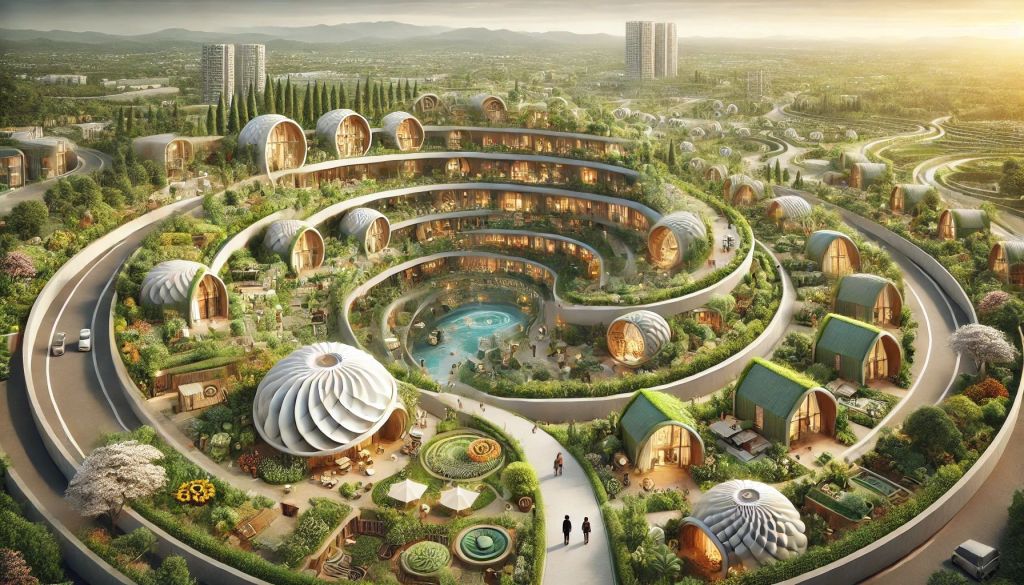
This futuristic cityscape embodies Fibonacci-inspired urban design, where walkable, layered terraces seamlessly integrate residential, social, and commercial spaces. The design prioritizes social cohesion by fostering spontaneous human interaction, reducing isolation, and enhancing community resilience. Inspired by attachment theory, this city nurtures a secure emotional environment where people live in proximity without coercive density, reducing stress and reinforcing mutual aid as a cultural norm.
A highly adaptive, sensory-friendly urban environment, ensuring spaces that honor neurodivergence, introversion, and social flexibility. The city rejects the one-size-fits-all productivity model, instead allowing diverse cognitive styles to coexist without stigma. Drawing from Internal Family Systems (IFS) theory, this space supports self-leadership, co-regulation, and holistic well-being. It promotes harmonious, self-directed communal interaction rather than coercion-based social conformity.
A self-sustaining, circular economy where goods, services, and learning flow without exploitative hierarchies. This model deconstructs extractive capitalism, instead fostering cooperative ownership and mutual interdependence. It embodies Bookchin’s municipalism, where decision-making is distributed, ensuring direct democratic control over local resources. Psychological benefits include reduced economic precarity, heightened intrinsic motivation, and restorative relational dynamics.

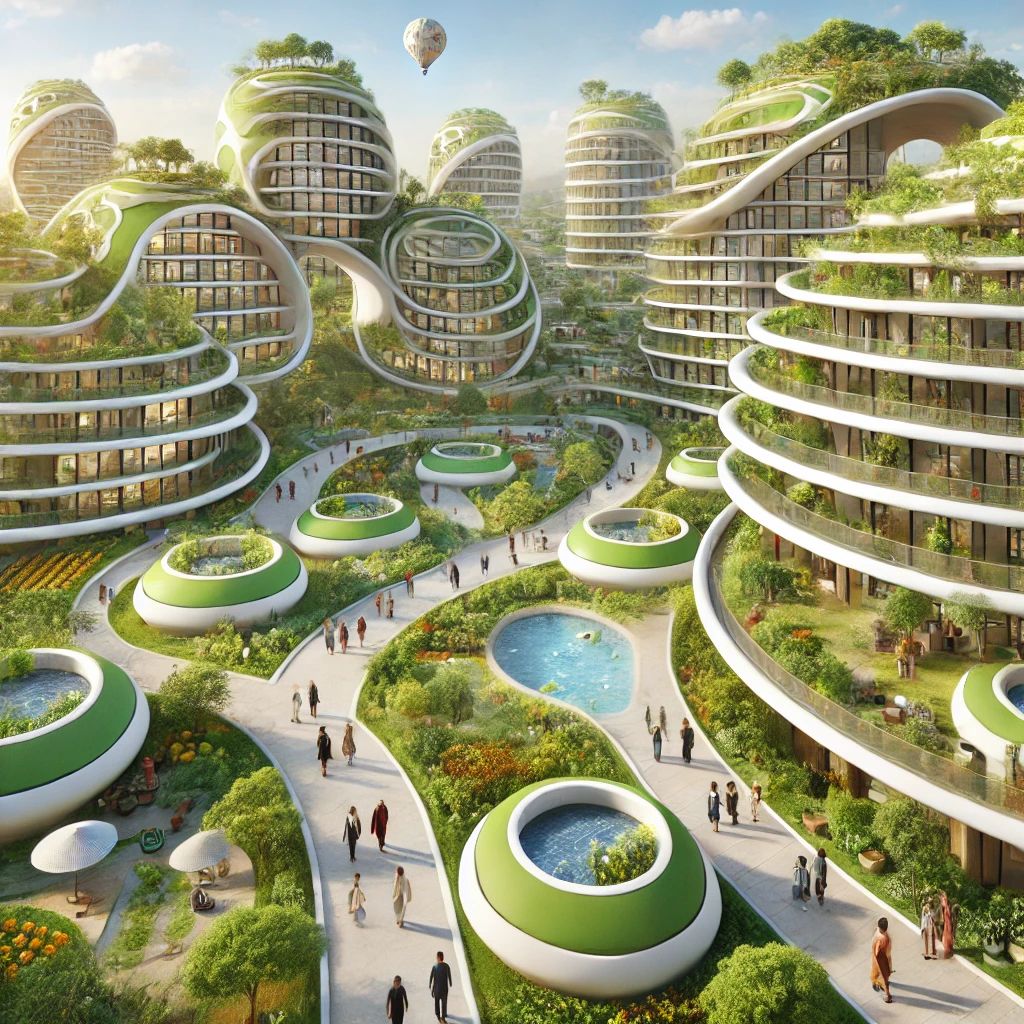
These rounded, nature-integrated dwellings reflect biophilic architecture, offering homes that reduce stress, enhance emotional regulation, and support communal interdependence. The structures decentralize ownership, enabling cooperative housing and wealth distribution, disrupting capitalist housing hierarchies. Inspired by Foucault’s critique of power, this model rejects surveillance-based urban planning and replaces it with fluid, adaptable, and human-centered living spaces.

This rural, self-sustaining cooperative merges permaculture with non-hierarchical social structures, ensuring food security, resource sovereignty, and deep community bonds. The decentralization of production challenges capitalist dependency cycles and embodies socioeconomic resilience. Inspired by Harlow’s work on maternal comfort, these spaces emphasize relational proximity and safety, fostering secure attachments and preventing the emotional fragmentation seen in modern urban life.

A centralized, communal gathering space where people of all ages engage in shared experiences, storytelling, and cooperative decision-making. This aligns with FCP’s emphasis on participatory governance, fostering collective meaning-making without top-down control. Drawing from Bowlby’s attachment theory, it supports secure relationships, active listening, and intergenerational connection, reinforcing a resilient, emotionally intelligent society where decisions emerge from dialogue, not authoritarian dictates.
A Blueprint for the Future
The Spiral City represents a living, breathing model of regenerative human civilization, integrating:
✅ Trauma-informed governance → Policy shaped by nervous system regulation and emotional intelligence.
✅ Decentralized, cooperative economics → Economic systems built on worker ownership, public banking, and sustainable exchange.
✅ Non-hierarchical social organization → Communities function based on mutual aid, participation, and non-coercive conflict resolution.
✅ Lifelong human development → Education and relational skills are embedded in daily life, not isolated in institutions.
✅ Restorative ecological relationships → The built environment heals, rather than harms, human and planetary well-being.
This vision aligns deeply with everything we’ve discussed—from Functional Conflict Perspective, Attachment Theory, Polyvagal Regulation, Economic Decentralization, and Trauma-Informed Systems.
🚀 Final Thought: If these communities were replicated globally, they could reshape civilization itself, dismantling oppressive hierarchies and cultivating a world rooted in connection, security, and abundance.

Introduction
This document compiles key analyses, case studies, scalability insights, and a structured strategy roadmap for implementing economic justice, trauma-informed governance, and participatory democracy policies globally. The roadmap includes pilot programs, legislative advocacy, scaling strategies, and risk mitigation approaches to ensure sustainable implementation.
Scalability Analysis of Policy Reforms
High Scalability Policies:
✔ Public Banking & Community Wealth (Germany) – Strengthens local economies, resists financial crises. ✔ Worker-Owned Cooperatives (Spain) – Provides equitable wages and economic resilience. ✔ Community-Based Mental Health Centers (Iceland) – Reduces hospitalization, increases accessibility. ✔ Alternative Healing in Public Health (India) – Integrates traditional healing with modern medicine.
Moderate Scalability Policies:
⚠ Universal Basic Income (UBI) Trials (Finland) – Politically contested but proven to increase well-being. ⚠ Restorative Justice Sentencing (New Zealand) – Requires legal and cultural adaptation. ⚠ Debt Cancellation for the Poor (Democratic Republic of Congo) – Needs international financial reform. ⚠ Decolonized Education Models (Mexico) – Faces institutional resistance but supports Indigenous leadership.
Key Challenges to Scaling:
🔹 Political Resistance – Requires cross-partisan coalitions and economic justifications.
🔹 Corporate Pushback – Needs tax incentives and public-private partnership pathways.
🔹 Public Trust Issues – Must include community engagement & participatory governance.
🔹 Cultural Adaptation – Policies should be customized to local governance models.
Successful Case Studies & Impact
📌 Sweden: Universal Parental Leave → Increased childhood well-being and gender equality.
📌 New Zealand: Restorative Justice → Reduced crime, improved rehabilitation outcomes.
📌 Canada: Public Trauma Recovery → Decreased suicide rates, improved mental health.
📌 Spain: Worker-Owned Cooperatives → Higher wages, stable democratic workplaces.
📌 Germany: Public Banking → Economic resilience, financial crisis resistance.
Strategic Roadmap for Global Policy Implementation
Phase 1: Pilot Programs & Feasibility (Years 1-3)
🔹 Select Test Regions – Implement policies in diverse economic and cultural contexts.
🔹 Develop Partnerships – Collaborate with local governments, NGOs, research institutions.
🔹 Public Engagement – Conduct town halls, media campaigns, and community forums.
🔹 Data Collection & Adaptation – Track impact metrics and refine strategies.
Phase 2: Legislative Advocacy & Legal Integration (Years 3-6)
🔹 Draft Model Legislation – Develop adaptable policy frameworks.
🔹 Legislative Lobbying – Secure political buy-in and policy sponsorship.
🔹 Economic Feasibility Studies – Build cost-benefit arguments to counter opposition.
🔹 Stakeholder Engagement – Align business leaders, unions, and grassroots coalitions.
Phase 3: National & International Expansion (Years 6-10)
🔹 Expand Public Banking & Worker Co-ops – Strengthen economic infrastructure.
🔹 Formalize Trauma-Informed Policies – Standardize community-based mental health models.
🔹 Secure Global Agreements – Partner with IMF, UN, World Bank for financial backing.
🔹 Ongoing Monitoring & Adaptation – Adjust strategies based on long-term policy data.
Risk Mitigation & Challenge Response
📍 Overcoming Political Resistance – Build multi-partisan coalitions, showcase economic benefits.
📍 Addressing Corporate Pushback – Provide business tax incentives, promote public-private cooperation.
📍 Ensuring Public Trust – Conduct educational outreach, implement participatory budgeting.
📍 Adapting to Different Cultures – Use localized adaptation frameworks and community-led governance.
Visual Resources
🗺 Scalability Map – Highlights which policies have been successfully implemented in different nations.
📊 Strategic Roadmap Flowchart – Outlines implementation phases, key actions, and timeline.
🔄 Feedback Loops Diagram – Illustrates the interconnections between economic justice, governance, and social well-being.
Conclusion: A Sustainable Roadmap for Global Change
By following this structured strategy, policies that prioritize community ownership, economic resilience, and trauma-informed governance can be scaled internationally. Through pilot testing, legislative backing, public engagement, and global cooperation, a sustainable, equitable future is achievable. 🚀


 Spirolateral