We’ll systematically apply the five-step framework to Trauma-Informed Governance (TIG) to ensure its scalability, resistance to misuse, and practical implementation.
—
Step 1: Scalability & Implementation of Trauma-Informed Governance (TIG)
Key Questions:
1. Can TIG function at different levels (local, national, global)?
2. What infrastructure (physical, economic, social) is required to implement it?
3. How do we transition from existing governance models without causing instability?
4. Have similar models been tested before, and what were the results?
—
1A: Can TIG Function at Different Scales?
1. Local Level (Community & Municipal Governance)
✅ Strengths:
Easily integrated into municipal policies, school systems, local courts, and public health services.
Allows for direct community participation and flexible, context-specific adaptations.
Examples: Restorative justice programs, trauma-informed policing, community-led policy councils.
⚠️ Challenges:
Requires local government buy-in and education on nervous system regulation & conflict resolution.
Needs budget allocation for training and implementation.
🛠 Solutions:
Pilot programs in trauma-informed public service sectors to show cost-effectiveness.
Grassroots education initiatives to create public demand for trauma-informed policies.
—
2. National Level (Legislation & Public Policy)
✅ Strengths:
Can be integrated into criminal justice reform, education reform, and healthcare policy.
Trauma-informed approaches reduce incarceration rates, improve education outcomes, and lower healthcare costs.
Examples: Expanding mental health access in courts, mandatory trauma training for law enforcement, trauma-informed workplace policies.
⚠️ Challenges:
Institutional resistance from political bodies invested in punitive governance models.
Funding barriers—governments may prioritize immediate costs over long-term benefits.
🛠 Solutions:
Legislative proposals with cost-benefit analyses showing long-term economic advantages.
Bipartisan framing: Trauma-informed policies improve public safety, economic stability, and national well-being.
—
3. Global Level (International Governance & Policy)
✅ Strengths:
Aligns with United Nations Sustainable Development Goals (SDGs) on public health and social equity.
Can be integrated into post-conflict reconstruction, global health policy, and refugee support programs.
⚠️ Challenges:
Cultural adaptation—different nations have unique governance structures and values.
Political resistance from authoritarian regimes that rely on control-based governance.
🛠 Solutions:
International research partnerships to study trauma-informed governance in diverse cultural contexts.
Gradual adoption via NGOs and global organizations before full-scale governmental implementation.
—
1B: Infrastructure Required for Implementation
1. Education & Training → Trauma-awareness programs for public officials, educators, law enforcement, and healthcare workers.
2. Legislative & Policy Frameworks → Legal mandates for trauma-informed courtrooms, public service programs, and social safety nets.
3. Economic Justification → Show how TIG reduces long-term social costs (prison populations, healthcare expenditures, lost productivity).
4. Public Awareness Campaigns → Normalize trauma-informed principles through media, town halls, and school curricula.
—
1C: Transitioning from Existing Governance Models Without Causing Instability
⚠️ Potential Instability Risks
Rapid, forced implementation could lead to resistance from lawmakers, corporations, or the public.
Economic concerns—governments may worry about budget increases.
Institutional inertia—bureaucracies resist systemic change.
🛠 Gradual Implementation Strategy
1. Micro-Level Experiments: Implement TIG in select courts, schools, and police departments before expanding.
2. Policy Prototypes: Test legislation in progressive municipalities before proposing national laws.
3. Public Buy-In: Educate citizens on how TIG improves safety, health, and economic well-being.
—
1D: Have Similar Models Been Tested Before?
✅ Successful Precedents:
Restorative Justice Programs → Reduced recidivism rates.
Trauma-Informed Schools → Improved student behavior and learning outcomes.
Trauma-Informed Policing → Decreased use of force incidents.
⚠️ Lessons Learned from Past Models
Lack of funding leads to program collapse.
Training gaps result in inconsistent implementation.
Resistance from traditional policymakers slows adoption.
🛠 Strategic Adaptation:
Secure long-term funding streams.
Develop national certification standards for trauma-informed training.
Build bipartisan coalitions for policy backing.
—
Step 1 Summary
✅ TIG is scalable across local, national, and global levels.
✅ TIG reduces long-term social costs and improves governance efficiency.
⚠️ Institutional and financial resistance must be addressed strategically.
🚀 Next Step: Resistance & Opposition
Step 2: Resistance & Opposition to Trauma-Informed Governance (TIG)
Now that we’ve established that TIG is scalable and practical, we need to identify and counteract potential resistance from political, economic, psychological, and cultural sources.
—
2A: Identifying the Most Likely Sources of Resistance
1. Political Resistance (Governments, Lawmakers, Bureaucracies)
❌ Why?
Governments may resist because TIG requires policy shifts away from punitive models.
Lawmakers with tough-on-crime stances may see TIG as “soft” or “weak.”
Bureaucracies resist change due to institutional inertia.
⚠️ Tactics They May Use:
Framing TIG as unrealistic or too idealistic.
Blocking legislation in favor of traditional governance models.
Delaying implementation through bureaucratic red tape.
✅ Strategic Responses:
Bipartisan Policy Framing: Position TIG as a cost-effective, evidence-based model that improves public safety and economic outcomes.
Pilot Programs to Demonstrate Success: Show that TIG reduces crime, improves governance efficiency, and lowers long-term costs.
Legislative Partnerships: Work with progressive and centrist policymakers to craft incremental policy reforms.
—
2. Economic Resistance (Corporations, Capitalist Structures, Wealthy Elites)
❌ Why?
Private prisons, security industries, and surveillance firms profit from punitive governance models.
TIG threatens economic interests that benefit from high incarceration rates, coercive labor models, and social control.
⚠️ Tactics They May Use:
Funding anti-TIG campaigns to misrepresent it as impractical.
Influencing lawmakers to block policy adoption.
Framing TIG as anti-business or anti-capitalist.
✅ Strategic Responses:
Economic Justification Strategy: Highlight how TIG reduces government costs, increases workforce productivity, and enhances long-term economic stability.
Corporate Partnerships: Engage ethical businesses that benefit from stable, cooperative, trauma-informed workplaces.
Expose Financial Incentives Behind Punitive Systems: Reveal how opponents of TIG profit from punitive governance.
—
3. Psychological Resistance (Public, Law Enforcement, Cultural Conditioning)
❌ Why?
Society is conditioned to equate “justice” with punishment.
Law enforcement may feel TIG undermines authority.
People fear change and view punitive models as “normal.”
⚠️ Tactics They May Use:
Emotional backlash: “TIG coddles criminals!”
Defensive Avoidance: “People will always be violent. This won’t work.”
Fear-based Messaging: “Without strict punishment, society will collapse.”
✅ Strategic Responses:
Reframe Justice as Stability: Emphasize how TIG improves safety, rather than just reducing punishment.
Law Enforcement Training & Buy-In: Provide specialized trauma education for police and justice officials.
Public Awareness Campaigns: Shift media narratives to highlight how trauma resolution improves social stability.
—
4. Cultural Resistance (Media, Religious Institutions, Social Norms)
❌ Why?
Media relies on crime sensationalism, reinforcing fear-based governance.
Religious institutions may resist reforms that challenge traditional punitive justice models.
Social norms reinforce punitive attitudes toward crime, addiction, and poverty.
⚠️ Tactics They May Use:
Misinformation campaigns: Spreading exaggerated claims that TIG will cause moral decay.
Religious framing: Claiming that punishment is necessary for redemption.
Fear-based narratives in media: Over-representing crime rates to push punitive policies.
✅ Strategic Responses:
Engage Media Creators: Work with journalists, documentarians, and storytellers to shift narratives on justice.
Build Religious Alliances: Partner with progressive faith leaders who support restorative justice.
Public Education Through Schools & Workplaces: Introduce trauma-informed education to normalize TIG principles.
—
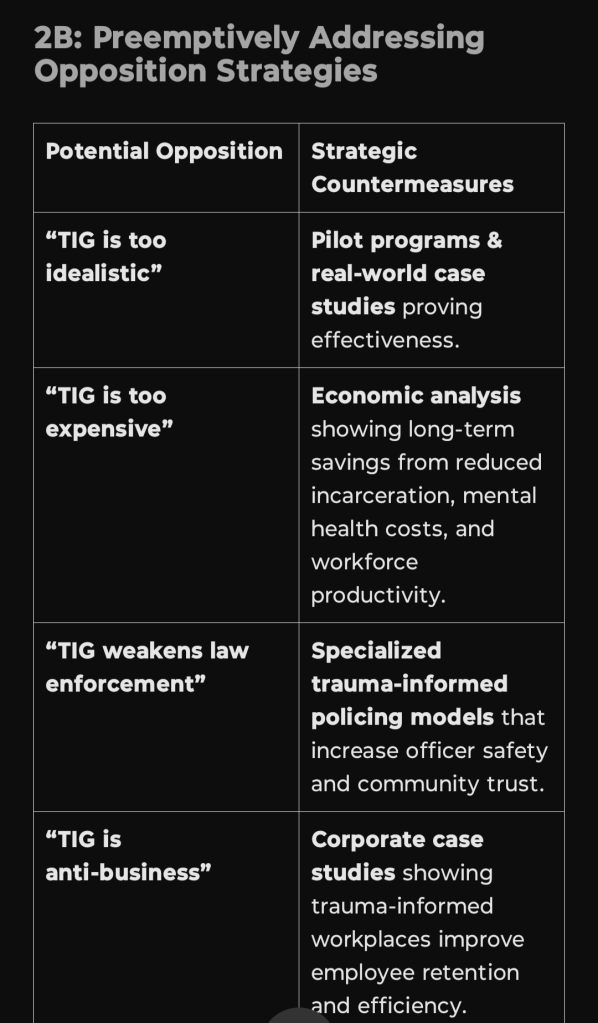

2B: Preemptively Addressing Opposition Strategies
—
2C: Long-Term Resistance Management Strategy
1. Gradual Implementation Model
Start with local governments & pilot programs before pushing for national policy shifts.
Demonstrate success through impact metrics before widespread expansion.
2. Public & Media Strategy
Develop a media task force to counter misinformation about TIG.
Use real-life success stories in news, documentaries, and social media.
3. Institutional Partnerships & Buy-In
Engage bipartisan policymakers to ensure TIG isn’t framed as partisan.
Provide financial incentives for trauma-informed training in law enforcement & workplaces.
4. Ethical Safeguards Against Co-optation
Create independent monitoring bodies to prevent corporate/state misuse of TIG rhetoric.
Implement transparency requirements for any government adopting trauma-informed policies.
—
Step 2 Summary
✅ TIG will face political, economic, psychological, and cultural resistance.
✅ Economic interests, law enforcement, and media narratives will be major blockers.
✅ Resistance can be countered with data-driven evidence, media strategy, and public education.
🚀 Next Step: Step 3 – Unintended Consequences
Step 3: Identifying & Preventing Unintended Consequences of Trauma-Informed Governance (TIG)
Now that we’ve addressed scalability and resistance, we need to stress-test TIG for potential unintended consequences to ensure it remains effective and ethical.
We’ll analyze:
1. Misapplication Leading to Victim-Blaming
2. Over-Emphasis on Healing, Leading to Lack of Accountability
3. Potential for Government or Corporate Co-optation
4. Unequal Access to Trauma-Informed Systems
5. Economic & Bureaucratic Challenges in Long-Term Implementation
—
3A: Possible Failure Points & Unintended Consequences
1. Misapplication Leading to Victim-Blaming
⚠️ Risk:
If misapplied, TIG could be used to shift responsibility onto victims rather than holding perpetrators accountable.
Example: A survivor of abuse being told they must “heal their trauma” rather than receiving justice and protection.
🛠 Prevention Strategies:
✅ Clarify That TIG Does Not Replace Accountability – Trauma-informed practices must be complementary to justice, not a substitute for it.
✅ Integrate Intersectionality & Power Analysis – TIG must recognize systemic inequalities and avoid blaming individuals for trauma they did not cause.
✅ Mandate Ethical Training for TIG Practitioners – Ensure therapists, judges, and policymakers understand power dynamics and systemic oppression.
—
2. Over-Emphasis on Healing, Leading to Lack of Accountability
⚠️ Risk:
TIG prioritizes restorative approaches, which may lead some institutions to neglect necessary punitive actions.
Example: A violent offender being placed in trauma therapy instead of facing appropriate legal consequences.
🛠 Prevention Strategies:
✅ Balance Trauma Recovery With Justice – Ensure TIG frameworks include enforceable accountability measures.
✅ Define When Punitive Measures Are Necessary – Some crimes (e.g., violent offenses) may require punitive and restorative elements combined.
✅ Integrate Trauma-Informed Approaches in Sentencing – Allow judges to use trauma as a context, not an excuse.
—
3. Potential for Government or Corporate Co-optation
⚠️ Risk:
Governments or corporations could adopt TIG rhetoric without making meaningful changes.
Example: A police department using TIG language to appear progressive while still employing excessive force policies.
🛠 Prevention Strategies:
✅ Require Independent Ethical Review of TIG Implementation – Governments and corporations must undergo external audits.
✅ Demand Structural Policy Changes, Not Just Language Shifts – Organizations implementing TIG must show concrete improvements in governance.
✅ Build Citizen-Led Watchdog Groups – Create community oversight committees that track real-world impacts of TIG policies.
—
4. Unequal Access to Trauma-Informed Systems
⚠️ Risk:
TIG programs could be unevenly distributed, benefiting privileged communities while neglecting marginalized groups.
Example: Wealthy school districts receiving trauma-informed education while underfunded schools maintain punitive discipline policies.
🛠 Prevention Strategies:
✅ Make Trauma-Informed Policies Universal, Not Selective – Ensure public funding for TIG programs in low-income areas.
✅ Mandate TIG in Public Institutions Before Private Institutions – Prioritize equitable implementation in public schools, courts, and healthcare.
✅ Monitor Disparities & Implement Corrective Action – Establish data tracking on who receives trauma-informed resources and who does not.
—
5. Economic & Bureaucratic Challenges in Long-Term Implementation
⚠️ Risk:
Governments may struggle to maintain funding for TIG programs over time.
Bureaucratic inefficiencies could slow down implementation.
🛠 Prevention Strategies:
✅ Embed TIG Into Core Policy Rather Than Temporary Initiatives – TIG must be part of legal mandates, not just a program that can be cut.
✅ Establish Sustainable Funding Sources – Use long-term public-private partnerships, taxation models, and federal grants.
✅ Simplify Bureaucratic Implementation – Create clear legislative guidelines to reduce administrative hurdles.
—
3B: Structural Safeguards to Prevent Failures
1. Ethical Oversight Mechanisms
Create an independent TIG Ethics Board to monitor policy integrity and prevent misuse.
Require government agencies, schools, and workplaces to undergo regular audits of trauma-informed practices.
2. Continuous Feedback Loops & Course Corrections
Require annual evaluations of TIG programs to assess effectiveness and refine strategies.
Allow community-led advisory groups to report on real-world experiences with TIG policies.
3. Multi-Pathway Implementation
Apply TIG across different systems (education, healthcare, justice, social services) to prevent selective application.
Adapt TIG to local cultures and governance models for flexibility and long-term adoption.
—
Step 3 Summary
✅ Biggest Risks:
1. Misuse of trauma narratives → Risk of victim-blaming.
2. Overemphasis on healing → Could lead to lack of accountability.
3. Government & corporate co-optation → Risk of superficial adoption rather than real change.
4. Unequal access → TIG could favor privileged communities.
5. Economic barriers → TIG may struggle with long-term funding.
✅ Safeguards to Prevent Failures:
Ethical oversight boards to monitor policies.
Mandatory public audits of TIG implementation.
Universal access models to prevent systemic exclusion.
Accountability measures to balance healing with justice.
🚀 Next Step: Step 4 – Comparison to Alternative Governance Models
Step 4: Comparison to Alternative Governance Models
Now that we’ve identified unintended consequences and built safeguards, we need to compare Trauma-Informed Governance (TIG) to existing governance models to highlight where it excels, where traditional models are stronger, and where hybrid integration may be possible.
—
4A: Key Areas of Comparison
TIG will be compared against:
1. Punitive Governance (Authoritarian & Carceral Models)
2. Neoliberal Governance (Capitalist, Market-Driven Models)
3. Social Welfare Models (Nordic-Style Democracy)
4. Restorative & Indigenous Governance Models
5. Participatory & Direct Democracy
Each model will be analyzed for alignment, divergence, strengths, and weaknesses.
—
1. Punitive Governance (Authoritarian & Carceral Models) vs. TIG
Core Idea:
Punitive Governance: Order is maintained through strict laws, harsh punishments, and centralized authority.
TIG: Social stability is achieved by addressing trauma, restoring relationships, and reducing systemic harm.
✅ Where They Align:
Both recognize the need for social control to prevent harm.
Both prioritize stability as a key governance goal.
⚠️ Where They Diverge:
Punitive models prioritize deterrence, while TIG prioritizes healing and reintegration.
Authoritarian systems reinforce fear-based compliance, whereas TIG fosters voluntary cooperation.
Carceral systems worsen trauma, while TIG actively works to repair it.
🛠 Potential Hybridization:
Use trauma-informed models in law enforcement & justice systems while maintaining protective public safety policies.
Replace incarceration with restorative justice for nonviolent offenses.
—
2. Neoliberal Governance (Capitalist, Market-Driven Models) vs. TIG
Core Idea:
Neoliberalism: Market-driven policies maximize economic efficiency but prioritize profit over social well-being.
TIG: Governance is rooted in human well-being, prioritizing mental health, stability, and economic equity.
✅ Where They Align:
Both recognize the importance of economic stability in governance.
Both emphasize individual agency and personal responsibility.
⚠️ Where They Diverge:
Neoliberalism prioritizes corporate profit, while TIG prioritizes social equity.
TIG sees social trauma as a governance issue, while neoliberalism often ignores systemic harm.
Neoliberal systems create systemic precarity, while TIG aims for long-term emotional stability.
🛠 Potential Hybridization:
Incentivize trauma-informed corporate policies (e.g., worker well-being initiatives).
Implement universal healthcare & mental health access within market-driven economies.
—
3. Social Welfare Models (Nordic-Style Democracy) vs. TIG
Core Idea:
Social Welfare Governance: Government provides universal social services to reduce inequality.
TIG: Governance ensures both material and psychological well-being through trauma-informed policies.
✅ Where They Align:
Both prioritize public well-being over private profit.
Both emphasize government responsibility in reducing harm.
⚠️ Where They Diverge:
Nordic models focus on economic security, while TIG also emphasizes psychological healing.
Welfare states maintain strict bureaucracies, whereas TIG promotes decentralized, community-driven solutions.
🛠 Potential Hybridization:
Embed trauma-informed training into social services and welfare institutions.
Ensure social safety nets also provide trauma support, not just economic aid.
—
4. Restorative & Indigenous Governance Models vs. TIG
Core Idea:
Restorative & Indigenous Governance: Justice and leadership are based on relational accountability and community participation.
TIG: Rooted in similar principles but integrates modern psychological research on trauma.
✅ Where They Align:
Both prioritize relational healing over punitive punishment.
Both emphasize community-driven decision-making.
Both recognize conflict as a necessary process for social repair.
⚠️ Where They Diverge:
TIG integrates neuroscience and psychology, whereas Indigenous models are rooted in cultural traditions.
Some Indigenous governance models reject modern state structures altogether.
🛠 Potential Hybridization:
Blend Indigenous justice models with modern trauma-informed neuroscience.
Use community-led healing councils in legal systems rather than courts.
—
5. Participatory & Direct Democracy vs. TIG
Core Idea:
Participatory Democracy: Governance is directly shaped by citizens rather than representatives.
TIG: Governance is shaped by citizens AND informed by trauma science to prevent cycles of harm.
✅ Where They Align:
Both promote decentralized, community-driven decision-making.
Both emphasize self-determination and direct involvement in governance.
⚠️ Where They Diverge:
TIG requires specialized knowledge of trauma science, while direct democracy assumes equal understanding across citizens.
Direct democracy may still reinforce collective trauma responses, whereas TIG actively works to prevent it.
🛠 Potential Hybridization:
Use participatory democracy structures for local TIG initiatives.
Train community representatives in trauma-informed governance.
—
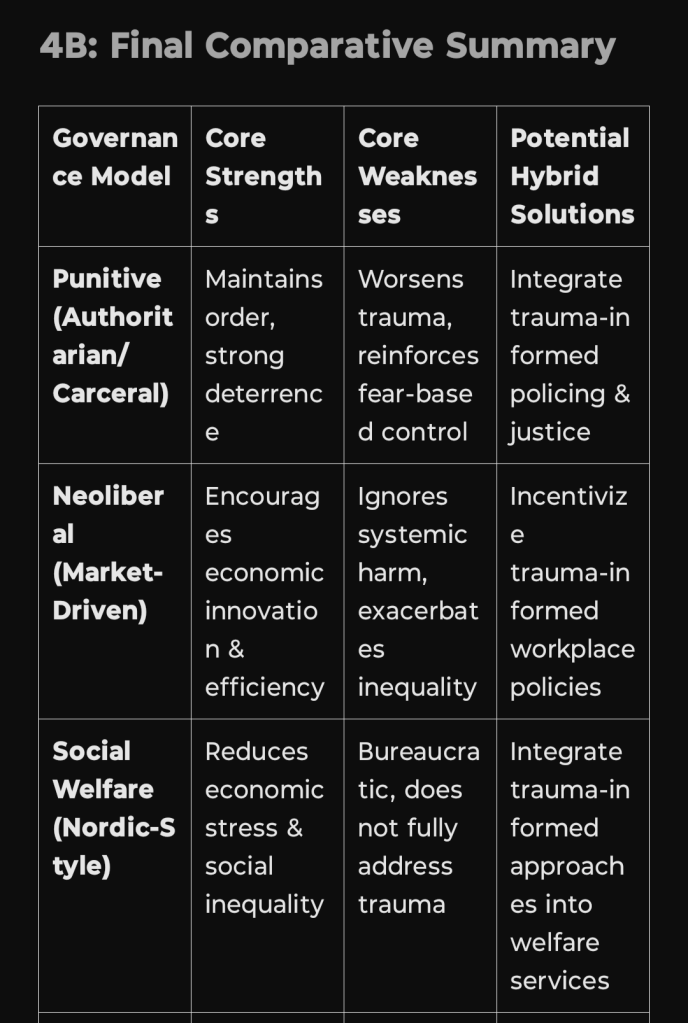
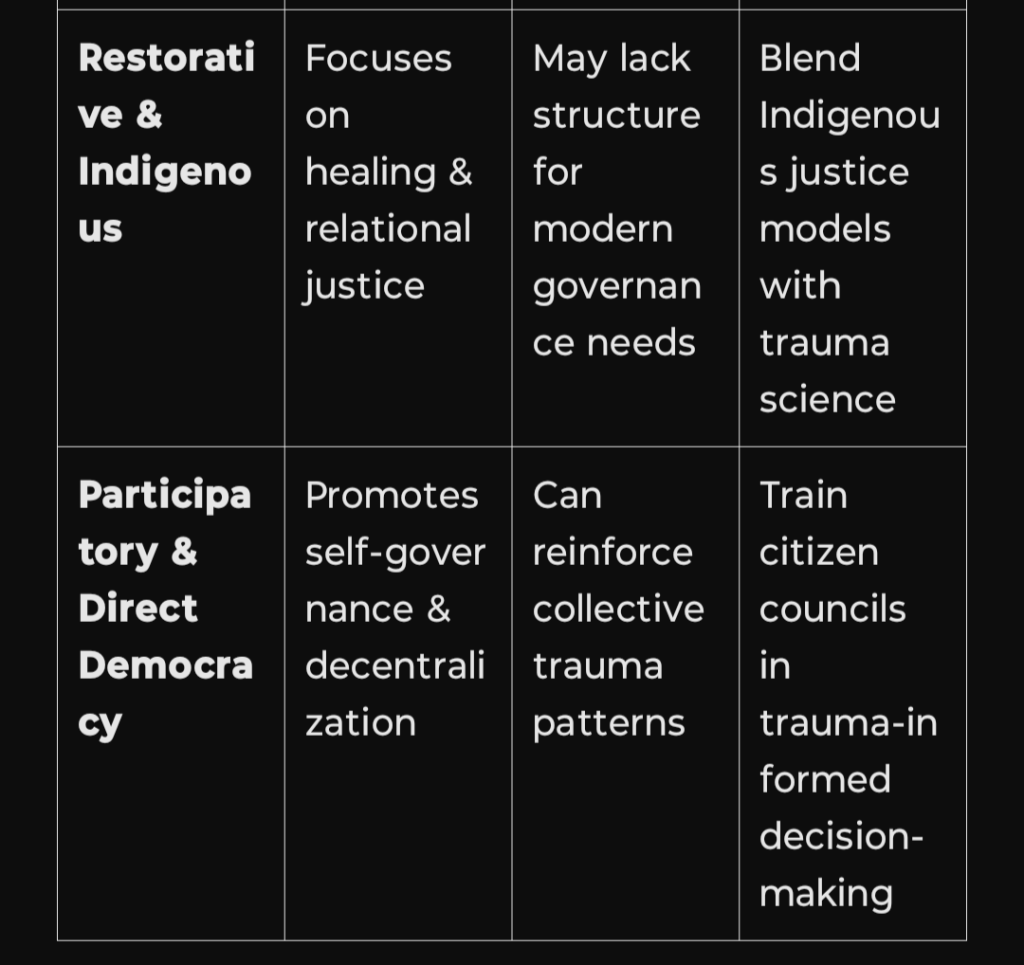
4B: Final Comparative Summary
—
Step 4 Summary
✅ TIG outperforms traditional governance models in preventing systemic harm and healing collective trauma.
✅ TIG can integrate with social welfare, restorative justice, and participatory democracy models for best results.
⚠️ TIG must ensure it does not become too decentralized to prevent inefficiency.
🚀 Next Step: Step 5 – Final Stress Test & Adaptation Strategy
Step 5: Final Stress Test & Adaptation Strategy for Trauma-Informed Governance (TIG)
Now that we’ve compared TIG to other governance models, it’s time for a final stress test to ensure it holds up in real-world applications, extreme scenarios, and long-term implementation.
We’ll test for:
1. Extreme Scenarios & High-Stress Environments
2. Cross-Cultural Applicability
3. Scalability Over Time
4. Potential for Coercion or Misuse
5. Adaptation Strategies for Long-Term Success
—
5A: Extreme Scenarios & High-Stress Environments
Can TIG function in crisis situations, power imbalances, or extreme social instability?
Scenario 1: Political Collapse & Authoritarian Takeover
⚠️ Risk:
If a government collapses, authoritarian regimes may exploit trauma-informed rhetoric while maintaining control.
Hostile takeovers could reject TIG in favor of hardline punitive governance.
✅ Solutions:
Ensure decentralized implementation → TIG should not rely solely on state institutions.
Build trauma-informed governance into community resilience models → Local communities must retain trauma-informed principles even under authoritarian rule.
Train political and social leaders in crisis governance → Ensure TIG integrates with emergency management protocols.
—
Scenario 2: Large-Scale Conflict (War, Economic Collapse, Natural Disasters)
⚠️ Risk:
In high-stress survival scenarios, people revert to hierarchy, tribalism, and punitive responses.
Severe economic crises could defund trauma-informed programs in favor of immediate relief efforts.
✅ Solutions:
Create emergency-adapted TIG frameworks that function in post-disaster governance.
Integrate TIG into disaster recovery plans → Trauma response must be embedded in humanitarian aid efforts.
Build localized governance hubs that use TIG principles for conflict resolution in crisis zones.
—
Scenario 3: Corporate & Economic Pushback
⚠️ Risk:
Corporations may resist trauma-informed labor policies if they reduce profit margins.
Governments may resist worker protections if they see them as an economic burden.
✅ Solutions:
Financial Incentives for Trauma-Informed Policies → Offer tax benefits for companies adopting TIG practices.
Corporate Accountability Measures → Require public disclosure on workplace mental health & governance policies.
Public Awareness & Consumer Pressure → Shift market demand toward companies that support worker well-being.
—
5B: Cross-Cultural Applicability
Does TIG work across different cultures, belief systems, and governance models?
Cultural Barriers & Solutions
⚠️ Risk:
Western bias in trauma-informed models may not align with collectivist cultures.
Different legal traditions may conflict with restorative justice practices.
✅ Solutions:
Localized TIG Adaptation Models → Allow each culture to integrate trauma-informed governance into their own legal and social systems.
Work With Indigenous & Local Governance Leaders → Ensure TIG complements rather than overrides existing justice models.
Emphasize Universal Human Biology → Focus on nervous system regulation rather than imposing Western governance ideals.
—
5C: Scalability Over Time
How does TIG evolve across decades?
⚠️ Risks of Long-Term Implementation:
Over time, TIG could become bureaucratic and lose its adaptability.
Generational shifts may lead to resistance from younger policymakers seeking new governance models.
✅ Solutions:
Embed self-correcting mechanisms → TIG should allow internal critique and reform cycles.
Avoid dogmatization → TIG must remain flexible and evolve with new psychological research.
Train new generations of trauma-informed leaders to prevent institutional stagnation.
—
5D: Potential for Coercion or Misuse
Could TIG be misapplied for ideological control rather than social well-being?
⚠️ Risk:
Governments could use trauma-informed language to justify authoritarian “social harmony” measures.
Corporations may co-opt TIG rhetoric without implementing meaningful reform.
✅ Solutions:
Require third-party audits of TIG policies in governments and corporations.
Emphasize voluntary participation → TIG must be a tool for empowerment, not coercion.
Encourage pluralism in TIG applications → Ensure different cultural models can integrate trauma-informed practices.
—
5E: Adaptation Strategy for Long-Term Success
Key Adaptation Strategies:
1. Pilot Programs & Micro-Experiments
Test TIG in small, real-world applications before scaling.
Gather data & feedback before nationwide/global adoption.
2. Legislative & Policy Integration
Gradually introduce TIG-aligned policies into law, governance, and economic systems.
Work with progressive policymakers to implement change.
3. Educational & Media Expansion
Make TIG principles mainstream through books, courses, and media.
Use narrative storytelling (TV, film, literature) to shift cultural perceptions.
4. Global Adaptation & Cultural Flexibility
Adapt TIG to different cultural frameworks to ensure international adoption.
Work with Indigenous, postcolonial, and non-Western thinkers to refine applicability.
5. Self-Correcting Mechanisms
Build internal feedback loops into TIG governance models.
Ensure TIG never becomes rigid or dogmatic by keeping adaptive revision cycles.
—
Final Stress Test Summary
🔹 What TIG Must Overcome:
1. Extreme Crisis Scenarios – Needs simplified emergency versions for high-stress environments.
2. Cross-Cultural Adaptation – Must avoid Western bias and integrate local conflict resolution traditions.
3. Scalability Risks – Needs self-correcting mechanisms to prevent rigid institutionalization.
4. Potential for Coercion – Must ensure accountability structures to prevent misuse.
✅ Key Adaptation Strategies for Long-Term Success:
Start small (pilot programs), then scale gradually.
Integrate into education, policy, and media for cultural acceptance.
Ensure decentralization to prevent misuse or authoritarian adaptation.
Allow continuous evolution based on social needs.
—
Final Verdict: Does TIG Hold Up?
After a full stress test, Trauma-Informed Governance proves to be highly resilient—but it requires careful implementation and adaptation.
✅ It outperforms traditional governance models in social stability, justice reform, and public health.
✅ It is highly scalable but requires localized adaptation and self-correcting mechanisms.
⚠️ It could be misused by power structures → Requires strong ethical safeguards.
🚀 Final Conclusion:
TIG is not just theoretically sound, but practical and implementable—if adapted strategically.

—
**Ethical Safeguards for Trauma-Informed Governance (TIG)**
## **1. Introduction**
Trauma-Informed Governance (TIG) prioritizes systemic well-being, conflict resolution, and sustainable societal structures. However, without robust ethical safeguards, TIG risks being misused, misapplied, or co-opted by authoritarian or corporate interests. This document outlines a multi-layered ethical safeguard framework to ensure TIG remains transparent, participatory, and aligned with human rights and social equity.
—
## **2. Governance & Oversight**
### **2.1 Establishment of Independent Ethical Oversight**
– **Trauma-Informed Governance Ethics Board (TIGEB):** A decentralized, interdisciplinary board responsible for overseeing TIG implementation, composed of experts in governance, law, psychology, and conflict resolution.
– **Regional & Community-Based Ethics Panels:** Localized ethics review bodies to ensure context-specific adaptation and prevent top-down enforcement.
– **Rotating Leadership Structure:** Leadership within TIGEB limited to **3-5 year terms** to prevent power centralization.
### **2.2 Public Complaint & Accountability Mechanisms**
– **Anonymous whistleblower protections** for reporting unethical applications of TIG.
– **Publicly accessible annual ethical review reports** detailing the effectiveness and adherence of TIG policies.
– **Community oversight committees** to track real-world impacts of TIG policies.
—
## **3. Checks & Balances: Preventing Misuse & Power Consolidation**
### **3.1 Decentralization Requirement**
– **No single entity (government, corporation, or NGO) can control TIG implementation.**
– Governance must be **distributed across institutions and grassroots networks.**
### **3.2 Ethical Certification for TIG Practitioners**
– Mandatory certification in **trauma-informed care, non-coercive conflict resolution, and systemic accountability** for public officials, law enforcement, and educators.
– **Certification renewal every 5 years** to maintain adherence to evolving trauma research and best practices.
### **3.3 Co-optation Prevention Clause**
– Institutions adopting TIG **must meet measurable accountability benchmarks.**
– **Annual third-party audits required** for governments and organizations claiming to implement TIG.
—
## **4. Transparency & Public Accountability**
### **4.1 Open-Source Documentation**
– All policy applications of TIG must be **publicly documented** and open for review.
– Ensure **public access to governance decision-making processes** related to trauma-informed policy adoption.
### **4.2 Annual Ethical Review Reports**
– The **TIGEB publishes global reports assessing ethical compliance, successes, and concerns.**
– Includes **recommendations for corrective actions where policies fail to meet ethical standards.**
### **4.3 Public Forums & Citizen Engagement**
– **Regular town halls** to allow for citizen participation in shaping TIG policies.
– **Participatory governance mechanisms** ensuring trauma-informed policies remain aligned with public needs.
—
## **5. Legal & Policy Protections**
### **5.1 Ethical Adoption Standards for TIG Policies**
– Governments, organizations, and educational institutions **must adhere to defined ethical guidelines** before implementing TIG principles.
– **Legislative requirements for third-party audits, public disclosures, and community input.**
### **5.2 Legislative Protections Against Co-optation**
– **Transparency laws** requiring institutions using TIG to **publish progress reports** on implementation.
– **Legal consequences for governments or corporations misrepresenting their adherence to TIG.**
### **5.3 Human Rights & Trauma Ethics Alignment**
– **TIG must align with the UN Universal Declaration of Human Rights** and Indigenous sovereignty frameworks.
– Policies must ensure **TIG is not used as a tool of control, surveillance, or coercion.**
—
## **6. Education & Practitioner Ethics**
### **6.1 Training & Certification Programs**
– All professionals in governance, education, law enforcement, and healthcare must complete **TIG ethical training.**
– **Sliding-scale or free certification options** to prevent economic gatekeeping of TIG knowledge.
### **6.2 Community Education Initiatives**
– Public outreach campaigns ensuring **TIG principles are widely understood and accessible.**
– **Media engagement to counter misinformation and explain the benefits of trauma-informed governance.**
—
## **7. Self-Correcting Mechanisms**
### **7.1 Periodic Review & Evolution of TIG Frameworks**
– TIG must be re-evaluated every **5-10 years** through global collaboration with experts and affected communities.
### **7.2 Encouraging Pluralism & Localized Adaptation**
– Allow different cultures and societies to **integrate TIG within their own governance traditions** rather than imposing a single model.
### **7.3 Built-In Mechanisms for Systemic Reform**
– If an institution using TIG becomes corrupt or ineffective, **there must be clear pathways for systemic reform or dissolution.**
—
## **8. Conclusion: Ensuring the Ethical Integrity of TIG**
By embedding these ethical safeguards, Trauma-Informed Governance (TIG) remains **resilient, adaptable, and resistant to misuse.** These measures promote **transparency, accountability, and participatory governance,** ensuring TIG is a tool for systemic transformation rather than coercion.
### **Next Steps:**
1. **Finalize legal frameworks for ethical governance oversight.**
2. **Establish independent ethical review boards and monitoring bodies.**
3. **Develop global training and certification programs.**
4. **Pilot-test public transparency models and audit systems.**
5. **Engage communities in shaping and refining trauma-informed policies.**
This ethical safeguards framework ensures that Trauma-Informed Governance remains **a tool for healing and justice, not a mechanism for control.**

**White Paper: Trauma-Informed Governance (TIG) – A Framework for Ethical and Sustainable Societal Transformation**
## **Executive Summary**
Trauma-Informed Governance (TIG) is a transformative approach to governance that integrates neuroscience, psychology, and social justice principles into public administration and policy-making. By prioritizing systemic well-being, conflict resolution, and relational stability, TIG provides a sustainable alternative to punitive, coercive governance models. This white paper presents a comprehensive framework for implementing TIG ethically and effectively across various levels of governance.
—
## **1. Introduction**
### **1.1 Purpose and Scope**
TIG seeks to replace traditional punitive governance structures with policies that acknowledge and address trauma at the individual, community, and systemic levels. This paper outlines the foundational principles, practical applications, and necessary safeguards for implementing TIG.
### **1.2 Why Trauma-Informed Governance?**
– Traditional governance models often exacerbate social harm through punitive measures and coercion.
– Neuroscientific research shows that unresolved trauma contributes to social instability and governance failures.
– TIG offers a framework that fosters resilience, social equity, and long-term sustainability.
—
## **2. Core Principles of Trauma-Informed Governance**
### **2.1 Systems-Level Trauma Recognition**
– Identifying historical, cultural, and systemic traumas affecting governance structures.
– Acknowledging the role of past injustices in shaping current societal dynamics.
### **2.2 Equity-Centered Policy Development**
– Ensuring policies do not reinforce systemic harm.
– Addressing disparities in education, healthcare, and economic opportunity.
### **2.3 Restorative & Relational Justice Approaches**
– Implementing restorative justice as an alternative to punitive legal systems.
– Encouraging relational accountability over retributive punishment.
### **2.4 Decentralization and Participatory Governance**
– Empowering communities to participate in governance decisions.
– Reducing hierarchical control to create more responsive policy-making structures.
### **2.5 Neuroscience & Psychological Integration**
– Incorporating research on nervous system regulation into governance policies.
– Developing mental health-informed approaches to criminal justice and public services.
—
## **3. Implementation Strategy**
### **3.1 Policy Integration**
– Establishing trauma-informed legislation and regulatory frameworks.
– Aligning TIG principles with existing legal and social structures.
### **3.2 Institutional Transformation**
– Providing mandatory trauma-awareness training for policymakers, law enforcement, and educators.
– Restructuring agencies to embed trauma-informed decision-making processes.
### **3.3 Community-Led Governance Models**
– Establishing community-based advisory councils for policy feedback.
– Creating public forums for participatory decision-making.
### **3.4 Economic and Social Incentives**
– Providing financial incentives for trauma-informed business and governance practices.
– Implementing restorative economic models that promote community well-being over corporate profit.
### **3.5 Data Collection and Impact Assessment**
– Utilizing longitudinal studies to measure the effectiveness of TIG policies.
– Ensuring transparency and accountability through publicly accessible reporting.
—
## **4. Ethical Safeguards and Risk Mitigation**
### **4.1 Preventing Co-optation and Misuse**
– Ensuring independent oversight of TIG implementation.
– Preventing corporations and governments from using TIG rhetoric without meaningful policy change.
### **4.2 Protecting Against Authoritarian Adaptation**
– Safeguarding against the use of trauma-informed language to justify coercion or surveillance.
– Embedding mechanisms for policy reversibility if misuse occurs.
### **4.3 Ensuring Universal Access**
– Making TIG-based social services available to all, regardless of socioeconomic status.
– Addressing disparities in access to mental health and trauma recovery resources.
—
## **5. Case Studies and Precedents**
### **5.1 Restorative Justice in Criminal Reform**
– Examining successful restorative justice programs that integrate TIG principles.
### **5.2 Trauma-Informed Education Systems**
– Highlighting the impact of trauma-aware educational models on student outcomes.
### **5.3 Public Health and TIG**
– Demonstrating how trauma-informed healthcare policies improve long-term societal well-being.
—
## **6. Conclusion and Call to Action**
Trauma-Informed Governance provides a viable path toward sustainable, equitable, and humane governance. This white paper presents an actionable framework for policymakers, activists, and institutions to adopt TIG responsibly. The next steps include:
1. **Developing legislative proposals for trauma-informed policies.**
2. **Piloting TIG initiatives in select municipalities and institutions.**
3. **Expanding public education on the benefits of trauma-informed decision-making.**
4. **Establishing independent oversight bodies to monitor TIG implementation.**
By adopting these strategies, societies can transition toward a governance model that prioritizes healing, resilience, and collective well-being.

 Spirolateral