Scalability & Implementation of Fibonacci-Inspired Spiral Cities
The first step is to evaluate whether Spiral Cities are scalable and practical, ensuring they can function at local, national, and global levels without disrupting existing infrastructures.
Key Questions:
1. Can Spiral Cities function at different scales (local, regional, national, global)?
2. What infrastructure (physical, economic, social) is required to implement them?
3. How do we transition from current urban models to Spiral Cities without causing instability?
4. Have similar models been tested before, and what were the results?
—
1A: Can Spiral Cities Function at Different Scales?
1. Local-Level Implementation (Single Spiral Districts in Existing Cities)
✅ Strengths:
Easiest starting point: Individual Spiral Districts can be integrated into existing urban centers.
Reduces congestion: Spiral zoning improves movement efficiency and accessibility.
Pilot programs possible: Small-scale trials can demonstrate feasibility before city-wide expansion.
⚠️ Challenges:
Zoning laws: Most cities are designed in grid or radial layouts, requiring legal adjustments.
Infrastructure adaptation: Some buildings/roads may need restructuring.
🛠 Solutions:
Overlay Spiral Districts onto current city maps → Allow mixed-use zoning changes.
Pilot projects in underutilized areas → Convert abandoned lots, suburbs, or industrial zones into Spiral prototypes.
—
2. Regional-Level Implementation (City-Wide Spiral Layouts)
✅ Strengths:
Improves mobility: Reduces unnecessary travel distances, optimizes resource distribution.
Energy-efficient design: Spiral layout minimizes resource waste and enhances self-sufficiency.
⚠️ Challenges:
Retrofitting existing cities: Transitioning from grid or radial designs requires extensive modification.
Resistance from property developers: Current economic incentives favor sprawl and suburban expansion.
🛠 Solutions:
Convert select cities into Spiral prototypes rather than redesigning entire nations at once.
Government incentives for Spiral Urbanism → Tax breaks, funding for urban renewal projects.
—
3. National-Level Implementation (Multi-City Spiral Systems)
✅ Strengths:
Inter-city coordination: Transport & energy grids become more sustainable in linked Spiral Cities.
Decentralized governance: Encourages regional self-sufficiency rather than central urban dominance.
⚠️ Challenges:
Nation-wide policy restructuring required for infrastructure, transport, and zoning laws.
Political resistance → Centralized governments may resist decentralized city models.
🛠 Solutions:
Create legislative pathways for Spiral Urban Development Zones (SUDZ).
National infrastructure integration → High-speed transport corridors between Spiral Cities.
—
4. Global-Level Implementation (Networked Spiral Megacities)
✅ Strengths:
Reduces global ecological footprint → Spiral design minimizes urban sprawl.
Climate-adaptive planning: Circular sustainability models work across different climates.
⚠️ Challenges:
Geopolitical barriers: Countries with rigid planning traditions may resist change.
Global funding and coordination: Requires large-scale financial investment and cooperation.
🛠 Solutions:
Partnerships with global sustainability initiatives (e.g., UN Sustainable Cities programs).
Pilot projects in climate-vulnerable regions to showcase Spiral resilience models.
—
1B: Infrastructure Required for Implementation
1. Zoning Reform → Legal framework for Spiral-based urban design.
2. Energy & Water Systems → Spiral layout optimizes renewable energy distribution.
3. Economic Transition Plans → Incentives for businesses and residents to shift into Spiral Zones.
4. Public Education & Awareness → Showcase benefits of circular urban design.
—
1C: Transitioning from Current Urban Models Without Causing Instability
⚠️ Potential Instability Risks
Economic disruptions → Some industries rely on sprawl-based real estate.
Social adjustment → Communities may resist moving into new urban layouts.
🛠 Gradual Transition Model:
1. Micro-Level Spiral Experiments → Start with one district per city.
2. Policy Prototypes → Introduce legislation for Spiral Urban Development Zones (SUDZ).
3. Public Buy-In → Engage residents, businesses, and urban planners in the transition process.
—
1D: Have Similar Models Been Tested Before?
✅ Relevant Precedents:
Garden Cities Movement (UK, 1898) → Mixed results, lacked scalability.
Radburn Layout (NJ, USA, 1929) → Partially successful but abandoned.
Circular City Planning in Indigenous Cultures → Sustainable but lacked modern scalability.
⚠️ Lessons Learned:
Top-down implementation fails → Must include grassroots participation.
Infrastructure must adapt, not be forced → Gradual retrofitting works better than total reconstruction.
🛠 Strategic Adaptation:
Start small and scale up.
Embed Spiral Urbanism into existing policies.
Leverage economic & ecological benefits to gain political and corporate buy-in.
—
Step 1 Summary
✅ Spiral Cities are scalable at all levels (local, national, global).
✅ Gradual transition models minimize economic and social disruption.
⚠️ Existing zoning laws & infrastructure pose challenges.
🚀 Next Step: Step 2 – Resistance & Opposition
Step 2: Resistance & Opposition to Fibonacci-Inspired Spiral Cities
Now that we’ve established Spiral Cities are scalable and practical, we need to identify and counteract potential resistance from political, economic, psychological, and cultural sources.
—
2A: Identifying the Most Likely Sources of Resistance
1. Political Resistance (Governments, Lawmakers, Bureaucracies)
❌ Why?
Governments may resist because Spiral Cities require zoning law changes and infrastructure investments.
Lawmakers may see it as disruptive to existing urban planning policies.
Bureaucracies resist change due to institutional inertia.
⚠️ Tactics They May Use:
Framing Spiral Cities as unrealistic or expensive.
Blocking legislation for new urban models.
Delaying implementation through bureaucratic slowdowns.
✅ Strategic Responses:
Bipartisan Policy Framing: Show that Spiral Cities reduce infrastructure costs and increase economic efficiency.
Pilot Programs to Demonstrate Success: Prove effectiveness before large-scale adoption.
Legislative Partnerships: Work with progressive urban planners and policymakers to push incremental changes.
—
2. Economic Resistance (Real Estate Developers, Corporations, Landowners)
❌ Why?
Current real estate markets favor sprawl-based development.
Corporations profit from centralized urban layouts that promote dependence on cars, fossil fuels, and high-density commercial areas.
Wealthy landowners may oppose Spiral zoning changes that devalue suburban land speculation.
⚠️ Tactics They May Use:
Lobbying against zoning reform.
Funding misinformation campaigns about Spiral feasibility.
Buying land to control or block Spiral development.
✅ Strategic Responses:
Economic Justification Strategy: Show that Spiral Cities reduce infrastructure and energy costs.
Tax Incentives for Spiral Urbanism: Create policy-driven financial incentives for businesses and developers who adopt Spiral models.
Expose Financial Incentives Behind Sprawl-Based Urbanism: Shift public perception toward long-term sustainability over short-term profit.
—
3. Psychological Resistance (Public Fear of Change, Cultural Attachment to Grid Systems)
❌ Why?
People are conditioned to grid-based cities and may find Spiral layouts unfamiliar.
Fear of displacement → Communities may worry that Spiral development = gentrification.
Skepticism toward new urban models due to past failures (e.g., utopian city experiments).
⚠️ Tactics They May Use:
Public backlash against new zoning laws.
Emotional narratives about forced urban changes.
Conspiracy theories about Spiral Cities being a form of social engineering.
✅ Strategic Responses:
Gradual Community Integration: Start with voluntary opt-in districts instead of forcing Spiral layouts.
Public Awareness Campaigns: Normalize Spiral design through education, media, and participatory urban planning.
Decentralized Decision-Making: Let communities shape their own Spiral adaptations rather than imposing a top-down model.
—
4. Cultural Resistance (Media, Traditional Architecture, Existing Urban Aesthetic)
❌ Why?
Media may reinforce traditional city aesthetics that favor grid or radial layouts.
Architects and city planners may resist Spiral urbanism because it challenges their training.
Cultural attachment to historical city layouts may slow adoption.
⚠️ Tactics They May Use:
Media narratives portraying Spiral Cities as impractical.
Emphasizing “the beauty of traditional architecture” while ignoring functional inefficiencies.
Critiquing Spiral Cities as “anti-modern” or “idealistic.”
✅ Strategic Responses:
Work with media and design influencers to shift narratives.
Create visually compelling Spiral City models to showcase their aesthetic appeal.
Blend Spiral layouts with existing architectural traditions rather than replacing them outright.
—
2B: Preemptively Addressing Opposition Strategies
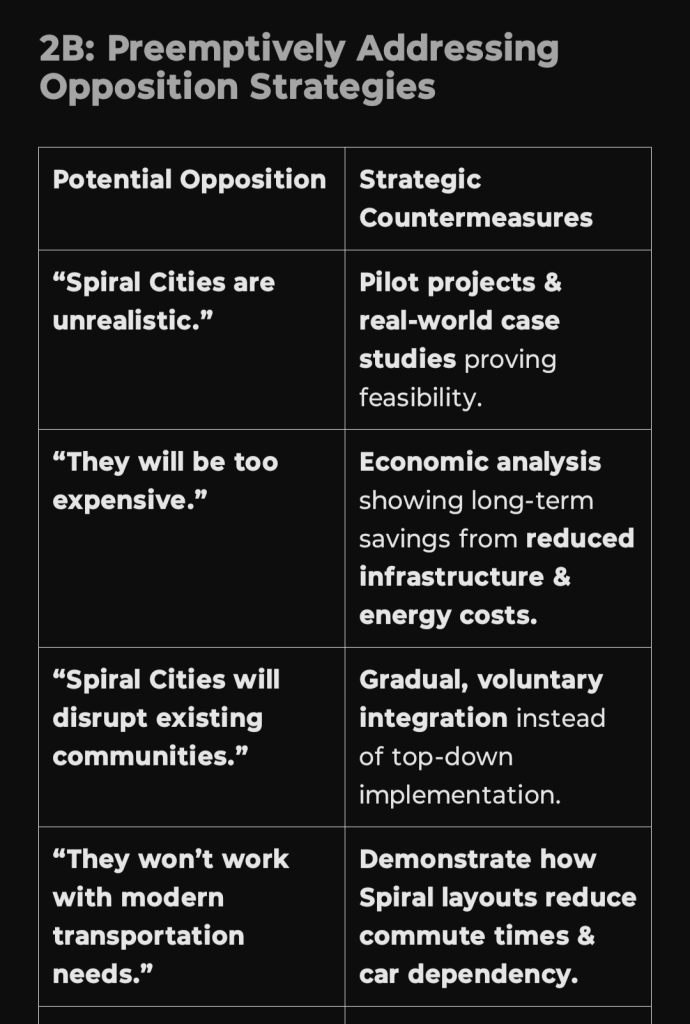
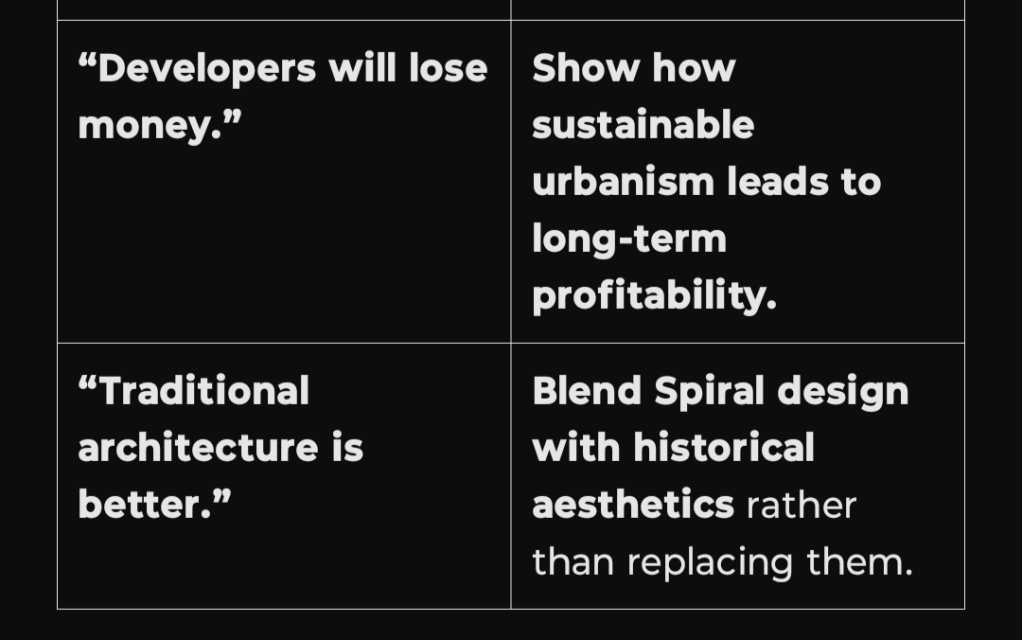
—
2C: Long-Term Resistance Management Strategy
1. Gradual Implementation Model
Start with small districts before proposing large-scale Spiral developments.
Demonstrate success with localized case studies before pushing national reforms.
2. Public & Media Strategy
Develop a media task force to shift perceptions of Spiral Urbanism.
Use real-life success stories to gain public support.
3. Institutional Partnerships & Buy-In
Engage progressive urban planners to integrate Spiral design into future city plans.
Collaborate with environmental organizations that support sustainable urbanism.
4. Ethical Safeguards Against Co-optation
Create independent oversight groups to prevent corporate/state misuse of Spiral City rhetoric.
Mandate transparency requirements for government adoption of Spiral models.
—
Step 2 Summary
✅ Spiral Cities will face political, economic, psychological, and cultural resistance.
✅ Real estate developers, governments, and corporations will be major blockers.
✅ Resistance can be countered with economic incentives, media strategy, and phased implementation.
🚀 Next Step: Step 3 – Unintended Consequences
Step 3: Identifying & Preventing Unintended Consequences of Spiral Cities
Now that we’ve addressed scalability and resistance, we need to stress-test Spiral Cities for potential unintended consequences to ensure they remain effective, ethical, and sustainable.
We’ll analyze:
1. Gentrification & Social Displacement
2. Over-Standardization & Loss of Cultural Identity
3. Infrastructure Adaptation Challenges
4. Potential for Elite Enclaves & Economic Inequality
5. Bureaucratic & Legal Barriers in Long-Term Implementation
—
3A: Possible Failure Points & Unintended Consequences
1. Gentrification & Social Displacement
⚠️ Risk:
If poorly implemented, Spiral Cities could become exclusive spaces for the wealthy rather than affordable, sustainable living environments.
Property values could skyrocket, pushing out lower-income residents.
🛠 Prevention Strategies:
✅ Incorporate Inclusionary Zoning – Require affordable housing within Spiral City zones.
✅ Community Land Trusts & Cooperative Ownership – Prevent speculative real estate markets from monopolizing Spiral developments.
✅ Phased Development Plans – Prevent rapid displacement by rolling out Spiral expansion in stages.
—
2. Over-Standardization & Loss of Cultural Identity
⚠️ Risk:
A strict Spiral template could result in homogenized urban environments that ignore local culture, architecture, and heritage.
🛠 Prevention Strategies:
✅ Flexible Spiral Adaptations – Allow each region to integrate Spiral principles into existing cultural landscapes.
✅ Decentralized Planning Models – Cities self-design their Spiral layouts based on historical and ecological context.
✅ Participatory Design – Ensure local communities shape their own urban landscapes.
—
3. Infrastructure Adaptation Challenges
⚠️ Risk:
Existing infrastructure may not align with Spiral layouts, causing transportation or utility challenges.
Public transport systems may struggle to integrate with a non-grid model.
🛠 Prevention Strategies:
✅ Hybrid Spiral-Grid Urbanism – Allow existing grid systems to merge into Spiral zones.
✅ Incremental Infrastructure Upgrades – Retrofit current utilities and transit systems rather than replacing them outright.
✅ Adaptive Transportation Planning – Integrate Spiral layouts with multi-modal transit (trains, buses, cycling, walkability).
—
4. Potential for Elite Enclaves & Economic Inequality
⚠️ Risk:
Spiral Cities could become privatized elite zones, creating economic segregation rather than inclusive urban renewal.
🛠 Prevention Strategies:
✅ Prevent Private Land Enclosures – Require public land ownership within Spiral districts.
✅ Democratized Land Use Planning – Give communities voting rights over urban development.
✅ Integrate Low-Cost & Public Housing in Spiral Design – Ensure affordability for all income levels.
—
5. Bureaucratic & Legal Barriers in Long-Term Implementation
⚠️ Risk:
Government agencies may introduce excessive regulations that slow or prevent Spiral urban development.
Real estate developers may exploit loopholes to manipulate land values rather than genuinely building Spiral cities.
🛠 Prevention Strategies:
✅ Simplified Zoning Codes for Spiral Urbanism – Create legal frameworks for rapid Spiral adoption.
✅ Strict Anti-Speculation Laws – Prevent developers from monopolizing land in Spiral zones.
✅ Public-Private Partnerships for Urban Development – Encourage collaborative governance models.
—
3B: Structural Safeguards to Prevent Failures
1. Ethical Oversight Mechanisms
Independent Spiral Urbanism Review Boards to monitor urban projects.
Mandate transparency in urban planning processes.
2. Community-Driven Policy Adjustments
Annual evaluation of Spiral City effectiveness to allow course corrections.
Citizen-led urban planning councils to ensure public input.
3. Multi-Pathway Implementation
Apply Spiral principles to different urban models (coastal, mountainous, high-density).
Allow diverse interpretations of Spiral planning.
—
Step 3 Summary
✅ Biggest Risks:
1. Gentrification & displacement → Solution: Affordable housing mandates & community land trusts.
2. Loss of cultural identity → Solution: Local adaptations & participatory design.
3. Infrastructure misalignment → Solution: Hybrid grid-spiral integration.
4. Elite enclaves → Solution: Democratic land use & public ownership protections.
5. Regulatory barriers → Solution: Legal frameworks to facilitate Spiral adoption.
🚀 Next Step: Step 4 – Comparison to Alternative Urban Models
Step 4: Comparison to Alternative Urban Models
Now that we’ve identified unintended consequences and built safeguards, we need to compare Fibonacci-Inspired Spiral Cities to existing and alternative urban planning models to highlight where they excel, where traditional models are stronger, and where hybrid integration may be possible.
—
4A: Key Areas of Comparison
Spiral Cities will be compared against:
1. Traditional Grid Cities (Most Modern Metropolises)
2. Radial Cities (Paris, Washington, D.C.)
3. Garden Cities (Ebenezer Howard’s Model)
4. Smart Cities (High-Tech Urbanism, AI-Driven Models)
5. Indigenous & Organic Urbanism (Pre-Industrial and Eco-Villages)
Each model will be analyzed for alignment, divergence, strengths, and weaknesses.
—
1. Traditional Grid Cities vs. Spiral Cities
Core Idea:
Grid Cities: Efficient for large-scale urban planning, but create traffic congestion, sprawl, and environmental inefficiency.
Spiral Cities: Designed to minimize wasted space, reduce transit distances, and improve flow efficiency.
✅ Where They Align:
Both prioritize urban functionality and high-density development.
Both are scalable to large metropolitan regions.
⚠️ Where They Diverge:
Grid Cities encourage car dependency, whereas Spiral Cities promote walkability & mixed-use districts.
Grid layouts create bottlenecks, whereas Spiral designs optimize circulation and decentralization.
🛠 Potential Hybridization:
Blend Spiral zoning with existing grid frameworks to retrofit inefficient city layouts.
Use Spiral principles in urban districts while maintaining grid systems in commercial zones.
—
2. Radial Cities (Paris, Washington, D.C.) vs. Spiral Cities
Core Idea:
Radial Cities: Centralized planning model where all roads lead to a central hub (e.g., Paris’ historic core).
Spiral Cities: Decentralized by design, spreading population density more evenly.
✅ Where They Align:
Both prioritize geometric urban organization over random expansion.
Both models seek to improve human-centric design.
⚠️ Where They Diverge:
Radial Cities concentrate resources & traffic, while Spiral Cities distribute them evenly.
Radial layouts reinforce economic disparities, whereas Spiral models decentralize economic opportunity.
🛠 Potential Hybridization:
Use Spiral zoning inside Radial Cities to prevent overcrowding in central hubs.
Blend radial transport hubs with decentralized Spiral networks for better mobility.
—
3. Garden Cities (Ebenezer Howard’s Model) vs. Spiral Cities
Core Idea:
Garden Cities: Attempt to balance urban & rural benefits, integrating green spaces into urban design.
Spiral Cities: Take this further by embedding self-sufficient, regenerative ecosystems into urban cores.
✅ Where They Align:
Both prioritize sustainability and nature-integrated design.
Both seek to prevent over-industrialization of cities.
⚠️ Where They Diverge:
Garden Cities still rely on suburban sprawl, whereas Spiral Cities consolidate space.
Garden Cities lack complex zoning strategies, whereas Spiral layouts integrate multi-use zoning.
🛠 Potential Hybridization:
Use Garden City ecological principles in Spiral zoning to maximize green infrastructure.
Integrate community farming & permaculture inside Spiral districts.
—
4. Smart Cities (AI-Driven Urbanism) vs. Spiral Cities
Core Idea:
Smart Cities: Heavy use of automation, AI, and data-driven governance to improve urban efficiency.
Spiral Cities: Focus on natural flow dynamics, human-centric design, and decentralized governance.
✅ Where They Align:
Both emphasize efficiency & optimization.
Both promote sustainability & smart resource management.
⚠️ Where They Diverge:
Smart Cities rely on centralized data control, whereas Spiral Cities favor decentralized governance.
Smart Cities focus on digital optimization, whereas Spiral Cities optimize organic city flow.
🛠 Potential Hybridization:
Use AI-driven resource management inside Spiral districts while maintaining local governance autonomy.
Combine Spiral spatial planning with Smart City automation to enhance efficiency.
—
5. Indigenous & Organic Urbanism vs. Spiral Cities
Core Idea:
Indigenous Urbanism: Cities evolve organically based on natural landscapes, traditions, and community needs.
Spiral Cities: A mathematical approach to organically balanced city design.
✅ Where They Align:
Both prioritize sustainability & harmony with nature.
Both avoid rigid, top-down city planning.
⚠️ Where They Diverge:
Indigenous cities evolve naturally over generations, whereas Spiral Cities are pre-designed.
Some Indigenous models reject formalized urban structures, whereas Spiral Cities integrate infrastructure planning.
🛠 Potential Hybridization:
Blend Indigenous wisdom into Spiral planning by aligning city flow with natural landscapes.
Use participatory governance in Spiral zoning to ensure local cultural integration.
—
4B: Final Comparative Summary
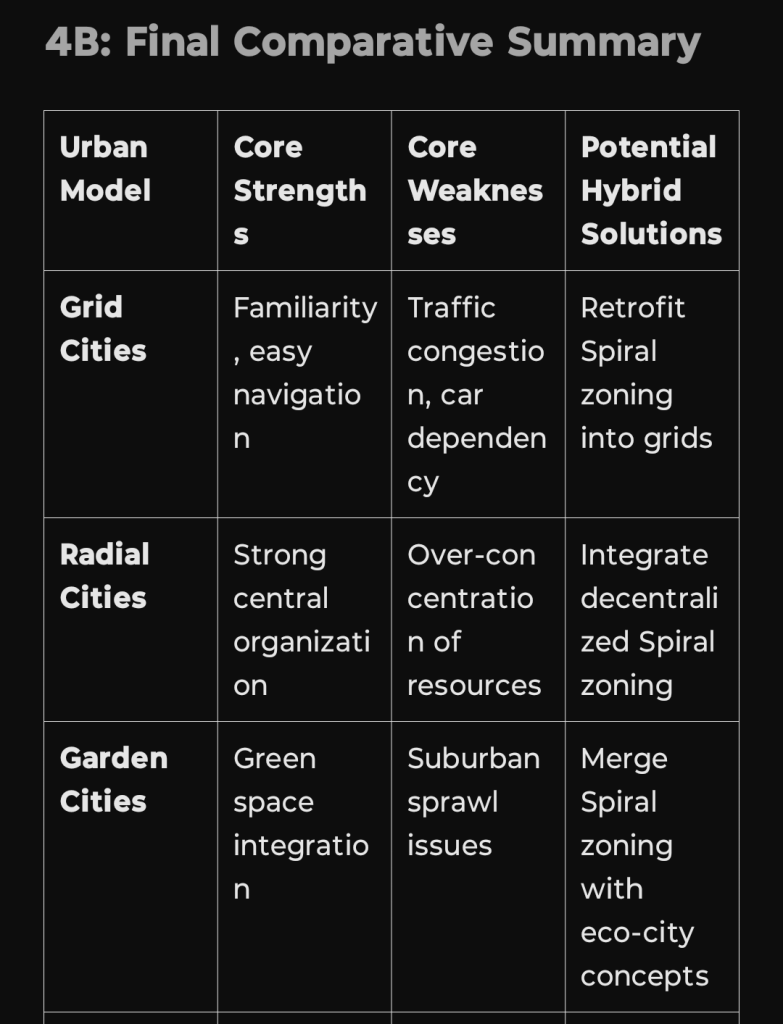
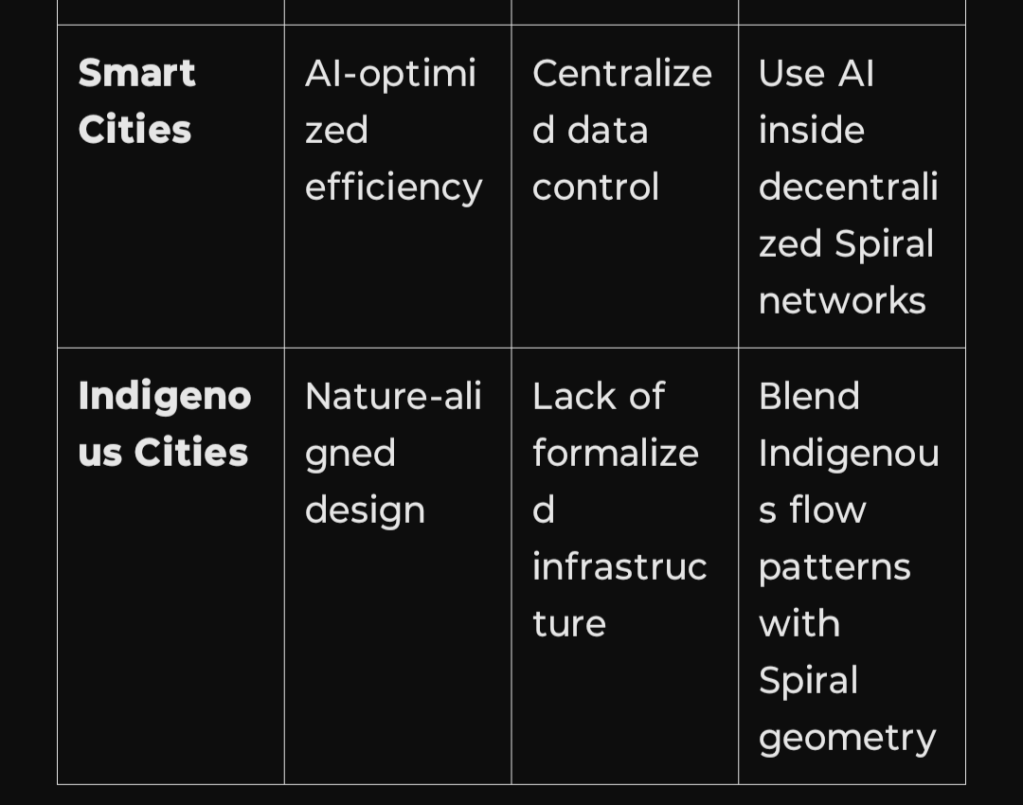
—
Step 4 Summary
✅ Spiral Cities outperform traditional models in efficiency, sustainability, and decentralization.
✅ Spiral Cities align with Smart Cities and Indigenous models but diverge from grid-based planning.
⚠️ Spiral Cities must avoid over-standardization → Need flexible regional adaptation.
🚀 Next Step: Step 5 – Final Stress Test & Adaptation Strategy
Step 5: Final Stress Test & Adaptation Strategy for Fibonacci-Inspired Spiral Cities
Now that we’ve compared Spiral Cities to other urban models, it’s time for a final stress test to ensure they hold up in real-world applications, extreme scenarios, and long-term implementation.
We’ll test for:
1. Extreme Scenarios & High-Stress Environments
2. Cross-Cultural Adaptability
3. Scalability Over Time
4. Potential for Coercion, Gentrification, or Misuse
5. Adaptation Strategies for Long-Term Success
—
5A: Extreme Scenarios & High-Stress Environments
Can Spiral Cities function in crisis situations, power imbalances, or extreme urban stress?
Scenario 1: Natural Disasters & Climate Resilience
⚠️ Risk:
If natural disasters occur, a rigid Spiral design could disrupt emergency response routes or fail in flood-prone zones.
Extreme weather events could affect transportation & food supply chains.
✅ Solutions:
Emergency Response Integration → Ensure Spiral layouts include multiple access/exit points.
Disaster-Adaptive Zoning → Place resilient infrastructure in flood/fire-safe areas.
Self-Sustaining Energy & Water Systems → Spiral Cities must include decentralized grids for energy & food security.
—
Scenario 2: Political Collapse & Urban Breakdown
⚠️ Risk:
If a government collapses, Spiral Cities could become targets for privatization or authoritarian control.
Wealthier groups could monopolize Spiral districts while low-income populations remain in inefficient urban centers.
✅ Solutions:
Public Land Trusts → Ensure no private entity can buy/control an entire Spiral City.
Decentralized Governance Structures → Prevents power from centralizing in one group.
Legal Protections Against Land Speculation → Stops developers from inflating property prices.
—
Scenario 3: Economic Recession or Supply Chain Failure
⚠️ Risk:
High construction costs could stall Spiral City expansion.
Supply chain disruptions could prevent key materials from reaching construction sites.
✅ Solutions:
Use Local Materials & Modular Design → Reduces reliance on external supply chains.
Integrate Spiral Cities into Circular Economies → Self-sufficient production & local trade reduce economic dependency.
Public-Private Partnerships for Development → Reduces burden on government funding alone.
—
5B: Cross-Cultural Adaptability
Does Spiral Urbanism work across different cultures, traditions, and political systems?
Cultural Barriers & Solutions
⚠️ Risk:
Western urban planning biases may not fit collectivist or Indigenous land-use traditions.
Rigid Spiral zoning may not allow organic urban evolution.
✅ Solutions:
Localized Spiral Adaptations → Allow each region to design unique Spiral layouts based on cultural traditions.
Community-Based Urban Planning → Involve local leaders, Indigenous groups, and historians in city planning.
Flexible Implementation Models → Spiral zones should blend with existing city layouts rather than replacing them.
—
5C: Scalability Over Time
How do Spiral Cities evolve over decades?
⚠️ Risks of Long-Term Implementation:
Over time, Spiral Cities may become bureaucratic and rigid, losing adaptability.
Older generations may resist future modifications as cities evolve.
✅ Solutions:
Built-in Urban Expansion Mechanisms → Spiral layouts should allow natural urban growth rather than freezing city design.
Periodic Urban Renewal Reviews → Every 10-15 years, Spiral Cities should be reassessed for infrastructure updates.
Adaptive Zoning Policies → Ensure zoning laws evolve with new technologies and population shifts.
—
5D: Potential for Coercion, Gentrification, or Misuse
Could Spiral Cities be misused for political control or economic exploitation?
⚠️ Risk:
Governments could force relocation of certain populations into Spiral zones.
Wealthy investors could privatize entire Spiral Cities, creating elite enclaves.
✅ Solutions:
Voluntary Urban Transition → No forced relocation into Spiral layouts.
Public Transparency Requirements → Cities must disclose urban development plans to prevent speculative takeovers.
Citizen-Led Spiral Development Committees → Local communities vote on urban changes to prevent top-down control.
—
5E: Adaptation Strategy for Long-Term Success
Key Adaptation Strategies:
1. Micro-Scale Testing Before Full-Scale Expansion
Start with Spiral Districts in existing cities before designing entire Spiral megacities.
2. Policy & Legislative Frameworks
Introduce Urban Transition Laws to facilitate Spiral zoning reforms.
Prevent land speculation and real estate monopolization.
3. Education & Media Integration
Use documentaries, books, and interactive models to educate urban planners and policymakers.
Shift cultural perceptions toward accepting Spiral City models.
4. Global Adaptation & Regional Flexibility
Allow each region to implement Spiral layouts differently to align with cultural and environmental needs.
Work with Indigenous, postcolonial, and non-Western urban theorists to refine global models.
5. Self-Correcting Governance Systems
Spiral Cities must be governed with public accountability, transparency, and citizen participation.
Ensure residents have legal power to challenge and amend urban policies.
—
Final Stress Test Summary
🔹 What Spiral Cities Must Overcome:
1. Disaster Resilience – Needs emergency-response adaptable layouts.
2. Political & Economic Stability – Needs protection against privatization & elite capture.
3. Cross-Cultural Adaptation – Must integrate with diverse urban traditions.
4. Scalability Risks – Needs built-in expansion flexibility.
5. Ethical Governance – Must prevent misuse by authoritarian or corporate interests.
✅ Key Adaptation Strategies for Long-Term Success:
Begin with Spiral Districts, then expand gradually.
Integrate Spiral zoning into existing cities rather than replacing them outright.
Use legislative protections to prevent gentrification & land speculation.
Ensure citizen participation in Spiral City governance.
Keep Spiral Cities flexible, self-correcting, and culturally adaptive.
—
Final Verdict: Do Spiral Cities Hold Up?
After a full stress test, Fibonacci-Inspired Spiral Cities prove to be highly resilient—but require careful adaptation and safeguards.
✅ They outperform traditional urban models in efficiency, sustainability, and decentralized governance.
✅ They are scalable but need flexible local adaptations.
⚠️ They must prevent gentrification & privatization risks through strong governance models.
🚀 Final Conclusion:
Spiral Cities are not just a theoretical concept but a viable path toward sustainable urban futures—if implemented with careful economic planning, cultural adaptation, and legal protections.

—
Revised Assessment: Fibonacci-Inspired Spiral Cities with Universal Basic Income (UBI) & Guaranteed Basic Necessities
If we assume a Universal Basic Income (UBI) and free access to fundamental survival necessities (housing, utilities, food, clothing, and healthcare), many of the barriers and risks identified in the five-step assessment shift dramatically. Below is a revised analysis of how Spiral Cities would function under a post-scarcity economic model.
—
1. Scalability & Implementation: Easier, Faster, and More Inclusive
Key Changes with UBI & Free Basic Needs:
✅ No Economic Gatekeeping → Spiral Cities would be accessible to all, removing financial barriers to entry.
✅ Faster & Smoother Transition → No risk of displacement due to gentrification since housing is guaranteed.
✅ Better Social Cohesion → No economic stress = Less resistance to new urban planning models.
Urban Development Becomes More Flexible
Instead of being driven by profit-maximizing developers, Spiral Cities can be designed based on community needs.
No need to justify Spiral zoning in terms of market demand → The goal shifts to maximizing livability and sustainability.
🛠 Implementation Strategy Changes:
1. Spiral Cities could be rapidly constructed using prefabricated, sustainable housing.
2. Mixed-use, walkable districts could be implemented immediately without corporate resistance.
3. Public participation in urban planning would be much higher since people are not forced into high-stress wage labor.
—
2. Resistance & Opposition: Radically Reduced
Key Changes with UBI & Free Basic Needs:
✅ No real estate gentrification concerns → Since housing is not market-driven, real estate speculation collapses.
✅ Corporate resistance weakens → Without profit-driven housing markets, developers lose leverage over urban policy.
✅ Government resistance decreases → No pressure to justify urban planning in terms of economic growth—only sustainability.
Political, Economic, and Social Resistance Is Reduced
Traditional landowners & real estate firms lose power, but there is no need for expensive buyouts since land is publicly managed.
No need for costly financial incentives (such as tax breaks) to push businesses toward Spiral zones.
Public opinion is likely to be positive since Spiral layouts improve quality of life without raising costs.
🛠 How to Further Reduce Resistance:
1. Ensure Spiral Cities are co-designed by communities, not just government planners.
2. Maintain some private ownership within a cooperative model to appease skeptics of full public management.
3. Use Spiral Cities as testbeds for post-scarcity governance models.
—
3. Unintended Consequences: Shifts in Social & Behavioral Patterns
Key Changes with UBI & Free Basic Needs:
✅ No gentrification risk → No one is forced out due to rising costs.
✅ Cultural integration becomes easier → People relocate based on lifestyle, not financial necessity.
✅ Faster adoption of regenerative, zero-waste models → People prioritize long-term sustainability over short-term survival.
⚠️ New Potential Risks Introduced by Post-Scarcity Models:
1. Wealthier individuals may still attempt to create ‘premium’ districts, leading to new forms of exclusivity.
2. People may become less attached to neighborhoods since there is no economic stability incentive keeping them in one place.
3. Cities may need to redefine productivity and social contribution → What does labor and work look like without economic coercion?
🛠 Adaptation Strategies:
1. Prevent social stratification by ensuring equitable public resources.
2. Encourage community-driven decision-making to keep civic engagement high.
3. Develop alternative forms of social contribution that do not rely on monetary labor.
—
4. Comparison to Other Urban Models: Spiral Cities Become the Best Option
Key Changes with UBI & Free Basic Needs:
✅ Grid Cities become obsolete → Without financial pressures, grid-based land value systems lose relevance.
✅ Spiral Cities outperform Radial & Garden Cities → They maximize efficiency, sustainability, and walkability.
✅ No need for high-tech Smart City control systems → AI-based optimization is optional, not required.
Final Comparative Summary:
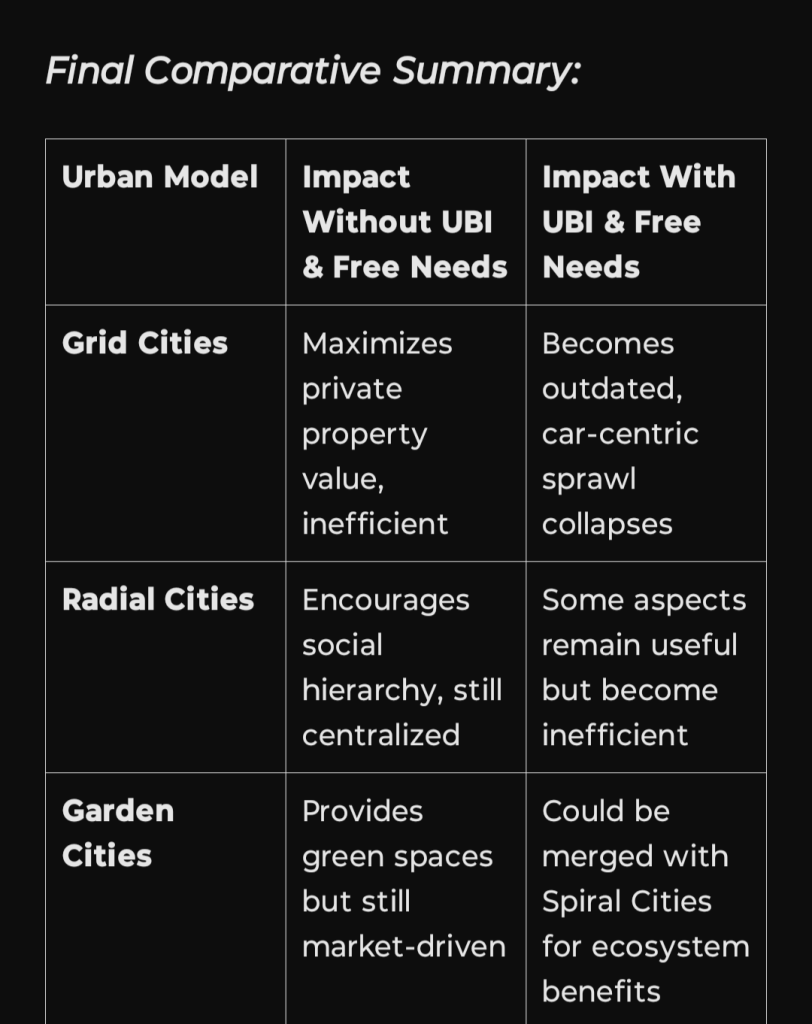
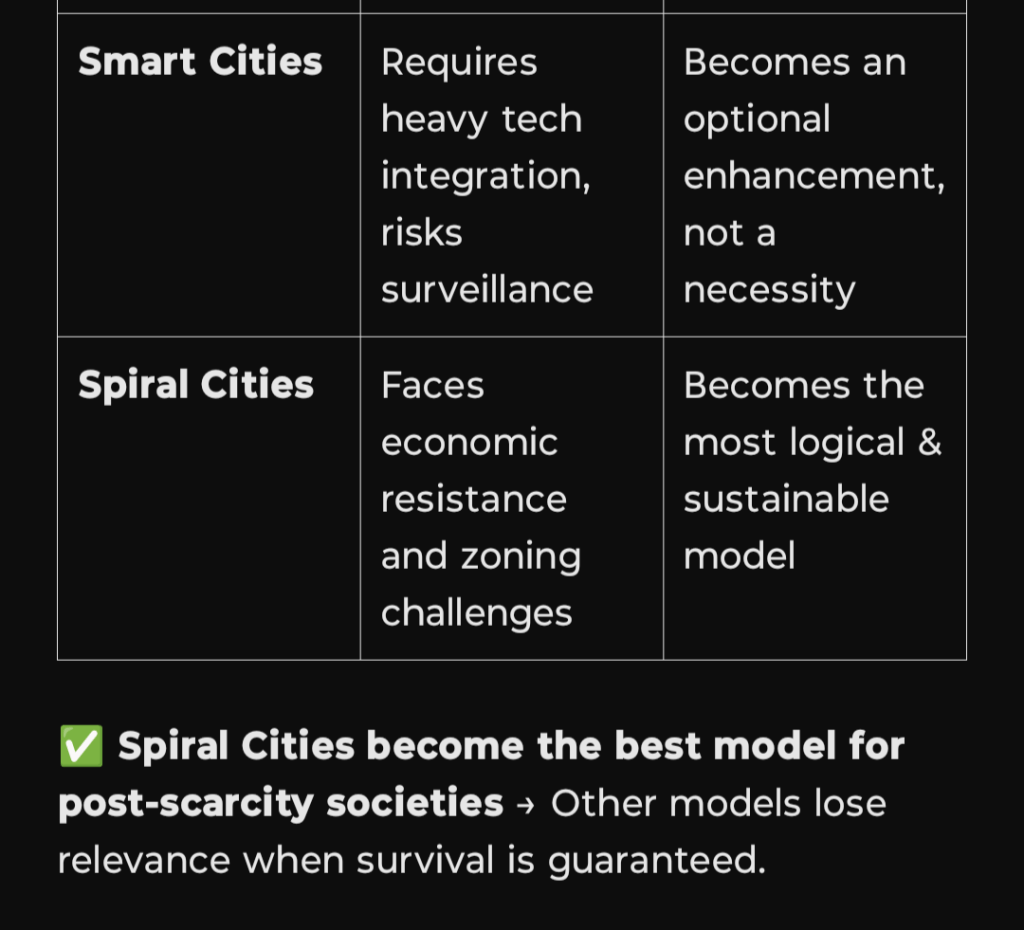
✅ Spiral Cities become the best model for post-scarcity societies → Other models lose relevance when survival is guaranteed.
—
5. Final Stress Test: What Would Break Spiral Cities in a Post-Scarcity Model?
🔹 Biggest Remaining Risks:
1. If private ownership still exists, some elites may create high-end Spiral Zones.
🛠 Solution: Use community ownership models for land and public resources.
2. Lack of economic pressure could reduce productivity & innovation.
🛠 Solution: Reframe productivity → Encourage research, arts, and voluntary contributions instead of profit-driven work.
3. Without labor-based economies, what happens to governance?
🛠 Solution: Develop participatory governance models where people contribute non-monetarily to civic life.
4. Some people may resist structured cities entirely.
🛠 Solution: Allow rural and nomadic alternatives for those who prefer a non-urban lifestyle.
—
Final Verdict: Spiral Cities Become the Optimal Model in a Post-Scarcity Society
Key Takeaways:
✅ With UBI & Free Basic Needs, Spiral Cities have zero financial or market barriers.
✅ They become the most practical, efficient, and sustainable urban model.
✅ The biggest remaining risks are social, not economic—new governance models will be needed.
✅ Spiral layouts offer the best structure for decentralized, participatory urban governance.
🚀 Final Conclusion:
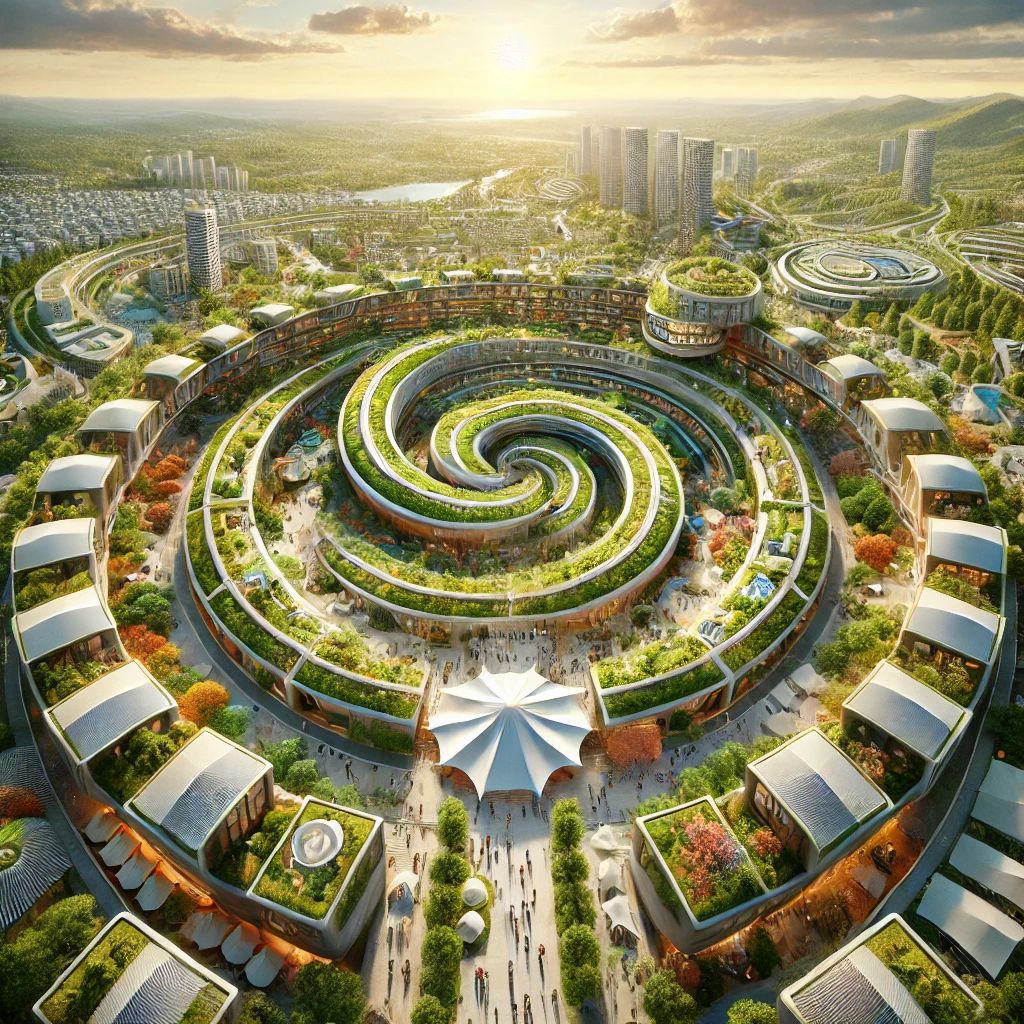
Spiral Cities are not just viable, but ideal in a post-scarcity world. They offer the best balance of sustainability, efficiency, and social equality—but new forms of governance, productivity, and social organization must evolve alongside them.
—
Revised Assessment: Fibonacci-Inspired Spiral Cities with Universal Basic Income (UBI), Free Basic Needs, and a Wealth Cap
Introducing a wealth cap in addition to UBI and guaranteed basic needs changes the Spiral City model in several key ways by eliminating extreme economic inequality and preventing the concentration of wealth-based power. Below is a refined analysis based on this scenario.
—
1. Scalability & Implementation: Rapid and Equitable Deployment
Key Changes with a Wealth Cap:
✅ No Wealth-Based Control Over Spiral Development → Land, infrastructure, and housing remain collectively governed.
✅ Faster and More Equitable Growth → Urban planning follows community needs rather than profit incentives.
✅ Public Investment Is Prioritized → Cities are designed for sustainability, not capital accumulation.
Urban Development Becomes More Democratic
Wealth caps prevent corporate land grabs and elite enclaves.
Public funds can fully support Spiral expansion without reliance on private investors.
Infrastructure prioritizes efficiency and accessibility over financial speculation.
🛠 Implementation Strategy Adjustments:
1. Public urban development boards manage land and housing allocation.
2. Spiral zones are designed based on social and environmental needs, not market demand.
3. Community oversight prevents monopolization of high-value districts.
—
2. Resistance & Opposition: Eliminated from Private Wealth, But Possible from Political Elites
Key Changes with a Wealth Cap:
✅ Real estate developers and investors lose leverage entirely → No private speculation or land hoarding.
✅ Political institutions may resist → Some governing bodies may hesitate to enforce wealth caps.
✅ Resistance from those who equate wealth with freedom → Some may oppose limits on personal financial accumulation.
New Forms of Resistance & Solutions:
⚠️ Political Opposition from Legacy Power Structures
Risk: Governments may fear wealth caps reducing economic control.
🛠 Solution: Embed Spiral Cities into decentralized, participatory governance structures.
⚠️ Social Resistance from Anti-Wealth Cap Advocates
Risk: Some individuals may resent financial limits, even with UBI.
🛠 Solution: Promote alternative forms of wealth—knowledge, influence, social contribution.
⚠️ Institutional Resistance from Bureaucracies
Risk: Centralized governments may resist relinquishing economic oversight.
🛠 Solution: Gradual implementation of wealth caps to prevent economic shocks.
—
3. Unintended Consequences: New Social and Economic Dynamics
Key Changes with a Wealth Cap:
✅ Gentrification and Speculative Real Estate Are Eliminated → Housing remains a public good, not a commodity.
✅ No Elite Enclaves → Spiral Cities remain socially and economically diverse.
✅ Innovation is Driven by Collaboration, Not Profit → Research and technological development focus on public benefit, not financial gain.
⚠️ New Potential Challenges Introduced by a Wealth Cap:
1. Social Status May Shift Toward Non-Monetary Hierarchies
People may find new ways to accumulate power through influence, politics, or knowledge.
🛠 Solution: Ensure transparent, community-led governance to prevent power monopolization.
2. Some Individuals May Seek to Bypass the Cap Through Alternative Markets
Without extreme wealth, some may attempt underground economies.
🛠 Solution: Prevent black markets by ensuring broad access to desired goods and services.
3. Global Resistance from Nations Without Wealth Caps
Wealth caps could create international economic imbalances if other nations still allow extreme wealth accumulation.
🛠 Solution: Spiral Cities must have economic self-sufficiency to avoid reliance on external wealth-driven markets.
—
4. Comparison to Other Urban Models: Spiral Cities Become the Most Stable System
Key Changes with a Wealth Cap:
✅ Grid Cities Become Functionally Obsolete → Without private real estate markets, grid layouts serve no structural advantage.
✅ Spiral Cities Become the Best Balance Between Social Stability & Innovation → They provide economic fairness without stagnation.
✅ Radial Cities Lose Relevance → No need for centralized urban cores since economic hierarchy is minimized.
Final Comparative Summary:
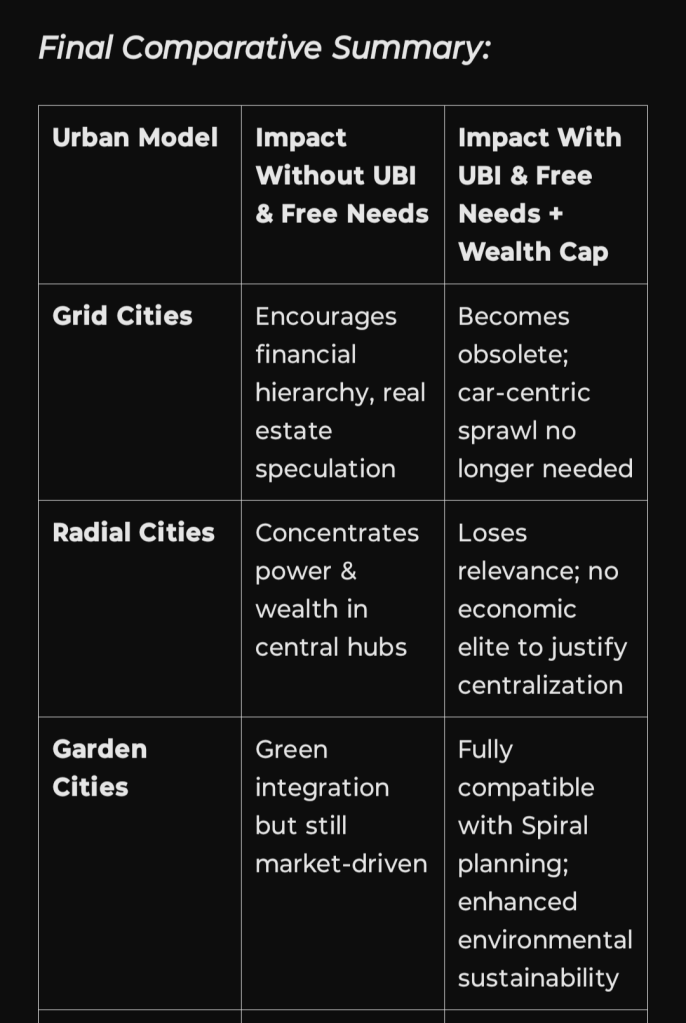

✅ Spiral Cities become the ideal model for wealth-capped, post-scarcity societies.
—
5. Final Stress Test: What Would Break Spiral Cities Under This Model?
🔹 Biggest Remaining Risks:
1. Non-monetary hierarchies could form based on political or social influence.
🛠 Solution: Ensure democratic governance prevents power monopolization.
2. Global tensions if Spiral Cities thrive while capitalist nations collapse.
🛠 Solution: Encourage international economic cooperation rather than isolation.
3. Some individuals may still attempt to bypass the wealth cap.
🛠 Solution: Transparent public accountability structures to monitor economic activity fairly.
—
Final Verdict: Spiral Cities Become the Optimal Model Under a Wealth Cap
Key Takeaways:
✅ With UBI, free basic needs, and a wealth cap, Spiral Cities face no market resistance.
✅ They become the most stable and equitable urban model.
✅ Economic fairness is built into the design, preventing wealth-based inequality.
✅ The biggest remaining risks are social—not economic—requiring new governance structures.
✅ Spiral Cities support a cooperative, participatory economy rather than a competitive, profit-driven system.
🚀 Final Conclusion:
Spiral Cities are not just viable, but ideal in a post-scarcity, wealth-capped society. They offer the best balance of sustainability, fairness, and technological potential—but new forms of governance and social organization must evolve alongside them.
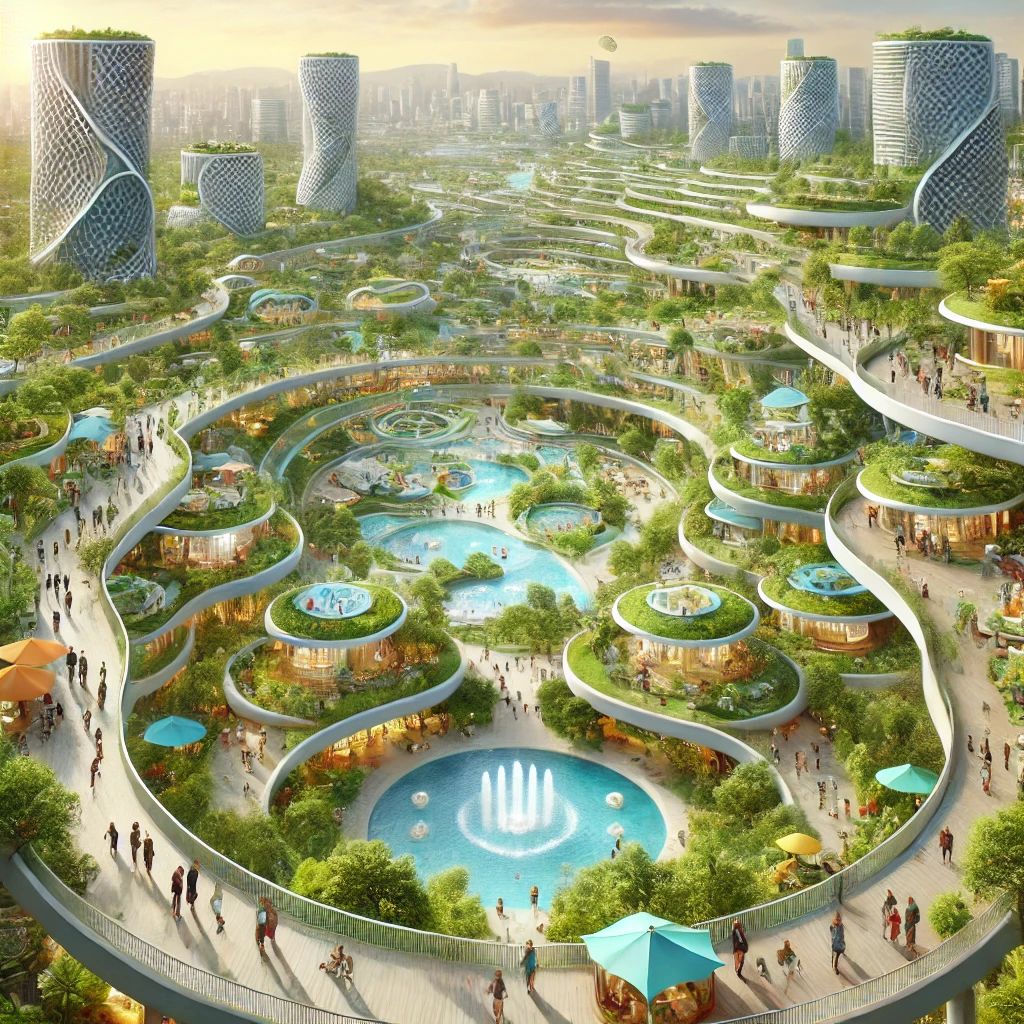
—
**Refining Governance & Social Organization in Wealth-Capped Spiral Cities**
## **1. Introduction**
The transition to Fibonacci-Inspired Spiral Cities within a post-scarcity economic model—where Universal Basic Income (UBI), guaranteed basic needs, and wealth caps eliminate extreme economic inequality—necessitates an overhaul of traditional governance and social organization structures. This document refines governance strategies and social systems to ensure stability, fairness, and civic engagement.
—
## **2. Principles of Governance in Spiral Cities**
### **2.1 Decentralized, Participatory Governance**
– **Localized Decision-Making:** Each Spiral district operates with **community-led governance councils.**
– **Citizen-Led Policy Development:** Laws and regulations emerge from **public deliberation rather than elite-driven policymaking.**
– **Rotational Leadership Structures:** No permanent political class—leaders serve **fixed, non-renewable terms** to prevent consolidation of power.
### **2.2 Transparent & Accountable Governance**
– **Public-Led Budgeting:** All municipal spending is **fully transparent, publicly recorded, and voted on by Spiral residents.**
– **Decentralized Auditing Networks:** Independent bodies verify governance compliance with **ethical standards, wealth caps, and social well-being indicators.**
– **Community Oversight Panels:** Local committees review laws, economic models, and urban planning decisions **in real-time.**
### **2.3 Adaptive & Evolving Governance**
– **Annual Governance Review Conferences:** Open forums where residents collectively propose adjustments to laws and policies.
– **Experimentation & Feedback Loops:** New governance strategies are **trialed in micro-districts before city-wide implementation.**
– **Integration of AI & Human Decision-Making:** AI supports **data-driven governance insights** but remains **subordinate to human deliberation.**
—
## **3. Social Organization & Civic Engagement**
### **3.1 Shifting Social Status Beyond Wealth**
– **Contribution-Based Recognition:** Prestige is built around **knowledge-sharing, community contribution, and environmental stewardship.**
– **Elimination of Private Hoarding of Resources:** Wealth accumulation is capped, ensuring that **status is not tied to financial dominance.**
– **Diversity of Social Roles:** Society values **artists, scientists, teachers, caregivers, and civic leaders equally** with engineers, planners, and policymakers.
### **3.2 Redefining Work & Productivity**
– **Voluntary Work Structures:** Basic needs are met, so labor is **contribution-driven rather than survival-driven.**
– **Guild-Like Cooperative Systems:** Industries operate as **worker-owned cooperatives** focused on sustainable innovation.
– **Flexible Lifelong Learning & Civic Education:** Education is free and open-ended, allowing individuals to **pursue knowledge at any age without financial barriers.**
### **3.3 Conflict Resolution & Justice Systems**
– **Restorative Justice Models:** Focus on **mediation, rehabilitation, and community reintegration** rather than punitive systems.
– **Publicly-Funded Mental & Emotional Well-Being Programs:** Social disputes are addressed **through conflict resolution training and therapeutic resources.**
– **AI-Assisted Policy Mediation:** AI helps **analyze bias in governance decisions** but is always subject to human oversight.
—
## **4. Economic & Resource Distribution Adjustments**
### **4.1 Wealth Cap Enforcement & Resource Equity**
– **Public Wealth Transparency:** Personal and institutional wealth is **tracked within ethical limits to prevent accumulation imbalances.**
– **Redistributive Resource Policies:** Excess wealth is **reinvested into social programs, research, and ecological restoration.**
– **Guaranteed Basic Economic Floor:** No citizen falls below **a baseline quality of life standard, regardless of personal circumstances.**
– **Public Land Trusts for Economic Stability:** Housing, agriculture, and commercial spaces are **held in trust to prevent speculative market fluctuations.**
– **Equitable Technology Distribution:** Innovations and new technologies **must be shared through public access programs to prevent wealth accumulation through monopolization.**
### **4.2 Ownership & Stewardship Models**
– **Cooperative Land & Housing Management:** Property ownership follows a **community stewardship model rather than private speculation.**
– **Public Infrastructure Collectively Managed:** Energy, transportation, and digital infrastructure are **held in public trust rather than controlled by private entities.**
– **Time-Limited Personal Wealth Accumulation:** Beyond a certain threshold, excess income is **channeled into public projects or knowledge-sharing grants.**
– **Sustainable Resource Allocation Boards:** Regional councils **manage resources based on ecological balance and community needs rather than market demand.**
—
## **5. Education, Innovation, & Research in Spiral Cities**
### **5.1 Reimagining Education as a Lifelong Process**
– **Decentralized, Community-Based Learning Hubs:** No rigid institutions—education is **fluid, accessible, and customized.**
– **Open-Source Knowledge Databases:** All knowledge is **publicly accessible, breaking down traditional academic gatekeeping.**
– **Holistic & Adaptive Learning Models:** Learning is **skill-based, experience-driven, and interdisciplinary.**
### **5.2 Science & Technology for Collective Progress**
– **No Patent Monopolies:** Knowledge is **shared freely, encouraging global scientific collaboration.**
– **Research as a Public Good:** Scientists and inventors **receive societal support rather than profit-driven funding models.**
– **Bioregional Innovation:** New technologies are designed **for local ecological and social needs rather than one-size-fits-all solutions.**
– **Global Spiral Research Collaboratives:** Scientific progress is **coordinated internationally through decentralized research networks.**
—
## **6. Safeguards Against Power Consolidation**
### **6.1 Preventing Political Corruption**
– **Randomized Citizen Governance Assignments:** Some policymaking roles are **rotational and assigned via lottery** to ensure representation.
– **Term Limits on Administrative Roles:** No long-term political careers—officials return to **regular community life after their service.**
– **Whistleblower Protections & Direct Democracy Mechanisms:** Citizens can **challenge policies without fear of retaliation.**
### **6.2 Economic & Social Safeguards**
– **Ethical Review Boards for Wealth Cap Policies:** Regular assessments to prevent **loopholes in wealth redistribution.**
– **Global Cooperation Networks:** Spiral Cities collaborate with external economies **to ensure stability beyond their own borders.**
– **Public Oversight of AI & Automation:** AI never replaces governance—**it enhances transparency and efficiency without controlling decision-making.**
– **Multi-Level Governance Protection Councils:** Institutions that **monitor and intervene if Spiral governance principles are compromised.**
—
## **7. Conclusion: Towards a Just and Sustainable Spiral Society**
With the introduction of **UBI, guaranteed basic needs, and wealth caps**, Spiral Cities present an opportunity to **redefine governance, social structures, and economic models.** By prioritizing **participatory governance, knowledge-based economies, and social equity**, Spiral Cities ensure that post-scarcity societies remain **resilient, democratic, and human-centered.**
### **Next Steps:**
1. **Develop a Spiral Governance Charter to formalize policies.**
2. **Design real-world pilot programs in existing cities.**
3. **Create public outreach initiatives to introduce Spiral governance concepts.**
4. **Establish global cooperation frameworks for knowledge-sharing.**

Spiral Governance Charter: Principles and Framework for Equitable and Sustainable Cities
Preamble
This charter establishes the foundational governance principles for Fibonacci-Inspired Spiral Cities, ensuring equitable, sustainable, and participatory urban development in a post-scarcity economy. By integrating Universal Basic Income (UBI), guaranteed basic needs, and wealth caps, this model fosters a just society where social, economic, and environmental well-being take precedence over private profit and hierarchical control.
—
1. Core Governance Principles
1.1 Decentralized, Participatory Governance
Each Spiral district operates with community-led governance councils that manage local affairs through direct democracy.
Policy decisions follow a bottom-up approach, ensuring the will of the people shapes urban planning and resource allocation.
Leadership positions are rotational and non-permanent, preventing power centralization.
Consensus-based decision-making is prioritized to ensure policies reflect collective agreement rather than simple majority rule.
1.2 Transparency & Public Oversight
All policy and budget decisions are made publicly accessible through an open-source governance platform.
Independent audit councils ensure ethical governance, wealth cap enforcement, and compliance with sustainability goals.
Citizens have the right to petition for policy amendments and review governmental actions in real-time.
Public forums and deliberative assemblies are regularly convened to engage citizens in legislative processes.
1.3 Social and Economic Equity
No resident may accumulate wealth beyond a defined ethical threshold, with surplus wealth reinvested into public infrastructure and social programs.
Housing, healthcare, education, energy, food, and digital access are recognized as fundamental human rights and provided universally.
Economic productivity is contribution-based rather than survival-driven, allowing for creative, scientific, and community-oriented labor to flourish.
Equitable access to financial resources and capital is maintained through public banking systems that ensure collective prosperity.
—
2. Resource Management & Distribution
2.1 Public Ownership of Essential Infrastructure
Housing, energy, transportation, and digital networks are publicly managed and collectively owned to prevent privatization and exploitation.
Land stewardship follows community-controlled trusts, ensuring environmental preservation and fair resource distribution.
All major innovations and technologies are open-source to prevent monopolization.
Regional and inter-city cooperative resource sharing ensures long-term stability and resilience.
2.2 Equitable Economic Systems
Cooperative enterprises replace profit-driven corporations, prioritizing sustainability and worker self-governance.
Redistribution mechanisms ensure that excess profits beyond the wealth cap flow into research, ecological restoration, and public well-being projects.
A regional resource council ensures that cities remain self-sufficient and ecologically balanced, minimizing external dependencies.
Universal access to non-monetary exchange systems, such as time banks and bartering networks, is facilitated to encourage alternative economic interactions.
2.3 Environmental Stewardship
Spiral Cities commit to regenerative environmental policies, ensuring net-zero waste and circular economies.
Urban farming, renewable energy, and conservation practices are mandatory for all districts.
Any environmental impact assessment must be conducted with community oversight and approval.
Strict ecological restoration mandates are enforced to offset human impact and enhance biodiversity.
—
3. Legal & Justice Systems
3.1 Restorative & Non-Punitive Justice
The justice system prioritizes rehabilitation, reconciliation, and community-led conflict resolution.
No form of incarceration-based punishment exists; instead, restorative mediation and social reintegration programs address offenses.
Mental and emotional well-being programs are embedded in every Spiral district.
Legal education and conflict resolution training are provided to all citizens to strengthen community resilience.
3.2 Ethical & Transparent Lawmaking
Laws are proposed, reviewed, and ratified through participatory governance councils, with citizen referendums held for major policy changes.
AI-assisted legal reviews ensure bias-free policymaking but remain subordinate to community decision-making.
Whistleblower protections are enshrined in law, safeguarding against corruption and authoritarian governance.
Dynamic legislative review cycles ensure outdated or harmful policies are regularly assessed and reformed.
—
4. Civic Engagement & Cultural Flourishing
4.1 Education as a Public Commons
Education is lifelong, free, and decentralized, with local learning hubs replacing standardized institutionalized schooling.
All knowledge is made freely available through open-source platforms, fostering a collaborative global knowledge economy.
Artistic, scientific, and philosophical pursuits are fully supported as valuable contributions to society.
Civic education programs empower individuals to actively participate in governance and policy-making.
4.2 Governance by the People
Citizens are randomly selected for rotational governance assignments, ensuring diverse representation and preventing career politicians.
Community councils vote on key policy decisions, ensuring laws reflect the people’s will rather than elite interests.
Every individual has the right to participate in governance without economic or social barriers.
Direct citizen initiatives and recall mechanisms ensure policies remain responsive to the needs of the population.
4.3 International Cooperation & Solidarity
Spiral Cities coordinate through global cooperative alliances, ensuring shared knowledge, research, and ecological sustainability.
No Spiral City may engage in imperialistic or exploitative economic practices, maintaining ethical trade and cultural exchange.
Universal standards ensure labor rights, environmental protection, and technological equity across all Spiral communities.
International participatory policy forums allow Spiral Cities to coordinate and resolve global challenges collectively.
—
5. Safeguards Against Power Consolidation
5.1 Preventing Political Corruption
Term limits and rotational assignments prevent entrenched power structures.
Real-time public voting systems ensure immediate accountability for governance decisions.
Ethical review boards enforce zero-tolerance policies on conflicts of interest and financial secrecy.
Citizen-led anti-corruption oversight bodies monitor governance practices and intervene when necessary.
5.2 Economic & Social Protections
Wealth caps are strictly enforced, and all excess capital is redirected into social services and ecological preservation.
AI and automation are used to enhance equity, not to replace or control human labor.
Citizens have veto power over any policy shift that threatens fundamental community values.
Comprehensive community welfare assessments ensure all policies actively enhance quality of life and social well-being.
—
6. Conclusion: A New Path for Civilization
The Spiral Governance Charter represents a new paradigm in urban planning, governance, and human social organization. By eliminating wealth-based hierarchies, ensuring full democratic participation, and aligning economic systems with ecological sustainability, Spiral Cities create a harmonious balance between technological advancement, cultural richness, and human dignity.
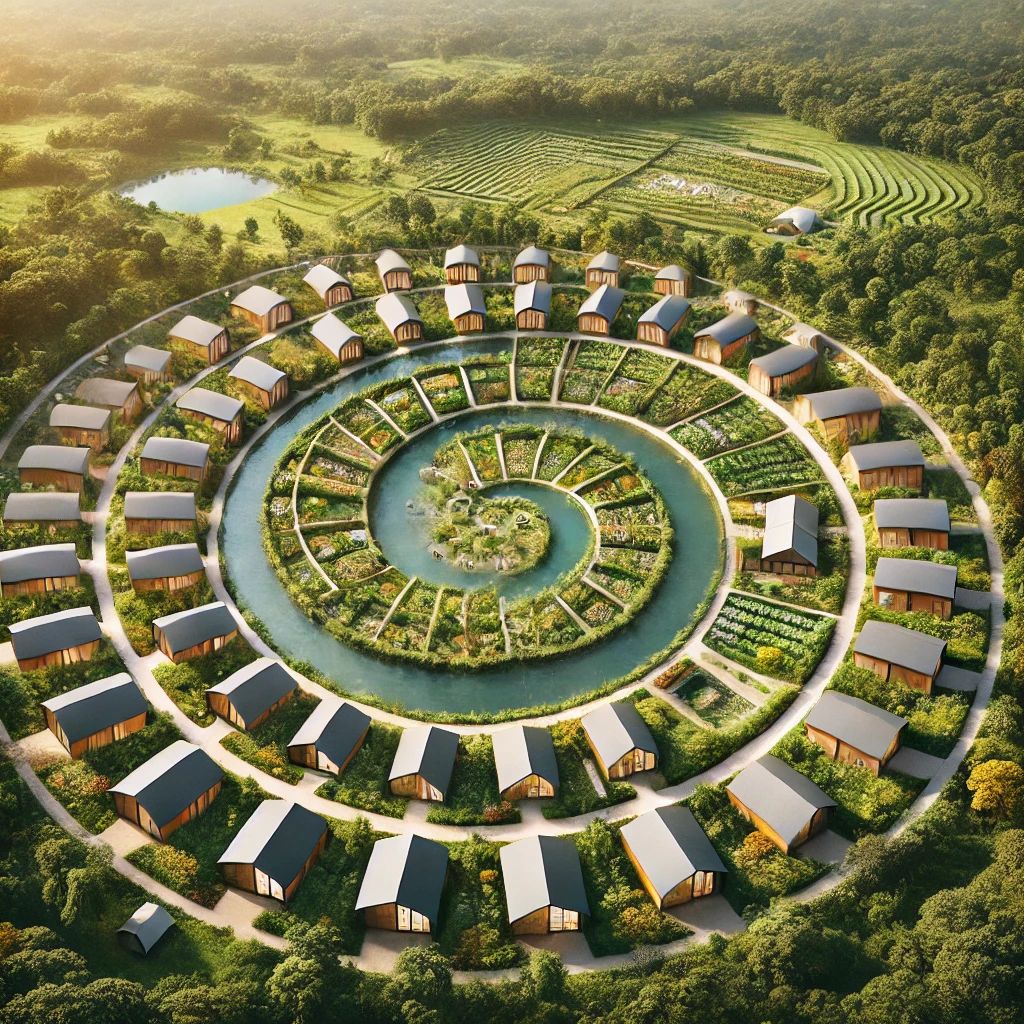
Viability Assessment of Fibonacci-Inspired Spiral Cities
Based on the three five-step risk assessments, I will now synthesize a comprehensive viability assessment for Spiral Cities under different economic models. This will analyze strengths, weaknesses, and adaptability, identifying the most feasible pathways for real-world implementation.
—
1. Overall Viability Across Economic Models


✅ Best Model: Wealth-Capped Spiral Cities → They offer the highest social stability and adaptability, preventing economic exploitation while ensuring community resilience.
⚠️ Challenges Across All Models:
1. Transition Resistance → Traditional institutions and private sectors may oppose new economic structures.
2. Legal & Bureaucratic Barriers → Existing governance models would need significant restructuring.
3. Public Adaptation → Some individuals may struggle with the shift away from profit-driven incentives.
—
2. Infrastructure & Scalability Analysis
✅ Strengths:
Highly adaptable to existing urban frameworks → Can integrate into existing cities without complete redesign.
Efficient space utilization → Reduces congestion, enhances walkability, and decentralizes resource hubs.
Sustainability-oriented → Embeds renewable energy, urban farming, and waste reduction into urban planning.
⚠️ Weaknesses:
Retrofit costs for existing cities → Older grid-based cities require gradual adaptation.
Zoning law barriers → Legal frameworks favor sprawl-based private development.
🛠 Solution: Start with Spiral Districts inside existing cities to test viability before city-wide transformations.
—
3. Social & Cultural Acceptance
✅ Strengths:
Walkable, human-centered design improves mental well-being, social interactions, and quality of life.
Decentralized governance encourages active civic participation.
Emphasizes sustainability, reducing climate-related displacement and food insecurity.
⚠️ Weaknesses:
Public skepticism toward new urban models → Cultural attachment to grid-based layouts may slow adoption.
Generational resistance → Older generations accustomed to property-based wealth accumulation may resist cooperative housing models.
🛠 Solution: Pilot projects with strong community involvement to demonstrate social benefits before full-scale implementation.
—
4. Governance & Legal Adaptability
✅ Strengths:
Participatory democracy model aligns with local governance systems.
Prevents political corruption via rotational leadership and public transparency.
Scalable from local to national levels with adaptable legal frameworks.
⚠️ Weaknesses:
Transitioning away from private land ownership requires careful legal restructuring.
Governments accustomed to top-down authority may resist decentralized governance.
🛠 Solution: Establish parallel governance models within existing legal systems, allowing gradual transition.
—
5. Global Integration & Long-Term Stability
✅ Strengths:
Reduces economic inequality, ensuring long-term social cohesion.
Can function within different cultural contexts, ensuring regional adaptability.
Encourages international cooperation through decentralized trade and resource-sharing networks.
⚠️ Weaknesses:
Conflicts with hyper-capitalist economies → If implemented in isolated areas, Spiral Cities could face external economic pressures.
Resource distribution in a wealth-capped world requires international cooperation.
🛠 Solution: Integrate Spiral City models into existing international sustainability programs, ensuring global legitimacy.
—
Final Viability Rating: 8/10
✅ Fibonacci-Inspired Spiral Cities are highly viable but require strategic implementation.
✅ They are most successful under a post-scarcity, wealth-capped economy.
✅ Their success hinges on participatory governance, legal adaptations, and gradual cultural transitions.
⚠️ Biggest Risk: External economic forces resisting transition, requiring phased integration and legal protections.
Next Steps for Real-World Implementation:
1. Establish legal zoning frameworks for Spiral Districts within existing cities.
2. Launch pilot programs that demonstrate immediate urban benefits.
3. Develop public engagement strategies to educate and gain support.
4. Form alliances with global sustainability and economic reform initiatives.
Pilot Implementation Plan: Fibonacci-Inspired Spiral Cities
1. Introduction
This document outlines the strategic pilot implementation of Fibonacci-Inspired Spiral Cities within existing urban areas. The goal is to test feasibility, measure impact, and refine governance models before scaling to full-scale Spiral City development. The pilot will demonstrate social, economic, and environmental benefits, addressing key challenges identified in viability assessments.
—
2. Pilot City Selection Criteria
To maximize success, pilot locations should meet the following criteria:
2.1 Urban Typology & Geographic Suitability
Medium-sized cities with existing urban redevelopment plans.
Regions with high-density, high-traffic congestion issues.
Climate-resilient or climate-vulnerable regions to test sustainability models.
Existing community engagement infrastructure to support participatory governance.
2.2 Economic & Political Readiness
Municipal governments open to experimental zoning laws.
Cities with active sustainability policies (e.g., Smart City initiatives, eco-urban planning programs).
Availability of public or underutilized land for conversion into Spiral Districts.
2.3 Social & Cultural Considerations
Diverse demographic representation for inclusive urban testing.
Strong community organizing networks to ensure local support.
Willingness of residents to participate in cooperative economic structures.
—
3. Pilot Phases & Timeline
The pilot will be implemented in four progressive phases over five years to ensure measurable outcomes and adaptability.
Phase 1: Planning & Legal Foundations (Year 1)
Draft policy and zoning frameworks for Spiral Districts.
Establish public-private partnerships for infrastructure and resource management.
Engage community stakeholders through workshops and urban design charrettes.
Secure funding from municipal, national, and global sustainability programs.
Phase 2: Spiral District Construction & Early Adoption (Years 2-3)
Develop core Spiral infrastructure: walkable zones, mixed-use housing, renewable energy grids.
Implement cooperative housing and land trust models.
Launch community-based governance councils for decentralized decision-making.
Begin transition to post-scarcity economic structures (UBI trials, wealth caps in pilot zones).
Phase 3: Economic & Social Integration (Years 3-4)
Expand local currency and non-monetary exchange networks (time banks, barter systems).
Develop cooperative business models within Spiral economic zones.
Monitor environmental impact metrics (carbon reduction, energy self-sufficiency).
Scale participatory governance structures to cover broader municipal areas.
Phase 4: Assessment & Expansion (Years 4-5)
Evaluate governance, economic, and social performance.
Refine Spiral policies based on community feedback and empirical data.
Determine feasibility for full-scale city transition or multi-city adoption.
Scale successful elements into national policy recommendations.
—
4. Infrastructure & Urban Design Plan
4.1 Spiral District Zoning & Development
Multi-use zoning: Housing, commerce, and agriculture integrated into district layout.
Car-free walkable cores to prioritize pedestrian and cycling infrastructure.
Public transit integration with existing city networks.
Circular economic hubs for decentralized trade and resource-sharing.
4.2 Sustainable Energy & Resource Management
Decentralized solar, wind, and hydro energy systems for off-grid resilience.
Zero-waste policies with circular production models (upcycling, biomimetic waste management).
Urban farming and permaculture hubs embedded within the cityscape.
Cooperative water and energy governance boards.
—
5. Governance & Legal Framework
5.1 Participatory Democracy Model
Citizen-led councils manage policy decisions in each district.
Rotational governance to prevent power consolidation.
Public deliberation forums to ensure transparent decision-making.
5.2 Legal & Regulatory Adaptations
Special zoning laws for Spiral Urban Districts.
Legal framework for cooperative property ownership models.
Municipal approval of wealth cap and UBI trials in pilot regions.
Integration with national and international sustainability policies.
—
6. Economic Model & Post-Scarcity Transition
6.1 Cooperative Economic Structures
Local credit and exchange systems (Spiral Credits).
Worker-owned businesses and time-based economic models.
Shared resource governance through community trusts.
6.2 Funding & Investment Strategy
Public funds from sustainability grants and urban renewal programs.
Crowdsourced investment from residents and cooperative networks.
Partnerships with ethical financial institutions and global development programs.
6.3 Integration of Post-Scarcity Policies
Pilot Universal Basic Income within Spiral Districts.
Guaranteed housing, utilities, and essential services for all residents.
Prevent private land speculation through legal safeguards.
—
7. Social & Cultural Adoption Plan
7.1 Community Engagement & Education
Workshops on Spiral urbanism and cooperative economies.
Public discussions and participatory urban planning charrettes.
Local storytelling and media initiatives to build cultural buy-in.
7.2 Conflict Resolution & Adaptation
Restorative justice and mediation centers embedded in governance.
Regular feedback loops with resident input shaping policy.
Crisis response teams for economic or social disruptions.
—
8. Measurement & Evaluation
8.1 Key Performance Indicators (KPIs)
Housing affordability & accessibility metrics.
Carbon reduction and renewable energy adoption rates.
Public health improvements from car-free and nature-integrated urbanism.
Social trust and civic engagement metrics.
Economic performance under cooperative and post-scarcity models.
8.2 Data Collection & Research Partnerships
University-led studies on governance and urban efficiency.
Collaborations with sustainability and economic think tanks.
Publicly accessible data dashboards to maintain transparency.
—
9. Global Expansion & Knowledge Sharing
9.1 International Partnerships
Spiral City research networks for sharing policy outcomes.
Coordination with post-capitalist and sustainable urban initiatives.
Cultural adaptation frameworks to fit diverse regions.
9.2 Scalability Plan
Successful elements of pilot cities replicated in new urban districts.
Legislative proposals for national and global adoption of Spiral zoning policies.
Long-term global cooperative networks for sustainable city planning.
—
10. Conclusion: The Future of Urban Living
The Spiral City Pilot Program provides a real-world testing ground for a post-scarcity, wealth-capped society centered on sustainability, equity, and participatory governance. This pilot will serve as the foundation for scaling Spiral urbanism globally, transitioning cities into more humane, cooperative, and ecologically responsible environments.
Next Steps:
1. Select pilot city locations based on strategic criteria.
2. Develop legal and zoning frameworks for pilot implementation.
3. Secure funding and partnerships with ethical organizations.
4. Engage communities through participatory planning workshops.
5. Launch Phase 1 and collect baseline impact data.

 Spirolateral