Policy Roadmap Groups & Their Color Representation
The policy roadmap is divided into five thematic groups, each color-coded to represent its core focus. Below is a detailed description of each group and why these reforms are categorized together.
—
🔴 Trauma-Informed Governance (Red)
Core Focus:
Policies that acknowledge and address systemic trauma through social structures, justice reform, and caregiving policies.
Shifts governance from punitive control to healing and co-regulation.
Key Policies:
1. Universal Parental Leave → Ensures secure attachment and early childhood well-being.
2. Restorative Justice in Sentencing → Moves from punishment to rehabilitation, reducing recidivism.
3. Public Trauma Recovery Centers → Provides accessible healing spaces for individuals and communities affected by systemic and generational trauma.
Why Red?
Red represents urgency, systemic change, and deep emotional transformation.
Trauma and justice reform require immediate intervention to prevent harm and build long-term resilience.
—
🟠 Economic Justice & Reparations (Orange)
Core Focus:
Policies that restructure wealth distribution, eliminate exploitative financial systems, and repair historical economic inequalities.
Key Policies:
1. Guaranteed Basic Income (GBI) → Provides financial stability and removes the survival-based stress cycle.
2. Debt Cancellation for the Poor → Recognizes how debt serves as a tool for economic oppression.
3. Wealth Redistribution & Reparations → Addresses historical injustices, including colonial wealth extraction.
Why Orange?
Orange represents economic vitality, balance, and redistribution.
A shift towards economic justice means revitalizing communities and redistributing wealth equitably.
—
🟣 Decolonized Social Systems (Purple)
Core Focus:
Policies that challenge colonial power structures, revitalize indigenous knowledge, and redefine social contracts.
Key Policies:
1. Decolonized Education Curriculums → Moves away from Eurocentric narratives, centering diverse histories and epistemologies.
2. Land Return to Indigenous Groups → Recognizes that colonialism was built on land theft, advocating for reparative justice.
3. Non-Punitive Bereavement Policies → Acknowledges that Western work cultures commodify grief, whereas other cultures emphasize communal mourning.
Why Purple?
Purple symbolizes sovereignty, cultural resilience, and wisdom.
Decolonization is not just political—it’s psychological, educational, and structural.
—
🟢 Participatory Democracy & Mutual Aid (Green)
Core Focus:
Policies that replace hierarchical governance with local, cooperative, and non-exploitative social structures.
Key Policies:
1. Worker-Owned Cooperatives → Shifts from corporate profit extraction to shared community wealth.
2. Community-Run Local Councils → Decentralizes power, allowing local governance to be truly democratic.
3. Public Banking Systems → Ensures financial resources are controlled by communities, not corporations.
Why Green?
Green represents sustainability, collective growth, and self-sufficiency.
Mutual aid and community-led governance are about long-term social health, not just short-term fixes.
—
🔵 Mental Health & Community Well-Being (Blue)
Core Focus:
Policies that integrate nervous system regulation, holistic healing, and community-led health approaches.
Key Policies:
1. Community-Based Mental Health Centers → Moves away from institutional psychiatric care towards accessible, culturally responsive healing.
2. Alternative Healing in Public Health → Recognizes that Western medicine isn’t the only valid health model.
3. Trauma-Informed Schools → Ensures education integrates emotional regulation instead of relying on discipline.
Why Blue?
Blue symbolizes healing, safety, and emotional resilience.
Mental health policies must prioritize trust, accessibility, and holistic care.
—
🌎 Final Integration: Why These Groups Matter
Each color-coded policy group tackles a different level of systemic reform, but they are interconnected.
Governance (🔴) affects economic systems (🟠), which influence cultural structures (🟣), which shape governance models (🟢), all of which impact mental health and social well-being (🔵).
The holistic approach ensures that reforms don’t exist in isolation but support one another for long-term systemic transformation.
Policy Recommendations Based on Feedback Loops in Functional Conflict Perspective (FCP)
These policy proposals address systemic dysfunctions revealed by FCP’s feedback loops, integrating trauma-informed governance, economic justice, and social transformation.
—
🔁 1. Secure Attachment & Social Cohesion
John Bowlby ↔ Émile Durkheim
🛠 Policy Solution: Universal Parental Support & Community Integration
Proposed Policies:
Federally funded parental leave (6-12 months) + stipends for low-income parents.
Community childcare co-ops: Reduce reliance on institutional daycare, enhance social trust.
Relational education in schools: Teach emotional regulation & secure attachment principles.
Expected Outcomes:
Increased social trust & reduced political polarization.
Lower crime rates, as secure attachment leads to stronger social bonds.
—
🔁 2. Nervous System Regulation & Cultural Capital
Stephen Porges ↔ Pierre Bourdieu
🛠 Policy Solution: Trauma-Informed Education & Universal Childcare
Proposed Policies:
Trauma-sensitive school curriculums (e.g., mindfulness, co-regulation strategies).
Universal, free childcare to reduce stress on low-income families.
School funding redistribution: Ensure equal cultural capital opportunities across socio-economic classes.
Expected Outcomes:
Higher academic success rates.
Reduced cycles of intergenerational poverty.
—
🔁 3. Trauma & Economic Exploitation
Gabor Maté ↔ David Graeber
🛠 Policy Solution: Anti-Poverty & Restorative Justice Programs
Proposed Policies:
Debt cancellation for the working poor.
Public banking system to eliminate predatory lending.
Guaranteed Basic Income (GBI): Reduce economic stress & its trauma impacts.
Restorative justice in sentencing: Shift from punishment to trauma-informed rehabilitation.
Expected Outcomes:
Lower addiction rates.
Decreased economic inequality.
Reduced recidivism and crime.
—
🔁 4. Power Structures & Media Manipulation
Michel Foucault ↔ Noam Chomsky
🛠 Policy Solution: Publicly Owned Media & Misinformation Regulation
Proposed Policies:
Publicly funded, ad-free media outlets (BBC model).
AI-driven misinformation tracking systems for news regulation.
Transparency laws requiring political funding disclosures.
Expected Outcomes:
Less corporate influence over political narratives.
Reduced mass manipulation via propaganda.
—
🔁 5. Decolonization & Revolutionary Theory
Frantz Fanon ↔ Vladimir Lenin
🛠 Policy Solution: Reparations & Decolonized Governance
Proposed Policies:
Reparations for colonial & indigenous communities (land return, wealth redistribution).
Abolition of neo-colonial debt structures.
Decolonized education systems (history rewritten from indigenous/global perspectives).
Expected Outcomes:
Wealth redistribution to formerly colonized nations.
Stronger self-determination for marginalized groups.
—
🔁 6. Reproductive Labor & Early Childhood Development
Silvia Federici ↔ Mary Ainsworth
🛠 Policy Solution: Feminist Economic Reform & Parental Equity
Proposed Policies:
Guaranteed parental wage for caregiving labor.
Free postpartum support & therapy for new parents.
Public breastfeeding & childcare-friendly spaces.
Expected Outcomes:
Better early childhood development outcomes.
Economic security for women in caregiving roles.
—
🔁 7. Cultural Trauma & Mental Health Outcomes
Bessel van der Kolk ↔ WHO Schizophrenia Study
🛠 Policy Solution: Culturally Responsive Mental Health Systems
Proposed Policies:
Community-based mental health centers instead of psychiatric hospitals.
Cultural competency training for healthcare providers.
Insurance coverage for indigenous & alternative healing practices.
Expected Outcomes:
Higher schizophrenia recovery rates.
Less medicalization of normal grief & distress.
—
🔁 8. Mutual Aid & Decentralized Governance
Peter Kropotkin ↔ Murray Bookchin
🛠 Policy Solution: Localized Participatory Democracy
Proposed Policies:
Community-run councils replacing centralized bureaucracies.
Worker-owned cooperatives replacing corporate monopoly structures.
Public banking & local currency initiatives to sustain community economies.
Expected Outcomes:
Stronger local economies.
Reduced corporate dependency.
—
🔁 9. Cultural Grief & Medical Anthropology
Renato Rosaldo ↔ Byron Good
🛠 Policy Solution: Trauma-Informed Legal & Healthcare Policies
Proposed Policies:
Non-punitive bereavement policies (grief leave, ritual integration).
Legal recognition of cultural trauma responses in the justice system.
Alternative healing models integrated into public health systems.
Expected Outcomes:
Lower incarceration rates.
Healthier emotional processing & grief adaptation.
—
🌍 Final Vision: A Trauma-Informed, Decentralized, and Equitable Society
Economic, psychological, and political systems must be redesigned around human well-being rather than control.
Interdisciplinary policy reform is essential for breaking trauma-driven social cycles.
Governance should be participatory, ensuring community-driven decision-making.
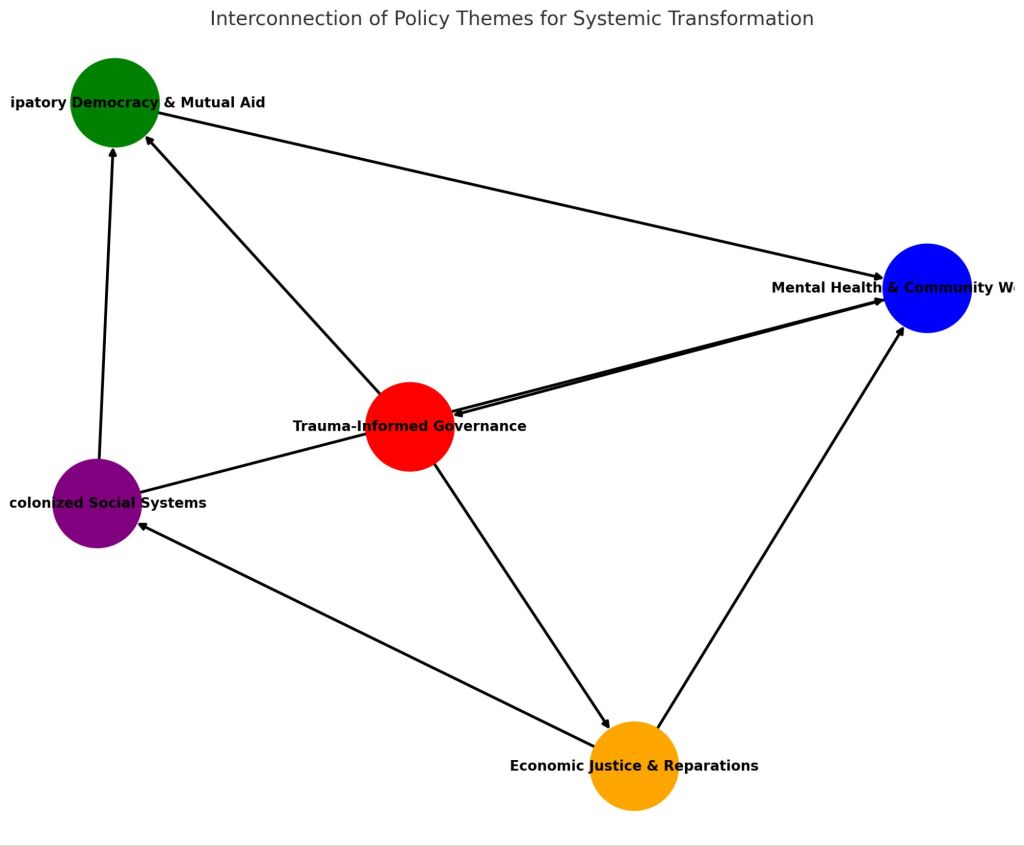
🔗 How These Themes Interconnect:
1. Trauma-Informed Governance (🔴) ↔ Economic Justice & Reparations (🟠)
Healing trauma requires financial security, and economic justice requires policies that repair intergenerational harm.
2. Economic Justice & Reparations (🟠) ↔ Decolonized Social Systems (🟣)
Economic oppression is deeply rooted in colonial extraction, making decolonization an essential part of wealth redistribution.
3. Decolonized Social Systems (🟣) ↔ Participatory Democracy & Mutual Aid (🟢)
Decolonization is not just about symbolic change; it must empower self-governance and community-based decision-making.
4. Participatory Democracy & Mutual Aid (🟢) ↔ Mental Health & Community Well-Being (🔵)
Decentralized, cooperative governance fosters a sense of belonging, reducing chronic stress and improving mental health.
5. Mental Health & Community Well-Being (🔵) ↔ Trauma-Informed Governance (🔴)
Emotional regulation must be integrated into justice policies—trauma-responsive legal systems create a cycle of healing rather than punishment.
6. Economic Justice & Reparations (🟠) ↔ Mental Health & Community Well-Being (🔵)
Economic precarity is a major driver of stress, anxiety, and intergenerational trauma, meaning financial policies must be trauma-informed.
7. Trauma-Informed Governance (🔴) ↔ Participatory Democracy & Mutual Aid (🟢)
Restorative justice strengthens democratic engagement, giving communities power over their own conflict resolution models.
8. Decolonized Social Systems (🟣) ↔ Mental Health & Community Well-Being (🔵)
Cultural identity and traditional knowledge play a critical role in psychological resilience, and Western mental health frameworks must integrate these perspectives.
—
🌀 Final Takeaways:
Systemic change must address all levels of human experience—psychological, economic, political, and cultural.
Policies must be designed to work together, reinforcing social cohesion rather than fragmenting communities.
Breaking cycles of trauma and exploitation requires interdisciplinary, holistic governance models.
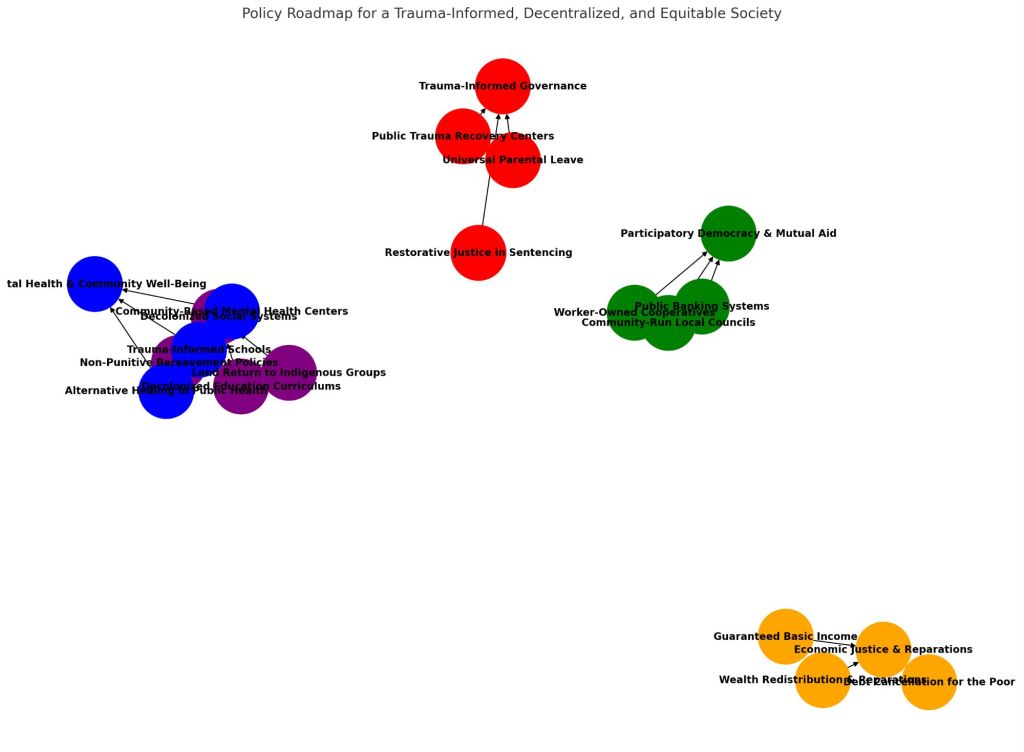
🔴 Trauma-Informed Governance
Universal Parental Leave → Supports secure attachment and long-term social trust.
Restorative Justice in Sentencing → Replaces punitive models with rehabilitation.
Public Trauma Recovery Centers → Community-based healing hubs to address collective trauma.
🟠 Economic Justice & Reparations
Guaranteed Basic Income (GBI) → Reduces economic precarity and stress.
Debt Cancellation for the Poor → Eliminates predatory financial cycles.
Wealth Redistribution & Reparations → Corrects historical inequalities.
🟣 Decolonized Social Systems
Decolonized Education Curriculums → Reframes history and governance beyond Eurocentrism.
Land Return to Indigenous Groups → Direct reparative action.
Non-Punitive Bereavement Policies → Acknowledges cultural grief practices.
🟢 Participatory Democracy & Mutual Aid
Worker-Owned Cooperatives → Empowers local economies.
Community-Run Local Councils → Decentralized decision-making.
Public Banking Systems → Keeps wealth within communities.
🔵 Mental Health & Community Well-Being
Community-Based Mental Health Centers → Moves care away from institutionalized psychiatry.
Alternative Healing in Public Health → Validates diverse cultural trauma recovery models.
Trauma-Informed Schools → Incorporates nervous system regulation into education.
This roadmap visually structures key reforms into a holistic, interdisciplinary governance model that integrates trauma-informed care, economic justice, participatory democracy, and decolonization.

 Spirolateral