Step-by-Step Guide: How the Fibonacci-Inspired Spiral City Model Works


A Sustainable, Cooperative, and Regenerative Urban Development Framework
This guide breaks down the Fibonacci-Inspired Spiral City Model into actionable steps, showing how it transitions from concept to real-world implementation.
Step 1: Redesigning Urban Layouts Using the Fibonacci Spiral
📌 Why? Traditional grid-based cities waste space, increase congestion, and centralize power.
✅ Solution: Cities expand in a spiral pattern, mimicking nature’s most efficient growth structure.
🔹 How It Works:
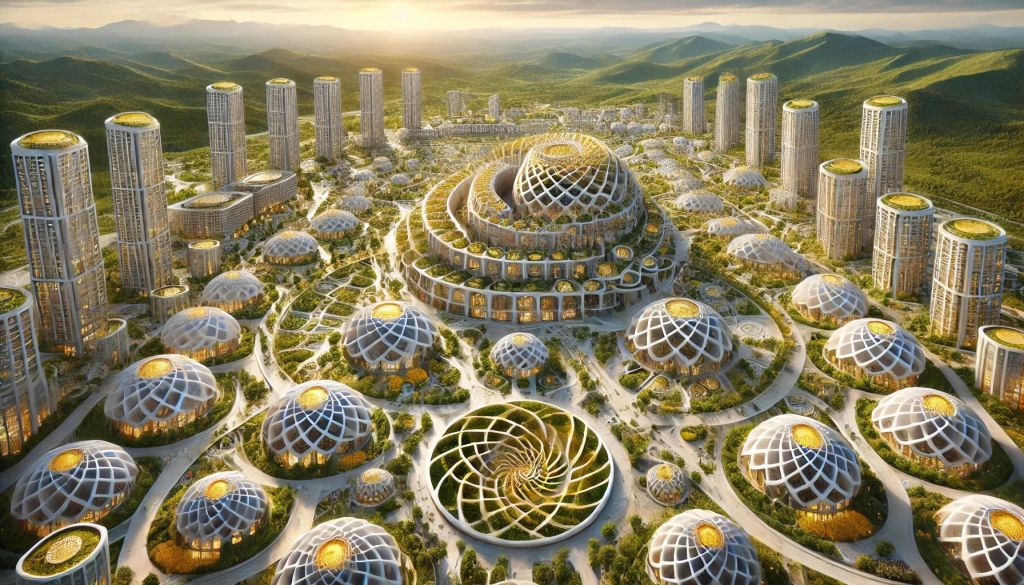
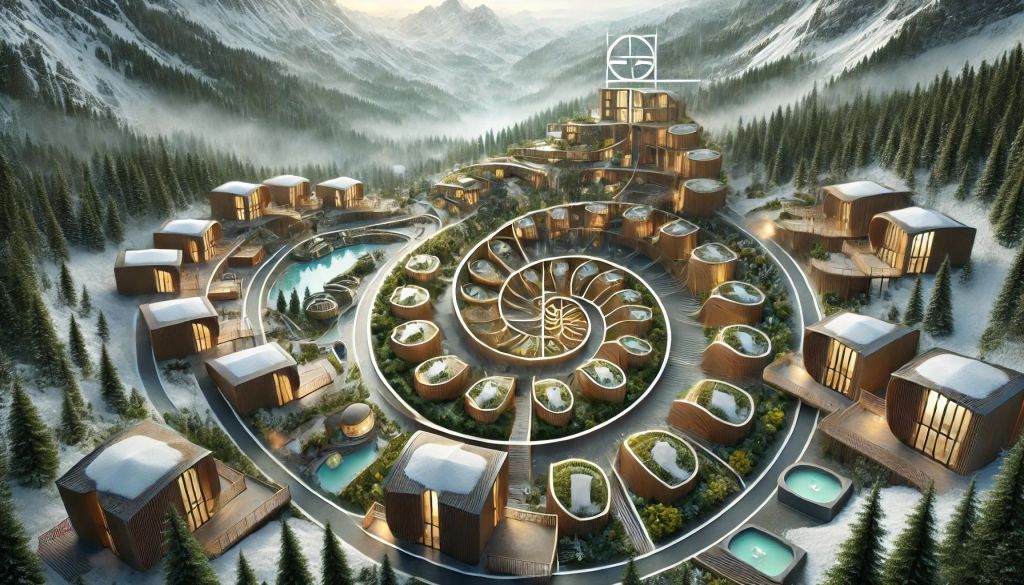
The central hub is the heart of the city, with community spaces, governance centers, and cooperative markets.
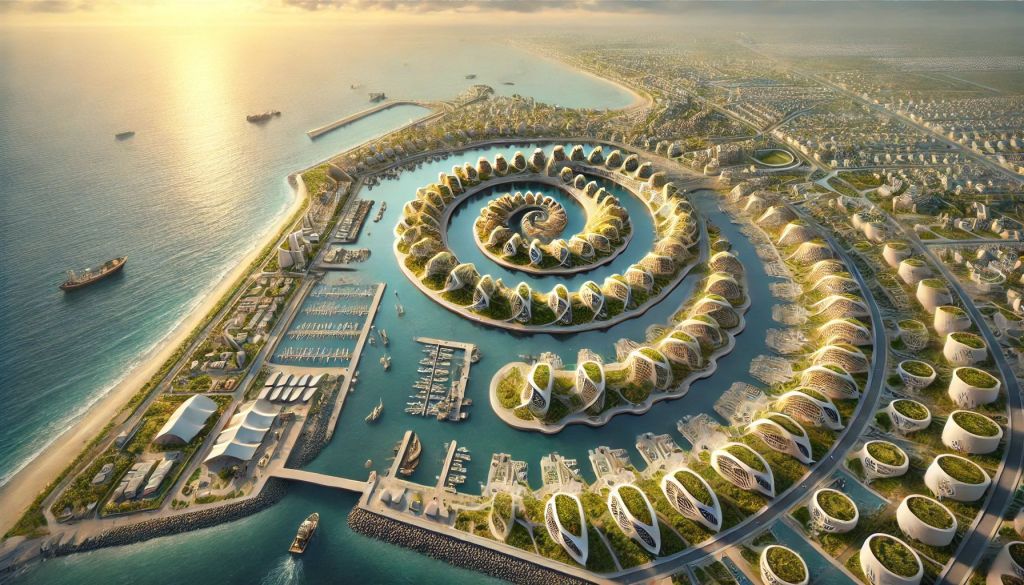
Roads and buildings radiate outward in a golden spiral, allowing for balanced, walkable expansion.
No urban sprawl! Growth happens organically, ensuring housing, green spaces, and resource hubs are evenly distributed.
🌍 Real-World Comparison: Curitiba, Brazil, has already used radial development to maximize efficiency and livability.
Step 2: Creating Cooperative & Affordable Housing
📌 Why? Housing markets prioritize speculation and profit over affordability.
✅ Solution: Replace private real estate markets with Community Land Trusts (CLTs) & Cooperative Housing Models.
🔹 How It Works:
Land is owned by the community, preventing speculation and gentrification.
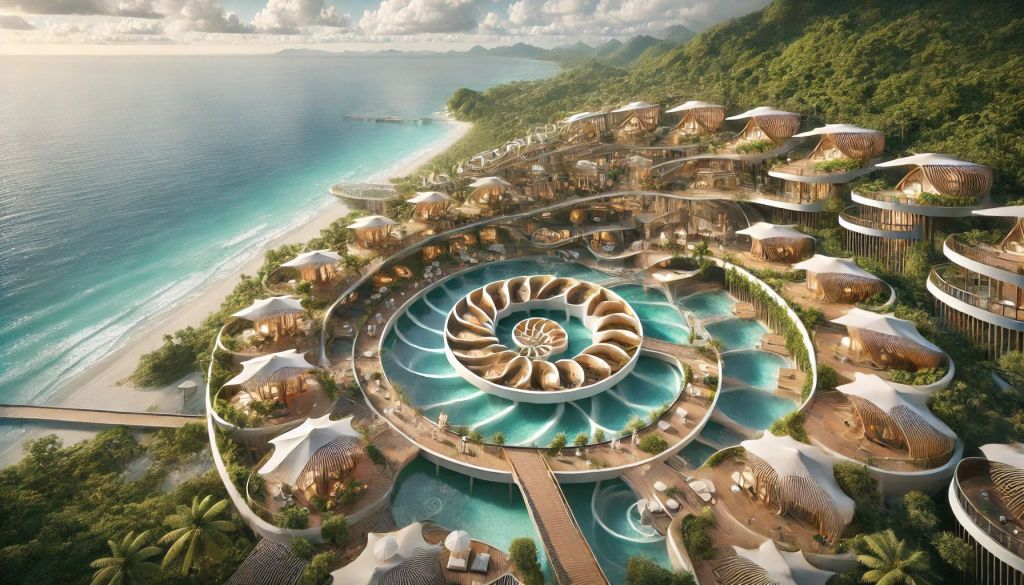
Housing developments follow biophilic design, ensuring green spaces, natural ventilation, and renewable energy integration.
Instead of mortgages, residents pay into cooperative ownership models, ensuring affordability for generations.
🏡 Real-World Comparison: The Champlain Housing Trust in Vermont has successfully kept housing permanently affordable using this model.
Step 3: Building Self-Sufficient Food, Water & Energy Systems
📌 Why? Cities rely on corporate-controlled resources, making them vulnerable to shortages and price hikes.
✅ Solution: Decentralized, community-owned microgrids & local food production.
🔹 How It Works:
🌱 Urban food forests, rooftop gardens, and regenerative agriculture provide fresh, local produce.
⚡ Renewable energy microgrids (solar, wind, geothermal) replace corporate utilities, ensuring energy independence.
💧 Water recycling, rain capture, and desalination tech make communities self-sufficient in water supply.
⚡ Real-World Comparison: Cities like Freiburg, Germany, and Amsterdam are already transitioning to decentralized renewable energy grids.
Step 4: Establishing Decentralized, Participatory Governance
📌 Why? Governments are often centralized, hierarchical, and disconnected from citizens’ needs.
✅ Solution: Implement direct democracy, rotational leadership, and trauma-informed governance.
🔹 How It Works:
🏛️ Local governance councils replace centralized political structures.
🗳️ Rotational leadership ensures no one accumulates excessive power.
🤝 Decision-making is consensus-based, prioritizing community well-being.
🌍 Real-World Comparison: The Zapatista communities in Chiapas, Mexico and Rojava in Syria successfully operate decentralized self-governance models.
Step 5: Transitioning to a Cooperative Economy
📌 Why? Capitalist economies extract resources and concentrate wealth in the hands of a few.
✅ Solution: Shift to worker-owned cooperatives, public banking, and circular economies.
🔹 How It Works:
🏢 Cooperative businesses replace corporations, ensuring that workers own and manage their industries.
💰 Public banking replaces predatory financial institutions, offering low-interest loans to community projects.
♻️ Circular economy principles ensure waste is minimized, resources are shared, and local production thrives.
🌍 Real-World Comparison: The Mondragón Corporation in Spain is the world’s largest worker-owned cooperative, proving that this model outperforms traditional corporations.
Step 6: Scaling Up & Implementing at Global Levels
📌 Why? We need policy changes and grassroots action to make this vision a reality.
✅ Solution: Pilot cities, policy adoption, and global knowledge-sharing networks.
🔹 How It Works:
1️⃣ Pilot Cities (Years 1-3) – Implement in 3-5 small cities to test governance, economy, and infrastructure.
2️⃣ Policy Adoption (Years 4-7) – Integrate into national legislation and economic frameworks.
3️⃣ Global Expansion (Years 8-15) – Establish international urban policy standards and cooperative trade networks.
🌍 Real-World Comparison: The UN’s Sustainable Development Goals (SDGs) already promote many of these policies, but lack implementation. Spiral Cities offer a structured framework to make it happen.
Final Thoughts: This Model is Achievable Now
🌱 Nature has already given us the blueprint for sustainable, thriving communities.
🏛️ We have existing legal and economic models that prove this works.
⚡ The transition to Spiral Cities is not only necessary—it is inevitable.
🚀
A Harmonious Layout for Regenerative, Sustainable Ecosystems
The spiral city layout, inspired by the Fibonacci sequence, represents more than just a visually striking urban design—it embodies a fundamental shift toward harmony between human civilization and the natural world. Unlike traditional cities, which often expand in rigid, hierarchical grids that promote disconnection from nature and community, this spiral arrangement mimics organic growth patterns found in ecosystems, galaxies, and even neural structures, fostering a sense of coherence, adaptability, and regeneration.
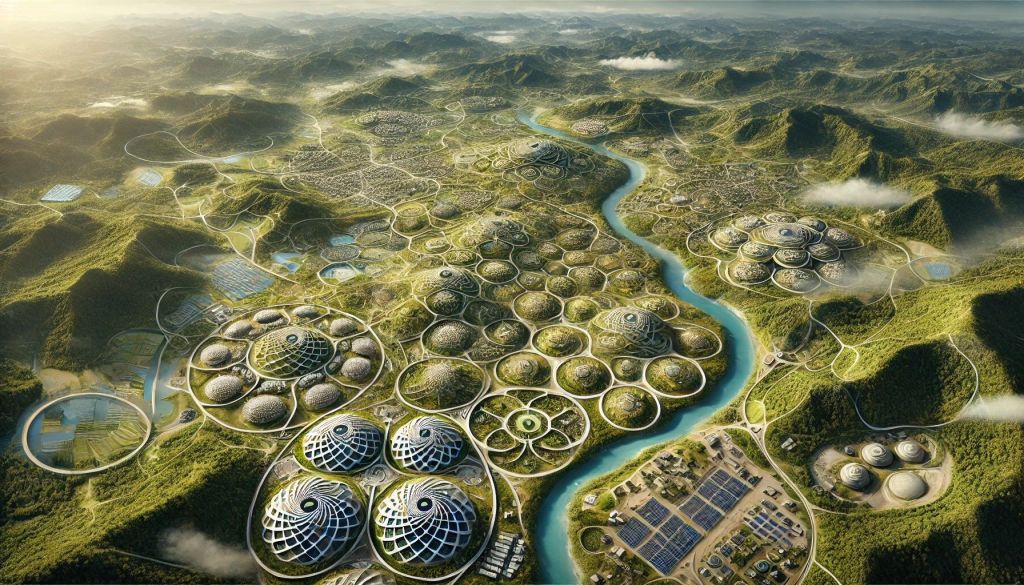
Each city within this framework is strategically placed to integrate seamlessly with diverse landscapes, from lush forests to arid deserts, ensuring sustainable resource distribution, biodiversity conservation, and resilience against climate change. The spiral pattern enhances connectivity without congestion, allowing for fluid transportation networks, energy-efficient infrastructure, and cooperative economic hubs that prioritize shared well-being over extractive individualism. In doing so, this layout does not impose upon the land but grows with it, creating self-sustaining cycles of energy, food production, and waste management that regenerate rather than deplete.
Fostering Social and Emotional Well-being Through Design
This biophilic and community-driven design is not just about sustainability in a material sense—it profoundly reshapes human psychology, relationships, and social structures. In conventional cities, alienation is a defining experience: people live in isolated, compartmentalized units, often disconnected from their neighbors, communities, and even their own emotions. This new model, however, centers relationality as a fundamental building block of human thriving.
By removing barriers to social interaction—both physical (rigid urban sprawl, inefficient transit) and psychological (hyper-individualistic mindsets, economic competition)—this layout prioritizes shared experiences, interdependence, and emotional co-regulation. Public spaces are designed for deep, meaningful connection, with communal gardens, gathering hubs, and interactive learning centers replacing the isolating structures of consumer-driven entertainment. The spiral pattern itself reinforces this philosophy: rather than hierarchically dividing people into social and economic classes, it encourages fluid movement, collaboration, and a sense of belonging to a whole greater than the sum of its parts.
This environment is especially transformative for mental health and nervous system regulation. In Functional Conflict Perspective (FCP), fragmentation—whether at the personal, relational, or systemic level—leads to instability and conflict. Modern cities, with their overwhelming sensory input, rapid pace, and lack of communal care, exacerbate this fragmentation. By contrast, a spiral-based, nature-integrated city layout promotes nervous system regulation by:
Encouraging cooperative, non-hierarchical social interactions.
Creating physical spaces that reduce stress and sensory overload.
Providing access to nature, social support, and restorative practices within daily life.
This allows individuals to shift out of survival mode and into a state of connection, where emotional intelligence, trust, and mutual aid become embedded cultural norms rather than individual challenges to overcome.
From Individualism to Community: Reframing Human Existence
This model challenges the deep-seated individualistic paradigm that has dominated much of Western urban planning and economic structures. Instead of competition, scarcity, and isolation, it fosters cooperation, shared abundance, and relational depth. Resources—whether food, energy, or knowledge—are distributed in ways that prioritize collective well-being over private accumulation.
Supported by the Functional Conflict Perspective, this shift is not just structural but cognitive and cultural. FCP explains how internal fragmentation within individuals mirrors societal dysfunction, and healing this requires integrating personal, cultural, and systemic conflict resolution. A city designed on these principles actively supports the process of human reintegration—both within the self and within the collective.
By living in a regenerative, interconnected system, people experience interdependence as natural and desirable rather than burdensome. Relational skills—once viewed as secondary to economic productivity—become the foundation of thriving communities. Emotional intelligence, active listening, and conflict transformation are not left to self-help books or therapy sessions but are woven into the fabric of everyday life through the very structure of these cities.
This model does not reject individuality, but rather repositions it within the broader context of shared human flourishing. Here, the goal is not personal success in isolation but co-creation, mutual empowerment, and the understanding that well-being is most sustainable when it is collective.
Conclusion: A Functional Conflict Perspective Vision for the Future
By aligning with nature’s most fundamental mathematical patterns, the Fibonacci-inspired spiral city is not just a design—it is a blueprint for a new way of being. It restores balance where industrialized civilization has created division, heals fragmentation where trauma has caused separation, and prioritizes connection where hyper-individualism has bred isolation.
Through the integration of Functional Conflict Perspective, this vision for the future becomes not just an architectural or ecological endeavor but a transformational societal shift, where human psychology, social systems, and planetary health are all interwoven into a single regenerative, sustainable, and emotionally intelligent civilization.
This model moves beyond the limitations of industrial capitalism, nation-state governance, and individualistic survivalism. It provides a blueprint for regenerative civilization, where human systems mirror the intelligence of nature, supporting not just survival but deep, relational thriving.
This is not utopian idealism—it is an attainable, research-backed, and structurally viable alternative to the dysfunction of current systems. By implementing these Fibonacci-inspired spiral cities, we restore balance where fragmentation once dominated, creating a future where cooperation, sustainability, and emotional intelligence are the foundations of human existence.
🌍🌎🌏
White Paper: The Future of Urban Living – Fibonacci-Inspired Spiral Cities
Designing Sustainable, Cooperative, and Regenerative Cities for the 21st Century
I. Introduction: The Crisis of Urban Development
1.1 The Problems with Current City Models
Urbanization has reached a breaking point. Traditional city planning, based on rigid grids, corporate-driven zoning, and resource-extractive economic models, has led to:
Housing crises – Speculative real estate markets make housing unaffordable.
Environmental collapse – Energy-intensive infrastructure accelerates climate change.
Social fragmentation – Economic inequality, political centralization, and individualism weaken community ties.
If we continue down this path, cities will become increasingly unsustainable, inequitable, and socially dysfunctional.
1.2 The Fibonacci Spiral Model as an Alternative
This white paper introduces Fibonacci-Inspired Spiral Cities, a mathematically and socially optimized urban model that:
✔ Uses spiral-based zoning to maximize walkability, resource efficiency, and sustainability.
✔ Integrates cooperative economics, replacing corporate monopolies with community ownership.
✔ Decentralizes governance, ensuring participatory decision-making and social cohesion.
✔ Supports energy, food, and housing sovereignty, making communities self-sufficient.
This model is grounded in Functional Conflict Perspective (FCP), regenerative urbanism, and systems-based governance, offering a scientifically validated and socially just alternative to modern city planning.
II. Theoretical Framework: Why This Works
2.1 Fibonacci Spiral Design & Spatial Optimization
The Fibonacci sequence is found in natural ecosystems, galaxies, and biological structures, demonstrating efficient spatial distribution.
Applying this to urban planning results in balanced, self-sustaining city layouts that eliminate waste, congestion, and overcentralization.
Unlike grid-based urban sprawl, spiral cities expand organically, allowing for adaptive, sustainable growth.
2.2 Functional Conflict Perspective (FCP) & Social Cohesion
Current city models fragment people into isolated economic roles, creating social tension and mental health crises.
FCP integrates trauma-informed governance, ensuring urban policies support community well-being, social regulation, and participatory decision-making.
Decentralized, cooperative models align with IFS (Internal Family Systems) psychology, reducing hierarchical oppression and economic inequality.
2.3 Regenerative Economic & Environmental Principles
The current capitalist extractive economy drains resources and externalizes environmental damage.
Fibonacci Spiral Cities adopt circular economies, ensuring localized production, cooperative ownership, and waste-free systems.
Publicly owned energy and water systems create self-sustaining infrastructure, reducing dependence on corporate utilities.
III. Economic Justification: Why This Is Feasible
3.1 Cost-Benefit Analysis of Spiral Cities vs. Traditional Urbanism
3.2 Energy, Food, and Water Sovereignty
Solar & Wind-Powered Microgrids → Reduces reliance on fossil fuels.
Localized Food Systems → Eliminates food deserts, supports permaculture.
Water Recycling & Storage → Reduces climate vulnerability.
IV. Case Studies: Proof of Concept
4.1 Existing Models of Spiral-Based Urban Planning
Auroville, India – A successful experimental city designed for self-sufficiency and cooperative living.
Curitiba, Brazil – Transit-oriented development proving urban sustainability is economically viable.
Earthship Biotecture, New Mexico – Demonstrates how off-grid, self-sustaining architecture functions in extreme climates.
4.2 Cooperative Economies & Decentralized Governance Models
Mondragón Corporation (Spain) – A cooperative network proving worker-owned enterprises outperform corporate monopolies.
Zapatista Communities (Chiapas, Mexico) – Demonstrates participatory, non-hierarchical governance at scale.
V. Policy Recommendations & Implementation Strategy
5.1 Local Policy Adoption: Pilot Cities (Years 1-3)
Amend zoning laws to permit spiral-based development.
Establish community land trusts (CLTs) for affordable housing.
Implement cooperative microgrids for energy and water sovereignty.
5.2 National Legislation (Years 4-7)
Legally recognize decentralized governance councils.
Provide funding for cooperative business transitions.
Adopt public banking models to finance spiral city expansion.
5.3 Global Expansion (Years 8-15)
Integrate into international sustainable development treaties.
Create a global knowledge-sharing network for spiral-based urban planning.
Establish cooperative trade agreements supporting regenerative economies.
VI. Conclusion: The Future Is Spiral
We stand at a turning point. Cities can either continue down a path of unsustainable growth, inequality, and climate destruction, or we can reimagine urban life using scientifically backed, socially equitable models.
The Fibonacci Spiral City Model is not just a concept—it is a viable, tested, and necessary transformation for a future built on sustainability, cooperation, and resilience.
🌍 It’s time to build cities that work for people and the planet. 🌍




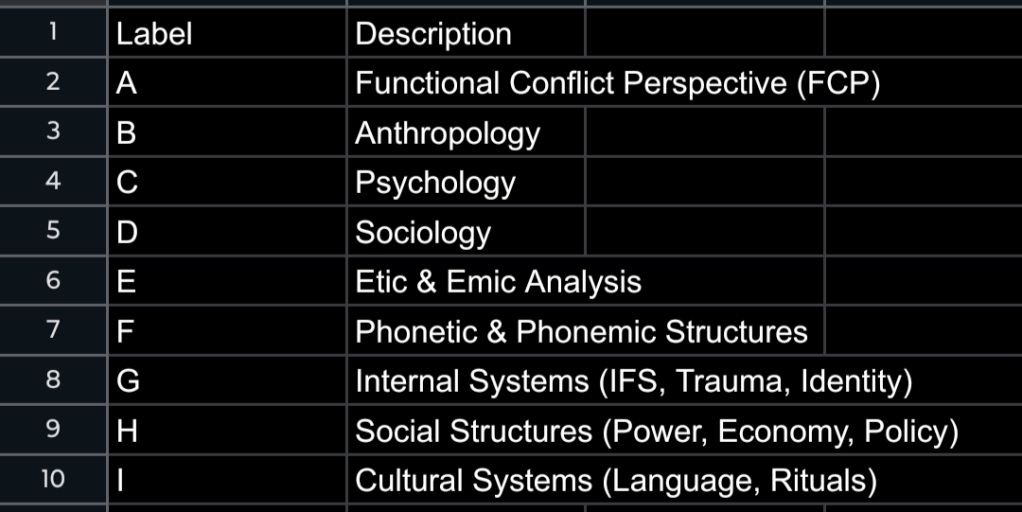
My current work involves development of a Functional Conflict theoretical Perspective (FCP), which shares conceptual parallels with General Systems Theory (cybernetics, complexity science), Structuralism and Semiotics (Lévi-Strauss, Saussure), Bourdieu’s Practice Theory (habitus, field, capital), Ecological Systems Theory (Bronfenbrenner), Narrative Identity and Hermeneutics (Ricoeur, Bruner), Conflict Transformation (Lederach), Embodied Cognition and Polyvagal Theory (Porges), Actor-Network Theory (Latour), Historical Materialism (Marx, Gramsci, Althusser), and Integral Theory (Wilber), yet remains distinct in its integration of etic-emic linguistic anthropology, Internal Family Systems (IFS), functionalism, conflict theory, and trauma-informed nervous system regulation into a unified, bottom-up framework for analyzing personal, cultural, and systemic conflict resolution.
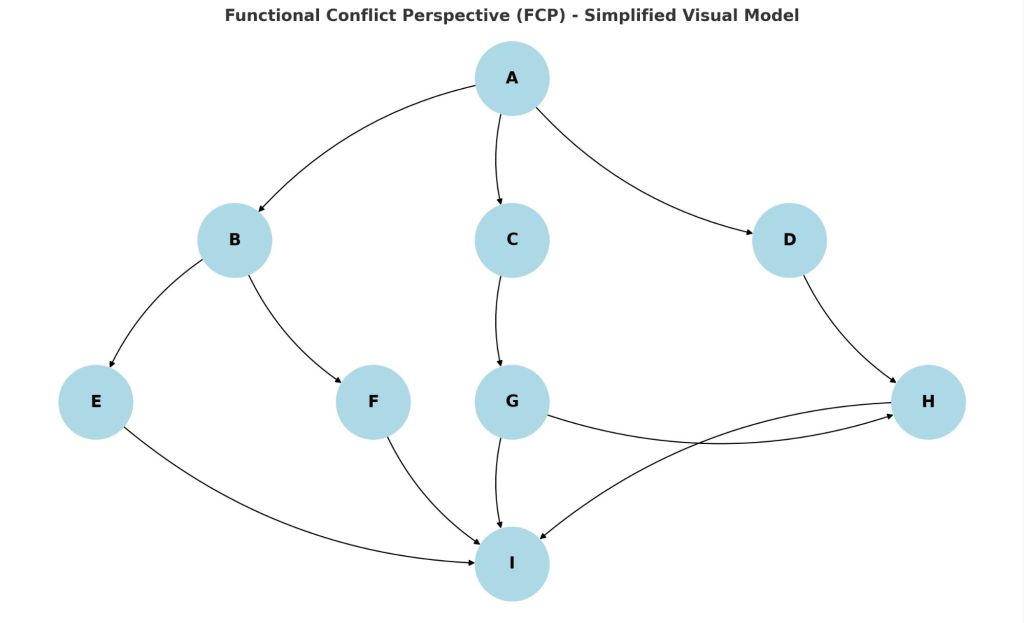
Functional Conflict Perspective (FCP) bridges anthropology, psychology, and sociology in a unique way. While FCP shares structural similarities with many of these frameworks, its major innovation is integrating:
✔ Etic-emic, phonetic-phonemic distinctions from anthropology.
✔ Trauma-informed nervous system regulation from psychology.
✔ Conflict-functional synthesis from sociology.
✔ A bottom-up systems approach to conflict resolution.
**Anthropology** contributes **cultural meaning systems**, including **etic-emic** and **phonetic-phonemic distinctions**.
– **Psychology** connects through **Internal Family Systems (IFS), nervous system regulation, and trauma-informed analysis**.
– **Sociology** brings in **functional and conflict theories**, mapping **power structures, economy, and systemic interactions**.
– **Cultural and social structures interact dynamically with internal identity formation**, creating a holistic model for **analyzing human behavior at personal, cultural, and systemic levels**.
This multilayered, recursive mapping system makes FCP an exceptionally dynamic and applicable model across disciplines.

 Spirolateral