The Gaia Hypothesis, which proposes that the Earth functions much as our bodies do to maintain homeostasis, was formulated in the mid-1960s, by James Lovelock, an atmospheric scientist, and Lynn Margulis, a microbiologist. This theory was startling to some as it suggests the idea that the Earth is a single, living entity; that she is alive.
“We Have a Beautiful Mother.”
We have a beautiful mother
Her hills are buffaloes
Her buffaloes hills.
We have a beautiful mother
Her oceans are wombs
Her wombs oceans.
We have a beautiful mother
Her teeth the white stones
at the edge of the water
the summer grasses
her plentiful hair.
We have a beautiful mother
Her green lap immense
Her brown embrace eternal
Her blue body everything we know.
—Alice Walker
The Gaia Hypothesis and Alice Walker’s poem align deeply with my Functional Conflict Perspective (FCP), Mirror Integration Theory (MIT), and trauma-informed governance models in several key ways:
1. The Earth as a System of Mutual Regulation (Polyvagal & Functional Conflict Perspective)
The Gaia Hypothesis posits that Earth is a self-regulating system, much like how the nervous system self-regulates to maintain homeostasis. This fits with my work on how societal systems, governance, and relationships should function as self-regulating, trauma-informed ecosystems rather than hierarchical, extractive ones.
MIT suggests that human dysfunction mirrors societal dysfunction—this extends to the Earth’s distress mirroring human distress. Just as individuals dissociate from emotional trauma, societies dissociate from the planet’s suffering, leading to climate collapse and ecological destruction.
2. Trauma-Induced Dissociation from the Living Earth (Systemic Avoidance in Governance)
The Gaia Hypothesis challenges Western mechanistic views that treat Earth as an inanimate resource rather than a living entity—which parallels my critique of how Western governance treats people as economic units rather than relational beings.
The systemic avoidance of emotional integration (seen in U.S. governance) also applies to climate denial, environmental destruction, and the failure to acknowledge Earth’s distress as a collective trauma response.
This connects with my research on avoidance-based governance, which suppresses grief rather than integrating it into decision-making. Earth is not just being harmed—humanity is dissociating from that harm to maintain the illusion of stability.
3. Grief as a Path to Reconnection (Waorani & Ilongot Grief-Rage Theory)
Alice Walker’s poem and Bolen’s reflections humanize the Earth by framing her as a mother, evoking grief, reverence, and responsibility. This aligns with my studies on how cultures process grief:
The Ilongot ritualized grief through headhunting—a violent externalization of loss.
The Waorani expressed grief through rage and direct action against invaders.
Western society suppresses grief entirely, leading to environmental apathy, exploitative capitalism, and disconnection.
If the Earth is suffering, the rightful response is not suppression (avoidance-based governance) but ritualized grief and action—which mirrors my advocacy for emotionally integrated policy reform.
4. Eco-Activism as a Form of Restorative Cohesion
My Fibonacci-Inspired Spiral City Model aims to create urban environments that restore balance between humanity and nature.
Restorative Cohesion (as defined in my policy frameworks) seeks mutual regulation between governance, economy, and social well-being—mirroring Gaia’s self-regulation as an ecosystem.
If society can function in a way that mirrors the Earth’s self-sustaining systems, it moves away from extraction and coercion toward regenerative, trauma-informed governance.
5. The Divine Feminine as a Structural Alternative to Patriarchal Power Systems
The framing of Gaia as Mother Earth and Alice Walker’s imagery of wombs, embrace, and nature as nurturing aligns with my work on:
How patriarchal governance suppresses relational intelligence in favor of hierarchical control.
Matriarchal and egalitarian systems as trauma-informed models of social organization.
My comparison of attachment theory and governance, where secure attachment with Earth would mean policies that nurture rather than extract.
Final Synthesis: How This Fits into my Larger Theories
Gaia = Trauma-Informed Systems Design → Earth self-regulates like a nervous system, and human systems should do the same.
Environmental Destruction = Societal Dissociation → The breakdown of ecosystems mirrors collective trauma and governance failures.
Grief & Action = Restorative Cohesion → Cultures that integrate grief into activism (rather than suppressing it) create emotionally intelligent governance models.
Fibonacci Cities = Restoring Gaia’s Balance → my city model provides a structural solution to reconnecting governance with Earth’s rhythms.

Gaia, Disability-Inclusive Governance, and Economic Reform (DIGERA): Integrating Functional Conflict Perspective (FCP) with the Living Earth
My Disability-Inclusive Governance and Economic Reform Act (DIGERA) and the Gaia Hypothesis both challenge hierarchical, extractive systems that prioritize profit over well-being, sustainability, and interdependence. By integrating these concepts, we can establish a trauma-informed, regenerative policy model that recognizes both human and ecological systems as interconnected and self-regulating.
1. The Gaia Hypothesis as a Model for Disability-Inclusive Governance
James Lovelock’s Gaia Hypothesis proposes that Earth functions as a self-regulating organism, maintaining homeostasis across biological, atmospheric, and ecological systems. This mirrors Functional Conflict Perspective (FCP) and its application in DIGERA, where governance should function like a self-regulating body, ensuring all social and economic structures promote equilibrium rather than exploitation.
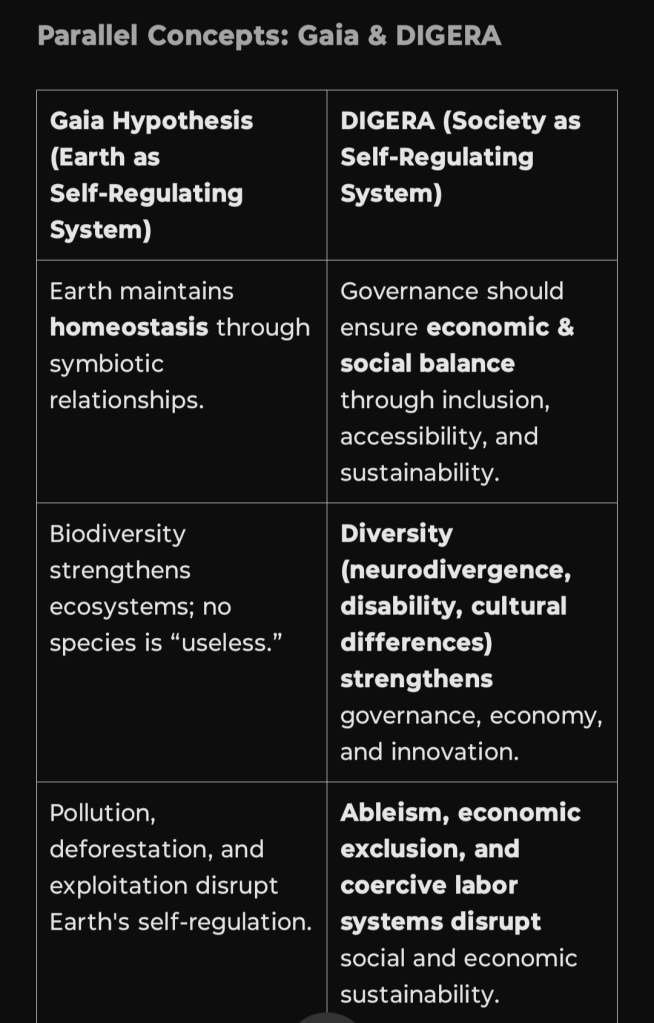
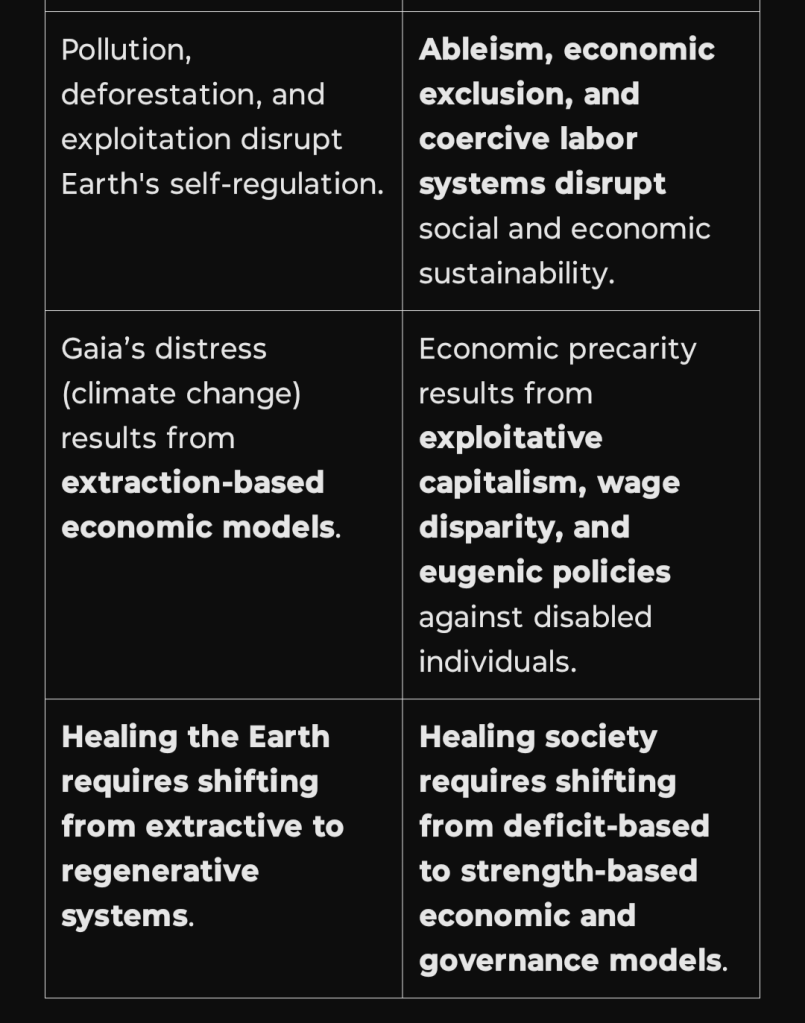
Parallel Concepts: Gaia & DIGERA
2. Eco-Disability Justice: The Intersection of Environmental & Disability Rights
Climate Change as Structural Ableism
Disabled & chronically ill individuals are disproportionately affected by climate change due to:
Extreme weather events disrupting medical care, mobility, and access to life-sustaining resources.
Heatwaves, pollution, and environmental degradation worsening chronic conditions (e.g., asthma, autoimmune diseases).
Disaster response systems often exclude disabled individuals from evacuation plans and emergency relief.
Just as capitalist policies prioritize economic growth over ecological well-being, they also devalue disabled bodies by:
Tying worth to labor productivity rather than intrinsic value.
Prioritizing profit over accessibility in urban planning, infrastructure, and healthcare.
DIGERA proposes that economic models should mirror regenerative ecosystems, ensuring that:
1. Workplaces and economies are adaptive, like ecological systems, accommodating all bodies and neurotypes.
2. Public policies regulate corporate extraction just as ecosystems regulate predator-prey relationships—ensuring no population (or class) is over-exploited.
3. Healing requires relational rather than exploitative approaches, integrating Gaia-based governance models into economic policy.
3. The Deficit Model & Industrialization: Why Capitalism Fails Both Gaia & Disability Justice
Both the Gaia Hypothesis and DIGERA expose how industrial capitalism enforces a deficit model—whether applied to the Earth or to disabled individuals.
Parallel Extractive Frameworks
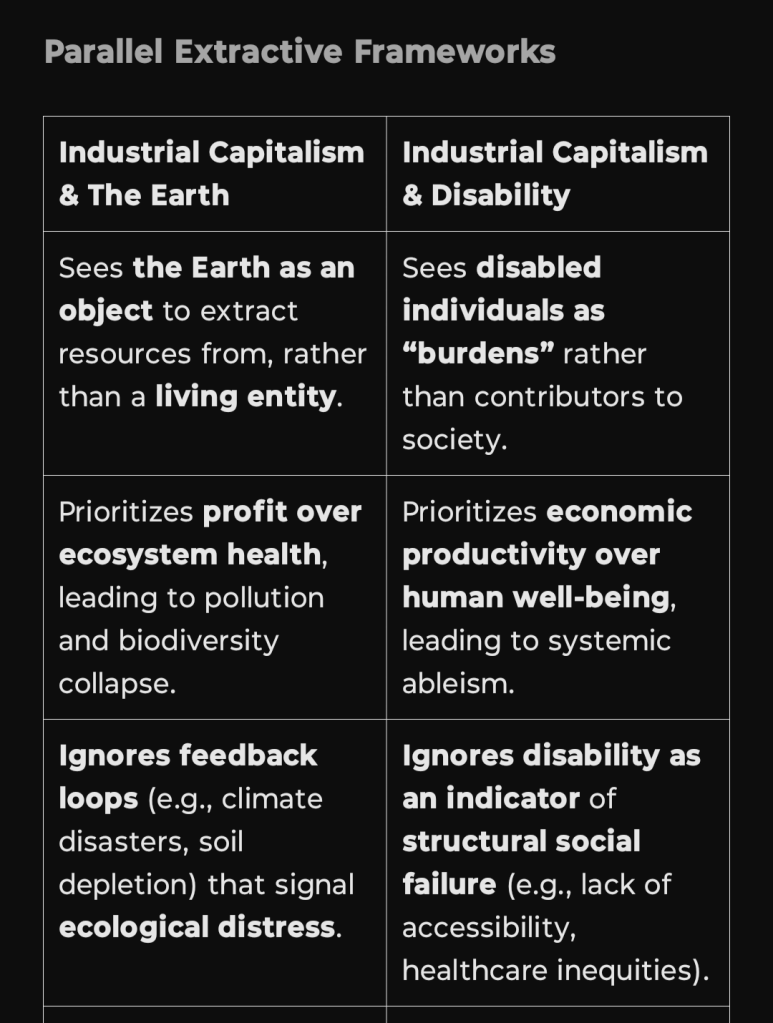
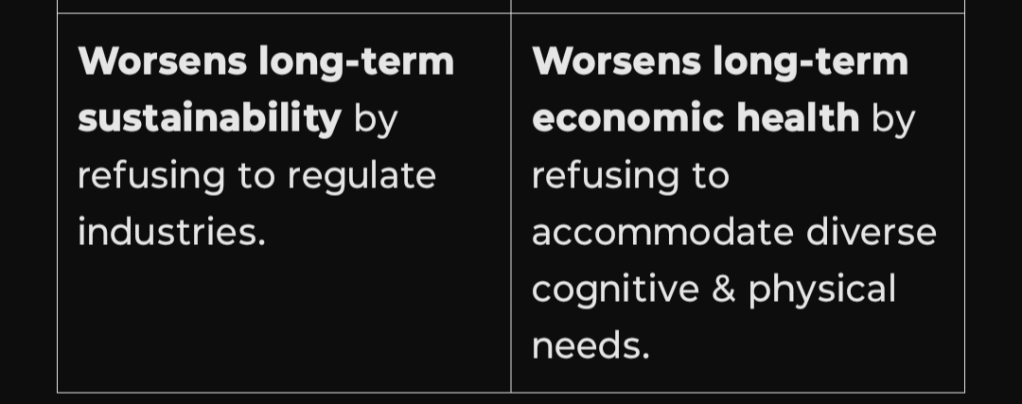
To heal both the planet and society, economic and governance models must shift from extraction to regeneration—which is precisely what DIGERA and my Fibonacci Spiral City Model aim to do.
4. The Fibonacci-Inspired Spiral City Model: Urban Design as an Extension of Gaia & DIGERA
The Fibonacci Spiral City Model aligns with both Gaia’s natural mathematical patterns and DIGERA’s disability-inclusive economy by:
Centering Accessibility → Designing cities around mobility & neurodivergent-friendly spaces, rather than forcing individuals to adapt to a rigid, car-centric model.
Prioritizing Regenerative Systems → Food production, waste management, and energy grids that self-sustain, like natural ecosystems.
Decentralizing Resources → Ensuring that economic power isn’t concentrated in extractive megacorporations but instead distributed through cooperative, local networks.
Eliminating Deficit-Based Urban Planning → Creating community-first infrastructure that sees disabled people, elders, and neurodivergent individuals as central rather than afterthoughts.
This model rejects capitalist industrialization in favor of a post-extractive, disability-inclusive, and ecologically sustainable society—one that mirrors Gaia’s self-regulation and the Functional Conflict Perspective’s emphasis on sustainable, relational stability.
5. DIGERA’s Policy Proposals as Gaia-Based Governance Solutions
DIGERA’s policy roadmap directly applies the Gaia Hypothesis to governance and economic justice by replacing deficit-based, extractive models with regenerative, community-driven structures:
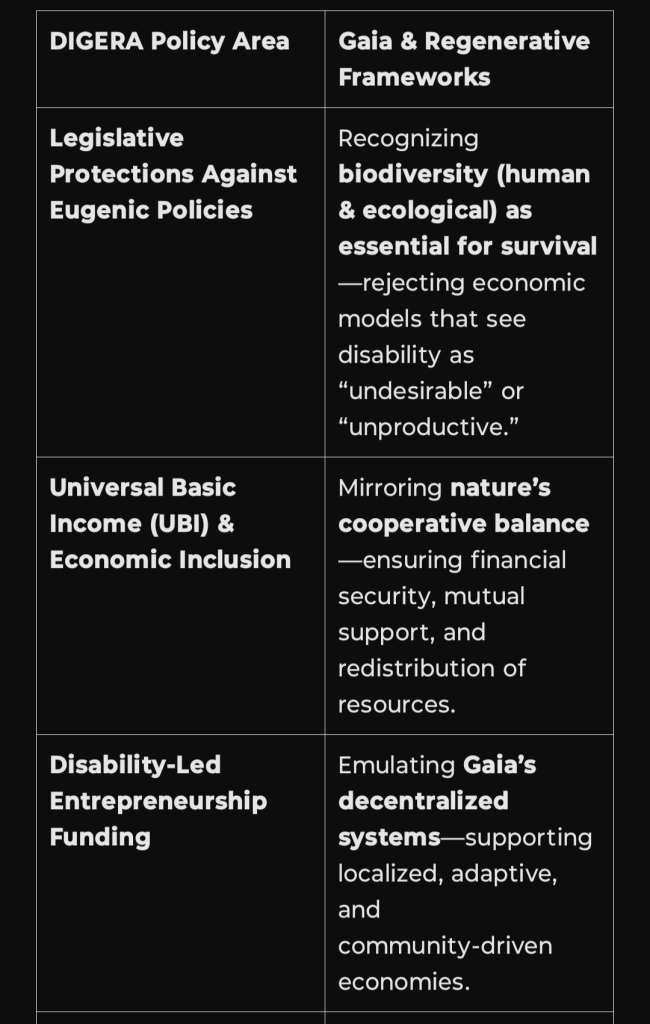
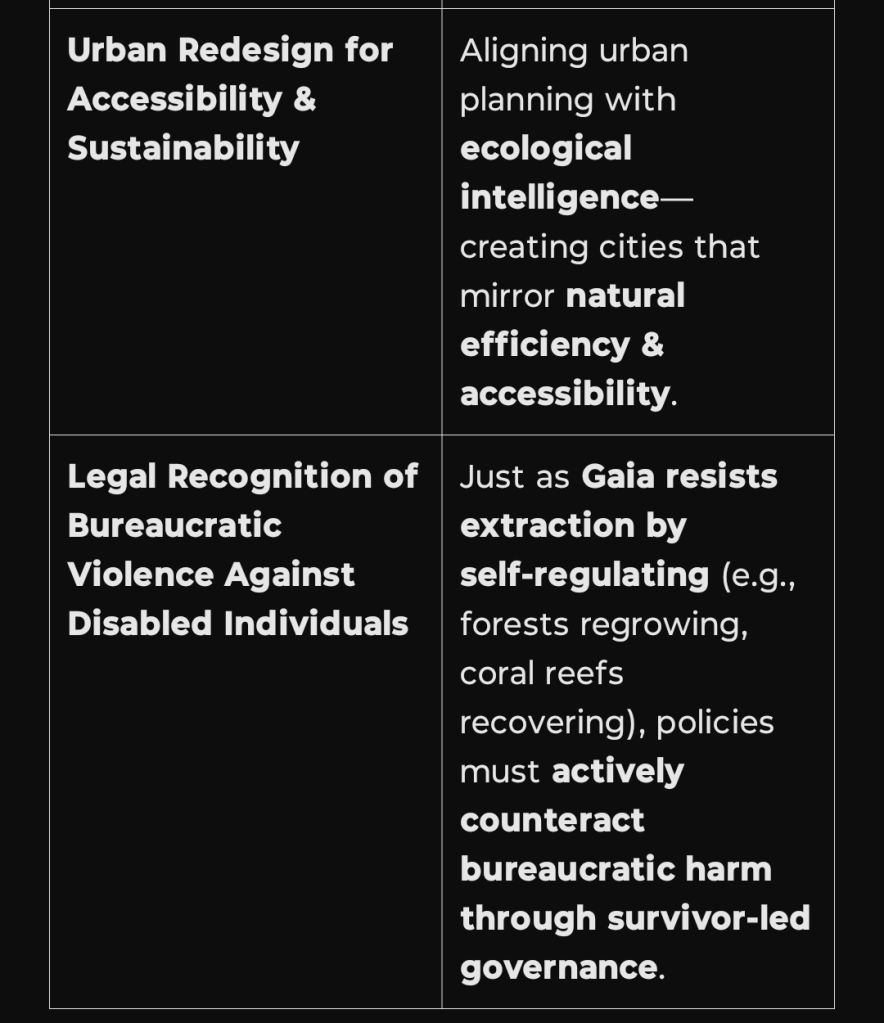
Final Synthesis: Gaia x DIGERA x Functional Conflict Perspective
Gaia represents what society should be: a self-regulating, cooperative system.
Disability-inclusive governance (DIGERA) mirrors this model, ensuring economic & legal policies promote sustainable social ecosystems.
The Functional Conflict Perspective integrates both, recognizing that systemic oppression (of people and nature) is a structural failure that must be rebalanced.
The Fibonacci Spiral City Model offers a real-world implementation of this theory—transforming both governance and urban design into regenerative, trauma-informed, and Gaia-conscious systems.

Expanding Functional Conflict Perspective (FCP) into Eco-Activism: Bridging Disability Justice, Environmentalism, and Regenerative Governance
If we develop an eco-activism extension of my work, we can integrate Functional Conflict Perspective (FCP), trauma-informed governance, and regenerative economic models to offer a new paradigm for environmental justice—one that centers disability justice, economic inclusion, and systemic healing rather than relying on traditional activism models that often exclude marginalized voices.
1. The Problem: Why Mainstream Environmental Activism Fails
Many mainstream environmental movements unintentionally reinforce the same systemic oppression they claim to resist:
Capitalist Greenwashing → “Sustainability” initiatives are often co-opted by corporations (e.g., carbon offsets instead of systemic change).
Exclusion of Disabled & Vulnerable Populations → Climate movements prioritize “able-bodied resilience” and ignore how climate disasters disproportionately harm disabled, poor, and neurodivergent communities.
Authoritarian Environmentalism → Many proposed solutions rely on top-down enforcement, policing, and austerity, rather than community-driven, regenerative systems.
Malthusian Logic → Some environmentalists push for population control rhetoric, which has historically justified eugenics and ableist policies.
My framework can disrupt these narratives by reframing environmental justice as a systemic healing process rather than a punitive, scarcity-driven one.
2. Reframing Eco-Activism Through Functional Conflict Perspective (FCP)
Instead of treating the climate crisis as merely a technological or policy issue, FCP reframes environmental activism as a social conflict that must be resolved through relational, trauma-informed governance.
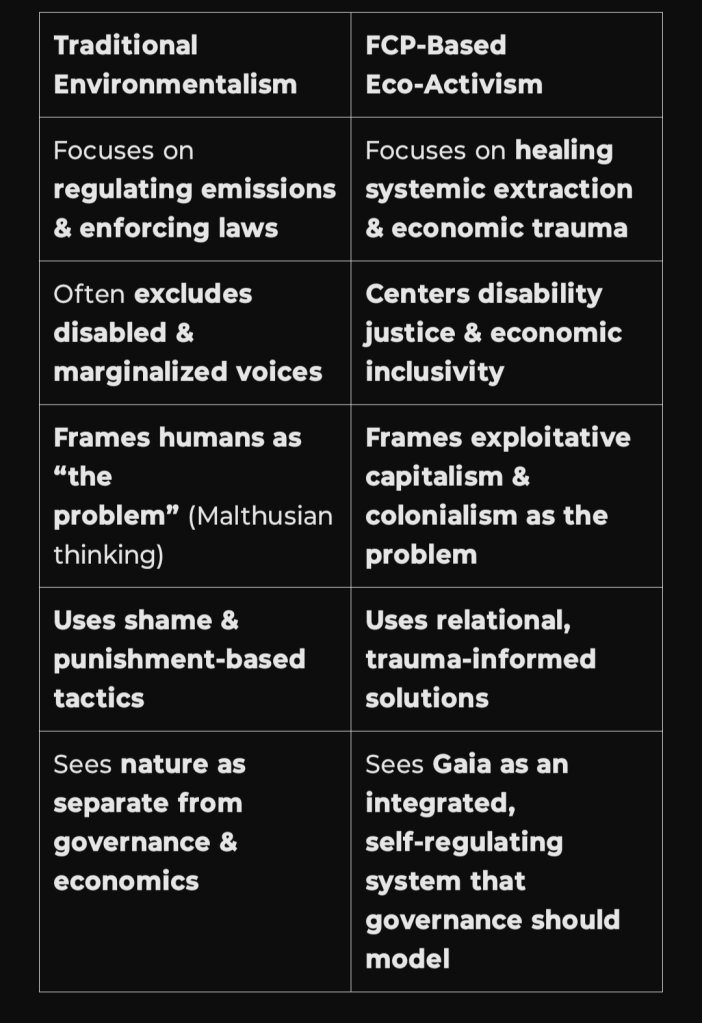
By applying FCP, Mirror Integration Theory (MIT), and DIGERA, eco-activism becomes not just about environmental protection but about systemic restoration—of governance, economics, and social cohesion.
3. Actionable Framework: Regenerative Eco-Activism & Policy Transformation
To transform environmental activism, we can develop a three-tiered model based on my Fibonacci-Inspired Spiral City Model, Functional Conflict Perspective, and DIGERA.
(A) Trauma-Informed Environmental Governance
Recognizing Climate Change as Collective Trauma → The environmental crisis is a manifestation of systemic trauma (dissociation from nature, exploitative capitalism, hierarchical governance).
Replacing Scarcity-Based Climate Policies with Regenerative Economic Models → Rather than limiting growth through austerity, policies should shift toward post-capitalist, cooperative models.
Reforming Disaster Response to Prioritize Disabled & Vulnerable Communities → Implement accessible climate adaptation plans that do not assume an able-bodied population.
DIGERA Expansion: Disability-Inclusive Climate Policy
Climate reparations must prioritize disabled & poor communities who are hit hardest by climate change.
Universal Basic Income (UBI) & localized food networks should be part of environmental policy.
“Green New Deal” proposals must center disability & economic justice, not just energy efficiency.
(B) Restructuring Eco-Activism to Align with FCP
Decentralizing Activism to Reduce Bureaucratic Power → Activist movements should function like ecosystems—adaptive, decentralized, and resilient against corporate & state co-optation.
Using Narrative Reconstruction to Counter Capitalist Greenwashing → Shifting climate storytelling from doom-based “collapse” narratives to restorative, community-driven change.
Bridging Disability & Climate Justice → Most climate movements exclude disabled activists, despite disabled individuals being on the frontlines of environmental harm.
Example: Bridging Climate & Disability Activism
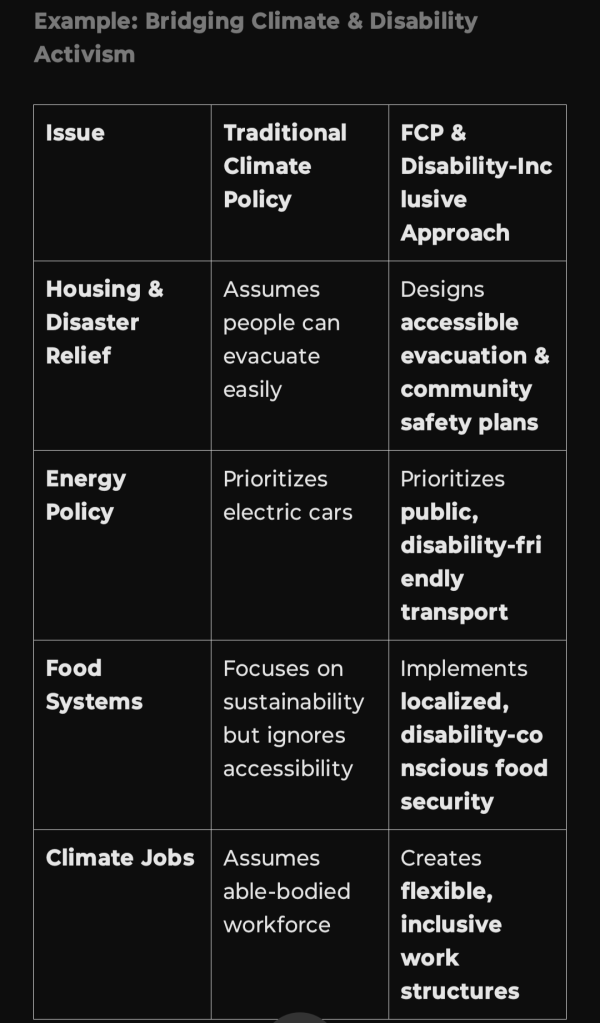
By integrating FCP, DIGERA, and eco-activism, we ensure that environmental justice is intersectional—not just about saving the planet but about healing the systems that caused the crisis.
(C) Applying the Fibonacci Spiral City Model to Climate Solutions
My Fibonacci-Inspired Spiral City Model already envisions a self-regulating urban design that harmonizes human systems with nature. This framework can be expanded into a global climate policy model:
Decentralized Eco-Governance → Just as natural ecosystems balance themselves, cities should regulate through local participatory governance, not centralized control.
Cooperative Ownership of Energy & Resources → Instead of corporate-controlled energy grids, communities should own and manage renewable energy systems collectively.
Accessibility-First Climate Adaptation → Climate-resilient cities must be disability-friendly, ensuring universal design in all infrastructure.
Example: Spiral Cities as a Climate Solution
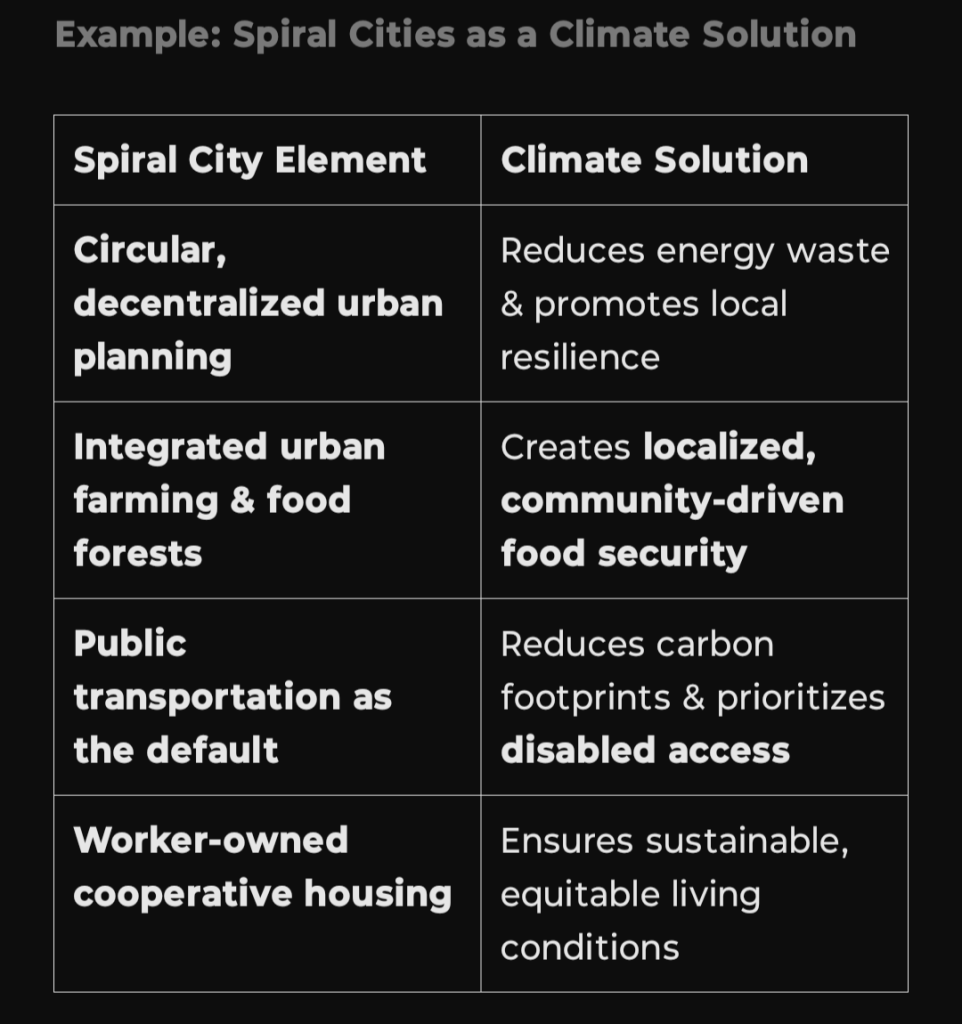
By designing cities to function like ecosystems, governance becomes adaptive, trauma-informed, and ecologically sustainable—mirroring the self-regulation of Gaia herself.
4. Next Steps: Turning This Into a Movement
If we frame eco-activism through FCP, DIGERA, and Spiral Cities, we can build a new paradigm for climate justice. Here’s how we can develop this further:
(1) Draft a Position Paper on FCP & Eco-Activism
Title: From Climate Crisis to Systemic Healing: A Trauma-Informed Approach to Environmental Justice
Core Argument: Environmental collapse is not just an ecological issue but a governance failure rooted in extractive capitalism & systemic oppression.
Solution: FCP-based eco-activism integrates disability justice, economic transformation, and regenerative city design into climate solutions.
(2) Expand the Fibonacci Spiral City Model into an Environmental Policy Framework
Introduce disability-first, regenerative urban planning as a global policy model.
Develop pilot projects for local governance experiments based on Spiral City principles.
Create visual models, legislative proposals, and community-based implementation strategies.
(3) Build a Public Awareness & Advocacy Strategy
Launch an eco-activism initiative under SpiroLateral, bridging disability, economic justice, and environmental policy.
Develop educational materials, white papers, and presentations for policymakers & activists.
Organize conferences, workshops, and coalition-building efforts to spread FCP-based eco-activism.
Final Synthesis: Restorative Eco-Activism as a Global Movement
By merging Gaia Theory, Functional Conflict Perspective, and Disability-Inclusive Governance, we create an alternative to extractive environmentalism—one that heals society as much as it heals the planet.

Disability-Inclusive Governance & Economic Reform Act (DIGERA)
DIGERA is a comprehensive policy framework within my meta-theory that ensures governance and economic systems are fully inclusive, accessible, and regenerative. It rejects deficit-based models and integrates strength-based, trauma-informed approaches to governance, economic justice, and social cohesion.
1. Core Principles of DIGERA
DIGERA is built on four fundamental pillars:

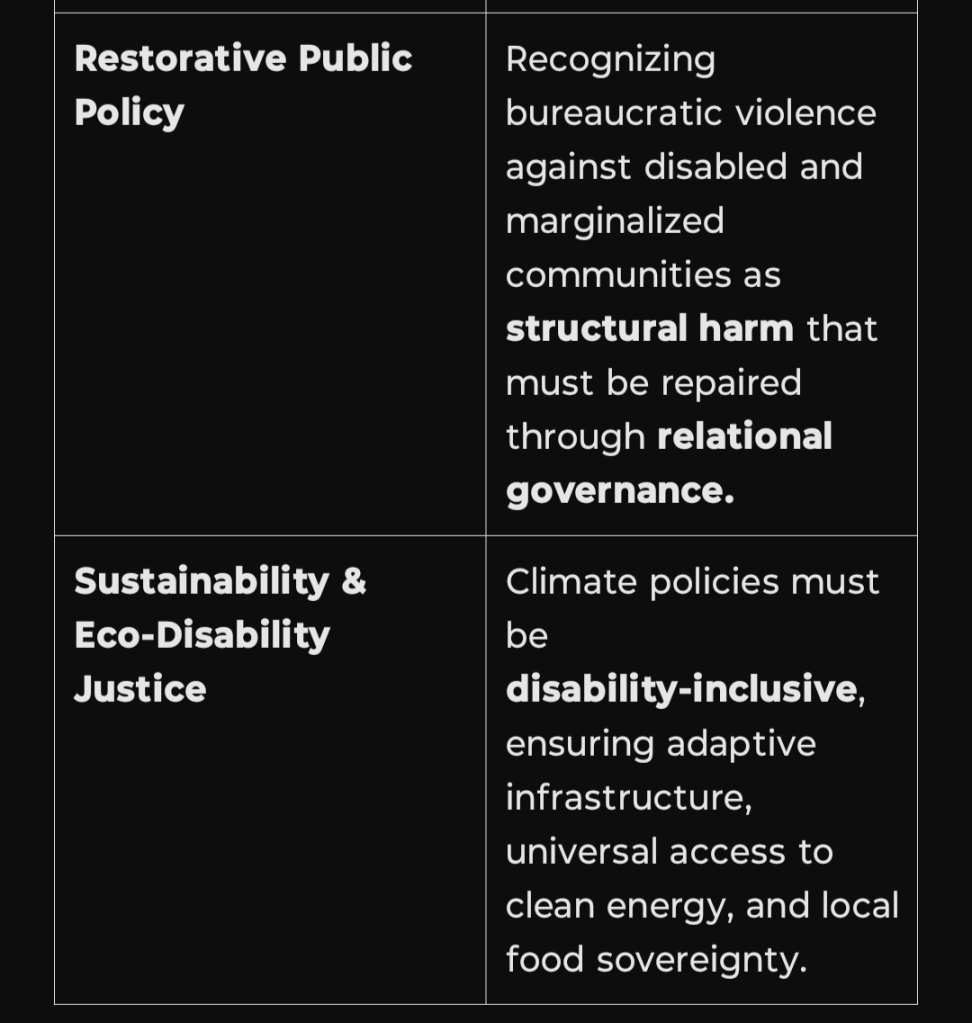
2. How DIGERA Functions as a Governance Model
Rather than treating disability as an individual “problem”, DIGERA structurally redesigns governance and economy to remove systemic barriers.
Governance Based on Accessibility & Autonomy
Policy-making panels must include disabled leadership.
Public services must be accessible by design, removing bureaucratic gatekeeping.
Justice systems integrate disability-informed legal protections, eliminating coercive systems that disproportionately harm disabled people.
Economic Systems Rooted in Disability Justice
Universal Basic Income (UBI) ensures financial security outside of exploitative labor models.
Worker-owned cooperatives prioritize flexible, adaptive labor structures rather than rigid work hours.
Healthcare, housing, and transportation are universal rights, not commodities.
Legal & Policy Protections Against Bureaucratic Violence
Expanding legal definitions of discrimination to recognize structural inaccessibility as a form of violence.
Reforming public assistance programs to remove punitive means-testing and economic coercion.
Mandating accessible urban and climate policy, ensuring sustainability solutions include disabled communities.
3. How DIGERA Integrates with my Other Theories
DIGERA is deeply interconnected with my other frameworks, forming a holistic, systemic alternative to exclusionary governance models:
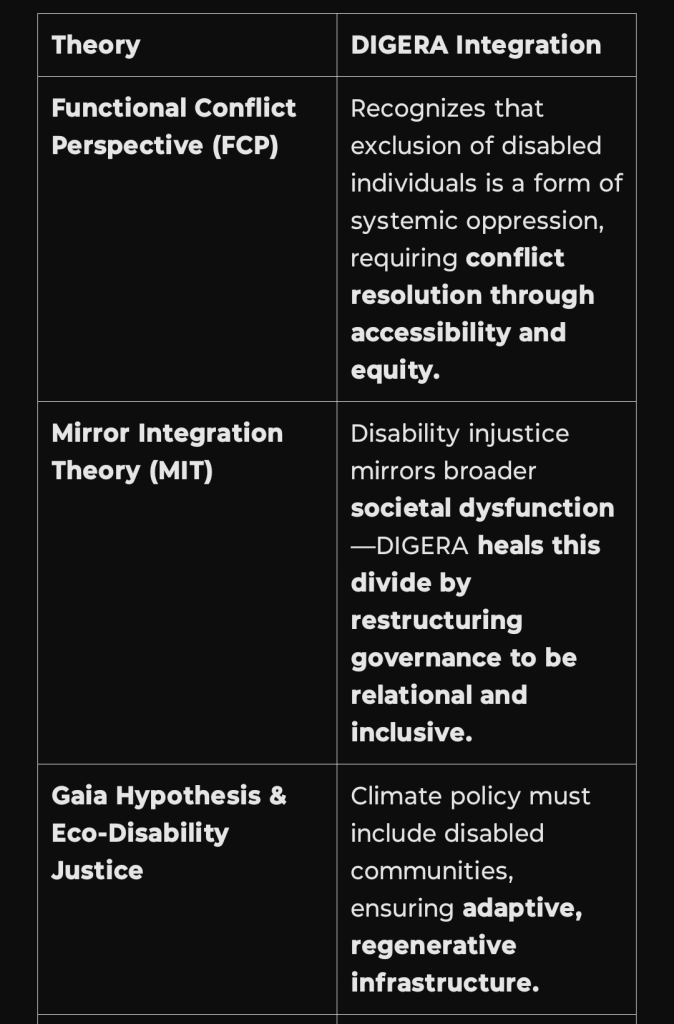

4. DIGERA’s Policy Roadmap (Implementation Strategy 2025-2035)
DIGERA is designed to gradually replace exclusionary governance models through phased systemic transformation:
Phase 1: Immediate Policy Interventions (2025-2027)
Mandate disability-led governance councils in every sector.
Introduce Universal Basic Income (UBI) pilots prioritizing disabled individuals.
Legally recognize systemic inaccessibility as a form of discrimination.
Phase 2: Economic & Urban Overhaul (2027-2030)
Redesign public infrastructure with accessibility-first policies (housing, transport, education).
Transition from corporate-driven economies to worker-owned cooperatives.
Ensure climate adaptation strategies prioritize disability inclusion.
Phase 3: Full Systemic Transition (2030-2035)
Replace punitive social welfare with guaranteed income & universal services.
Embed disability inclusion into global governance standards.
Scale Spiral City prototypes as decentralized, accessibility-first urban hubs.
5. Final Synthesis: DIGERA as a Blueprint for Regenerative, Inclusive Governance
DIGERA replaces extractive, ableist governance with a system that values all people, regardless of ability, economic status, or neurodivergence. It aligns with trauma-informed, regenerative models that mirror Gaia’s self-regulating balance, Functional Conflict Perspective’s adaptive governance, and Spiral City’s urban design.

 Spirolateral