Building a Sustainable Future: A Roadmap for Systemic Transformation
Introduction: A Vision for Change
A sustainable, trauma-informed, and equitable society is within reach. This brochure provides a brief outline of key policies, a roadmap to implementation, and a timeline for systemic change. These reforms will address economic justice, participatory democracy, decolonized social systems, and mental health governance.
—
Core Idea: Policies for a Just Future
To create a more just and sustainable world, we propose the following policy reforms:
Universal Parental Leave: Paid leave for at least 6 months to ensure childhood well-being and gender equity.
Restorative Justice Programs: Transition from punitive incarceration to rehabilitative justice models.
Universal Basic Income (UBI): Direct cash assistance to eliminate economic precarity and improve well-being.
Public Banking & Worker Cooperatives: Democratized financial institutions to redistribute wealth fairly.
Decolonized Education Systems: Integration of Indigenous and diverse knowledge into curricula.
Community-Based Mental Health: Shift from institutional care to accessible, localized support systems.
—
The Process: How We Get There
Phase 1: Pilot Programs & Awareness (Years 1-3)
Launch localized pilots in cities and regions.
Engage public discourse through education and advocacy.
Gather data to refine implementation strategies.
Phase 2: Policy Adoption & Legal Integration (Years 3-6)
Push for municipal, state, and national legislation.
Develop legal frameworks for public banking, UBI, and restorative justice.
Build coalitions of policymakers, activists, and community leaders.
Phase 3: Full-Scale Implementation (Years 6-10)
Expand policies nationwide based on proven successes.
International agreements on debt relief, economic justice, and governance.
Ensure sustainability by embedding policies into institutional frameworks.
—
Projected Timeline for Key Steps
Year 1: Launch pilot programs, conduct feasibility studies.
Year 2-3: Legislative advocacy, secure funding for expansion.
Year 4-5: Enact early policies, monitor and refine implementation.
Year 6-7: Expand public banking, worker co-ops, UBI trials.
Year 8-10: Establish global models, integrate reforms into governance.
—
Why This Matters: Real-World Success Stories
Sweden’s Parental Leave: Led to improved childhood outcomes and workforce equality.
New Zealand’s Restorative Justice: Reduced recidivism rates and rehabilitated offenders.
Finland’s UBI Trial: Increased economic stability and personal well-being.
Germany’s Public Banks: Strengthened local economies and financial resilience.
Spain’s Worker Cooperatives: Ensured fair wages and democratic workplaces.
Iceland’s Mental Health Model: Reduced hospitalization through community-led care.
—
Join the Movement
The path to systemic transformation requires collective action. Support these policies, advocate for change, and become part of a movement toward a just, sustainable future.
For more information, visit http://www.spirolateral.org
Scalability Analysis of Policy Reforms
This analysis categorizes each proposed policy based on its scalability potential—whether it can be widely implemented with minimal adaptation (High) or requires structural and cultural adjustments (Moderate). It also outlines key challenges to scaling each reform globally.
—
🔴 Trauma-Informed Governance
1. Universal Parental Leave
Current Implementation: Sweden
Scalability Potential: High – Can be implemented in any country with existing social safety nets.
Challenges: Cultural resistance in individualist societies; requires strong labor protections.
2. Restorative Justice in Sentencing
Current Implementation: New Zealand
Scalability Potential: Moderate – Requires cultural adaptation but works well in countries with strong community justice systems.
Challenges: Legal barriers in punitive justice systems; requires judicial training and public acceptance.
3. Public Trauma Recovery Centers
Current Implementation: Canada
Scalability Potential: High – Easily replicable in Indigenous and marginalized communities globally.
Challenges: Funding and resource allocation; requires long-term government commitment.
—
🟠 Economic Justice & Reparations
4. Universal Basic Income (UBI) Pilot Expansion
Current Implementation: Finland
Scalability Potential: Moderate – Requires economic restructuring but proven feasible in both developed and developing nations.
Challenges: Political opposition from neoliberal economists; requires pilot programs to build public trust.
5. Debt Relief & Financial Liberation
Current Implementation: Democratic Republic of Congo
Scalability Potential: Moderate – Works best when combined with financial reforms to prevent new debt accumulation.
Challenges: Potential pushback from international financial institutions; requires strong advocacy for global debt reform.
6. Worker-Owned Cooperatives
Current Implementation: Spain (Mondragon Corporation)
Scalability Potential: High – Proven model, adaptable to various industries and economies.
Challenges: Corporate resistance; requires worker organization and supportive legislation.
—
🟣 Decolonized Social Systems
7. Alternative Healing in Public Health
Current Implementation: India
Scalability Potential: High – Works best in nations with strong traditional medicine histories.
Challenges: Pharmaceutical industry opposition; requires integration into public health policies.
8. Decolonized Education Curriculums
Current Implementation: Mexico
Scalability Potential: Moderate – Needs government commitment and educational reform support.
Challenges: Pushback from conservative education systems; requires strong Indigenous leadership.
—
🟢 Participatory Democracy & Mutual Aid
9. Public Banking & Community Wealth
Current Implementation: Germany
Scalability Potential: High – Can be scaled globally with regulatory adjustments; already exists in multiple nations.
Challenges: Banking industry resistance; requires legal protections for public finance.
—
🔵 Mental Health & Community Well-Being
10. Community-Based Mental Health
Current Implementation: Iceland
Scalability Potential: High – Already successful in various healthcare systems; requires government buy-in.
Challenges: Healthcare funding; requires decentralization of mental health services.
—
🔍 Summary: What This Means
High Scalability Policies (✔) can be widely implemented with minimal resistance (e.g., Public Banking, Worker Cooperatives, Community-Based Mental Health).
Moderate Scalability Policies (⚠) require structural or cultural adjustments (e.g., Restorative Justice, UBI, Decolonized Education).
Challenges to Scaling include political resistance, industry opposition, financial constraints, and cultural adaptation barriers.
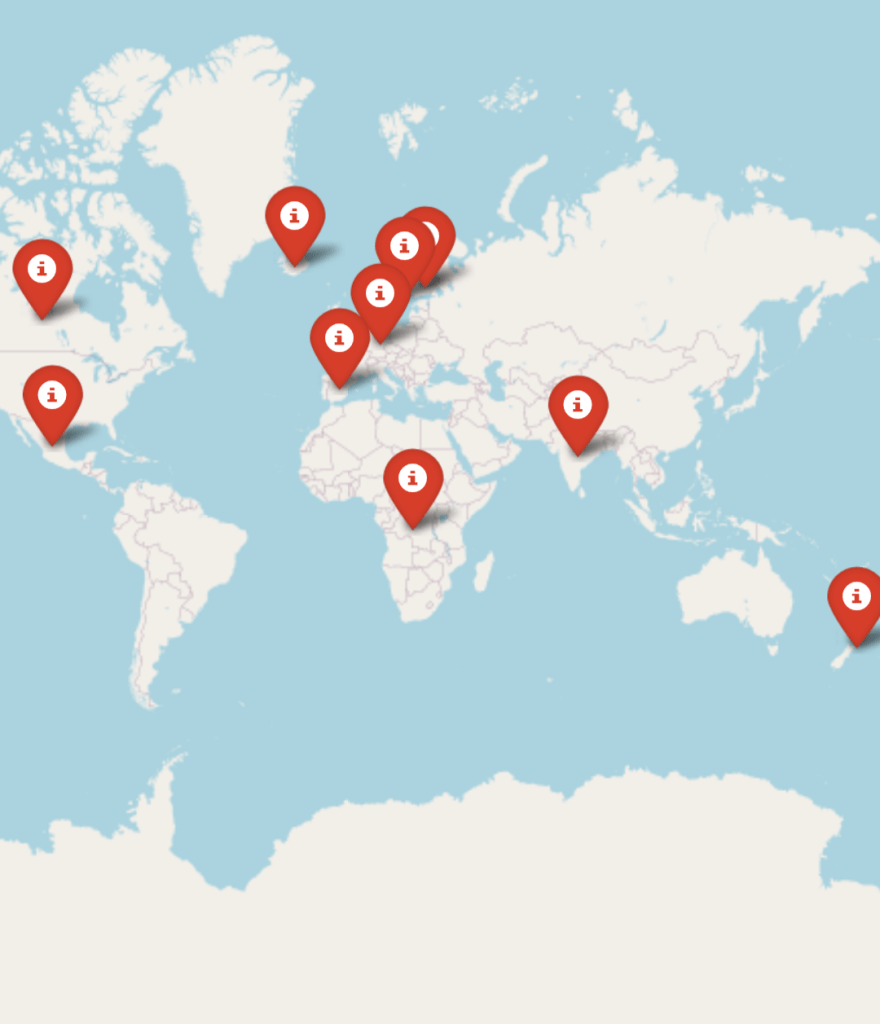
These real-world examples showcase successful implementations of policies that align with the Functional Conflict Perspective (FCP) framework, demonstrating their impact on social cohesion, economic justice, and trauma-informed governance.
—
🔴 Trauma-Informed Governance
🇸🇪 Sweden – Universal Parental Leave
Policy: Parents receive 480 days of paid leave per child, with flexible sharing between partners.
Impact:
Increases secure attachment in children.
Reduces gender inequality by allowing fathers to participate equally.
Improves work-life balance, reducing long-term stress and economic strain.
🇳🇿 New Zealand – Restorative Justice in Sentencing
Policy: Restorative justice programs are used in youth and criminal courts, focusing on rehabilitation rather than punishment.
Impact:
20% reduction in reoffending rates.
Increased victim satisfaction by allowing dialogue and healing.
Saves millions in incarceration costs by reducing prison populations.
🇨🇦 Canada – Indigenous-Led Trauma Recovery Centers
Policy: Indigenous-led healing lodges and trauma recovery centers provide culturally sensitive care for survivors of violence, addiction, and intergenerational trauma.
Impact:
Higher healing success rates than state-run mental health programs.
Recognizes traditional healing methods alongside modern therapy.
Reduces suicide rates among Indigenous populations.
—
🟠 Economic Justice & Reparations
🇫🇮 Finland – Universal Basic Income (UBI) Pilot
Policy: Finland conducted a two-year experiment giving 2,000 unemployed people €560 per month with no conditions.
Impact:
Increased employment rates despite no work requirement.
Participants reported higher well-being and lower stress.
Proved that removing financial precarity improves mental health and social engagement.
🇨🇩 Democratic Republic of Congo – Debt Cancellation & Economic Growth
Policy: In 2010, the IMF canceled $12.3 billion of debt for the DRC, relieving financial pressure on essential services.
Impact:
Freed resources for education, healthcare, and infrastructure.
Reduced economic instability and extreme poverty.
Demonstrated that debt relief enables long-term economic resilience.
—
🟣 Decolonized Social Systems
🇮🇳 India – Alternative Healing in Public Health
Policy: The Indian government officially recognizes Ayurveda, Siddha, and Yoga as integral parts of its healthcare system.
Impact:
Provides culturally relevant healing alongside Western medicine.
Increases public trust in healthcare services.
Promotes holistic wellness over pharmaceutical dependency.
🇲🇽 Mexico – Decolonized Education Curriculum
Policy: Curriculum reform integrates Indigenous knowledge, history, and language preservation into the national education system.
Impact:
Improves academic success rates among Indigenous students.
Strengthens cultural identity and language preservation.
Reduces educational disparities caused by Eurocentric curricula.
—
🟢 Participatory Democracy & Mutual Aid
🇪🇸 Spain (Mondragon Corporation) – Worker-Owned Cooperatives
Policy: The Mondragon Corporation, a network of 80,000+ workers, operates democratically owned businesses where profits are shared among workers.
Impact:
Increased economic stability compared to traditional corporations.
Higher wages, better working conditions, and lower unemployment.
Serves as a scalable model for non-exploitative economic structures.
🇩🇪 Germany – Public Banking System
Policy: Germany operates a strong network of public and cooperative banks that prioritize local reinvestment over profit-seeking.
Impact:
More stable financial system compared to the U.S. during crises.
Ensures that wealth stays within communities rather than being extracted.
Increases financial security for small businesses and cooperatives.
—
🔵 Mental Health & Community Well-Being
🇮🇸 Iceland – Community-Based Mental Health Centers
Policy: Iceland transitioned from a hospital-based psychiatric model to community-run mental health services.
Impact:
Lower hospitalization rates.
Increased access to therapy and mental health support.
Reduces stigma around seeking mental health care.
—
🌍 Final Takeaways from These Case Studies
These policies work because they address systemic issues from a functional, conflict-aware perspective.
Trauma-informed and decolonized models outperform punitive and extractive systems.
Community-led, cooperative, and mutual-aid-based structures create sustainable alternatives to corporate and state control.
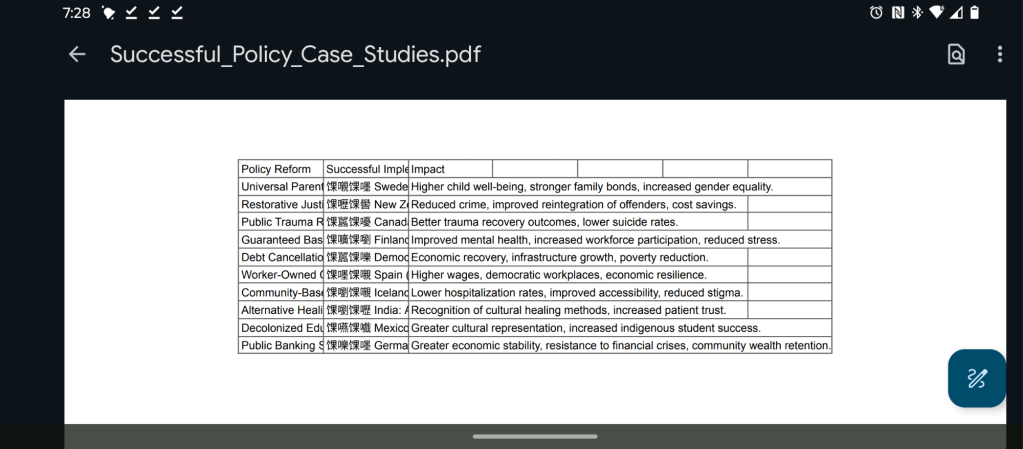
📌 This table highlights real-world policy implementations across different nations, showcasing their positive impacts on social well-being, economic stability, and governance.
Sweden’s parental leave policy strengthens family bonds and gender equality.
New Zealand’s restorative justice system reduces crime and improves rehabilitation.
Canada’s trauma recovery centers enhance mental health outcomes and reduce suicide rates.
Finland’s UBI trials show improved mental well-being and workforce participation.
Spain’s worker-owned cooperatives increase wages and economic resilience.
Germany’s public banking model enhances financial stability and wealth retention.
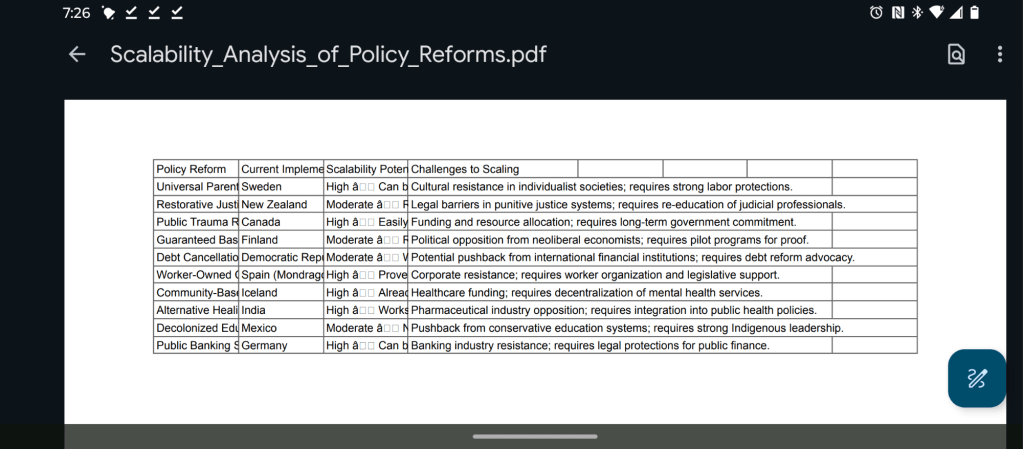
2️⃣ Scalability Analysis of Policy Reforms
📊 This table evaluates the feasibility of scaling key policy reforms globally, highlighting scalability potential and challenges to implementation.
High scalability: Policies like public banking, worker cooperatives, and community-based mental health are easily transferable across regions.
Moderate scalability: Programs such as restorative justice, UBI, and decolonized education require structural adjustments before widespread adoption.
Key challenges: Political resistance, industry opposition, financial constraints, and cultural adaptation barriers need strategic solutions.

Introduction: The Need for a Coordinated Approach
Scaling successful policy reforms requires a structured, strategic approach. This roadmap outlines key phases, implementation steps, stakeholder engagement, and risk mitigation strategies to ensure the smooth adoption of economic justice, trauma-informed governance, and participatory democracy policies on a global scale.
—
Phase 1: Pilot Programs & Feasibility Studies (Years 1-3)
Objectives:
✔ Launch localized pilot programs in diverse economic and cultural contexts.
✔ Gather data on effectiveness, public reception, and economic impact.
✔ Identify key barriers to scaling and develop solutions.
Key Actions:
1️⃣ Select Test Regions – Implement policies in small-scale cities or municipalities to assess impact.
2️⃣ Partnership Development – Work with local governments, NGOs, and research institutions.
3️⃣ Public Engagement & Awareness – Host town halls, educational campaigns, and media outreach.
4️⃣ Data Collection & Analysis – Track economic shifts, well-being metrics, and public response.
5️⃣ Adjust for Localized Needs – Adapt policies based on pilot feedback.
—
Phase 2: Policy Advocacy & Legislative Integration (Years 3-6)
Objectives:
✔ Move from local pilots to national-level policy discussions.
✔ Develop legal frameworks for public banking, UBI, restorative justice, and trauma recovery.
✔ Secure cross-partisan political buy-in and support from stakeholders.
Key Actions:
1️⃣ Draft Model Legislation – Create legal templates for policymakers to adapt.
2️⃣ Legislative Lobbying – Engage with government representatives and build coalitions.
3️⃣ Economic & Feasibility Studies – Present cost-benefit analyses to counter opposition.
4️⃣ Stakeholder Alignment – Bring business leaders, labor unions, and grassroots activists into discussions.
5️⃣ Legal Protections & Institutional Backing – Secure long-term safeguards to prevent policy reversals.
—
Phase 3: Scaling to National & International Levels (Years 6-10)
Objectives:
✔ Secure national implementation in multiple countries.
✔ Expand international cooperation to create cross-border policy alignment.
✔ Institutionalize reforms through global economic agreements.
Key Actions:
1️⃣ Expand Public Banking & Cooperative Models – Transition financial infrastructure to prioritize community ownership.
2️⃣ Formalize Trauma-Informed Governance Policies – Implement nationwide mental health and justice reforms.
3️⃣ Strengthen Participatory Democracy Systems – Introduce citizen-led councils to shape local policies.
4️⃣ Secure International Policy Agreements – Partner with UN, IMF, World Bank, and regional coalitions.
5️⃣ Long-Term Monitoring & Adaptation – Ensure ongoing evaluation to refine policies over time.
—
Risk Mitigation & Challenge Response Strategy
1. Overcoming Political Resistance
✅ Build multi-partisan support through data-driven arguments & economic case studies.
✅ Engage business leaders and financial sectors to demonstrate economic benefits.
2. Addressing Corporate Pushback
✅ Implement corporate tax incentives for participation in cooperative economic models.
✅ Create public-private partnership opportunities to align interests.
3. Ensuring Public Trust & Adoption
✅ Conduct extensive public outreach campaigns to explain benefits.
✅ Establish feedback mechanisms for continuous citizen engagement.
4. Adapting to Different Cultural & Economic Contexts
✅ Use localized adaptation frameworks to ensure cultural relevance.
✅ Collaborate with regional experts and Indigenous leaders for policy customization.
—
Conclusion: A Roadmap for Sustainable Global Change
This strategic roadmap provides a structured pathway to scaling transformative policies worldwide. By starting with pilot programs, securing legislative support, expanding internationally, and mitigating risks, we can establish a sustainable, cooperative, and trauma-informed future.
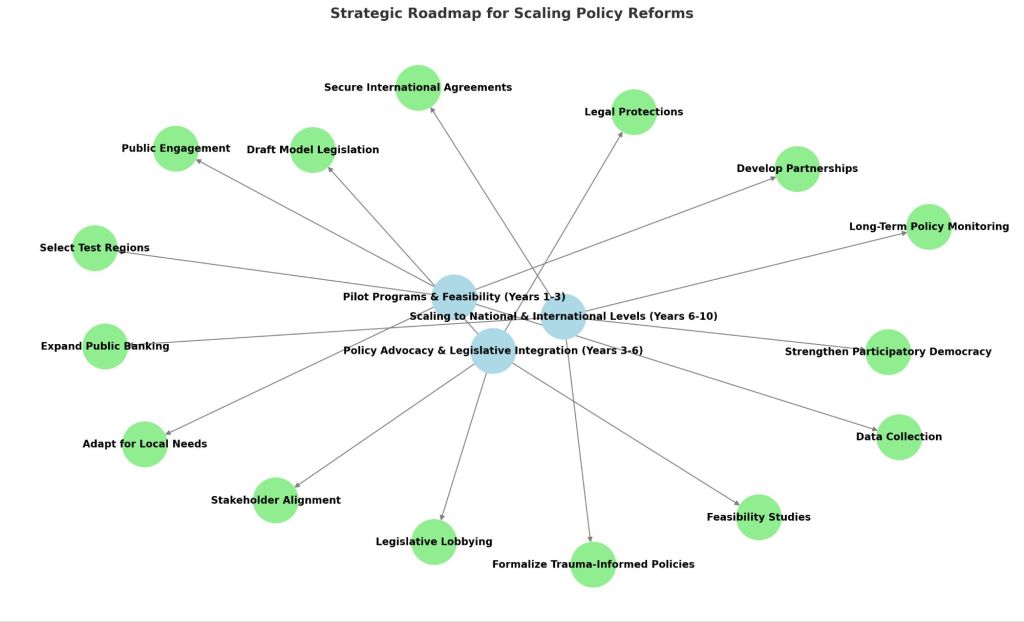
Blue Nodes represent the major phases (Pilot Programs, Policy Advocacy, and Scaling).
Green Nodes represent key action steps within each phase.
Arrows show the logical progression of implementation from local pilots to global policy integration.

 Spirolateral