Conflict as a Path to Integration
FCP integrates multiple academic disciplines into a unified framework that maps conflict across different levels of analysis. Below is the structural breakdown:
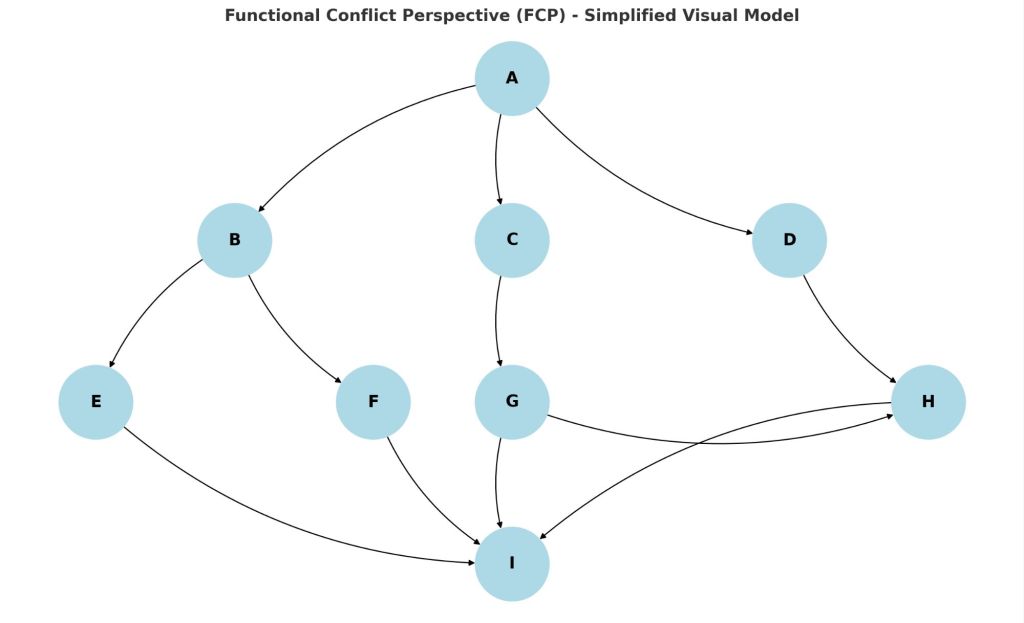
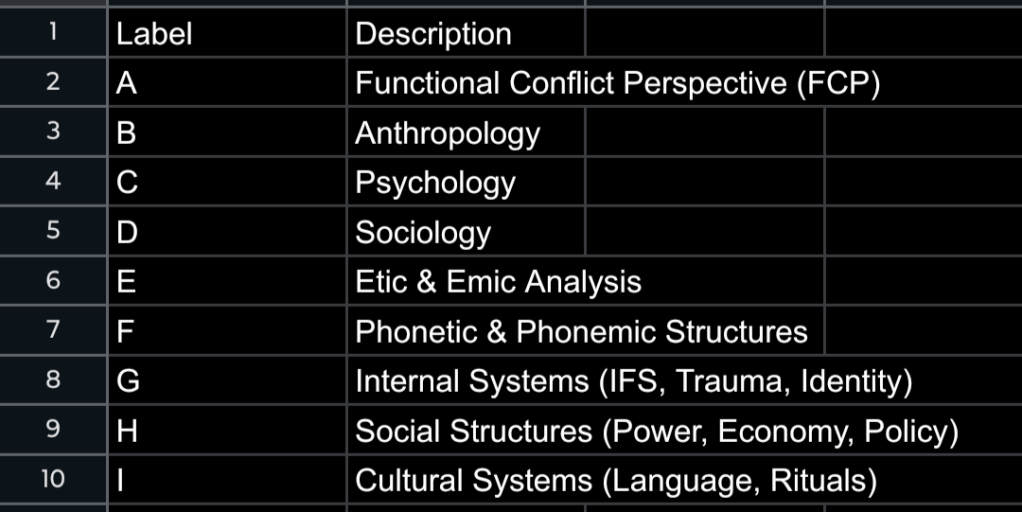
Each of these elements interacts dynamically, meaning that conflict in one domain (e.g., economic oppression) often mirrors unresolved tensions in another (e.g., individual trauma, historical narratives, or governance failures).
Traditional social, political, and economic systems have viewed conflict as a threat—something to be eliminated, suppressed, or controlled through hierarchical structures. Whether in governance, workplace dynamics, or social movements, the dominant response to conflict has been coercion and suppression, which often leads to greater instability, polarization, and systemic breakdowns.
The Functional Conflict Perspective (FCP) offers a transformational approach, recognizing that conflict is not inherently destructive. Instead, conflict is a signal of unintegrated needs within individuals, communities, and institutions. Rather than suppressing conflict, FCP seeks to integrate competing perspectives into a coherent and adaptive whole.
FCP is a meta-framework that bridges anthropology, psychology, sociology, linguistics, and systems theory to analyze and resolve conflict at multiple levels. It incorporates:
Mirror Integration Theory (MIT) → Understanding societal conflict as a reflection of internal psychological fragmentation.
Restorative Cohesion → Moving from coercion-based stability to trust-based, relational stability.
Trauma-Informed Governance & Decentralized Structures → Replacing top-down control with participatory, adaptable systems.
Curiosity-Driven Knowledge Production → Shifting from adversarial debate models to collaborative, discovery-based knowledge systems.
Linguistic Anthropology & Cultural Analysis → Mapping how language and communication shape conflict and cohesion.
This paper presents FCP as a meta-framework, integrating sociology, psychology, political theory, and neuroscience to provide a roadmap for resolving social, economic, and epistemic conflicts in a way that fosters sustainable societal cohesion.
I. The Core Principles of Functional Conflict Perspective (FCP)
- Conflict is Functional When Engaged Constructively
- Conflict arises not from dysfunction but from unmet needs.
- Suppression intensifies division, while structured integration leads to stability.
- Hierarchical Power Structures Exacerbate Conflict
- Centralized authority structures do not resolve conflict but instead control it through coercion.
- Participatory governance, economic decentralization, and knowledge-sharing cultures create environments where conflict can be processed and integrated.
- Internal and External Conflicts Mirror Each Other
- Mirror Integration Theory (MIT) explains that fragmented individuals create fragmented societies.
- Healing social divisions requires relational healing at both individual and collective levels.
- Sustainable Stability Emerges from Integration, Not Suppression
- Systems that prioritize adaptability over rigid control foster long-term resilience.
- Conflict resolution should be framed as integration work rather than as a battle to be won.
II. Mapping Conflict Across Societal Structures
The FCP Visual Model maps conflict as an interconnected system rather than a linear struggle between opposing forces.
Each node in the diagram represents a domain of systemic function (governance, economics, psychology, epistemology, etc.), while the edges (connections between nodes) represent conflicts that must be integrated rather than eliminated.

III. FCP in Action: Case Studies in Social, Political, and Economic Transformation
1. Restorative Governance: From Coercion to Participation
Example: Indigenous Consensus-Based Governance (Iroquois Confederacy, Zapatista Self-Governance)
- Instead of coercive state control, participatory governance structures integrate diverse perspectives through relational accountability.
- FCP explains why participatory models create stability—because they address conflicts as opportunities for synthesis rather than suppression.
2. Economic Transformation: Shifting from Extractive to Regenerative Models
Example: Mondragon Worker Cooperatives (Spain), Universal Basic Security (UBS) Pilots
- Traditional capitalist models rely on scarcity-based coercion (job dependency, financial insecurity, worker exploitation).
- FCP advocates economic frameworks that provide financial security while encouraging participation, innovation, and sustainable productivity.
3. Curiosity-Driven Knowledge Production: From Debate to Discovery
Example: Open-Access Scientific Collaboration vs. Academic Gatekeeping
- Traditional academia relies on competitive, adversarial knowledge production.
- FCP proposes a shift toward collaborative, curiosity-driven inquiry, where intellectual conflict is framed as an opportunity for knowledge integration rather than territorial disputes.
IV. Implementing FCP at Scale: Policy and Structural Recommendations
- Governance & Political Systems
- Replace punitive legal structures with restorative justice models.
- Transition from hierarchical state control to participatory, trauma-informed governance.
- Decentralize decision-making processes to integrate diverse perspectives.
- Economic Reforms
- Implement universal basic security (UBS) to eliminate economic coercion.
- Expand worker-owned cooperatives as an alternative to corporate extraction.
- Measure economic success based on collective well-being rather than GDP growth.
- Social and Cultural Systems
- Decriminalize dissent and integrate protest movements into structured reform models.
- Teach emotional intelligence and conflict resolution in education systems.
- Use media narratives to reframe conflict as an adaptive, necessary process.
- Knowledge and Intellectual Systems
- Shift from adversarial debate models to cooperative knowledge production.
- Create interdisciplinary research structures that prioritize curiosity over ideological entrenchment.
- Reform academic gatekeeping to allow broader participation in knowledge creation.
V. Conclusion: The Future of Conflict as an Integrative Force
The Functional Conflict Perspective (FCP) provides a roadmap for resolving inequality, injustice, and systemic fragmentation by transforming the role of conflict from destruction to integration.
This meta-framework connects governance, anthropology, linguistics, economy, psychology, and knowledge production under a shared model of adaptive integration rather than coercive control.
By embracing trauma-informed governance, regenerative economics, participatory democracy, and curiosity-driven inquiry, we build a world where conflict strengthens rather than divides—where integration replaces suppression as the foundation of sustainable social cohesion.
References
- Coser, L. (1956). The Functions of Social Conflict.
- Durkheim, E. (1893). The Division of Labor in Society.
- Marx, K. (1848). The Communist Manifesto.
- Porges, S. (1995). Polyvagal Theory and the Biology of Trust.
- Graeber, D., & Wengrow, D. (2021). The Dawn of Everything: A New History of Humanity.
- Santos, B. de S. (2018). Epistemologies of the South: Justice Against Epistemicide.
- Snow, I. S. (2025). The Functional Conflict Perspective: A New Model for Social Transformation.
The Functional Conflict Perspective (FCP) transforms how we understand, engage with, and resolve conflict. Rather than viewing conflict as a destabilizing force, FCP recognizes that integration—not suppression—is the key to sustainable stability.
By applying FCP across governance, economics, education, and social systems, we can:
✅ Resolve inequalities without coercion
✅ Create knowledge systems that prioritize synthesis over competition
✅ Develop economic models that sustain collective well-being
✅ Build a political landscape that integrates, rather than polarizes, diverse perspectives
The future of societal cohesion depends on whether we choose to suppress conflict or integrate it into a system that allows for adaptation, inclusion, and collective resilience.


 Spirolateral