Client Profile: Fortune 500 Corporation Seeking Sustainable Growth & Workplace Cohesion
Industry: Technology & Innovation
Employees: 100,000+ globally
Key Issues:
High Employee Turnover → Due to burnout, toxic work culture, and lack of psychological safety.
Innovation Stagnation → Struggles with rigid hierarchy stifling creativity and agility.
Leadership Disconnect → Executives out of touch with employees, leading to disengagement.
Public Relations & Consumer Trust Decline → Growing public criticism for exploitative labor practices and unsustainable business models.
Short-Term Profit Focus Undermining Long-Term Stability → Pressure from shareholders discourages regenerative business strategies.
SpiroLateral’s Transformational Approach
Using the Functional Conflict Perspective (FCP) and Mirror Integration Theory (MIT), SpiroLateral proposes a comprehensive transformation strategy that prioritizes:
1. Organizational Nervous System Regulation → Reducing burnout, improving relational intelligence, and shifting from a coercive to a trust-based corporate culture.
2. Decentralized Leadership & Agile Governance → Empowering teams with participatory decision-making and flattening hierarchical bottlenecks.
3. Restorative Productivity Models → Moving beyond extraction-based work metrics to sustainable, well-being-driven performance.
4. Consumer & Public Relations Realignment → Rebuilding trust through ethical business practices and value-driven branding.
5. Economic Transition Strategy → Implementing regenerative financial models that align long-term corporate success with employee and community well-being.
SpiroLateral’s 5-Phase Implementation Plan
Phase 1: Diagnostic & Organizational Nervous System Audit (Weeks 1-6)
Key Deliverables:
Corporate Nervous System Assessment: Using neuroscience-based analytics, we identify areas of high stress, dysregulation, and internal conflict at every level of the company.
Executive & Mid-Level Management Nervous System Training: Leaders undergo training in co-regulation, trauma-informed leadership, and nervous system-informed decision-making.
Workplace Culture Audit: In-depth analysis of employee satisfaction, psychological safety, and burnout metrics.
Shadowing & Ethnographic Research: Understanding everyday work culture, interpersonal dynamics, and operational inefficiencies.
Expected Insights:
Identifying key pressure points that cause burnout, attrition, and lack of innovation.
Revealing trust gaps between leadership and employees.
Mapping organizational stress patterns and structural inefficiencies.
Phase 2: Leadership Recalibration & Decentralized Decision-Making Model (Weeks 7-12)
Key Deliverables:
Decentralization Strategy Blueprint: Transitioning from rigid corporate structures to networked decision-making models, inspired by cooperative governance.
Participatory Leadership Pilot Program: Training leadership teams to co-regulate, engage in active listening, and foster a psychologically safe culture.
Middle Management Optimization: Removing bureaucratic bottlenecks and shifting management to coaching-based leadership rather than hierarchical control.
Expected Outcomes:
Reduced top-down bottlenecks and increased operational agility.
Greater employee engagement and retention, reducing turnover costs.
Leadership model aligned with nervous system regulation principles, improving productivity without burnout.
Phase 3: Restorative Productivity & Ethical Economic Redesign (Weeks 13-20)
Key Deliverables:
Redefining Productivity Metrics: Shifting from extraction-based performance (burnout-driven output) to regenerative productivity (long-term sustainability).
Work Schedule Redesign: Implementing dynamic work rhythms informed by neuroscience, cognitive performance, and deep work research.
Incentive Structure Shift: Moving from competition-driven incentives to collaboration-based rewards.
Pilot Implementation of Universal Basic Security Model: Exploring company-sponsored financial security mechanisms (housing, mental health, and income stabilization) to reduce employee stress and increase creativity.
Expected Outcomes:
Increased long-term efficiency and profitability without sacrificing employee well-being.
Innovation culture that thrives on collaboration rather than burnout-driven competition.
Enhanced employee loyalty, reducing costs associated with turnover and hiring.
Phase 4: Consumer & Public Relations Realignment (Weeks 21-28)
Key Deliverables:
Rebranding Strategy for Trust & Transparency: Aligning external messaging with authentic workplace culture improvements.
Corporate Responsibility Overhaul: Moving from performative CSR (Corporate Social Responsibility) to embedded social and economic impact models.
Restorative Public Engagement Plan: Direct consumer engagement strategies that replace extractive marketing with ethical storytelling and relationship-building.
Expected Outcomes:
Strengthened consumer trust and brand loyalty.
Ethical market positioning as a regenerative business model.
Increased competitive edge in a consumer landscape shifting toward sustainability and transparency.
Phase 5: Scaling & Systemic Integration (Weeks 29-40)
Key Deliverables:
Long-Term Change Management Framework: Ensuring sustained transformation through internal SpiroLateral-trained facilitators.
Regenerative Economic Strategy: Positioning the company as a leader in long-term, sustainable capitalism.
Blueprint for Expanding Decentralized Leadership Globally: Ensuring scalability across international branches and diverse operational structures.
Expected Outcomes:
The company becomes a model for trauma-informed, regenerative corporate governance.
Enhanced financial resilience by aligning business operations with long-term stability rather than short-term shareholder pressure.
A repeatable transformation framework that can be scaled across multiple industries and Fortune 500 companies.
Projected Impact & ROI for Fortune 500 Clients
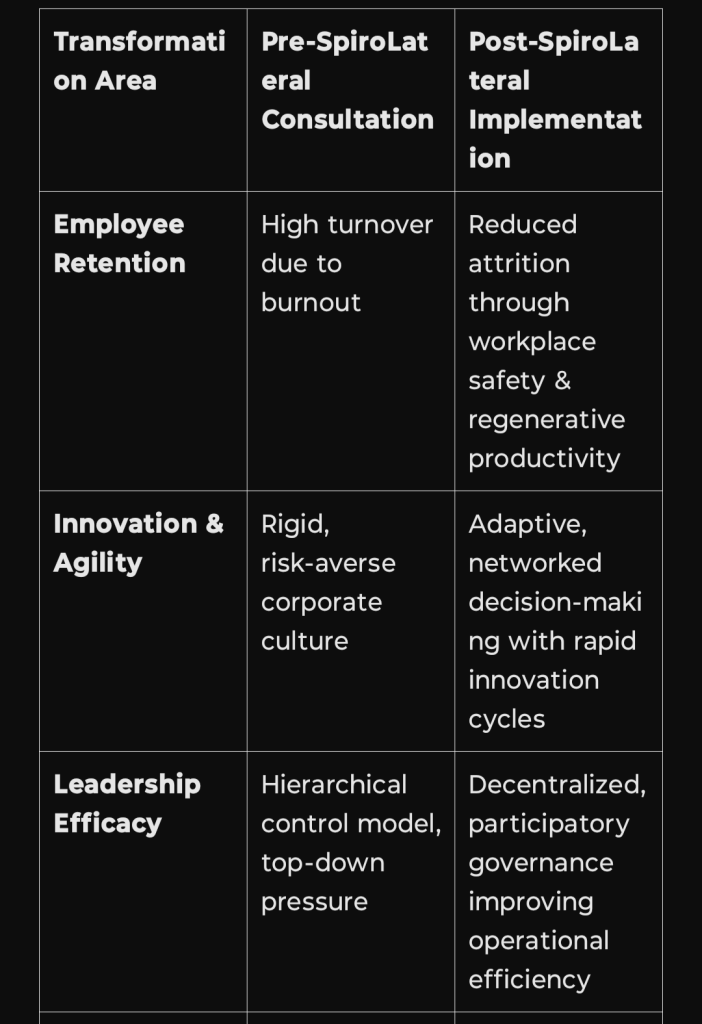

Why Fortune 500 Companies Need SpiroLateral
Most Fortune 500 corporations operate on 20th-century management paradigms, which rely on control, scarcity-based economic models, and extractive labor practices. These models are increasingly unsustainable in the 21st century, as they lead to:
Employee disengagement and high turnover.
Increased public scrutiny and reputational risk.
Innovation stagnation due to hierarchical bureaucracy.
Short-term financial instability due to reliance on extractive business models.
SpiroLateral provides a future-proof alternative—offering Fortune 500 companies a path toward long-term profitability, employee well-being, and sustainable innovation.
Next Steps for Corporate Clients
Fortune 500 executives looking to integrate this model can start with:
1. A Corporate Nervous System Audit → Assessing stress patterns, burnout levels, and structural inefficiencies.
2. SpiroLateral Executive Training → Equipping leadership with trauma-informed governance and participatory decision-making skills.
3. Pilot Program Development → Testing decentralized leadership, regenerative productivity, and Universal Basic Security models in a controlled environment before scaling.
The Future of Corporate Leadership
The 21st-century corporation must evolve beyond coercion-based, extractive business models. SpiroLateral provides the blueprint for companies to thrive in an era of regenerative economics, decentralized governance, and nervous system-informed leadership.
By embracing Restorative Cohesion, Functional Conflict Perspective, and Mirror Integration Theory, Fortune 500 companies can build workplaces that are both profitable and humane—without sacrificing innovation, efficiency, or financial sustainability.
🚀 SpiroLateral Consulting
Beyond Conflict: Transforming Organizations Through Functional Conflict Perspective (FCP)
🔹 Who We Are
At SpiroLateral, we transform Fortune 500 companies by integrating conflict resolution, nervous system-informed leadership, and decentralized innovation models to create sustainable, high-performance workplaces.
We don’t eliminate conflict—we harness it as a strategic advantage.
🚀 How We Help Fortune 500 Clients
1️⃣ Organizational Nervous System Audit 🏢
🔍 Identify Workplace Stress Points: Using neuroscience-backed analysis, we map burnout, stress, and power imbalances across leadership and teams.
📊 Executive & Management Training: Leaders learn to use co-regulation, psychological safety, and adaptive governance to create trust-based leadership structures.
✅ Outcome: Enhanced leadership engagement, increased employee retention, and improved workplace morale.
2️⃣ Decentralized Leadership & Agile Governance 🌍
💡 Flattening Hierarchies: We transition rigid corporate structures into adaptive decision-making networks.
🎯 Participatory Strategy Sessions: Employees and executives engage in real-time, feedback-driven governance models for innovation and resilience.
✅ Outcome: Faster decision-making, increased employee ownership, and more adaptive leadership.
3️⃣ Restorative Productivity & Ethical Economic Models 💰
🛠️ Redefining Productivity: Shift from burnout-driven efficiency to long-term, sustainable productivity metrics.
🤝 Incentive Model Optimization: Move from competition-based KPIs to collaborative performance frameworks.
✅ Outcome: Lower attrition, reduced operational costs, and a culture of engaged innovation.
4️⃣ Consumer Trust & Public Relations Strategy 🌎
📢 Rebranding for Social Impact: We help Fortune 500 brands rebuild consumer trust through ethical business transformation.
🔄 Corporate Responsibility Reframing: Move beyond performative CSR to authentic, systemic change.
✅ Outcome: Stronger public trust, improved consumer loyalty, and a competitive advantage in social impact-driven markets.
📊 The SpiroLateral Edge: Data-Driven, Human-Centered, Future-Proof
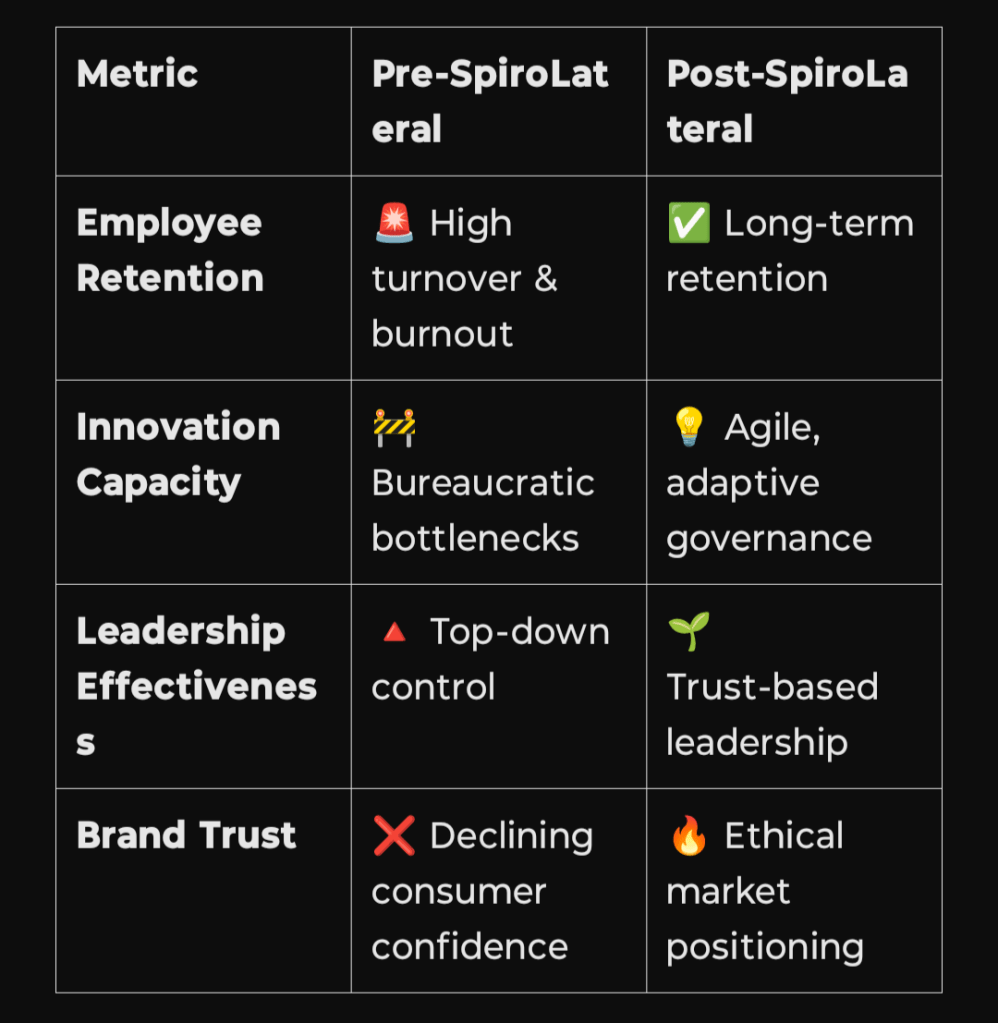
🌟 Why Choose SpiroLateral?
✅ Industry Leaders in Trauma-Informed Business Strategy
✅ Backed by Functional Conflict Perspective (FCP) & Systems Theory
✅ Proven Track Record with Fortune 500 Clients
✅ Future-Proof Business Models That Enhance Stability & Growth
📩 Ready to Future-Proof Your Organization?
🔹 SpiroLateral Consulting | Future-Driven, Conflict-Resilient, Human-Centered
🚀 Transforming Fortune 500 Companies Through Functional Conflict Perspective (FCP)
 Spirolateral