Written by
Kaven Winters, Karisma Vega, Sarah Flowers, Trevor Melton, Isabella Rich
Lower Columbia College
BUS144/Management of Human Relations
Tim Allwine, Instructor, Business Management
November 26, 2023
Affirmative Action in Hiring Veterans/Disabled
Table of Contents
Cover page
Title page
Table of Contents
Executive Summary
Thesis Statement
Main Body
Rebuttal
Conclusion
References
Appendix
Executive Summary
The different ways that brains process information results in two distinct communication styles. These communication styles are neurotypical and neurodivergent. A neurotypical person is defined as a person who has normal brain function and processing. A neurodivergent person is defined as a person who may sit on the spectrum or display atypical behavior and or development. Focusing on neurodivergent development and behavior, we will be discussing the miscommunications that can occur when managers are unaware of these differences. Failure for companies to acknowledge these differences can result in an unproductive, unprofitable, and uncomfortable work environment. Neurodivergence is a primary part of a person’s identity, it is something that someone cannot change. Neurodivergent people are born with a different outlook on the world because they process life differently than the average neurotypical person. The Civil Rights Act of 1964 makes it illegal to discriminate against race, color, religion, sex, or national origin. Yet it doesn’t mention any discrimination against neurodivergent people. Discrimination is a result of stereotypes and prejudice. Given that having a neurodivergent identity is never a choice and falls under the category of a primary identity characteristic, this paper contends that the Civil Rights Act should be amended to also include neurodiversity. If the United States government mandated policies of inclusivity and shifted their corporate cultures to a perspective of embracing and empowering neurodiverse people, they would find a hidden powerful asset among neurodivergent people. Creating a work environment that caters to both neurotypical and neurodivergent strengths, the results could succeed well and be above expectation. Making it aware to companies that not everyone perceives the world in the same light could result in a more positive work environment for both employee and employer. Compassion and the ability to understand differences within a workforce paves the way for an increase in productivity, profit, and a mutual understanding within a company.
Thesis Statement
The United States government doesn’t have a set of policies that prohibit corporations, businesses, and organizations the opportunity to discriminate against the neurodiverse populations. By neglecting to create inclusive policies that directly support our neurodiverse population, there is a grey area which allows for discrimination and inequality against anyone who is not neurotypical. This facilitates preexisting institutionalized of a neurotypical supremacy in society. Adopting a culture of inclusivity by utilizing a bottom-up style of managing and communication in the workplace, we believe that this style will lead to a more profitable, productive, and precise work environment that benefits all.
Introduction
Two ways of processing will result in two different ways of communicating. If we begin to accept these differences and understand that not everyone can fit into the same box, maybe then companies will begin to realize the error with having a system that can only benefit neurotypicals and not the neurodivergent. These both can be increased dramatically through understanding the ways that employees process information and learning how we can accommodate them. The neurodiversity movement is a social movement that acknowledges that everyone has differences. Believing that by adopting a culture of inclusivity by utilizing a bottom-up style of management and communication in the workplace, this style of leadership will lead to a more profitable, productive, and precise work environment that benefits all. The neurodiversity paradigm sees neurodiversity as a natural variation in neurocognitive functioning. It supports the issue that there is no right or wrong way of perceiving the world, that everyone’s brain functions differently within constructed societies. The terms neurodivergent and neurodiverse can be used interchangeably. This paper proposes defining a neurodiverse person as an individual who experiences the world intensely because of a higher number of neuronal connections and more electrical activity in the nervous system than is typically found in Western society, and who processes information in the order of energy/sensation first and words/cognitive second (known as bottom-up processing). The neurodivergent umbrella is ever expanding and includes Autism Spectrum Disorder, ADHD, BPD, DID and OSDD, NPD, ASPD, Bipolar, Epilepsy, OCD, ABI, Tic Disorders, Dyslexia, C-PTSD, Dyspraxia, Schizophrenia, Misophonia, HPD, Sensory Processing Disorder, Dyscalculia, Down Syndrome, PTSD, Dysgraphia, and Synthesis. (Lived Experiences Educator, 2019)
Main Body
A neurotypical is an individual whose brain does not differ from the statistical norm, which for the purposes of this paper will be defined as an individual who uses “top down” thinking, one which draws on prior learning and experiences, as opposed to the neurodivergent “bottom up” way of approaching their environment, viewing details before concepts. These different ways of thinking result in different ways of communicating as well, and ultimately result in two separate styles of managing a business, a top down being a hierarchical approach where decisions are made by leaders at the top, and a bottom-up approach of leadership where all teams and individuals have a voice. System theories provide a framework for understanding how complex systems work through the study of how interrelated and interdependent components comprise a larger unified whole, and systems theory could account for the primary reason why our most common managerial style in business, a top-down approach, so closely resembles the current hierarchical structure of the federal government in the United States, which is also a top-down system. Top-down styles of communication also predominate as the “neurotypical” accepted manner of speech, whereas neurodiverse bottom-up communication, which seeks to identify underlying behaviors communicating unmet needs challenges this culturally accepted norm. Affirmative action attempts to equalize unfairness that is caused by societies stratification such as people of color, women, and the disabled among others, but this paper contends that affirmative action and equality are not actually possible within a hierarchical top-down approach due to the system being founded upon institutionalized privileges and inequalities. For true equality to exist, a new system of government must be built based upon a bottom up or reverse hierarchical approach, where everyone has equal access to education, knowledge, skills, and opportunities. The first step to achieving that is to protect neurodivergence against discrimination in the workplace and following through on that promise by creating policies mandating bottom-up style management within America’s corporate culture.
The neurotypical versus neurodiverse communication styles can be broken down as follows: Logical vs. Emotional; Concrete vs Abstract; Absolutist vs. Relative; Avoidant vs. Insistent. (Forbes, 2017) Top-down processing occurs when inferences are made based on a general idea—something that overlaps to define the whole of what is being taken in. It is a concrete-driven act of processing that is dependent upon the previous parts of information to clarify data. The top-down approach to thinking incorporates an embracing belief, rule, or law to deduce something about a particular instance or circumstance and is dependent upon connections from experience and memories. A top-down approach to reading can be thought of as taking in the whole of the paragraph instead of deciphering each word separately. Bottom-up thinking is said to take place through a process of taking in details and building up from there. The fragmented bits and pieces are structured and categorized, and then an induction is made—a process that brings rise to something. This thinking style involves formulating connections with other examples to make sense of what is occurring, and then capturing the commonalities between the connections into something concrete. In total, the bits and pieces are being reassembled into something that makes sense and leads to a resulting conclusion. (Ciampi, 2017)
Solange Nicole said, “There’s nothing more debilitating about a disability than the way people treat you over it.” Neurodiverse individuals face many challenges when attempting to enter the workforce. The stress of placing demands on already stressed nervous systems can create new mental health issues or worsen existing ones. There is a significant lack of services and resources available for all adult Neurodiverse (ND) populations as soon as they age out of school. (NeuroHomes, 2021) They might find it harder to communicate and socially interact with typical people. Because of this and other factors, they are underemployed. Divergent people frequently work jobs that many typical people turn their backs on after graduating high school. Neurodiverse people are seen to be more than capable of executing jobs given to them when given the chance to be recruited. They contribute greatly to their workplace once given the chance to share ideas, thoughts, and their drive to get the job done. In fact, according to ADHS (Australia’s Department of Human Services), when comparing testing results of neurotypical and neurodiverse people, neurodiverse people tested 30% higher in productivity than any other group tested. One problem that prevents this group from moving up further in occupations and poses an issue for them to easily slip under the radar when applying to large companies, is the standardization of systems set in place today. This can make it very difficult for neurodivergent people to be recruited. It hinders them from being able to get a job done when their needs are overlooked in the workplace. It can make it difficult to be promoted to higher positions and make it almost impossible to grow and flourish within their own company. (Harvard Business Review, 2017) An estimated 700,000 people in the United Kingdom are on the spectrum, but only a scant 16% of this total are working full-time. (Fleximize)
The National Health and Resilience in Veterans Study (NHRVS) reported that among Veterans using VA care, 23 out of every 100 veterans surveyed (or 23%) had PTSD at some point in their lives, which is a shockingly high rate compared to the 6.8% incidence of PTSD among the general population. The risk is more significant for veterans who see combat and the more tours of duty that a veteran performs, the more likely the chances they will develop PTSD. PTSD is an acquired neurodivergence (meaning it is situational and can be resolved through treatment). Given that nearly a quarter of all military veterans will experience PTSD at some point, and considering their risk for developing PTSD increases exponentially with prolonged service, neurodivergent rights should also be extended to be veteran rights as well. Diversity, Equity, and Inclusion (DEI) initiatives are directed toward diversity groups including veterans. According to the U.S. Department of Labor, the affirmative action provisions of the Vietnam Era Veterans’ Readjustment Assistance Act of 1974 (VEVRAA) prohibit job discrimination and requires federal contractors and subcontractors to take affirmative action to recruit, hire, promote, and retain qualified veterans. This paper argues that the workforce should accommodate specific needs of veterans suffering from PTSD, a specific type of neurodivergence, through businesses utilizing bottom-up styles of communication with their employees in addition to operating businesses through a “open system” human resources framework (otherwise known as a reverse hierarchical system of management), which several businesses including the multinational technology company Google have recently popularized. It has been 59 years since the Civil Rights Act of 1964 and 49 years since the Vietnam Era Veterans’ Readjustment Assistance Act of 1974 were passed respectively, and in that time, society has acquired a vast amount of knowledge regarding neurology, which constitutes a primary identity characteristic, and as such neurology should be legally protected for being discriminated against. For the workplace to be fully inclusive and accessible to the neurodivergent population, which includes veterans with PTSD, new laws must be passed that mandate bottom-up styles of both communicating with employees and of managing businesses. Privilege isn’t the presence of perks and benefits; it is the absence of obstacles and barriers. Passing new laws that mandate bottom-up styles of communication and management eliminates some but not all the privileges that neurotypicals benefit from within top-down organizations.
Companies should be actively seeking to recruit the neurodiverse because they tend to have large IQs and often have specialized skills. They process greater quantities of information and have incredible attention to detail and can make patterns and connections that a typical person might miss. They tend to hyperfocus, which means they can work and concentrate intently for long periods of time without interruption. Another positive is their ability to think from the bottom up. While the top-down approach is considered the standard, it is often corrupted by confirmation bias. (Wright, 2020) Cognitive diversity drives better performance and limits groupthink within organizations. There are huge benefits to hiring the neurodiverse, so why aren’t we doing more as a society to accommodate them in the workforce? One reason is neurotypical privilege. Because this world is built for and favors a specific neurology, neurodivergent people are being excluded, to the detriment of the neurotypical world. (Bouckley, 2022) Dana Baker of Washington State University, in her article titled, ‘The Politics of Neurodiversity: Why Public Policy Matters’ discusses reasons why it is important to challenge neurotypical privilege. She quoted Ari Ne’eman, the founder of the nationally recognized Autistic Self-Advocacy Network (ASAN), who “like many modern disability activists, sees challenges relating to disability as resulting primarily from discrimination and from a failure to effectively support the celebration of different ways of being human.” (Baker, 2013) Another positive to businesses accommodating neurodiversity is by taking the necessary steps to make working environments more inclusive, the gates are opened for a more inclusive workforce. This can make companies eligible for the government’s Disability Confident scheme which will make a business more attractive to future employees. (Fleximize)
Communication helps build strong relationships with customers and colleagues, which accelerates closing deals while providing customers with tailored solutions that meet their needs. This results in satisfied customers who are more likely to make future purchases. (Seth, 2023) Labor burden is a crucial concept for running a profitable company and refers to company costs that go above and beyond employee wages. David Grossman reported in “The Cost of Poor Communications” that a survey of 400 companies with 100,000 employees each cited an average loss per company of $62.4 million per year because of inadequate communication to and between employees. Debra Hamilton asserted, in her article “Top Ten Email Blunders that Cost Companies Money,” that miscommunication costs even smaller companies of 100 employees an average of $420,000 per year. (SHRM, 2018) A Gallup study of nearly 200 organizations reported that companies with the highest levels of employee engagement were 22% more profitable and 21% more productive than those with low levels of engagement. (Push, 2021)
The word privilege refers to special advantages that one group has over another group, such as when a subculture is forced to acclimate to cultural norms within a larger group which dictates what is considered typical within a collective system. Neurotypical privilege places the burden and responsibility for performing the emotional labor of learning to communicate beyond their abilities on the shoulders of the neurodivergent individual, who already suffers from a taxed nervous system that is under constant stress due to living in a world that isn’t built to accommodate their needs. The information currently available to increase better communication between bottom up and top-down communicators often targets the neurodivergent individual, such as in the book “The Power of Neurodiversity: Unleashing the Power of Your Differently Wired Brain,” by Thomas Armstrong, Ph.D. (Armstrong, 2011) Accessibility is proactive and strives to remove barriers during the design stage of an event, program, or service.
Accommodation is reactive and strives to remove barriers caused by inaccessible design. This ensures people with disabilities have the same access as people without disabilities. Businesses could save millions of dollars every year by being proactive and learning how to communicate with bottom-up thinkers and by making their companies more accessible, they create more opportunities for employment and diversity in the workforce.

On September 28, 2023, a personal interview was conducted for this paper with Ms. Jacqueline Lewis, who works in a middle management position in the retail pet food industry at a store located in Nevada.
She related the following information:
“All of my coworkers are neurodivergent. All our bosses are neurotypical and allistic. I have been elected chief of communications because the communication barrier is that bad. Our bosses don’t say what they mean. “Can you come in for a bit until relief shows” really means “can you work a whole shift/open to close at the last minute? I don’t want to.” We had to make a huge group chat just to notify each other of price increases because they forget we have no way of knowing unless they tell us, and when they tell us they always tell the one who is not working that day. What should take 4 seconds to get a price takes 3 days because they refuse to be organized or efficient. They don’t even know who works for them, at what store, at what hours, or at what wage. We are all acting outside our pay grade because they are bad at managing neurodivergence. They had a huge problem with a coworker’s performance and wouldn’t say why. They just cut his hours without warning. All I was straight up and offer suggestions. Now they think I have management skills. I do, but I’m not a manager. They think I’m instrumental and that losing me would damage them when all I do is say please and keep instructions short. Before I realized all my people were neurodivergent like me and just needed things simplified in instructions/needed some teamwork to do the big daunting things, sales increased from around 600 a day to over 2k a day steadily for 6 months now and climbing.
Neurodivergent people think literally. We need our management to say what they mean the first time. Not talk to us like kids in a patronizing way, but in the sense of straightforward speech instead of fluffing to soften it. If a compliment sandwich is getting used, it should be short. “I like your initiative with inventory. But I need you to be more mindful of your time punches. Your attendance is fantastic.” If we’re doing something wrong, we need to be told or it’s going to keep happening. We don’t need to yell or lecture. A simple “phones are only out for work reasons” is enough. We hate good labor being rewarded with more labor. Give us money instead so we can feed off some unexpected dopamine. And praise. A tiny compliment or being noticed for the little contributions goes so far. I complimented the same coworker on his efforts for checking dates and he made spreadsheets with his motivation. When not praised, we feel unnoticed and unimportant, and that’s why my manager cries in her car after work. Everything would be a lot more productive and a lot more profitable if they could talk to us or treat us the way we need, but they don’t have the empathy or emotional intelligence for that, so it takes literal days for tasks that should take minutes because we must do a lot of guesswork to meet them where they want us to meet them. And for very little compensation.”
The neurodivergent nervous system is a vulnerable and sensitive thing. Frequently neurodivergent people struggle to adapt to change, stress, and conflict. (Neff, 2023) Many neurodivergent people have not only sensory processing differences but also language processing and communication differences. They are asked to learn to channel their nervous energy into positive energy, to present information logically, and to read and use body language effectively, all while seeming approachable and conversational. The most common communication differences are oversharing, under sharing, speaking anecdotally, being blunt/direct, having a high need for specificity, difficulty describing emotions (alexithymia) or physical sensations, and situational mutism. Executive dysfunction and a need for structure also have a communication component. (Associated Bodywork and Professionals, 2023) Neurodiverse people work to understand neurotypical people and to make themselves understood when interacting with them, and neurotypical people need to do the same amount of work (which might feel like more, because they’re not used to it). When someone speaks, a divergent person processes the words, then must consciously remember to manually interpret the facial expression, tone, and body language, and then assign importance to each factor. A neurotypical person immediately, and unconsciously processes all the non-verbal cues and unconsciously assigns them more importance than the words. Neither partner can change the way their brain works, so both need to keep in mind that their partner processes information differently. Helpful communication tips for neurodiverse and neurotypical people include having arguments over writing, allocating time for each person to speak, and using a color system to code preferences and needs. An article from Forbes magazine recommends that employers maximize communication channels and techniques by being cognizant of text-heavy emails and focusing on how to convey information that is concise, informative, and sensitive. (Kurter, 2020) Other tips for employers include being direct in communication, avoiding making assumptions about feelings and intentions, giving explicit details and instructions, allowing and answering questions, taking words at face value, reducing social expectations, understanding that neurodiverse individuals have variable functioning and have fluctuating energy levels, keeping in mind their justice orientation when strictly adhering to rules, refrain from unnecessary interruptions, evaluating employees based on skill level and not personal likability, and resisting the urge to encourage conformity. (Specialisterne, 2023) Some common sense rules for companies to follow are to be nice, be patient, listen carefully, pay attention, and instruct nicely. (Healthline, 2017)
Employee engagement is important because it improves loyalty and satisfaction, improves performance, and increases retention, lowers absenteeism, leads to a happier healthier workplace, and improves profitability. Communication is important for employee engagement because good communication keeps businesses moving forward and allows every member of the team to be heard. It helps leaders to understand their team members’ needs, enhances their sense of belonging, gives employees direction and purpose, and strengthens relationships between them. (Pumble, 2023) Poor communication results in a weakened company culture, decreased employee productivity, and a higher employee turnover. (Push, 2021) Our textbook states that “Individuals are the ones who determine the organizational ethics” (Dias, 2012, p 120-121), which means that for the United States government to begin to create inclusive policies, there must first be a public demand for change from the neurodivergent population and their allies.
Counter Thesis
It is crucial to consider the potential challenges and reservations associated with promoting neurodiversity in the workplace. While the argument underscores the importance of embracing neurodivergent individuals, it is worth noting that businesses, especially in today’s competitive world, often prioritize efficiency, productivity, and cost-effectiveness. Critics may argue that accommodating the unique needs of neurodivergent employees could entail substantial investments in resources and training, potentially slowing down overall operations and impacting the bottom line. They might contend that while inclusivity is vital, it should also be balanced with the pragmatic demands of a profit-driven world.
The study “Bottom-Up Workplace Law Enforcement: An Empirical Analysis” analyzed data on worker claims and retaliation in a landmark survey taken from 4,387 low-wage workers in three of the largest U.S. cities. (Alexander and Prasad, 2013) A major issue in a bottom-up style workplace is that many employment and labor laws rely on the workers themselves to enforce their rights, and because of this, it can fail to protect the rights of the most vulnerable, who lack information and access to it. Having knowledge is a prerequisite for enforcement of rights, like what we see in our nation today. Affirmative action attempts to equalize unfairness due to society’s stratification, which affords less social mobility and opportunities to people who are judged on their innate abilities, such as communication. Our modern world was created by a succession of meritocratic revolutions against aristocratic societies, where we first replaced the inherited land elite with people who are more deserving of their positions, and then this was broadened by giving rights to women, minorities, and the working class, but each successive movement for the gain of human and civil rights is historically pushed by a knowledge of a need for them or a sudden awareness of a lack of rights. The reason for that is because we live in a society with an imposed hierarchical system of governing itself, or a top-down system, where the needs of the many are seen as being less important than the needs of the few, who Karl Marx referred to as the ruling class. They exploit the working class and their lack of knowledge and abilities to protect themselves, and it is because of this capitalist system that a bottom-up workplace will become exploitative. For our paper to work effectively and based on the findings in the “Bottom-Up Workplace Law Enforcement: An Empirical Analysis” paper, for a bottom-up workplace to protect its most vulnerable populations, a Reverse Dominance Hierarchy must be applied to any mandated bottom-up approach. Reverse Dominance Hierarchy ensures that coercive leadership won’t develop through a process of empowering individuals autonomously and will counteract an imposed hierarchical system of exploitation.
Page 30 of Charlotte Alexander and Arthi Prasad’s paper “Bottom-Up Workplace Law Enforcement: An Empirical Analysis” states that “a bottom-up workplace enforcement regime may fail to protect the very workers who most need protection because workers making disputes often lack the legal knowledge and incentives needed for bottom-up workplace enforcement to work effectively.” (27) Therefore, to resolve this issue and for our paper to stand a rebuttal, legal knowledge must be distributed evenly amongst all workers to make bottom up communicating an effective and adoptable policy.
Furthermore, skeptics may express concerns about the unfortunate potential for miscommunication and misunderstanding in a mixed workforce. The argument posits that recognizing and addressing the distinct communication styles between neurodivergent and neurotypical individuals is essential. However, critics might argue that bridging this gap can be challenging, as it requires time, effort, and resources for training, coaching, and providing specialized accommodations. They may also point out that in a fast-paced business environment, where quick decision-making is crucial, the adjustments required to accommodate neurodivergent employees might not always be feasible. In addition, some may contend that placing the sole responsibility on employers to foster inclusivity might not be entirely fair. Instead, they argue that neurodivergent individuals should also adapt to the existing corporate culture and communication norms, as part of the give-and-take nature of the workplace.
While these counterarguments highlight valid concerns, it’s essential to strike a balance and consider the long-term benefits of neurodiversity in the workplace. Studies have shown that embracing neurodiversity can lead to enhanced creativity, innovation, and overall productivity, making it an asset for businesses. Additionally, fostering a culture of inclusivity not only benefits the neurodivergent workforce but can also lead to improved morale, loyalty, and employee retention, ultimately contributing to a healthier and more profitable work environment. Thus, the key is finding practical solutions to address these concerns and promote understanding among all employees to create a more equitable and productive workplace for everyone.
Conclusion
In conclusion, the United States government enables businesses and organizations to discriminate against the neurodiverse population by neglecting to create inclusive policies, not because it is in the nations or a company’s best interest, but because it facilitates preexisting institutionalized neurotypical supremacy structured into the United States’ hierarchical government system. Discrimination is a result of stereotypes and prejudice. The Civil Rights Act of 1964 makes it illegal to discriminate against race, color, religion, sex, or national origin. Because we are unable to control many of our identity characteristics that relate to our behavior and choices such as our basic neurology or our communications style, we believe that using a bottom-up style of communication would eliminate discrimination by creating a more inclusive atmosphere where everyone has a sense of belonging and feeling valued. The Equal Opportunity Commission (EEOC) was established to monitor discrimination laws. Their vision is about cultivating respectful and inclusive workplaces with equal opportunity for all. Because it would create a more inclusive work environment, using bottom-up styles of communication is aligned with the vision of the EEOC and thus should be a protected civil right. Washington State protects the presence of sensory, mental, or physical disabilities as well as protecting the rights of veterans and the military under their Fair Employment Practices Law and should adopt bottom-up communication as state policy. However, a barrier to an effective bottom-up workplace regime is a lack of knowledge and education about laws and regulations as well as individual rights. For a bottom-up style of operations to be fully equitable and inclusive, a reverse hierarchical style of management and governance must be employed, to avoid coercive leadership and worker exploitation. Affirmative action attempts to equalize unfairness due to society’s stratification, which affords less social mobility and opportunities to people who are judged on their race, color, religion, sex, or national origin. Society is currently structured so that equality is unattainable. It uses a hierarchical system that establishes social and physical controls over others to exploit resources. This is known to sociologists as dependency theory, where the more educated, skilled, and opportunistic people benefit from the exchange of other people having less education, skills, knowledge, and opportunities. For the system to work someone always must be on the peripheral, such as the neurodivergent are in the workplace. To achieve real equality, the state must provide equal opportunities to everyone based on individual talents regardless of their abilities, classes, or statuses. The only way to achieve that is through a reverse dominance hierarchy, which will ensure that coercive leadership does not develop. It empowers individuals autonomously and counteracts an imposed hierarchical system of exploitation. Fostering a culture of inclusivity by utilizing a bottom-up style of both managing and communicating in the workplace would lead to increased innovation and a healthier, more profitable and productive environment.
References
Management of Human Relations by Portolese Dias, 2012
Kirby, A.V., Bakian, A. V., Zhang, Y., Bilder, D. A., Keeshin, B. R., & Coon, H. (2019). A 20‐year study of suicide death in a statewide autism population. Autism Research, 12(4), 658–666. https://doi.org/10.1002/aur.2076 National Library of Medicine. (2019): https://www.ncbi.nlm.nih.gov/pmc/articles/PMC6457664/?fbclid=IwAR1Sw1wM8e8KeCmP5SduFt2jraQxaDENn2R2pekgaWQsh2ZTc9L5A1NmkFw
Labor’s Bill of Rights. (2017, July 18). The Century Foundation. https://tcf.org/content/report/labors-bill-rights/#:~:text=Labor%20rights%20are%20rooted%20in,Amendment%20freedoms%20from%20involuntary%20servitude.
Goldberg, H. (2023). Unraveling Neurodiversity: Insights from Neuroscientific Perspectives. Encyclopedia, 3(3), 972–980. https://doi.org/10.3390/encyclopedia3030070
https://www.mdpi.com/2673-8392/3/3/70
Resources. (2019). Lived Experience Educator. https://www.livedexperienceeducator.com/resources
Quora. (2017, July 7). Research Shows Three Distinct Thought Styles In People With Autism. Forbes. https://www.forbes.com/sites/quora/2017/07/05/research-shows-three-distinct-thought-styles-in-people-with-autism/
Ciampi, M. (2017, April 23). Bottoms-Up: The Innovative Thinking Style of the Asperger’s Mind. DIFFERENT BRAINS. https://differentbrains.org/bottoms-up-the-innovative-thinking-style-of-the-aspergers-mind/#:~:text=This%20thinking%20style%20involves%20formulating,leads%20to%20a%20resulting%20conclusion.
Business Plan. (2021, May 12). NeuroHomes. https://neurohomes.home.blog/about/
Austin, R., & Pisano, G. (2017, July 18). Neurodiversity Is a Competitive Advantage. Harvard Business Review. https://hbr.org/2017/05/neurodiversity-as-a-competitive-advantage
Owen, T. (n.d.). Promoting Neurodiversity in the Workplace [Review of Promoting Neurodiversity in the Workplace]. Fleximize. https://fleximize.com/articles/017844/promoting-neurodiversity-workplace
Wright, N. (2020, June 2). Neurodiversity: Why You Should Recruit Autistic Employees. RecruitingDaily. https://recruitingdaily.com/neurodiversity-why-you-should-recruit-autistic-employees/
Bouckley, C. (2022, February 24). Neurotypical privilege in the labour market. LSE Business Review. https://blogs.lse.ac.uk/businessreview/2022/02/24/neurotypical-privilege-in-the-labour-market/
Pollack, H. (2013). The Politics of Neurodiversity: Why Public Policy Matters. By Dana Lee Baker. Boulder, CO: Lynne Rienner, 2011. 239p. Perspectives on Politics, 11(4), 1181–1183. https://doi.org/10.1017/s153759271300296x;
https://www.researchgate.net/profile/Dana-Baker/publication/265029782_The_Politics_of_Neurodiversity_Why_Public_Policy_Matters/links/546e577f0cf29806ec2eb1cd/The-Politics-of-Neurodiversity-Why-Public-Policy-Matters.pdf
Owen, T. (n.d.). Promoting Neurodiversity in the Workplace [Review of Promoting Neurodiversity in the Workplace]. Fleximize. https://fleximize.com/articles/017844/promoting-neurodiversity-workplace
Seth, Joshua. Why Communication Skills Are Important In Sales. (2023). http://Www.linkedin.com. Retrieved November 16, 2023, from https://www.linkedin.com/pulse/why-communication-skills-important-sales-joshua-seth#:~:text=In%20short%2C%20communication%20is%20key,likely%20to%20make%20future%20purchases.
SHRM. (2018, April 10). The Cost of Poor Communications. SHRM; SHRM. https://www.shrm.org/resourcesandtools/hr-topics/behavioral-competencies/communication/pages/the-cost-of-poor-communications.aspx
Push. (2021, September 30). Increase Revenue and Reduce Costs with Employee Communication. Push, Inc. https://www.pushhere.com/blog/increase-revenue-and-reduce-costs-with-employee-communication/
Armstrong, T. (2011). The Power of Neurodiversity: Unleashing the Advantages of Your Differently Wired Brain (published in Hardcover as Neurodiversity). In Google Books. Hachette Books. https://books.google.com/books?hl=en&lr=&id=GpLIVYwLRxQC&oi=fnd&pg=PR9&dq=neurodiversity+percentage&ots=MYkxkVIsdx&sig=QWK4cliLHta3RcmtuNkGZdPCu8M#v=onepage&q&f=false
Neff. The Autistic and ADHD Nervous System. (2023). Insights of a Neurodivergent Clinician. https://neurodivergentinsights.com/blog/autistic-adhd-nervous-system
Communication with Neurodivergent Clients. (2023, April 18). Associated Bodywork & Massage Professionals. https://www.abmp.com/updates/blog-posts/communication-neurodivergent-clients
Kurter, H. L. (2020). 3 Effective Ways To Improve Your Internal Communication To Boost Employee Engagement. Forbes. Retrieved November 16, 2023, from https://www.forbes.com/sites/heidilynnekurter/2020/09/10/3-effective-ways-to-improve-your-internal-communication-to-boost-employee-engagement/?sh=62bad35f3686
12 Ways to Build Rapport With Your Autistic Employees | Specialisterne USA. (2023). Us.specialisterne.com. Retrieved November 16, 2023, from https://us.specialisterne.com/12-ways-to-build-rapport-with-your-autistic-employees/
A Neurotypical’s Guide to Speaking to Someone with Autism. (2017, August 1). Healthline. https://www.healthline.com/health/autism/dear-neurotypical-guide-to-autism#4.-Pay-attention
How to improve employee engagement. (2023). Pumble Blog. https://pumble.com/blog/employee-communication-and-engagement/#:~:text=Effective%20two%2Dway%20communication%20means
Push. (2021, September 30). Increase Revenue and Reduce Costs with Employee Communication. Push, Inc. https://www.pushhere.com/blog/increase-revenue-and-reduce-costs-with-employee-communication/
Alexander, Charlotte and Prasad, Arthi, Bottom Up Workplace Law Enforcement: An Empirical Analysis (February 6, 2013). Indiana Law Journal, Vol. 89, 2014, Georgia State University College of Law, Legal Studies Research Paper No. 2013-08, Available at SSRN: https://ssrn.com/abstract=2212751 And also at: https://ilj.law.indiana.edu/articles/8-Alexander-Prasad.pdf, Accessed on 11/11/2023
Ecological systems theory – Lancaster Glossary of Child Development. (2019). https://www.lancaster.ac.uk/fas/psych/glossary/ecological_systems_theory/
Hodge, B. J., Anthony, W. P., & Gales, L. M. (2003). Organization Theory.
Moyer, K. (2016, September 9). Periphery Role in the World Systems Theory. Medium; Medium. https://medium.com/@kendallgrace15/periphery-role-in-the-world-systems-theory-fa5d291cac55
Wu, J. (2013). Hierarchy Theory: An Overview. Linking Ecology and Ethics for a Changing World, 281–301. https://doi.org/10.1007/978-94-007-7470-4_24
Sawhney, H., & Suri, V.R. (2014). From hierarchy to open configurations: decentralization and user-generated content. Media, Culture & Society, 36(2), 234-245.
Fogle, B. M., Tsai, J., Mota, N., Harpaz-Rotem, I., Krystal, J. H., Southwick, S. M., & Pietrzak, R. H. (2020). The National Health and Resilience in Veterans Study: A Narrative Review and Future Directions. Frontiers in Psychiatry, 11. https://doi.org/10.3389/fpsyt.2020.538218
Veterans | U.S. Department of Labor. (n.d.). http://Www.dol.gov. https://www.dol.gov/general/topic/discrimination/vetsdisc
Appendix
Urie Bronfenbrenner (1917-2005) put forth a theory which states that “family relationships relative to child development must be understood as a network of interacting parts or systems in a whole that is itself influenced by wider social and cultural processes. In short, there is not just an ‘environment’, but rather a multiplicity of environmental systems that an individual interacts with during development.” (Lancaster, 2019) In the figure below, three of the original systems are depicted. The family layer is represented by the microsystem layer, the community layer the ecosystem layer, and public policy is the macrosystem layer. Related topics of inquiry include systems psychology and ecological psychology.
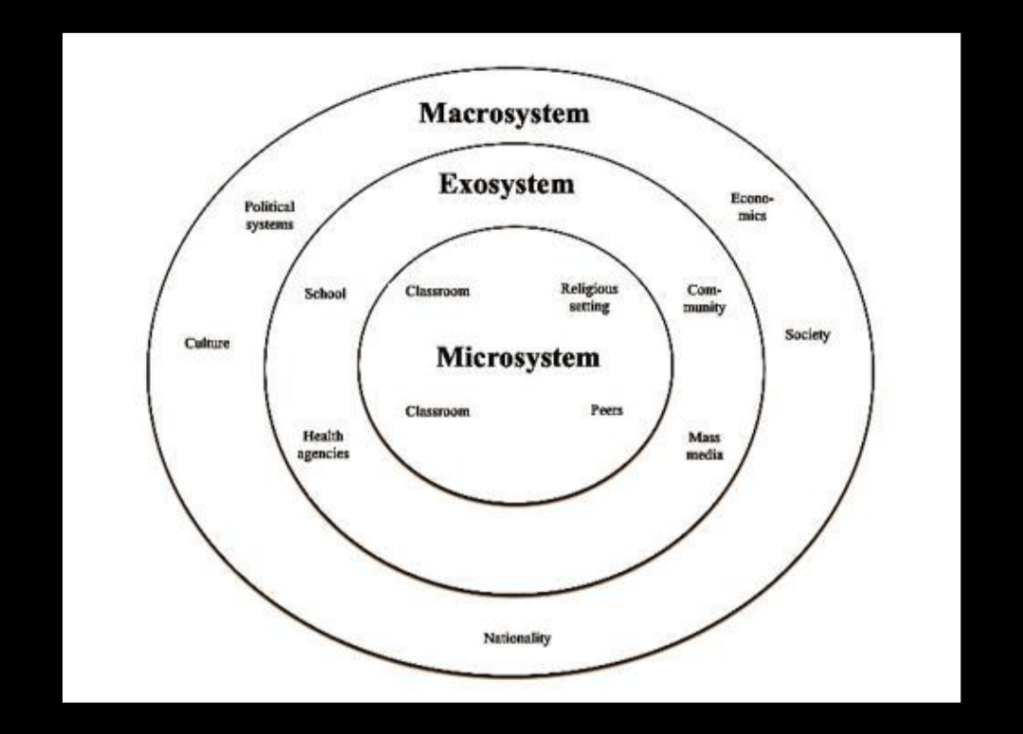
Organizations are open systems in active engagement with their environments. Systems theory proposes that complex systems share some basic organizing principles, Social, theological, and cultural systems are abstract systems because they are conceptual and created in the human mind. “Systems theory provides a simple way to model organizations by focusing on the structure and relationships or interdependence among parts of the organization. A systems approach conveys the idea that organizations are made up of parts and that the parts interact with each other to accomplish the organization’s goals.” (Hodge, Anthony and Gales, 2003)
Created by Immanuel Wallerstein in the 1970s, World Systems Theory is a dependency theory approach that views the entire world as a single socioeconomic system that is composed of core, periphery, and semi-periphery regions. It explains the development of the capitalistic economy, a system characterized by private ownership, in which the free market controls the production of goods and services. This theory contends that there are unequal relationships between countries with larger industrialized nations that dominate the world’s ecosystem. WST states that in order for a capitalist system to exist, someone always has to exist on the periphery being exploited, such as lower income nations on the macrosystem level, or on a microsystem level the neurodivergent individuals within a workplace. This paper attempts to connect Neurotypical “top down” styles of communication and management with capitalism and the world stage by analyzing the treatment of neurodiverse individuals in the workplace using the previously established works of both Bronfenbrenner and Wallerstein.

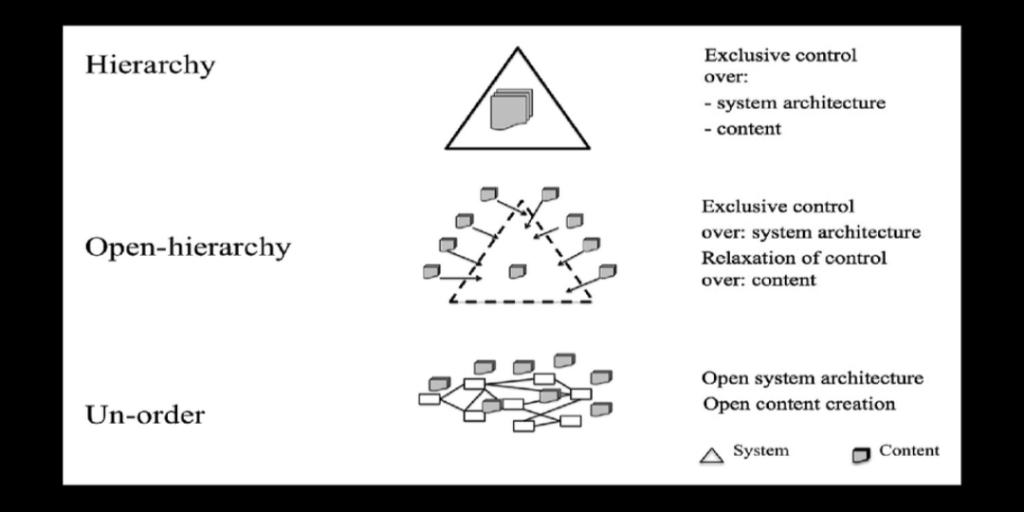
In the figure above (Medium, 2016), “Core” would be represented by the words “Neurotypical” and “Top Down” used in this paper, and the “Periphery” represents the “Neurodivergent” “Neurodiverse” and “Bottom up” concepts addressed within this document. Hierarchy theory is an offshoot of general systems theory. In the paper Hierarchy Theory: An Overview it contends that “In both the natural and the artificial worlds, complex systems are often hierarchically organized” (Wu, 2013). The United States federal government is an example of a top-down hierarchy that employs exclusive controls over its system architecture and the content found within its systems. This paper posits a theory that replacing a top-down hierarchy with open systems architecture and open systems content creation would end worker exploitation. Abusive systems based on dependency and unequal power dynamics could be substituted with a reverse dominance hierarchy, as seen in the figure below. (Sawhney and Suri, 2013)
The National Health and Resilience in Veterans Study (NHRVS) reported that among Veterans using VA care, 23 out of every 100 veterans surveyed (or 23%) had PTSD at some point in their lives, which is a shockingly high rate compared to the 6.8% incidence of PTSD among the general population. The risk is more significant for veterans who see combat and the more tours of duty that a veteran performs, the more likely the chances they will develop PTSD. PTSD is considered to be an acquired neurodivergence (meaning it is situational and can be resolved through treatment). Given that nearly a quarter of all military veterans will experience PTSD at some point, and considering their risk for developing PTSD increases exponentially with prolonged service, neurodivergent rights should also be considered to be extended to be veteran rights as well. Diversity, Equity, and Inclusion (DEI) initiatives are directed toward diversity groups including veterans. According to the U.S. Department of Labor, the affirmative action provisions of the Vietnam Era Veterans’ Readjustment Assistance Act of 1974 (VEVRAA) prohibits job discrimination and requires federal contractors and subcontractors to take affirmative action to recruit, hire, promote, and retain qualified veterans. This paper argues that the workforce should accommodate specific needs of veterans suffering from PTSD, a specific type of neurodivergence, through businesses utilizing bottom up styles of communication with their employees in addition to operating businesses through a “open system” human resources framework (otherwise known as a reverse hierarchical system of management), which several businesses including the multinational technology company Google have recently popularized. It has been 59 years since the Civil Rights Act of 1964 and 49 years since the Vietnam Era Veterans’ Readjustment Assistance Act of 1974 were passed respectively, and in that time society has acquired a vast amount of knowledge in regards to neurology, which constitutes a primary identity characteristic, and as such neurology should be legally protected for being discriminated against. In order for the workplace to be fully inclusive and accessible to the neurodivergent population, which includes veterans with PTSD, new laws must be passed that mandate bottom up styles of both communicating with employees and of managing businesses. Privilege isn’t the presence of perks and benefits, it is the absence of obstacles and barriers. Passing new laws that mandate bottom up styles of communication and management eliminates some but not all of the privileges that neurotypicals benefit from within top down organizations.
Fogle, B. M., Tsai, J., Mota, N., Harpaz-Rotem, I., Krystal, J. H., Southwick, S. M., & Pietrzak, R. H. (2020). The National Health and Resilience in Veterans Study: A Narrative Review and Future Directions. Frontiers in Psychiatry, 11. https://doi.org/10.3389/fpsyt.2020.538218
Veterans | U.S. Department of Labor. (n.d.). http://Www.dol.gov. https://www.dol.gov/general/topic/discrimination/vetsdisc
 Spirolateral