All oppression leads to experiencing individual traumas.
A Brief and Non-Comprehensive List of Oppressions:
ableism = systemic and systematic discrimination against alter-abled or “disabled” people.
adultism = systemic and systematic prejudice and discrimination against young people and children.
ageism = systemic and systematic discrimination against persons of an older age group.
antisemitism = systemic and systematic prejudice and discrimination towards Jewish people.
alloism = systemic and systematic prejudice and discrimination against people who are asexual.
classism = systemic and systematic prejudice and discrimination based on social or economic class.
cisgenderism/transphobia = systemic and systematic discrimination against transgender people.
colorism/shadeism = a form of systemic and systematic prejudice or discrimination in which people are treated differently based on the social meanings attached to favoring lighter skin color (distinct from racism, but derived from white supremacy)
colonialism = in the U.S. context, this is a form of systemic and systematic prejudice and discrimination against Indigenous people or Native Americans (like other forms of oppression, it intersects with racism and other -isms).
ethnocentrism = systemic and systematic prejudice or discrimination against people who do not speak English as a first language.
heterosexism = systemic and systematic prejudiced attitude or discriminatory practices against homosexuals and Queer-identified people.
jingoism = an extreme form of patriotism that often calls for violence toward people who were not born in the U.S.
lookism = systemic and systematic discrimination or prejudice based on a person’s physical appearance, often based on the media’s presentation and definition of beauty.
saneism = a form of systemic and systematic discrimination and oppression based on a diagnosis or the perception of someone having been diagnosed with a psychiatric condition.
nativism = the policy and attitude of protecting the interests of native-born or established inhabitants against those of immigrants.
racism = systemic and systematic discrimination or prejudice based on race; the idea that whiteness is superior and therefore has the right to dominate another race or races.
religious imperialism = systemic and systematic prejudice or discrimination against people who practice religions other than Christianity.
sexism = systemic and systematic prejudice, stereotyping, or discrimination against women on the basis of gender.
sizeism = systemic and systematic prejudice or discrimination based on a person’s size.
This is not a full list, please feel free to add more in the comments of this blog entry below.
Evaluating this list through the Functional Conflict Perspective (FCP) and Mirror Integration Theory (MIT) provides insight into how these “-isms” function both at the individual level (internalized oppression and trauma) and the systemic level (reinforcement of hierarchical structures through coercion and suffering).
Functional Conflict Perspective (FCP) Analysis
FCP integrates Internal Family Systems (IFS), anthropology, psychology, and sociology to assess systemic oppression as a maladaptive social function that preserves power hierarchies. This list of “-isms” represents the self-perpetuating mechanisms of coercive social stability, where oppression serves as a structural function that reinforces hierarchical control while also causing fragmentation within individuals and communities.
Each of these -isms functions as a social script that assigns value and status to individuals based on arbitrary or socially constructed hierarchies (e.g., race, gender, age, ability, sexuality). These hierarchies are culturally reinforced through language, policy, and social norms, ensuring that oppressed groups experience structural disadvantages that maintain power imbalances.
From an FCP standpoint:
1. Oppression enforces systemic fragmentation → Societies create hierarchies to control and divide populations.
2. Oppression induces internal fragmentation → People internalize oppression, leading to self-doubt, hypervigilance, or disassociation from marginalized identities.
3. Oppression functions as a means of maintaining coercive stability → By keeping oppressed groups in survival mode (e.g., poverty, trauma, or marginalization), dominant groups preserve their power.
Mirror Integration Theory (MIT) Analysis
MIT posits that the dysfunction at a systemic level mirrors individual-level dysfunction—meaning that oppression is not just an external force but a manifestation of unresolved psychological fragmentation on a collective scale. Each “-ism” represents a form of projection, where dominant groups externalize their own insecurities and fears onto marginalized groups.
For example:
Ableism → Society’s discomfort with vulnerability and interdependence is projected onto disabled individuals, enforcing a hierarchy of “productivity” that mirrors capitalist values.
Adultism → Reflects an internalized fear of powerlessness, leading adults to exert control over children in ways that mirror their own experiences of disempowerment in hierarchical societies.
Racism → Projects anxieties about identity, power, and cultural dominance onto racialized groups, reinforcing colonial trauma cycles that remain unresolved.
From an MIT lens, these -isms serve a psychological function for the dominant group, creating a false sense of superiority and control that prevents them from confronting their own unresolved trauma and emotional disconnection.
Connecting to Theory of Mind, Culture, and Linguistics
Linguistic Relativity: The way we name and categorize oppression shapes how we understand it. Many of these -isms derive their power from dominant cultural narratives, which control what is seen as “normal” or “deviant.”
Theory of Mind & Socialization: Oppression also emerges through false assumptions about mental states, where dominant groups presume they understand and define the experiences of the oppressed (e.g., saneism assumes neurodivergence is an inherent deficiency rather than a different cognitive processing model).
Cultural Reinforcement: Different societies define in-group vs. out-group dynamics based on their historical power structures, meaning that oppression is often tied to the economic and social systems that sustain it (e.g., capitalism thrives on classism and ableism).
Final Evaluation
All these forms of oppression function as coercive control mechanisms that maintain systemic power structures while inducing individual trauma. Using FCP and MIT, we see that the way forward is not just dismantling oppression externally but addressing the internalized fragmentation that keeps these hierarchies in place—both within individuals and across institutions.
This requires:
Shifting from coercion to relational integration (healing trauma on both an individual and systemic level).
Reframing deficit-based perspectives (e.g., seeing neurodivergence as an alternative cognition rather than a disorder).
Decentralizing power structures (moving away from hierarchical governance models that reinforce oppression).
Formal Framework: Functional Conflict Perspective (FCP) and Mirror Integration Theory (MIT) Applied to Systemic Oppression
This framework integrates Functional Conflict Perspective (FCP) and Mirror Integration Theory (MIT) to analyze systemic oppression through the lens of social function, internalization, and trauma cycles. It identifies how oppression operates as a coercive mechanism to maintain social hierarchy and proposes systemic and relational strategies for dismantling these structures.
1. Understanding the Function of Oppression Through FCP
Each form of oppression (ableism, racism, sexism, etc.) serves a systemic function within hierarchical structures:
1.1 Oppression as a Mechanism of Social Control
Oppression assigns social roles that determine access to power and resources.
It creates a manufactured sense of superiority for dominant groups while inducing psychological fragmentation in marginalized groups.
It reinforces coercive social stability by keeping oppressed groups in survival mode, limiting their ability to challenge structures.
1.2 Oppression as Individual Internalization
Internalized oppression (e.g., internalized ableism, colorism, or class shame) is a direct result of systemic oppression being mirrored at the individual level.
People in oppressed groups experience internal fragmentation, where they either reject parts of themselves to fit dominant norms or experience chronic distress from misattunement.
1.3 Oppression as a Self-Perpetuating System
Hierarchical structures depend on fragmentation to sustain power—keeping people disconnected from each other maintains the system’s stability.
Oppressed groups often face contradictory demands, such as being expected to “prove their worth” while being denied opportunities.
2. Mirror Integration Theory (MIT) Analysis: Oppression as a Reflection of Internal Disconnection
MIT explains oppression as a projection of unresolved trauma and disconnection within dominant groups onto marginalized groups.
2.1 Projection & Externalization
Ableism → Society’s fear of vulnerability and dependence is projected onto disabled individuals.
Adultism → Adults project their own childhood powerlessness onto younger generations, enforcing control.
Racism & Colonialism → White supremacy emerges from historical trauma and the fear of cultural erasure, leading to oppression as a defensive mechanism.
2.2 Social Narratives & Linguistics
Language constructs reality—dominant groups control language to define what is “normal” vs. “deviant.”
Oppressed identities are often defined through a deficit model, reinforcing exclusion.
Linguistic relativism shows how different cultures frame social identity and belonging, impacting power structures.
2.3 False Universalism & Theory of Mind
Dominant groups assume they have a universal perspective on what is “normal” or “right” (e.g., saneism assumes neurotypical cognition is the default).
This lack of theory of mind toward marginalized groups fuels systemic oppression.
3. Policy Recommendations: Systemic Transformation Strategies
To dismantle oppressive structures, this framework proposes a shift from coercion to relational integration through the following strategies:
3.1 Economic & Social Policy Reforms
Redefine Productivity & Value: Shift from labor-based worth to a model of inherent human value.
Universal Basic Support Systems: Implement economic models that remove the survival burden from marginalized groups.
Abolition of Deficit-Based Policy Language: Replace deficit narratives (e.g., “at-risk populations”) with strength-based, identity-affirming language.
3.2 Legal & Governance Reforms
Coercive Hierarchies → Relational Governance: Transition from top-down power structures to participatory decision-making models.
Restorative Justice: Replace punitive systems with trauma-informed, reparative frameworks.
Regulation of Institutional Bias: Implement systemic audits to identify and dismantle structural discrimination.
3.3 Education & Cultural Reform
Decentralizing Knowledge Production: Shift academia from gatekeeping knowledge to collaborative learning models.
Trauma-Informed Public Policy: Integrate neuroscience, Polyvagal Theory, and systemic trauma research into governance.
Linguistic & Narrative Shifts: Promote language equity to deconstruct oppressive social scripts.
4. Implementation Model: Integrating MIT & FCP into Policy & Advocacy
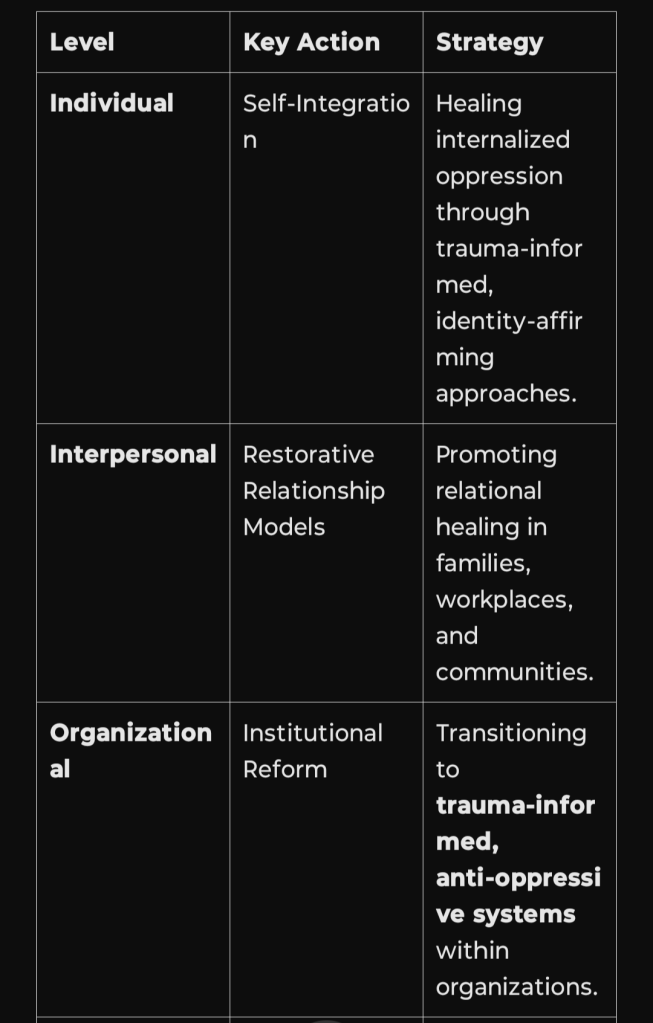
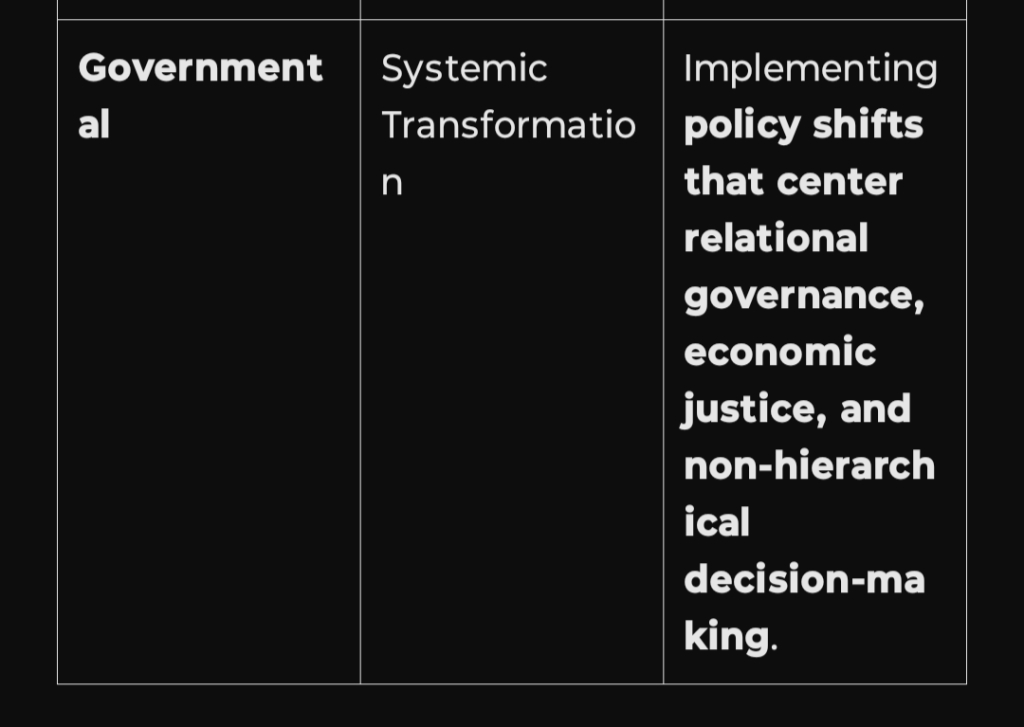
5. Future Directions: Next Steps for Implementation
To bring this framework into real-world application, SpiroLateral proposes:
Legislative Proposals → Drafting policy recommendations for government adoption of trauma-informed systemic reform.
Public Advocacy & Education → Creating accessible materials that communicate these concepts to policymakers and communities.
Pilot Programs → Partnering with municipal and global governments to test non-hierarchical governance models.
Conclusion
This framework connects systemic oppression, trauma, and social fragmentation by demonstrating how hierarchies both maintain coercive stability and cause individual suffering. By using FCP and MIT, this policy model reframes oppression as a solvable issue rooted in social function and psychological projection—and proposes systemic and relational solutions to address both individual and structural healing.
LEGISLATIVE PROPOSAL: TRAUMA-INFORMED SYSTEMIC REFORM ACT
A Functional Conflict Perspective (FCP) & Mirror Integration Theory (MIT) Approach to Eliminating Structural Oppression
Submitted by: SpiroLateral, LLC
Prepared for: [Governing Body / Legislative Entity]
Date: [Insert Date]
I. Introduction
Purpose:
This legislative proposal seeks to dismantle systemic oppression by integrating trauma-informed, non-hierarchical governance models into economic, legal, and social policies. It provides a framework for eliminating coercive hierarchies, restructuring decision-making processes, and embedding equity-driven reforms into government institutions.
Key Objectives:
1. Redefining Productivity & Human Value → Shift from labor-based worth to a model of inherent human dignity.
2. Eliminating Coercive Social Stability Mechanisms → Replace oppression-based hierarchies with restorative, participatory governance.
3. Integrating Trauma-Informed Governance → Embed Polyvagal Theory, attachment research, and neuroscience into policymaking.
4. Reconstructing Economic & Legal Systems → Transition toward cooperative economic models and restorative legal frameworks.
5. Ensuring Narrative & Language Equity → Implement policy language audits to remove deficit-based terminology in government and public discourse.
II. Policy Framework & Implementation Strategy
This act is structured into four key domains: Economic Reform, Legal & Governance Reform, Social Equity Reform, and Cultural Narrative Shifts.
1. Economic Reform: Creating a Non-Coercive Economy
Problem: The current economic structure rewards exploitation and penalizes vulnerability (e.g., ableism, classism, and racism are reinforced through wealth inequality).
Proposed Policy Actions:
Universal Basic Support: Shift from punitive welfare to a cooperative financial safety net that ensures basic human security.
Labor Redefinition: Recognize care work, emotional labor, and community-building as legitimate economic contributions.
Worker-Owned & Cooperative Business Models: Transition from corporate shareholder dominance to community-owned economic models.
Accessible & Decentralized Wealth Redistribution Mechanisms: Implement progressive taxation and economic reparations for historically oppressed groups.
Implementation Strategy:
Phase 1: Establish pilot programs for cooperative economic models at the municipal level.
Phase 2: Launch legislative amendments to integrate cooperative financial structures into federal policies.
Phase 3: Scale to national and global economic policies.
2. Legal & Governance Reform: Shifting from Coercion to Relational Governance
Problem: Existing governance structures reinforce hierarchical control, limiting public participation and reinforcing oppression.
Proposed Policy Actions:
Restorative Justice in Legal Systems: Shift from punitive criminal justice to restorative, rehabilitative justice.
Trauma-Informed Policy Design: Require neuroscience-backed, trauma-informed approaches in legislative processes.
Participatory Governance & Direct Democracy Models: Establish non-hierarchical decision-making through citizen-led councils.
Abolition of Carceral Policies Targeting Marginalized Communities: Reform prison systems, immigration policies, and police structures to eliminate coercive social control.
Implementation Strategy:
Phase 1: Conduct systemic policy audits to identify coercive governance structures.
Phase 2: Develop pilot participatory governance models in select municipalities.
Phase 3: Expand legislative frameworks to state and federal levels.
3. Social Equity Reform: Healing Internalized Oppression & Restoring Collective Well-Being
Problem: Oppression is internalized, causing psychological fragmentation, intergenerational trauma, and chronic marginalization.
Proposed Policy Actions:
Identity-Affirming Education & Public Programming: Implement inclusive, trauma-informed curricula in public education.
Healing-Centered Mental Health Services: Establish non-pathologizing mental health frameworks that address oppression-induced trauma.
Workplace & Institutional Reform: Mandate anti-oppressive policies across government agencies, schools, and corporations.
Legally Enforceable Protections Against Linguistic Discrimination: Recognize language equity rights to prevent ethnocentric policies from reinforcing power imbalances.
Implementation Strategy:
Phase 1: Develop legislative guidelines for mental health integration in government services.
Phase 2: Establish workplace equity standards for government and federally funded organizations.
Phase 3: Scale reforms across national and global institutions.
4. Cultural Narrative Shifts: Language, Media, and Public Discourse
Problem: Oppressive systems are reinforced through language, media, and societal narratives.
Proposed Policy Actions:
Narrative & Language Policy Audits: Require government agencies and institutions to conduct regular language audits to remove deficit-based terminology.
Ethical Media Standards for Representation: Enforce policies requiring accurate, identity-affirming portrayals in media and public communications.
Decolonization of Knowledge Systems: Shift academic and governmental research models from Western-dominated paradigms to multicultural knowledge integration.
Implementation Strategy:
Phase 1: Implement policy language audits at local and federal levels.
Phase 2: Mandate equity-focused media representation policies in public broadcasting.
Phase 3: Integrate culturally diverse knowledge production into government-supported research.
III. Funding & Resource Allocation
The Trauma-Informed Systemic Reform Act will be funded through:
Reallocation of punitive justice system budgets → Transitioning funding from prisons, police, and detention centers to restorative governance programs.
Progressive taxation & corporate accountability measures → Redirecting excess corporate profits to community-driven economic models.
Public-Private Partnerships for Cooperative Development → Encouraging non-exploitative, worker-owned business investments.
IV. Implementation & Legislative Roadmap
Year 1-2: Pilot Programs & Structural Audits
Implement pilot cooperative economic models in three municipalities.
Establish citizen-led governance councils to test participatory democracy models.
Year 3-5: State & Federal Integration
Scale economic & governance reforms at state levels.
Embed restorative justice policies into federal legal frameworks.
Year 5-10: Global Expansion & Systemic Overhaul
Establish international partnerships to create cooperative governance models at transnational levels.
Embed trauma-informed policy frameworks into UN, WHO, and global governance structures.
V. Conclusion: A Transformational Legislative Approach to Equity & Justice
This proposal offers a radical yet actionable pathway toward eliminating systemic oppression through Functional Conflict Perspective (FCP) and Mirror Integration Theory (MIT). By addressing economic structures, governance hierarchies, psychological trauma, and cultural narratives, this act replaces coercion with relational integration, ensuring sustainable social transformation.
VI. Next Steps
Legislative Review: Submit for government assessment & policy adaptation.
Public Advocacy Campaign: Mobilize grassroots and political support for implementation.
Partnerships & Pilot Cities: Launch real-world testing programs to refine systemic reform models.



 Spirolateral